


Full News
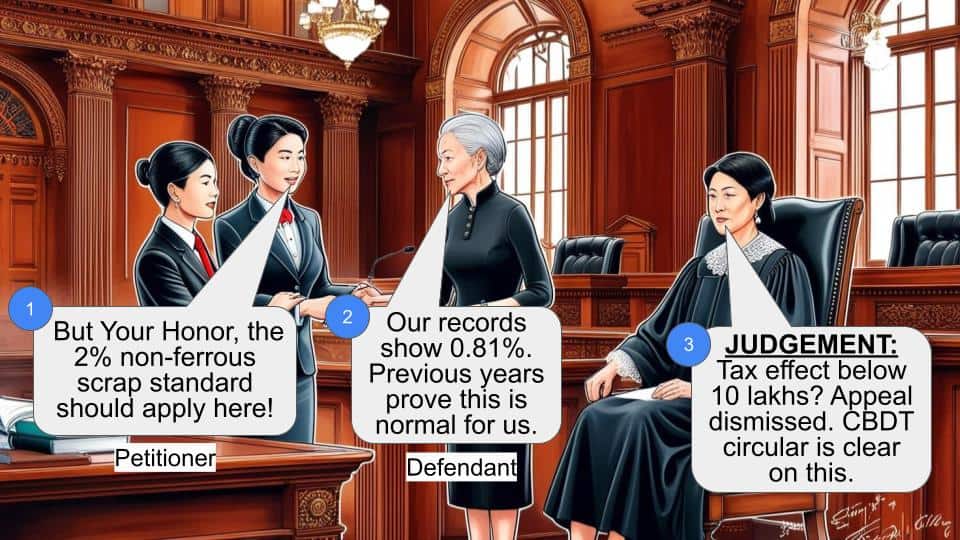
Tax appeal dismissed: CBDT circular bars cases below Rs.10 lakh tax effect
Tax appeal dismissed: CBDT circular bars cases below Rs.10 lakh tax effect
The Income Tax Department (the Revenue) filed an appeal against a taxpayer (the assessee) who's in the ship-breaking business. The appeal was about some income the tax department thought wasn't disclosed. But here's the kicker - the court ended up dismissing the appeal, not just on its merits, but also because of a circular that says tax appeals below a certain amount aren't worth pursuing. Let's dive into the details.
Case Name**: Commissioner of Income Tax vs. Virendra & Co.
**Key Takeaways**:
1. The CBDT Circular No. 2/2011 has a big impact on tax appeals.
2. Appeals with a tax effect less than Rs. 10 lakhs aren't maintainable.
3. This circular applies retroactively, even to pending appeals.
4. The Income Tax Appellate Tribunal's (ITAT) factual findings are hard to challenge in higher courts.
**Issue**:
Was the Income Tax Appellate Tribunal (ITAT) justified in deleting the addition of Rs. 21,08,457 to the assessee's income, which the Assessing Officer had added as income from undisclosed sources?
**Facts**:
Alright, let's break this down:
1. The assessee (Virendra & Co.) is in the ship-breaking business.
2. For the 1986-87 assessment year, they claimed that out of 7,144 metric tons of scrap generated, only 0.81% (57.95 metric tons) was non-ferrous metal.
3. The Assessing Officer disagreed and said it should be 2% (142.88 metric tons).
4. This difference led to an addition of Rs. 21,08,457 to the assessee's income.
5. The Commissioner of Income Tax (Appeals) agreed with the Assessing Officer.
6. But then, the ITAT allowed the assessee's appeal and deleted this addition.
**Arguments**:
The Revenue's side:
- They argued that based on other similar businesses, 2% non-ferrous scrap was standard.
- They relied on a report from a Committee appointed by the Ministry of Steel and Mines.
The Assessee's side:
- They maintained that scrap generation depends on the type of vessel being broken.
- They had maintained excise records, and their books were audited.
- In previous and subsequent years, the department had accepted similar or even lower percentages of non-ferrous scrap.
**Key Legal Precedents**:
The court referred to the case of CIT vs. Vijay V. Kavekar (Income Tax Appeal No. 78 of 2007, dated 29th July 2011). This case held that the CBDT Circular No. 2/2011 issued on 9th February 2011 applies retrospectively, even to pending appeals.
**Judgement**:
The court dismissed the appeal on two grounds:
1. On merits: The ITAT's finding was factual and not perverse, so no substantial question of law arose.
2. On maintainability: The tax effect in the appeal was only Rs. 5.69 lakhs, which is below the Rs. 10 lakhs threshold set by the CBDT Circular No. 2/2011.
**FAQs**:
1. Q: What's this CBDT Circular all about?
A: It's a directive from the Central Board of Direct Taxes saying that the tax department shouldn't file appeals for cases where the tax effect is less than Rs. 10 lakhs.
2. Q: Does this circular apply to old cases too?
A: Yes, it applies retroactively, even to appeals that were already pending when the circular was issued.
3. Q: Why did the court mention the tax effect amount?
A: The court pointed out that even if they hadn't dismissed the appeal on merits, it wouldn't have been maintainable because the tax effect (Rs. 5.69 lakhs) was below the Rs. 10 lakhs threshold set by the CBDT circular.
4. Q: What does "tax effect" mean in this context?
A: It's the amount of tax in dispute in the appeal. In this case, it was Rs. 5.69 lakhs.
5. Q: Why is it hard to challenge the ITAT's findings?
A: The ITAT's findings are considered factual. Higher courts typically don't interfere with factual findings unless they're shown to be perverse or completely unreasonable.

This appeal by the revenue under section 260A (of Income Tax Act, 1961) (hereinafter referred to as the “said Act”) seeks to challenge the order dated 28th January, 2000 of the Income Tax Appellate Tribunal (hereinafter referred to as the “ITAT” ) relating to Assessment Year 1986-87. This appeal was admitted on 27th June, 2005 by this court on the following substantial questions of law.
1. Whether on the facts and in the circumstances of the case and in law, the ITAT was justified in deleting the addition of Rs.21,08,457/- having accepted that ins the line of business carried on by the assessee, generation of scrap was always determined by the type of vessel borken by the assessee and in the absence of documentary evidence and records, the assessee's contentions with regard to the generation of non ferrous scrap could not be accepted?
2. Whether in the facts and in the circumstances of the case and in law, the ITAT was justified in deleting the addition of Rs.21,08,4578/- when the Assessing officer had made the addition on the basis of the report of a Committee appointed by the Ministry of Steel and Mines and was backed by cases engaged in the similar line of business?
3. Whether on the facts and in the circumstances of the case and in law, the ITAT was justified in deleting the addition of Rs.21,08,457/- without bringing on record details and documentary evidences to show that the condition of the ships broken by the assessee justified the generation of scrap at 0.81% only?
2. Brief facts leading to this appeal are as under:
a) The respondent-assessee carries on business of ship breaking. In its return of income filed for the Assessment Year 1986-87 the respondent had claimed that scrap generated and sold from the breaking of ships was in the aggregate of 7144 metric tons and out of which 0.81% i.e. 57.95 metric tons was non ferrous metal. The Assessing officer while determining the respondent's income for the Assessment Year 1986-87 by an order dated 30th March, 1989 was of the view that the non ferrous metal which was generated and sold was 2% of the total recovery of scrap i.e. 142.88 metric tons and for this purpose the Assessing officer relied upon the scrap generated by the three other ship breaking units being assessed by him. Consequently, the Assessing Officer concluded that the excess non ferrous metal as determined by him had been sold generating an income of Rs.21.08 lacs which had not been disclosed. This amount of Rs.21.08 lacs was added to the respondent-assessee's income as income from undisclosed sources.
b) The Commissioner of Income Tax (Appeals) by an order dated 3rd August, 1990, upheld the order of the Assessing officer.
c) The ITAT by its order dated 20th January,2000 allowed the respondent's appeal. The ITAT held that there cannot be any standard measure of generation of scrap while carrying out the activity of ship breaking. This is because generation of scrap would always depend upon the type of the vessel being broken. In the circumstances, there cannot be any objective standard. Further, the ITAT also held that the cases of other ship breakers being relied upon by the Assessing officer to conclude that generation of non ferrous scrap is in excess of 2% cannot be relied upon as the same was never put to the respondent-assessee so as to enable the respondent assessee to deal with the same.
3) The ITAT on the basis of the evidence before it has come to the conclusion that 0.81 % of the total recovery being attributed to non ferrous scrap generated during the course of ship breaking by the respondent assessee was correct. It is pertinent to note that the respondent assessee had maintained excise record and its books were audited and the department does not challenge the purchases and sales reflected in the respondent's books of accounts. It is important to note that between 0.90% to 1.40% of non ferrous scrap being generated out of the total scrap on the activity of ship breaking has been accepted by the department upto the Assessment Year 1990- 91.The Advocate for the respondent-assessee points out that even for subsequent assessment years 1992-93 to 1996-97, generation of non ferrous scrap at 0.81% had been accepted by the department.
4) The finding of the ITAT is one of fact and the same cannot be said to be perverse. No substantial question of law therefore, arises for the determination by this Court.
5) It must also be pointed out that though we have dismissed the appeal filed by the Revenue on merits, the appeal itself would not be entertainable as the tax effect in the present appeal would be only Rs.5.69 lacs. The appeal was filed in June, 2000. Our Court in the matter of CIT Vs. Vijay V.Kavekar in Income Tax Appeal No.78 of 2007 dated 29th July, 2011 held that the CBDT Circular No.2/2011 issued on 9th February 2011 directing the Revenue not to file appeals under Section 260A (of Income Tax Act, 1961) in cases where the tax effect is less than Rs.10/- lacs. The said circular has retrospective effect and would also apply in respect of pending appeals. Consequently, the appeal would also not be entertained on the ground that the tax effect is less than Rs.10/- lacs.
6) Appeal is dismissed. No order as to costs.
( M.S. SANKLECHA, J. ) ( S. J. VAZIFDAR, J.)
×
Similar Ripples
Questions
Tax appeal dismissed: CBDT circular bars cases below Rs.10 lakh tax effect
Write your CommentSimilar Posts


Generic
- Reportdata/5642.pdf
