


Tax Appeal Dismissed: Court Upholds Rejection of Assessee's Books of Accounts


Full News
Tax Appeal Dismissed: Court Upholds Rejection of Assessee's Books of Accounts
Tax Appeal Dismissed: Court Upholds Rejection of Assessee's Books of Accounts
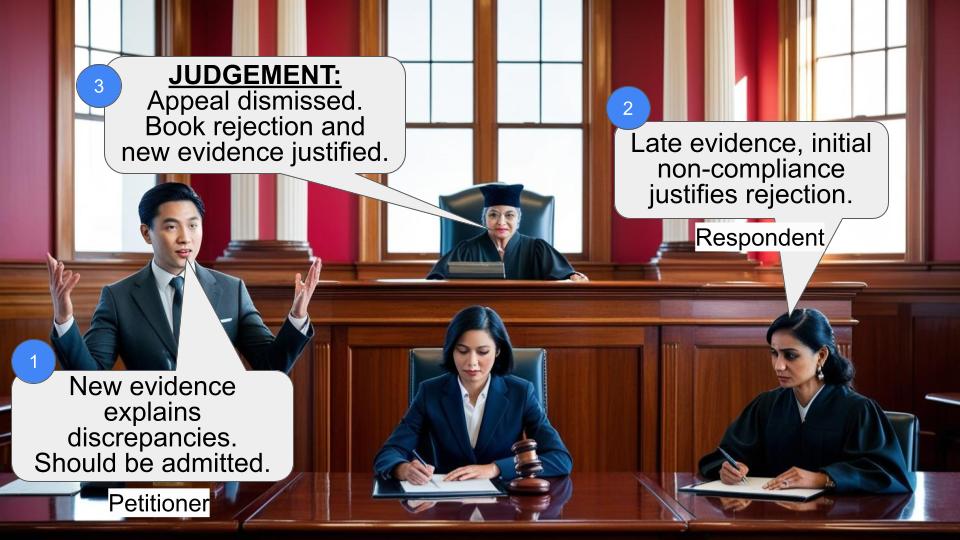
A taxpayer (let's call them the assessee) appealed against an Income Tax Appellate Tribunal decision. The assessee's books of accounts were rejected due to discrepancies, and they tried to introduce new evidence later. However, the court dismissed the appeal, agreeing with the lower authorities' decision.
Get the full picture - access the original judgement of the court order here
Case Name:
Rishi Sagar vs Commissioner of Income Tax and Another (High Court of Punjab & Haryana)
Income Tax Appeal No. 65 of 2014 (O&M)
Date: 28th March 2016
Key Takeaways:
1. The importance of maintaining accurate and consistent financial records
2. The difficulty in introducing new evidence at later stages of tax appeals
3. The court's emphasis on the overall conduct of the assessee in tax matters
Issue:
The main question here is: Was the Income Tax Appellate Tribunal correct in rejecting the assessee's additional evidence and upholding the assessment order?
Facts:
1. The assessee filed an e-return declaring an income of ₹2,43,980.
2. The case was selected for scrutiny, and the assessee was asked for more info.
3. Despite repeated notices, the assessee didn't provide the required information.
4. The assessing officer found discrepancies in the assessee's accounts, especially regarding creditors.
5. The books of accounts were rejected, and the income was assessed at ₹44,12,374.
6. The assessee appealed to the CIT(A) and then to the Tribunal, trying to introduce new evidence, but both appeals were dismissed.
Arguments:
The assessee's side:
- They couldn't furnish details earlier due to their Chartered Accountant's fault.
- They provided a balance sheet during the CIT(A) appeal showing some amounts had been cleared.
- The transactions were through bank accounts and shouldn't be considered unexplained income.
- The additional evidence should have been considered as per Section 250(4) (of Income Tax Act, 1961).
The Revenue's side:
- Large-scale discrepancies were found in the assessee's books.
- The assessee failed to answer queries during assessment.
- Even the new balance sheet provided later wasn't audited.
- The assessee was trying to claim isolated relief without explaining other discrepancies.
Key Legal Precedents:
Interestingly, this case doesn't heavily rely on previous legal precedents. Instead, it focuses on the application of specific sections of the Income Tax Act, 1961, and the Income Tax Rules, 1961. The key provisions mentioned are:
- Section 260A (of Income Tax Act, 1961) (for filing the appeal)
- Section 250(4) (of Income Tax Act, 1961) (regarding consideration of additional evidence)
- Section 143(3) (of Income Tax Act, 1961) (for framing the assessment)
- Rule 46A (of Income Tax Rules, 1962), 1961 (about admitting additional evidence in appeals)
Judgement:
The court dismissed the appeal, agreeing with the lower authorities. They found that:
1. The assessee's conduct and books of accounts didn't inspire confidence.
2. The attempt to introduce new evidence at the appeal stage wasn't justified under Rule 46A (of Income Tax Rules, 1962).
3. The assessee's explanation of just two transactions couldn't be examined in isolation.
4. No substantial question of law arose from the case.
FAQs:
1. Q: Why didn't the court allow the new evidence?
A: The court felt the assessee didn't meet the conditions under Rule 46A (of Income Tax Rules, 1962) for introducing additional evidence in appeals.
2. Q: What was wrong with the assessee's books of accounts?
A: There were discrepancies, especially in creditor accounts, and the assessee couldn't explain these when asked.
3. Q: Could this case have gone differently if the assessee had provided information earlier?
A: Possibly. The court emphasized the assessee's failure to respond to queries and provide complete books during the assessment.
4. Q: What's the takeaway for other taxpayers?
A: It's crucial to maintain accurate records, respond promptly to tax authorities' queries, and provide complete information during the initial assessment stage.
5. Q: Can taxpayers introduce new evidence in tax appeals?
A: Yes, but only under specific conditions outlined in Rule 46A (of Income Tax Rules, 1962). It's not a right, but a discretion of the appellate authority.

The assessee is in appeal under Section 260A (of Income Tax Act, 1961) (for short, 'the Act') against the order 23.5.2013, passed by the Income Tax Appellate Tribunal, Chandigarh Bench `A', Chandigarh (for short, 'the Tribunal') for the assessment year 2009-10 in ITA No. 10/Chd/2013, raising the following substantial questions of law:
“(i) Whether in the facts and circumstances of the present case, the action of the Ld. Authorities below in ignoring the provisions of Section 250(4) (of Income Tax Act, 1961) is legally unsustainable in the eyes of law ?
(ii) Whether in facts and circumstances of the case, the ld. Authorities below ought to have either taken into consideration the additional evidence upon receiving the remand report from the AO or got an enquiry qua the payment being made from the cash credit account of the assessee as no income has accrued to the assessee which could be chargeable to tax under the Act ?
(iii) Whether in the facts and circumstances of the case, the actions of the authorities necessitate that the matter be reconsidered by the ld. Authorities below to find the veracity of the averments of the assessee ?
(iv) Whether in facts and circumstances of the case, the action of the authorities below, the impugned orders are legally sustainable in the eyes of law as the ld. Authorities below failed to exercise the discretion judiciously ?”
Learned counsel for the assessee submitted that no doubt at the time of assessment, the assessee could not furnish the requisite details and the audited accounts on account of fault of the Chartered Accountant,however, at the time of hearing of the appeal before the Commissioner of Income Tax (Appeals)-II, Ludhiana [for short, 'CIT (A)'], balance sheet was furnished. It was from the material produced at that stage that it was clarified that certain amounts, which were shown in the credit of the creditors accounts had, in fact, been cleared. The transactions were through bank accounts. Additions were made stating that to be unexplained income.
Once the amounts had been paid through bank transactions and there was no dispute about that, additional evidence produced by the assessee before the CIT (A) should have been considered. The authorities having failed to appreciate the same in violation of the provisions of Section 215(4) (of Income Tax Act, 1961), this being a substantial question of law, the order passed by the Tribunal deserves to be set aside.
On the other hand, learned counsel for the Revenue submitted that on account of large scale discrepancies found in the books of accounts produced by the assessee at the time of assessment and on his failure to answer the queries raised, his books of accounts were rejected and the assessment was framed under Section 143(3) (of Income Tax Act, 1961). The discrepancies in the entries in creditors' accounts have not been disputed by the assessee. Even at the appellate stage, though the assessee filed fresh provisional balance sheet trying to explain the entries, which were found to be manipulated with earlier balance sheet filed, but even that was not an audited balance sheet. The assessee is trying to claim isolated relief explaining one transaction. In the absence of audited balance sheet and explanation for other discrepancies found in the books of accounts, which are large in number, such a claim by the assessee cannot be accepted. There is no error in the order passed by the authorities below. No substantial question of law arises. The appeal deserves to be dismissed.
Heard learned counsel for the parties and perused the paper book.
The assessee in the present case filed e-return declaring his income at 2,43,980/-. The case was selected for scrutiny. Notice was served upon the assessee. A questionnaire was sent. Despite repeated notices seeking information, the assessee failed to comply with the same and furnish requisite information. On certain dates, even none appeared for the assessee. The assessee had furnished the names and addresses of the persons, who had been shown to be sundry creditors as on 31.3.2009. On 30.12.2011, during the course of assessment proceedings, the assessee submitted documents of confirmation of credit in the accounts of creditors.
He did not produce any books of accounts, vouchers etc. The books of accounts, hence, were rejected and the assessment was made invoking the provisions of Section 143(3) (of Income Tax Act, 1961). Besides other discrepancies and anomalies found in the books of accounts in the list of creditors, the assessee had shown a credit amounting to ` 6,99,982/- in the account of Dewan Steel Industries. It was found that in his books of accounts, the balance was zero. Similar was the position in the account of Regent Steel Industries, another creditor, where credit balance of ` 30,00,000/- was shown, which was also found to be nil in the books of accounts of the creditor. This is despite the fact that the appellant had produced balance confirmation certificates. Substantial difference was found on the percentage of gross profit rates, as compared to the previous year. Certain expenses claimed without there being any supporting vouchers were disallowed. The taxable income was assessed at 44,12,374/- as against 2,43,980/-, declared by the assessee.
In appeal before the CIT (A), prayer was made for permitting the assessee to lead additional evidence in terms of Rule 46A (of Income Tax Rules, 1962), 1961, however, finding that none of the ingredients enumerated in the aforesaid Rule for permitting the assessee to lead additional evidence being available, the same was declined. The order passed by the Assessing Officer was confirmed. Even before the Tribunal, the assessee met the same fate. The observations made by the Tribunal in the order pertaining to conduct of the assessee are extracted below:
“17. In order to avail the benefit of Rule 46A (of Income Tax Rules, 1962) in relation to admission of additional evidence, the assessee is to show as to how its case of admission of additional evidence is covered by the conditions provided under sub-rule (1) to rule 46A (of Income Tax Rules, 1962). As referred to by us in the paras herein above, it is not a case of the application of clause (a) under which such evidence could be admitted by way of additional evidence where the AO had refused to admit the evidence. The case of the assessee was that as the entries of the cash credit limit and its application were not available with it during the course of assessment proceedings, the same was now being produced by way of additional evidence, does not merit admission as the assessee has failed to establish the reasonableness of the evidence not being available during the course of assessment proceedings.
In our opinion, no substantial question of law arises in the present appeal. The conduct of the assessee and the books of accounts produced by him did not inspire confidence and were rightly rejected by the Assessing Officer. Even at the appellate stage, he produced additional evidence in the form of unaudited provisional balance sheet and tried to take benefit of merely two entries which, in his books of account and the balance sheet earlier produced, he had shown differently. It cannot be said to be a mere error, rather, it was a deliberate attempt to defraud the revenue. The relief, which the assessee is claiming at this stage explaining two transactions pertaining to the creditors, cannot be examined in isolation in the absence of other entries in the books of accounts, which could not be explained by him at the time of assessment as the queries raised by the Assessing Officer were not responded to and complete books of accounts were not produced.
For the reasons mentioned above, we do not find that any substantial question of law arises in the present appeal. The same is, accordingly, dismissed.
(Rajesh Bindal)
Judge
(Harinder Singh Sidhu)
Judge
×
Similar Ripples
Questions
Tax Appeal Dismissed: Court Upholds Rejection of Assessee's Books of Accounts
Write your CommentSimilar Posts

Generic
- Reportdata/2962.pdf
