


Tax Appeal Dismissed: Court Upholds Tribunal's Decision on Transfer Pricing Dis…


Full News
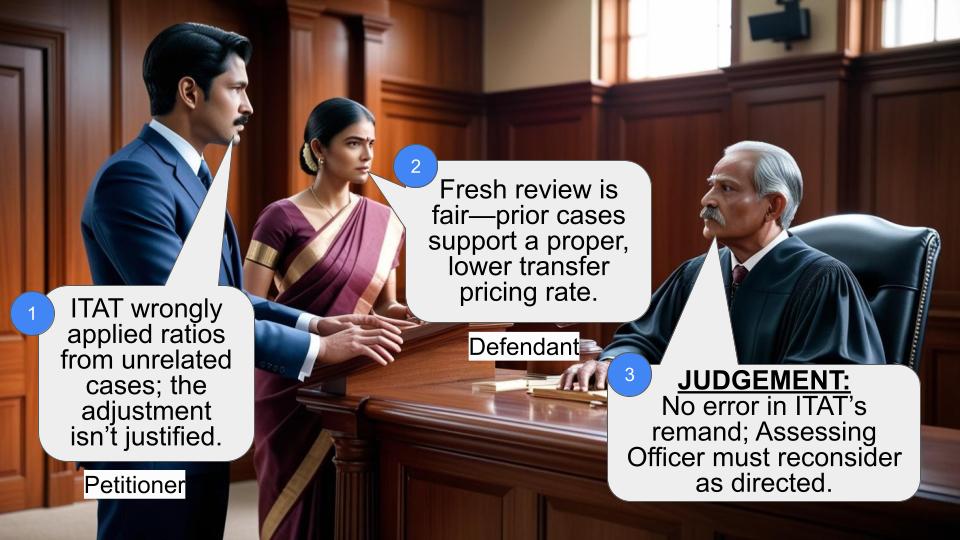
Tax Appeal Dismissed: Court Upholds Tribunal's Decision on Transfer Pricing Dispute
Tax Appeal Dismissed: Court Upholds Tribunal's Decision on Transfer Pricing Dispute
This case involves an appeal by the Principal Commissioner of Income Tax against RBS Financial Services (India) Pvt. Ltd. The dispute centered around transfer pricing issues for the assessment year 2008-09. The Income Tax Appellate Tribunal (ITAT) had remanded the case back to the Assessing Officer for fresh consideration. The High Court dismissed the Revenue's appeal, affirming the ITAT's decision.
Get the full picture - access the original judgement of the court order here
Case Name:
Principal Commissioner of Income Tax Vs RBS Financial Services (India) Pvt. Ltd. (High Court of Bombay)
Income Tax Appeal No.1417 of 2017
Date: 20th January 2020
Key Takeaways:
1. The court upheld the ITAT's decision to remand the case for fresh consideration.
2. The judgment emphasizes the importance of proper determination of Arm's Length Price in transfer pricing cases.
3. The court relied on previous ITAT decisions in similar cases to guide the fresh assessment.
Issue:
Was the Income Tax Appellate Tribunal (ITAT) correct in directing the Assessing Officer to reconsider the transfer pricing adjustment by following the ratios of previous decisions in similar cases?
Facts:
1. The case pertains to the assessment year 2008-09.
2. The Transfer Pricing Officer (TPO) determined the Arm's Length Price of syndication fee at 100% and added Rs.22,63,47,950/- to the assessee's income.
3. The Commissioner of Income Tax (Appeals) upheld the Assessing Officer's findings.
4. The ITAT remanded the matter back to the Assessing Officer for fresh consideration, citing previous decisions in similar cases.
5. The Revenue appealed this decision to the High Court under Section 260A (of Income Tax Act, 1961).
Arguments:
Revenue's Arguments:
1. The ITAT erred in directing the Assessing Officer to follow ratios from cases with dissimilar facts.
2. The ITAT's direction to apply a 20% rate violated Section 92(3) (of Income Tax Act, 1961), as the assessee had considered a 50% rate.
Assessee's Arguments:
While not explicitly stated, it can be inferred that the assessee supported the ITAT's decision to remand the case for fresh consideration.
Key Legal Precedents:
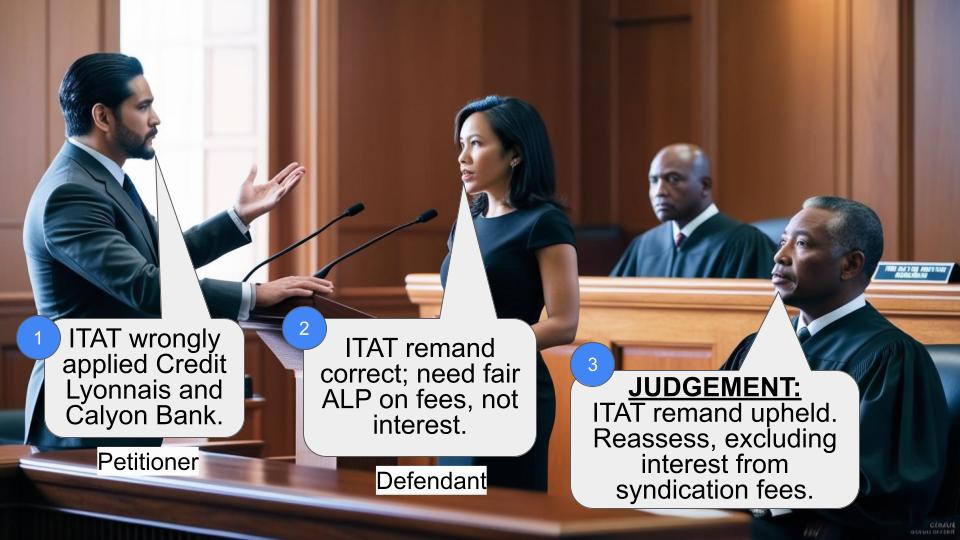
1. M/s Credit Lyonnais Vs. ADIT (ITA No.1935/Mum/2007 dated 30.09.2013): This case held that for transfer pricing adjustments, only fees and charges (excluding interest) received by foreign branches should be considered. It suggested a 20% rate for adjustment.
2. Calyon Bank Vs. DDIT (ITA No.4474/M/2009 dated 21.03.2014): This case relied on the M/s Credit Lyonnais decision.
Judgement:
1. The High Court dismissed the Revenue's appeal.
2. The court found no error in the ITAT's decision to remand the matter to the Assessing Officer for fresh consideration.
3. The court held that the proposed questions of law did not arise from the ITAT's order.
FAQs:
Q1: What was the main issue in this case?
A1: The main issue was whether the ITAT was correct in directing the Assessing Officer to reconsider the transfer pricing adjustment based on previous decisions in similar cases.
Q2: Why did the High Court dismiss the appeal?
A2: The High Court found no error in the ITAT's decision to remand the case for fresh consideration and determined that the questions of law proposed by the Revenue did not arise from the ITAT's order.
Q3: What guidance did the ITAT provide for the fresh assessment?
A3: The ITAT directed the Assessing Officer to consider only the fees and charges (excluding interest) received by foreign branches when making transfer pricing adjustments, based on the M/s Credit Lyonnais case.
Q4: What is the significance of this judgment for transfer pricing cases?
A4: This judgment emphasizes the importance of considering relevant precedents and properly determining the Arm's Length Price in transfer pricing cases, even if it means remanding the case for fresh consideration.
Q5: Does this judgment provide a definitive ruling on the transfer pricing dispute?
A5: No, the judgment doesn't provide a final ruling on the transfer pricing dispute itself. Instead, it upholds the ITAT's decision to have the case reconsidered by the Assessing Officer, taking into account specific precedents and principles.

1. Heard Mr. Suresh Kumar, learned standing counsel, Revenue for the appellant and Mr. P. J. Pardiwalla, learned senior counsel for the respondent/assessee.
2. This appeal has been preferred by the Revenue
under Section 260A (of Income Tax Act, 1961) (briefly
“the Act” hereinafter) assailing the legality and
correctness of order dated 2nd January, 2017 passed by
the Income Tax Appellate Tribunal (ITAT), Mumbai in ITA
No.5997/Mum/2013 for the assessment year 2008-09.
3. The appeal has been preferred on the following
questions, projected as substantial questions of law:-
“(i) Whether on facts and circumstances of
the case and in law, the ITAT was correct in
directing the Assessing Officer to follow the
ratio of decision in case of M/s Credit Lyonnais
(ITA No.1935/Mum/2007 dated 30.09.2013)
and M/s Calyon Bank (ITA No.4474/M/2009
dated 21.03.2014) when the facts of those
cases are not similar to facts of the assessee
and hence cannot be considered as a valid
comparable under Rule 10B (of Income Tax Rules, 1962)
so as to adopt the rates as adopted in those
cases?
(ii) Whether on the facts and circumstances
of the case and in law, the ITAT was correct
in directing the Assessing Officer to decide
the issue by applying rate of 20% in violation
of provision of section 92(3) (of Income Tax Act, 1961),
1961 when the assessee itself had considered
the rate of 50%?”
4. In the course of the assessment proceeding the
Transfer Pricing Officer passed an order dated 30th
September, 2011 under Section 92CA(3) (of Income Tax Act, 1961)
determining the arms length price of the syndication
fee at 100%. He held that the entire amount of
Rs.22,63,47,950/- was received by the assessee.
5. In the assessment order dated 25th January, 2012
which followed, the same was incorporated whereafter
an addition of Rs.22,63,47,950/- was made to the income
of the assessee.
6. On appeal before the first appellate authority,
Commissioner of Income Tax (Appeals) by his order dated
25th July, 2013 upheld the findings of the Assessing
Officer and dismissed the appeal.
7. Assessee thereafter preferred further appeal before
the Tribunal. Tribunal by the impugned order dated 2nd
January, 2017 remanded the matter back to the file of
the Assessing Officer to decide the issue afresh by
considering the decisions relied upon by the Tribunal for
allocation of non-syndication fee between the assessee
and associated enterprise after giving opportunity of
being heard to the assessee.
8. While passing the said order, Tribunal relied upon a
decision of the Coordinated Bench of the Tribunal in the
case of M/s Credit Lyonnais Vs. ADIT decided on
30th September, 2012 where it was held as under:-
‘8.8 Having held that para 4 of the Protocol
does not apply to the case of the assessee,
now, the question arises as to whether the
adjustment made by the authorities below is
justified. For making the adjustment, the
authorities below have taken into
consideration, the income towards interest as
well as the fee charged by the foreign branch
from the clients. It is pertinent to note that
when the loan is provided by the syndicate and
the assessee has not contributed to the loan
amount then as regards the income of interest,
the same cannot be attributed to the assessee
for providing the services of the financial
analysis of the borrowers, market condition
and regulatory environment in India. Since the
assessee has provided certain services for that
arms length charges can be determined as per
the provisions of transfer pricing regulation.
The TPO as well as CIT(A) has not brought out
any comparable for determination of the arms
length price but took the total income
comprising interest as well as other fees
charged by the foreign branches for allocation/
attribution to the assessee. In this case, the
ALP has not been determined by taking into
consideration uncontrolled similar transaction.
In our view, the interest cannot be taken into
account for attribution of income towards
service charges/fees and, therefore, in the
facts and circumstances of the case only the
fee charged by the foreign branches can be
taken into consideration for making
adjustment under transfer pricing provisions.
Accordingly, we direct the AO/TPO to make
adjustment in respect of the services
performed by the assessee for foreign currency
loan arranged for its existing clients by taking
into account only the fee and other charges
received by the foreign branches from the
borrowers in question. Since none of the
parties have come out with the suitable
comparables, therefore, we find that the
estimation made by the CIT(A) at the rate of
20% is just and proper, however, the same
would be only in respect of the fee and
charges other than interest received by the
foreign branches. Thus, these grounds of the
assessee are partly allowed.”
9. Further reference was made to another decision of a
Coordinated Bench of the Tribunal in the case of Calyon
Bank Vs. DDIT decided on 21st March, 2014 wherein
the decision in M/s Credit Lyonnais was relied upon.
10. Following the above decisions, Tribunal restored the
issue to the file of the Assessing Officer for a fresh
decision in accordance with law.
11. In the facts and circumstances of the case, we do
not find any error or infirmity in the view taken by the
Tribunal in remanding the matter back to the file of the
Assessing Officer for a fresh decision in accordance with
law.
12. On thorough consideration, we are of the opinion
that the proposed questions of law does not arise out of
the impugned order of the Tribunal.
13. In above view, Appeal is dismissed, but without any
order as to costs.
(MILIND N. JADHAV, J.) (UJJAL BHUYAN, J.)
×
Similar Ripples
Questions
Tax Appeal Dismissed: Court Upholds Tribunal's Decision on Transfer Pricing Dispute
Write your CommentSimilar Posts

Generic
- Reportdata/6319.pdf
