


Tax Appeal Dismissed: Tribunal's Decision on Section 14A (of Income Tax Act, 19…


Full News
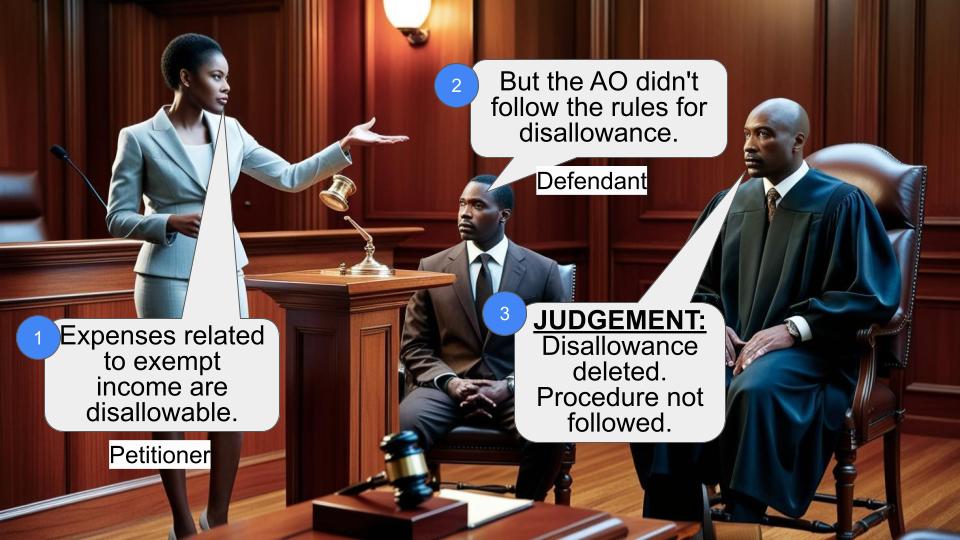
Tax Appeal Dismissed: Tribunal's Decision on Section 14A (of Income Tax Act, 1961) Disallowance Upheld
Tax Appeal Dismissed: Tribunal's Decision on Section 14A (of Income Tax Act, 1961) Disallowance Upheld
This case involves a tax appeal filed by the revenue department against CIMS Hospital Pvt. Ltd. The main dispute was about the disallowance of certain expenses under Section 14A (of Income Tax Act, 1961). The Income Tax Appellate Tribunal had ruled in favor of the assessee (CIMS Hospital), and the High Court upheld this decision, dismissing the revenue's appeal.
Get the full picture - access the original judgement of the court order here
Case Name:
Principal Commissioner of Income Tax vs CIMS Hospital Pvt. Ltd. (High Court of Gujarat)
R/Tax Appeal No.101 of 2020
Date: 25th February 2020
Key Takeaways:
1. The Assessing Officer must record satisfaction under Section 14A(2) (of Income Tax Act, 1961) before applying Rule 8D (of Income Tax Rules, 1962) for disallowance.
2. Mere presence of mixed funds doesn't automatically trigger application of Rule 8D (of Income Tax Rules, 1962).
3. The court emphasized the importance of following proper procedure in tax assessments.
Issue:
Did the Income Tax Appellate Tribunal err in deleting the disallowance made under Section 14A (of Income Tax Act, 1961), read with Rule 8D (of Income Tax Rules, 1962)?
Facts:
So, we're looking at the assessment year 2012-13. The Assessing Officer, during their review, disallowed an amount of Rs. 35,825 under Section 14A (of Income Tax Act, 1961). Why? Well, they thought the assessee (that's CIMS Hospital) hadn't correctly calculated the disallowance.
The assessee had initially disallowed Rs. 5,500, but the Assessing Officer said, "Nope, that's not right. It should be Rs. 41,325." So, they added the difference of Rs. 35,825 to the hospital's total income.
The hospital wasn't happy about this, so they appealed to the CIT(A), but no luck there. Then they took it to the Income Tax Appellate Tribunal, and that's where things turned around for them. The Tribunal said, "Hold on, the Assessing Officer didn't follow the proper procedure here," and deleted the disallowance.
Now, the tax department wasn't thrilled with this decision, so they brought it to the High Court. And that's where we are now!
Arguments:
The revenue department (that's the tax folks) argued two main points:
1. They said the Tribunal messed up by deleting the Rs. 35,825 disallowance made under Section 14A (of Income Tax Act, 1961) read with Rule 8D (of Income Tax Rules, 1962).
2. They also argued that the Tribunal shouldn't have deleted the addition of this disallowance to the book profit under Section 115JB (of Income Tax Act, 1961).
On the other side, CIMS Hospital basically said, "The Tribunal got it right. The Assessing Officer didn't follow the proper procedure, so the disallowance wasn't valid in the first place."
Key Legal Precedents:
The court relied on a couple of important cases here:
1. Principal Commissioner of Income Tax vs. Gujarat State Fertilizer and Chemical Ltd [(2019) 416 ITR 13 (Guj)]
This case emphasized that before applying Rule 8D (of Income Tax Rules, 1962), the Assessing Officer must indicate that they're not satisfied with the assessee's claim, based on the assessee's accounts.
2. Shreno Limited case (exact citation not provided in the text)
This case clarified that the Supreme Court's judgment in Maxopp Investment Limited doesn't change the fundamental understanding of Section 14A (of Income Tax Act, 1961) and Rule 8D (of Income Tax Rules, 1962).
Judgement:
The High Court sided with CIMS Hospital here. They agreed with the Tribunal's finding that the Assessing Officer didn't record the necessary satisfaction under Section 14A(2) (of Income Tax Act, 1961) before applying Rule 8D (of Income Tax Rules, 1962). Because of this procedural error, the disallowance wasn't valid.
The court emphasized that just having mixed funds doesn't automatically mean Rule 8D (of Income Tax Rules, 1962) applies. There's a process to follow, and it wasn't followed here.
As for the second question about book profits under Section 115JB (of Income Tax Act, 1961), the court said since the first issue was resolved in favor of the assessee, this second question doesn't even come into play.
So, in simple terms, the hospital won, and the tax department's appeal was dismissed.
FAQs:
1. Q: What's the main takeaway from this case?
A: The main takeaway is that tax authorities must follow proper procedures, especially when making disallowances under Section 14A (of Income Tax Act, 1961).
2. Q: Does this mean Section 14A (of Income Tax Act, 1961) disallowances are never valid?
A: Not at all! They can be valid, but the Assessing Officer needs to record their dissatisfaction with the assessee's accounts first, as required by Section 14A(2) (of Income Tax Act, 1961).
3. Q: What's the significance of Rule 8D (of Income Tax Rules, 1962) in this case?
A: Rule 8D (of Income Tax Rules, 1962) provides a method for calculating disallowances, but it can only be applied after the Assessing Officer has recorded their dissatisfaction as per Section 14A(2) (of Income Tax Act, 1961).
4. Q: Could this decision impact other tax cases?
A: Absolutely! It reinforces the importance of procedural correctness in tax assessments and could be cited in similar cases where proper procedures weren't followed.
5. Q: What should taxpayers learn from this case?
A: It's crucial to understand your rights as a taxpayer. If you believe proper procedures weren't followed in your assessment, you have the right to appeal, just like CIMS Hospital did in this case.

1. This Tax Appeal is filed under Section 260A (of Income Tax Act, 1961)1961 (for short the “Act1961”) at the instance of revenue and is directed against the order dated 05.09.2019, passed by the Income Tax Appellate Tribunal, Ahmedabad Bench 'B', Ahmedabad (for short the “Tribunal”)in the ITA No.3213/Ahd/2016 for the Assessment Year 201213.
2. The Revenue has proposed the following two questions as substantial questions of law: “2(A) Whether Appellate Tribunal has erred in law and on facts in deleting the disallowance of Rs.35,825/ made under Section 14A (of Income Tax Act, 1961) r.w. Rule 8D (of Income Tax Rules, 1962)? (B) Whether Appellate Tribunal has erred in law and on facts deleting the addition of disallowance made under Section 14A (of Income Tax Act, 1961) to the book profit under Section 115JB (of Income Tax Act, 1961)? 3. The Assessing Officer, during the course of the proceedings, disallowed the amount of Rs.35,825/ under Section 14A (of Income Tax Act, 1961)1961. The Assessing Officer was of the view that though the assessee has disallowed the amount of Rs.5500/ under Section 14A (of Income Tax Act, 1961)1961 in the statement of income, the assessee did not correctly work out the disallowance. According to the Assessing Officer, the correct working for the purpose of disallowance under Section 14A (of Income Tax Act, 1961)1961 r.w. Rule 8D (of Income Tax Rules, 1962) (for short the “Rules1962)was Rs.41,325/ as against Rs.5500/ calculated by the assessee. The Assessing Officer, therefore, made an addition of Rs.35,285/ to the total income of the assessee.
4. The assessee being aggrieved preferred an appeal before the CIT(A). The CIT(A) rejected the appeal qua the disallowance made by the Assessing Officer under Section 14A (of Income Tax Act, 1961)1961.
5. The assessee being dissatisfied with the order of CIT(A) preferred an appeal before the Tribunal. Considering the provisions of Section 14A (of Income Tax Act, 1961)- 1961 read with Rule 8D (of Income Tax Rules, 1962)1962, the Tribunal came to the conclusion that in order to make disallowance, the Assessing Officer has to be satisfied with regard to correctness of the claim of the assessee having regard to the amounts of expenditure in relation to his income which does not form part of the total income under the Act1961. The Tribunal, in the facts of the case, found that the Assessing Officer has not recorded any satisfaction in terms of Section 14A(2) (of Income Tax Act, 1961)1961 so as to apply Rule 8D (of Income Tax Rules, 1962)1962 for computation of amount of expenditure to be disallowed under Section 14A (of Income Tax Act, 1961)1961. The Tribunal, therefore, allowed the appeal filed by the assessee deleting the disallowance made under Section 14A (of Income Tax Act, 1961)1961 by the Assessing Officer.
6. In order to consider whether the Tribunal has the correctly deleted disallowance made under Section 14A (of Income Tax Act, 1961)1961 read with Rule 8D (of Income Tax Rules, 1962)1962, it would be germane to refer section 14A (of Income Tax Act, 1961)- 1961, which reads thus:
“Expenditure incurred in relation to income not includible in total income:
14A. (1) For the purposes of computing the total income under this Chapter, no deduction shall be allowed in respect of expenditure incurred by the assessee in relation to income which does not form part of the total income under this Act.
(2) The Assessing Officer shall determine the amount of expenditure incurred in relation to such income which does not form part of the total income under this Act in accordance with such method as may be prescribed, if the Assessing Officer, having regard to the accounts of the assessee, is not satisfied with the correctness of the claim of the assessee in respect of such expenditure in relation to income which does not form part of the total income under this Act.
(3) The provisions of subsection (2) shall also apply in relation to a case where an assessee claims that no expenditure has been incurred by him in relation to income which does not form part of the total income under this Act : Provided that nothing contained in this section shall empower the Assessing Officer either to reassess under section 147 (of Income Tax Act, 1961) or pass an order enhancing the assessment or reducing a refund already made or otherwise increasing the liability of the assessee under section 154 (of Income Tax Act, 1961), for any assessment year beginning on or before the 1st day of April, 2001.”
7. On perusal of the aforesaid provisions, it is clear that to determine the amount of expenditure incurred by the assessee in relation to the income which does not form part of the total income under the Act1961, the Assessing Officer can apply the method to calculate such expenditure as provided under Rule 8D (of Income Tax Rules, 1962)1962 only if the Assessing Officer having regard to accounts of the assessee is not satisfied with the correctness of the claim made by the assessee in respect of such expenditure in relation to the exempted income under the Act1961. Thus, precondition for applying Rule 8D (of Income Tax Rules, 1962)1962, the Assessing Officer is required to be satisfied as provided in subsection 2 (of Income Tax Act, 1961) of Section 14A (of Income Tax Act, 1961)1961.
8. In the aforesaid context, we may refer recent pronouncement of this Court in the case of Principal Commissioner of Income Tax Vs. Gujarat State Fertilizer and Chemical Ltd [(2019) 416 ITR 13 (Guj)], wherein this Court has observed as under:
“17. This Court, in Shreno Limited (supra), has taken the view that Maxopp Investment Limited (supra) cannot be seen or understood to be fundamentally changing the understanding and interpretation of Section 14A (of Income Tax Act, 1961) and Rule 8D (of Income Tax Rules, 1962). It went on to hold that the judgment of the Supreme Court does not lay down the proposition that, the requirement of subrule (1) of Rule 8D (of Income Tax Rules, 1962) of recording the satisfaction by the Assessing Officer before applying the formula given in sub- rule (2) of Rule 8D (of Income Tax Rules, 1962) is done away with. It clarifies that the judgment in the case of Maxopp Investment Limited does not lay down a proposition that the moment it is demonstrated that the assessee had availed of mixed funds and utilized them for making investment into securities earning tax free income, Section 14A (of Income Tax Act, 1961) read with Rule 8D (of Income Tax Rules, 1962) would be attracted automatically. The assessee has further relied on the judgment in the case of Principal Commissioner of Income Tax v. Gujarat State Financial Services Limited in the Tax Appeals Nos.1252, 1253 and 1255 of 2018 decided on 15th August 2018, which has followed the decision in the case of Shreno Limited (supra) dealing with the same issue and also an identical argument taken by the department.
18. The language of Section 14A (of Income Tax Act, 1961) is plain and clear Before invoking Rule 8D (of Income Tax Rules, 1962), the Assessing Officer is obliged to indicate that having regard to the accounts of the assessee, he is not satisfied with the correctness of the claim of the assessee in respect of such expenditure in relation to the income which does not form part of the total income under the Act. To put it in other words, the condition precedent of recording the requisite satisfaction which is a safeguard provided in Section 14A (of Income Tax Act, 1961) should not be overlooked before going to Rule 8 (of Income Tax Rules, 1962). In such circumstances we are not impressed by the submission canvassed on behalf of the Revenue that once there are mixed funds, Rule 8 (of Income Tax Rules, 1962) would be attracted automatically.”
9. The Tribunal has arrived at finding of fact that as the Assessing Officer did not record any satisfaction under Section 14A(2) (of Income Tax Act, 1961)1961 prior to invoking Rule 8D (of Income Tax Rules, 1962), he could not have made any disallowance by applying Rule 8D (of Income Tax Rules, 1962)- 1962.
10. We are in agreement with the finding of facts arrived at by the Tribunal. Therefore, Question No.2(A) as proposed by the Revenue cannot be termed as substantial question of law arising from the impugned order of the Tribunal.
11. So far as Question No.2(B) is concerned, as the Question No.2(A) is answered in favour of the assessee to the effect that the Tribunal has not erred in deleting the disallowance under Section 14A (of Income Tax Act, 1961)1961 read with 8D of the Rules1962, question of making addition of disallowance made under Section 14A (of Income Tax Act, 1961) by the Assessing Officer to the book profit under Section 115JB (of Income Tax Act, 1961)1961 would not arise. Therefore, the Question No.2(B) is also rejected.
×
Similar Ripples
Questions
Tax Appeal Dismissed: Tribunal's Decision on Section 14A (of Income Tax Act, 1961) Disallowance Upheld
Write your CommentSimilar Posts

Generic
- Reportdata/6279.pdf
