Tax Appeals Dismissed: Time-Barred Assessment and Lack of Evidence Favor Assess…


Full News
Tax Appeals Dismissed: Time-Barred Assessment and Lack of Evidence Favor Assessee
Tax Appeals Dismissed: Time-Barred Assessment and Lack of Evidence Favor Assessee
This case involves multiple tax appeals filed by the Commissioner of Income Tax against Kamlesh Damjibhai Yadav and others. The appeals primarily concern the validity of search and seizure operations, time limits for block assessments, and various additions made to the assessee's income. The High Court largely ruled in favor of the assessee, dismissing most of the Revenue's claims.
Get the full picture - access the original judgement of the court order here
Case Name:
Commissioner of Income Tax vs Kamlesh Damjibhai Yadav (High Court of Gujarat)
Tax Appeal No. 627, 714 and 719 of 2007
Date: 19th August 2016
Key Takeaways:
1. The court emphasized the importance of adhering to time limits in block assessments.
2. Evidence collected during post-search investigations may not always be admissible for assessments under Chapter XIV-B of the Income Tax Act.
3. The court reinforced the principle that additions under Chapter XIV-B should be based on materials found during the search operation.
Issue:
The main issues were:
1. Whether the search warrant issued for multiple occupants of a premises constitutes an association of persons or body of individuals?
2. Was the block assessment order passed within the prescribed time limit?
3. Can additions be made based on evidence collected during post-search investigations under Chapter XIV-B of the Income Tax Act?
Facts:
- A search warrant was issued on July 4, 2002, for the residential premises occupied by four persons, including the assessee.
- The search concluded on July 17, 2002, but a restraint order was issued only in the name of one person (Damji Bhai Khurji Bhai Yadav) until August 1, 2002.
- The block assessment order was passed on August 31, 2004.
- Various additions were made to the assessee's income based on evidence found during the search and post-search investigations.
Arguments:
Revenue's arguments:
- The search warrant for multiple occupants constitutes an association of persons.
- The block assessment was completed within the time limit.
- Additions based on post-search investigations are valid.
Assessee's arguments:
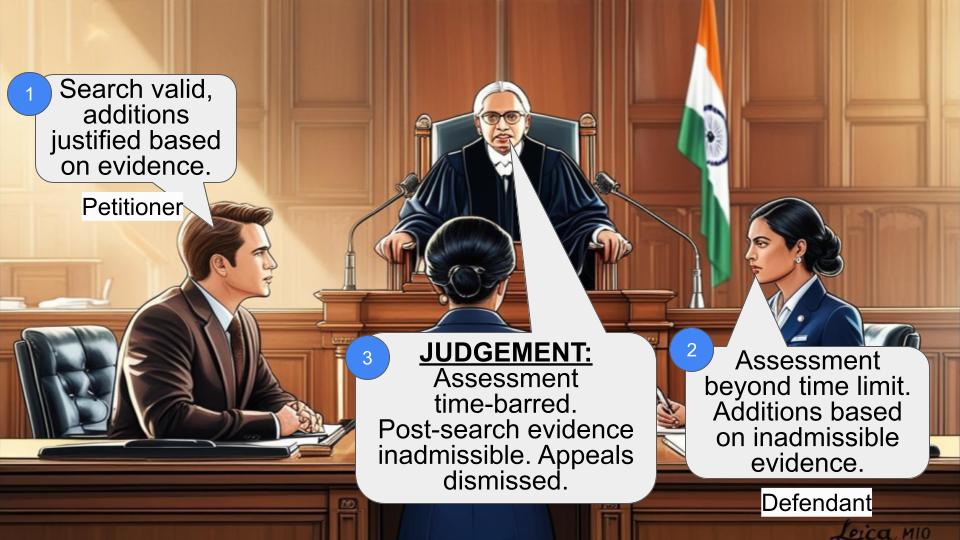
- The assessment order was time-barred as it wasn't passed within two years.
- Additions based on post-search investigations are not valid under Chapter XIV-B.
Key Legal Precedents:
1. CIT v. Anil Minda, [2010] 328 ITR 320 (Delhi)
2. CIT v. Dr. A.K. Bansal (Individual), [2013] 355 ITR 513
3. VLS Finance Ltd. v. CIT, [2016] 384 ITR 01 (SC)
4. Maneka Gandhi Vs. Union of India 1978 AIR 597
These cases were cited regarding the validity of search warrants and the interpretation of relevant sections of the Income Tax Act.
Judgement:
1. The court ruled that the search warrant issued for multiple occupants was valid, answering this question in favor of the Revenue.
2. However, the court found that the block assessment was time-barred, as it was not completed within two years of the search conclusion date (July 17, 2002). This key point was decided in favor of the assessee.
3. The court agreed with the Tribunal's decision to delete various additions made by the Revenue, particularly those based on post-search investigations, ruling in favor of the assessee.
FAQs:
1. Q: What was the main reason for dismissing the Revenue's appeals?
A: The main reason was that the block assessment order was time-barred, not being passed within the prescribed two-year limit from the date of search conclusion.
2. Q: Can evidence collected during post-search investigations be used for block assessments?
A: Generally, no. The court reinforced that additions under Chapter XIV-B should be based on materials found during the search operation itself.
3. Q: What's the significance of the restraint order in this case?
A: The restraint order was issued only in the name of one person, which meant the search concluded on July 17, 2002, for the assessee, starting the two-year time limit for assessment from that date.
4. Q: How did the court view the validity of the search warrant?
A: The court upheld the validity of the search warrant issued for multiple occupants of the premises, agreeing with the Revenue on this point.
5. Q: What lesson can be learned from this case for tax authorities?
A: Tax authorities should ensure that block assessments are completed within the prescribed time limits and that additions are based on evidence found during the search operation itself, not solely on post-search investigations.

1. In these appeals, the assessee is the same. Therefore, they are decided by this common judgment.
TAX APPEAL No.627/2007 :
2. Tax Appeal No.627/2007 was admitted in terms of the following substantial questions of law:
“(A) Whether the Appellate Tribunal was justified in law and on facts in holding that the warrant of authorization issued u/s 132(1) (of Income Tax Act, 1961) for search of the residential premises which was occupied by four persons and the mention of names of those four persons constitutes an association of persons or body of individuals?
(B) Whether the Appellate Tribunal was justified in law and on facts in holding that the search was concluded on 17.7.2002 and not on 1.8.2002 as there was no restraint order in respect of the assessee though there was no defect in the panchnama and the restraint order?
(C) Whether the Appellate Tribunal was justified in law and on facts in holding that the statements recorded u/s 132(4) (of Income Tax Act, 1961) and 131 (of Income Tax Act, 1961) did not constitute the material for the purpose of block assessment and thereby deleting the addition made on account of on money receipts?
(D) Whether the Appellate Tribunal was justified in law and on facts in deleting the addition of R. 7,46,992/ which was made on the basis of evidences found during the course of survey holding that such evidence cannot be used for making assessment under Chapter XIVB of the Act?
(E) Whether the Appellate Tribunal was justified in law and on facts in deleting the addition of Rs. 26,66,723/ which was made on the basis of evidences found in respect of Forum Coop. Housing Society holding that no addition can be made in the hands of the assessee ignoring the fact that the office bearers of these societies are either family members or relatives of Yadav Group and the activities of these societies are controlled by the persons of Yadav group?
(F) Whether the Appellate Tribunal was justified in law and on facts in deleting the addition of Rs. 4,56,161/ and Rs. 7,93,163/ which was made on the basis of evidences found ignoring the fact that the marble was supplied to the assessee?
(G) Whether the Appellate Tribunal was justified in law and on facts in deleting the addition of Rs. 87,75,000/ being unexplained investment in purchase of land holding that no evidence was found during the search and the addition was made on the basis of evidences collected during post search investigation, no addition can be made under Chapter XIVB of the Act?”
3. Learned Standing Counsel appearing for the Revenue contended that in view of the observations made by the Tribunal in Para64.3 of the impugned judgment and the principle rendered by Delhi High Court in CIT v. Anil Minda, [2010] 328 ITR 320 (Delhi), by the Allahabad High Court in the case CIT v. Dr. A.K. Bansal (Individual), [2013] 355 ITR 513 and by the Apex Court in VLS Finance Ltd. v. CIT, [2016] 384 ITR 01 (SC), the issues are covered in favour of the Revenue.
4. Learned counsel for the assessee submitted that the assessement order was not passed within two years and therefore, the same is time barred.
5. We have heard learned counsel for both the sides and perused the documents on record. Insofar as Question No.(A) is concerned, the same is settled by the judgments relied upon by learned Standing Counsel appearing for the Revenue. Hence, the Question No.(A) is answered in favour of the Revenue and against the assessee.
6. Insofar as Question Nos.(B) to (G) are concerned, it would be relevant to refer to the observations made by the Tribunal in Para64.3 of the judgment, which is reproduced hereunder;
“64.3 There is one more aspect of the issue of the time limit for completion of Block Assessement in this case. As noted by us earlier, the warrant of authorization dated 04.07.2002 was in the joint names of S/Sh. Damji Bhai Khurji Bhai Yadav, Kamlesh D. Yadav, Dhananjay D. Yadav and Smt. In such joint names, a panchnama was also prepared by the authorized officer on 17.07.2002. In the restraint order u/s.132(3) (of Income Tax Act, 1961), only name of Damji Bhai Khurji Bhai Yadav had been mentioned. From this, it means that, if at all the execution of warrant of authorization can be said to have been extended to 01.08.2002, such an extension was made only in the case of Shri Damji Bhai Khurji Bhai Yadav. There being no restraint order in the name of the assessee, either jontly with others or severally, the execution of warrant of authorization cannot be said to have been extended in his case. Therefore, so far as the assessee is concerned, the search got concluded on 17.07.2002 itself and consequently the limitation for passing the Block Assessement within the meaning of section 158BE (of Income Tax Act, 1961) had expired on 31.07.2004.
Therefore, we are of the view that the Block Assessement order dated 31.08.2004 is null and void as being barred by limitation. We, therefore, on this also also, quash the assessement order.”
7. It is evident from the above observations that assessement was not completed within two years. Hence, the issue raised in the form of Question No.(B), being time barred, the other Questions are not decided on merits. Thus, Question No.(B) is answered in favour of the assessee and against the Revenue.
TAX APPEAL No.719/2007 :
8. This Tax Appeal has been admitted in terms of the following substantial question of law:
“(A) Whether the Appellate Tribunal was justified in law and on facts in holding that the warrant of authorization issued u/S.132(1) (of Income Tax Act, 1961) for search of the residential premises which was occupied by four persons and the mention of names of those four persons constitutes an association of persons or body of individuals?
(B) Whether the Appellate Tribunal was justified in law and on facts in presuming that the satisfaction of the DIT(Inv.) must have been with reference to those four persons taken together and not individually without verifying the said satisfaction for which the Appellate Tribunal is not competent?
(C) Whether the Appellate Tribunal was justified in law and on facts in applying the decision of Hon'ble Apex Court in the case of Maneka Gandhi Vs. Union of India 1978 AIR 597 in holding that the copy of warrant of authorisation should have been made available to the assessee?
(D) Whether the Appellate Tribunal was justified in law and on facts in holding that no warrant of authorization was issued against the assessee and therefore, quashed the block assessment in spite of the fact that in the warrant of authorization issued in respect of residential premises and the assessee was mentioned as one of the co- occupants?
(E) Whether the Appellate Tribunal was justified in law and on facts in deleting the addition of Rs.2,00,220/ which was made on the basis of statement recorded u/S.132(4) (of Income Tax Act, 1961)?
(F) Whether the Appellate Tribunal was justified in law and on facts in deleting the addition of Rs.5,00,000/ which was found from the locker of the assessee ignoring the fact that the assessee failed to prove the source of the said cash?
(G) Whether the Appellate Tribunal was justified in law and on facts in deleting the addition of Rs.1,28,966/ which was made on the basis of statement recorded u/s.132(4) (of Income Tax Act, 1961)?
(H) Whether the Appellate Tribunal was justified in law and on facts in deleting the addition of Rs.37,200/ being unexplained investment in purchase of jewellery when no evidences was brought on record by the assessee indicating the said investment is duly recorded?
(I) Whether the Appellate Tribunal was justified in law and on facts in deleting the addition of Rs.10,000/ which was made on the basis of evidences found during the course of survey holding that such evidence cannot be used for making assessment under Chapter XIV- B of the Act?
(J) Whether the Appellate Tribunal was justified in law and on facts in deleting the addition of Rs.3,60,000/ which was made on the basis of evidences found during the course of post search enquiry holding that such evidence cannot be used for making assessment under Chapter XIVB of the Act?”
9. Insofar as Question Nos.(A) to (D) are concerned, the same are already settled by the judgment of Apex Court in the case of VLS Finance Ltd. (supra). Consequently, Question Nos.(A) to (D) are answered in favour of the Revenue and against the assessee and Question Nos.(E) to (G) are decided in favour of the assessee and against the Revenue.
TAX APPEAL No.714/2007 :
10. This Tax Appeal has been admitted in terms of the following substantial question law:
“(A) Whether the Appellate Tribunal was justified in law and on facts in deleting the addition of Rs.87,75,000/ being unexplained investment in purchase of land holding that no evidence was found during the search and the addition was made on the basis of evidences collected during post search investigation, no addition can be made under ChapterXIVB of the Act?”
11. In respect of the aforesaid issue, the Tribunal made the following observations in Para- 81 of the judgment of the Tribunal in ITA No. :
IT(SS)/134/Ahd/2005 & 172/Ahd/2005:
“81. On a careful consideration of the rival submissions, we find that as per the sale deeds found during the course of search, the land had been purchased on 31st March 1997. Addition under section 69 (of Income Tax Act, 1961) cannot be made on the basis of subsequent market value of the property. The sale instances given by Shri Pravin Kiku Bhai Patel in the statement recorded by the Investigation Wing on 16th September, 2002 were not relevant as the date of such sales instances fell in the later years. The additional payment amounting to Rs.24,50,000/ was paid to Shri Pankaj Karsan Bhai Patel who claimed to have interest in 13 Gunthas of land out of 45 Gunthas of land. In his statement recorded on the date of search itself (copy available at pages 266 to 267 of the paperbook) he has clearly stated that he received additional sale price for 13 Gunthas of land. Source of such payment has duly been accounted for by Shri Damji Bhai Khurji Bhai Yadav through withdrawals from his capital account with M/s. Satadhar Enterprises. Such withdrawals are recorded in the books of M/s. Satadhar Enterprises and have been taken into account for the purposes of computation of capital gain in the hands of the owner of the land namely Shri Damji Bhai Khurji Bhai Yadav. The report of the Architect M/s. Shilpam as had been impounded during the course of survey at Chandralok is also dated 26.11.2001. In such report, it was the market value of the land on the date of preparation of report, which is mentioned. It no where states that such a figure represented investment in the year 1997, which is the year of purchase. During the course of search operation, no incriminating material was found showing that the investment in purchase of land, was of the order of RS.87,75,000/. This is a settled law that the addition under Chapter XIVB can be made on the basis of the material found during search. No such material was brought to our knowledge. We, therefore, delete the addition of Rs.87,75,000/.”
11.1 We are in complete agreement with the reasonings given by the Tribunal and hence, answer the question in favour of the assessee and against the Revenue.
12. Consequently, all the three appeals stand disposed of.
(K.S.JHAVERI, J.)
(G.R.UDHWANI, J.)
×