


Tax authorities' addition rejected: High Court upholds ITAT decision in share i…


Full News

Tax authorities' addition rejected: High Court upholds ITAT decision in share investment case
Tax authorities' addition rejected: High Court upholds ITAT decision in share investment case
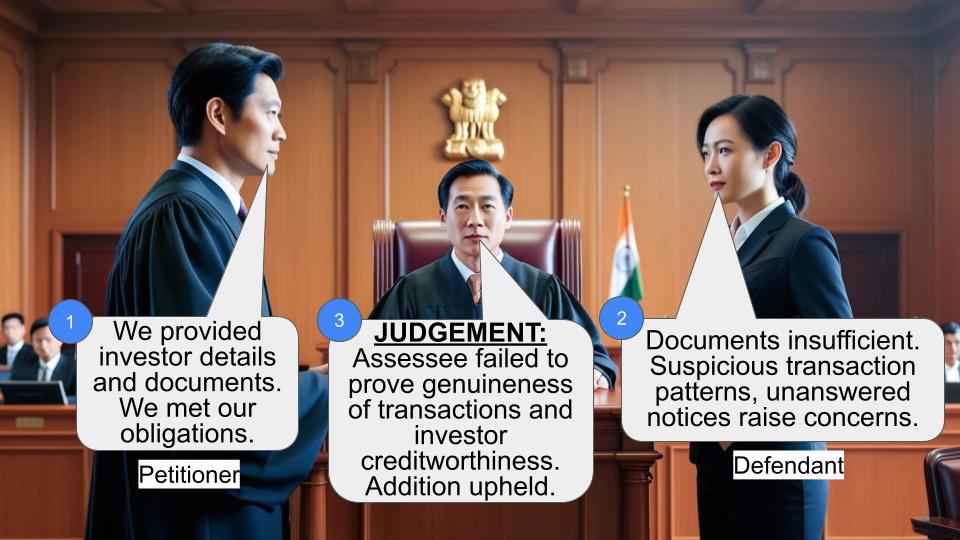
This case is about the Income Tax Department (the revenue) challenging a decision made by the Income Tax Appellate Tribunal (ITAT). The ITAT had agreed with the Commissioner of Income Tax (Appeals) [CIT(A)] to cancel a huge tax addition of ₹25,00,96,500 made by the Assessing Officer (AO) against a company called Goodview Trading Pvt. Ltd. The High Court ended up dismissing the revenue's appeal, effectively supporting the ITAT's decision.
Get the full picture - access the original judgement of the court order here
Case Name:
Principal Commissioner of Income-Tax (Central) vs. Goodview Trading Pvt. Ltd. (High Court of Delhi)
ITA 377/2016
Date: 21st November 2016
Key Takeaways:
1. The burden of proof in tax cases can shift from the assessee to the revenue once initial evidence is provided.
2. Tax authorities must act fairly and not be biased towards maximizing revenue collection.
3. Merely pointing out inconsistencies in income or bank transactions isn't enough to prove tax evasion.
4. The net worth of investors is crucial in determining the genuineness of share transactions.
Issue:
The main question here was: Did the ITAT and CIT(A) err in cancelling the tax addition made by the AO under Section 68 (of Income Tax Act, 1961)?
Facts:
1. Goodview Trading Pvt. Ltd. is in the investment business, dealing with capital markets.
2. The company received a notice under Section 153C (of Income Tax Act, 1961) after a search on Jakson Group and Associates on 10.02.2010.
3. The company filed its returns for the block period.
4. The AO added an amount under Section 68 (of Income Tax Act, 1961), claiming the share applicants' identity, transaction genuineness, and creditworthiness weren't established.
5. The CIT(A) cancelled this addition, and the ITAT agreed with the CIT(A)'s decision.
6. Now, the revenue has appealed to the High Court against these decisions.
Arguments:
Revenue's side:
- They argued that while the identity of investors was established, the genuineness and creditworthiness weren't proven.
- They presented a chart showing that most share applicants paid little or no income tax.
- They claimed that bank statements showed cash deposits and routing through different entities.
Assessee's side (as presented by CIT(A)):
- They provided details of share applicants, including income tax returns and net worth.
- They argued that the applicants had sufficient net worth to invest in the company's shares.
- They claimed to have discharged their initial burden of proof, shifting it to the revenue.
Key Legal Precedents:
1. CIT v. Lovely Exports, (2008) 216 CTR 195 (SC): This case set the standard for establishing the genuineness of share transactions.
2. CIT v. Simon Carves Ltd. [1976] 105 ITR 212 (SC): This case emphasized that tax authorities must act fairly and not be biased towards maximizing revenue.
Judgement:
The High Court dismissed the revenue's appeal. Here's why:
1. They found that the CIT(A)'s reasoning was factually accurate and supported by evidence.
2. The court noted that the AO focused on minimal tax payments by share applicants but ignored their substantial net worth.
3. They agreed with the CIT(A) that merely pointing out inconsistencies in income or bank transactions isn't enough to prove tax evasion.
4. The court didn't find any substantial question of law, given that the judgment in Lovely Exports was correctly applied.
FAQs:
1. Q: What's Section 68 (of Income Tax Act, 1961) about?
A: It deals with unexplained cash credits in a taxpayer's books of accounts.
2. Q: Why did the High Court side with the ITAT and CIT(A)?
A: They found that the CIT(A)'s analysis of the investors' net worth was more comprehensive and accurate than the AO's focus on tax payments.
3. Q: What's the significance of the "burden of proof" in this case?
A: Once the assessee provided initial evidence, the burden shifted to the tax department to prove any wrongdoing.
4. Q: How does this case impact future tax assessments?
A: It emphasizes the need for tax authorities to consider all aspects of financial transactions, not just tax payments, when determining their genuineness.
5. Q: What's the takeaway for companies receiving share investments?
A: It's crucial to maintain proper documentation of investors' identities and financial capabilities to support the genuineness of transactions.

1. The revenue is aggrieved by an order of the Income Tax Appellate Tribunal (ITAT) which had concurred with and affirmed the appellate Commissioner’s order directing the cancellation of an amount of 25,00,96,500/-. It is urged that having regard to the law laid down in relation to Section 68 (of Income Tax Act, 1961), the concurrent findings of the CIT (A) and ITAT are unsustainable.
2. The assessee which engages itself in investment business with capital markets received notice under Section 153C (of Income Tax Act, 1961) pursuant to search initiated on Jakson Group and Associates on 10.02.2010. The assessee filed its returns declaring income during the block period pursuant to which notices under Section 143(2) (of Income Tax Act, 1961) and 142 (1) (of Income Tax Act, 1961) together with a detailed questionnaire were issued. The assessee complied with the requisite information. Parallelly, a survey under Section 133(6) (of Income Tax Act, 1961) was apparently carried out by the revenue on the date of search. Based upon these materials and the responses received from the assessee during the proceedings, the AO added the amount under Section 68 (of Income Tax Act, 1961) determining that the genuineness of the identity of the share applicants, genuineness of the transactions and the investors’ credit worthiness had not been established in accordance with the authority in CIT v. Lovely Exports, (2008) 216 CTR 195 (SC).
3. The assessee’s appeal to the Commissioner succeeded. The Commissioner noticed that the details of the share applicants such as their income tax returns as well as the net worth were available on the file of the assessment record. Based upon analysis and the submissions, the CIT (A) concluded that the share applicants had sufficient net worth and finances to invest in the assessee’s offerings with the premium of `23 crores. The CIT (A) recorded inter alia as follows: -
“I have considered the assessment order and submissions of the appellant. It is settled law that the onus of proving a claim is initially on the assessee but this is a shifting burden and once an assessee discharge its primary onus, the burden shifts on the revenue. In the present case the appellant had duly discharged its onus by submitting necessary evidence available to establish the bona fide of the transactions. Thereafter, the onus shifted on the revenue to prove that the claim of the appellant was factually incorrect. Simply by pointing out that the claim of the appellant was factually incorrect. Simply by pointing out that the applicant companies did not have sufficient income or that the bank accounts indicated credits and debits in rapid succession leaving little balance does not discharge the burden cast upon the revenue to take an adverse view in the matter. Further, if there was statement of a person or any other material indicating tax evasion by the appellant, or persons in control of its management, the material relied upon should have been made available to the appellant in its entirety. From the records, it appears that this was not done. It has been held by the Hon’ble Apex Court that taxing authorities exercise quasi-judicial powers and in doing so they must act in a fair and not a partisan manner. Although it is part of their duty to ensure that no tax which is legitimately due from the assessee should remain unrecovered, they must also at the same time not act in a manner as might indicate that scales are weighted against the assessee. It is impossible to subscribe to the view that unless those authorities exercise the power in a manner most beneficial to the revenue and consequently most adverse to the assessee, they should be deemed to have exercised it in a proper and judicious manner {CIT v. Simon Carves Ltd. [1976] 105 ITR 212 (SC)}. In my considered opinion, this is not the case where addition should have been made u/s 153C (of Income Tax Act, 1961), but u/s 147 (of Income Tax Act, 1961)/143 (3) after making proper enquires. In the present facts of the case, the addition is not legally sustainable and is deleted. Appellant gets relief of Rs.25,00,96,500/-.”
4. The ITAT concurred with this view.
5. The revenue urges that the CIT (A) and the ITAT both grievously erred in cancelling the additions made. It is submitted that the genuineness of the transactions and the credit worthiness is suspect in the circumstances of the case. Learned counsel relied upon a tabular chart prepared by the AO to submit that most of the share applicants had paid little or no income tax and that analysis of the bank statements furnished by such investors revealed that the amounts were deposited in cash and also routed through different entities. It was submitted that whereas the identity of the investors was no doubt established, neither the genuineness nor credit worthiness could be said to have been satisfied to pass the test of bona fide transactions. It is submitted that in these circumstances, the CIT (A)’s decision - as endorsed by the ITAT - is required to be set aside in this appeal.
6. This Court has considered the materials on record.
7. As against the AO’s tabular appreciation of the facts, the CIT (A) also framed another chart which interestingly reveals the net worth of the companies that had invested in the course of the share offerings, of the applicant. The chart extracted in paragraph 4.2 of the CIT (A)’s order is reproduced below: -
S.No. Name of Party PAN NO. Amount of investment in shares
Net worth as on 31.3.06
1. M/s Golden Suppliers Pvt.Ltd.
AADCG0724F 5,723,250.00
2. M/s Web Tech International Ltd.
AAACW4551F 4,231,500.00 9,936,107.00
3. M/s Well Plan Corp. Management Pvt. Ltd.
AAACW2580N 570,000.00 12,551,638.00
4. M/s Triveni Tower Pvt. Ltd.
AABCT0558Q 13,494,000.00 10,079,080.00
5. M/s Allworth Commodities Pvt. Ltd.
AACCA5809Q 12,898,500.00 50,043,177.00
6. M/s Gunjan Agencies Pvt. Ltd.
AABCG2363E 2,343,750.00 5,498,065.00
7. M/s Simphony Trade Comm Pvt. Ltd.
AAECS0612B 4,161,750.00 5,112,447.00
8. M/s Texila Commerce Pvt.Ltd.
AABCT0569P 7,627,500.00 5,110,307.00
9. M/s Kajal Merchandise Pvt. Ltd.
AABCK4093R 12,591,750.00 30,019,461.00
10. M/s Majestic Deal Com Pvt.Ltd.
AABCM9098G 3,740,250.00
11. M/s Cherry Tie Up Pvt. Ltd.
AABCC9327N 17,466,000.00 35,688,065.00
12. M/s Marino Fresh Food Industries Ltd.
AABCM2781N 281,250.00 43,599,164.00
13. M/s Dev Lok AAACD9682L 12,36,000.00 Marketing Pvt. Ltd.
14. M/s Surya Shakti Marketing Pvt.Ltd.
AAECS0505K 955,500.00 40,697,791.00
15. M/s Super Deal Sales Pvt. Ltd.
AAECS2143K 17,958,750.00 250,046,932.00
16. M/s Quicker Impex & Credit Pvt. Ltd.
AAACQ0433E 10,769,250.00 32,711,907.00
17. M/s Satyam Credit Pvt. Ltd.
AADCS6627H 6,539,250.00 9,988,429.00
18. M/s Mudrika Fiscal Services Pvt. Ltd.
AABCM7362B 16,942,500.00 150,412,130.00
19. M/s Graceful Traders Pvt.Ltd.
AABCG7432L 15,226,500.00 30,005,878.00
20. M/s Goodward Agency Pvt.Ltd.
AABCG7433M 17,329,500.00 15,042,806.00
21. M/s Vishnupriya Prop. Pvt. Ltd.
AAACV8829P 4,648,500.00 3,892,620.00
22. M/s Zenith Goods & Services Pvt.Ltd.
AAACZ0908P 14,387,250.00 20,027,787.00
23. M/s Concert Tradelink Pvt.Ltd.
AABCC9445K 14,070,000.00 99,993,410.00
8. It is quite evident from the CIT (A)’s reasoning in paragraph 4.3, that the materials clearly pointed to the share applicants’ possessing substantial means to invest in the assessee’s company. The AO seized certain material to say that minimal or insubstantial amounts was paid as tax by such share applicants and did not carry out a deeper analysis or rather chose to ignore it. In these circumstances, the inferences drawn by the CIT (A) are not only factual but facially accurate.
9. Having regard to these circumstances, the Court discerns no question of law, least a substantial question, having regard to the fact that the judgment in Lovely Exports (supra) was cited and applied.
10. For these reasons, there is no merit in the appeal; the same is accordingly dismissed.
S. RAVINDRA BHAT, J
NAJMI WAZIRI, J
NOVEMBER 21, 2016
×
Similar Ripples
Questions
Tax authorities' addition rejected: High Court upholds ITAT decision in share investment case
Write your CommentSimilar Posts


Generic
- Reportdata/2272_PhtelHF.pdf
