


Tax Deduction Dispute: Court Upholds ITAT Decision, Dismisses Revenue's Appeal


Full News
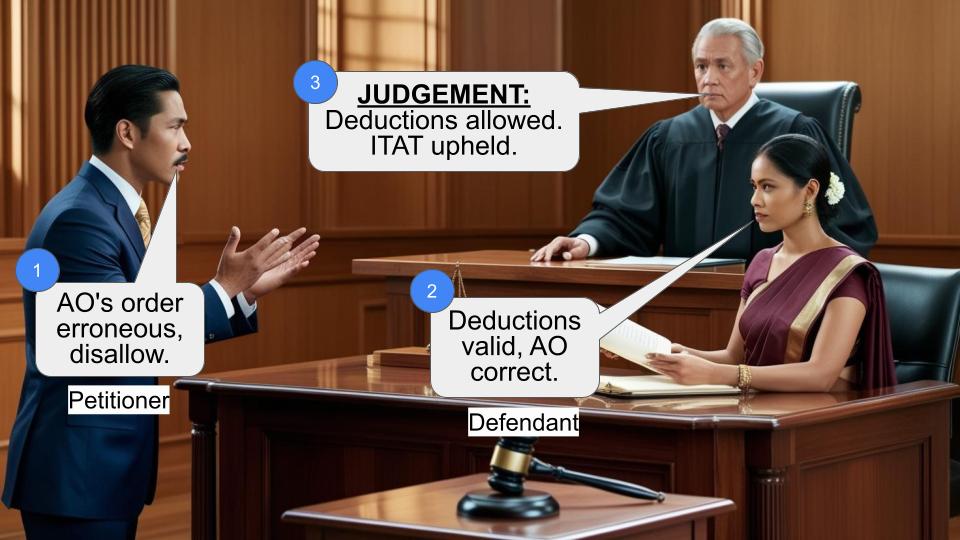
Tax Deduction Dispute: Court Upholds ITAT Decision, Dismisses Revenue's Appeal
Tax Deduction Dispute: Court Upholds ITAT Decision, Dismisses Revenue's Appeal
This case involves an appeal by the Revenue (tax authorities) against an order passed by the Income Tax Appellate Tribunal (ITAT) for the Assessment Year 2007-08. The dispute centered around the allowance of deductions under Sections 36(1)(viia)(c) (of Income Tax Act, 1961) and 36(1)(viii) (of Income Tax Act, 1961). The High Court dismissed the Revenue's appeal, upholding the ITAT's decision that the Assessing Officer's (AO) view was a possible interpretation of the law.
Get the full picture - access the original judgement of the court order here
Case Name:
Commissioner of Income Tax-LTU Vs Power Finance Corporation Ltd. (High Court of Delhi)
ITA 395/2015
Date: 1st October 2015
Key Takeaways:
1. The court affirmed that when multiple interpretations of tax law are possible, the view favorable to the taxpayer should be accepted.
2. The Commissioner of Income Tax's (CIT) jurisdiction under Section 263 (of Income Tax Act, 1961) should not be exercised when the Assessing Officer's view is a possible interpretation of the law.
3. The case reinforces the principle established in Malabar Industrial Co. Ltd. v. CIT and followed in CIT v. Honda Siel Power Products Ltd.
Issue:
Was the Commissioner of Income Tax justified in exercising jurisdiction under Section 263 (of Income Tax Act, 1961) to revise the Assessing Officer's order allowing deductions under Sections 36(1)(viia)(c) (of Income Tax Act, 1961) and 36(1)(viii) (of Income Tax Act, 1961)?
Facts:
1. The case pertains to the Assessment Year 2007-08.
2. The Assessing Officer passed an order on 29th September 2009, allowing deductions under Sections 36(1)(viia)(c) (of Income Tax Act, 1961) and 36(1)(viii) of the Income Tax Act in favor of the Assessee.
3. The Commissioner of Income Tax, on 30th March 2012, concluded that the AO's order was erroneous and prejudicial to the Revenue's interests.
4. The Income Tax Appellate Tribunal (ITAT) passed an order on 28th November 2014, which was challenged by the Revenue in this appeal.
Arguments:
Revenue's Argument:
- The CIT argued that the AO's order allowing both deductions was erroneous and prejudicial to the Revenue's interests.
Assessee's Argument:
- The Assessee contended that both deductions under Sections 36(1)(viia)(c) (of Income Tax Act, 1961) and 36(viii) (of Income Tax Act, 1961) are independent of each other.
Key Legal Precedents:
1. Malabar Industrial Co.Ltd. v. CIT 243 ITR 83 (SC): This Supreme Court case established the principle for determining when the CIT can exercise jurisdiction under Section 263 (of Income Tax Act, 1961).
2. CIT v. Honda Siel Power Products Ltd. (ITA No. 1376 of 2009): This High Court decision followed the principle laid down in the Malabar Industrial Co.Ltd. case.
3. Rural Electrification Corpn. v. Additional Commissioner of Income Tax (2009) 34 SOT 159 Delhi: This ITAT Delhi order presented one view on the computation of total income for Section 36(1)(viia)(c) (of Income Tax Act, 1961) purposes.
4. Infrastructure Development Finance Co. Ltd. v. ACIT (ITA No. 747,748/Mds/2005): This Chennai Bench of ITAT order presented another view on the same issue.
Judgement:
The High Court dismissed the Revenue's appeal, concluding that:
1. The view taken by the Assessing Officer was a possible interpretation of the law.
2. There was no occasion for the CIT to exercise jurisdiction under Section 263 (of Income Tax Act, 1961).
3. The ITAT's order did not suffer from any legal infirmity.
4. No substantial question of law arose from the case.
FAQs:
1. Q: What was the main issue in this case?
A: The main issue was whether the CIT was justified in revising the AO's order allowing certain tax deductions under Section 263 (of Income Tax Act, 1961).
2. Q: Why did the court dismiss the Revenue's appeal?
A: The court found that the AO's interpretation was a possible view of the law, and therefore, the CIT shouldn't have exercised jurisdiction under Section 263 (of Income Tax Act, 1961).
3. Q: What principle did this case reinforce?
A: It reinforced the principle that when multiple interpretations of tax law are possible, the view favorable to the taxpayer should be accepted.
4. Q: How does this judgment impact taxpayers?
A: It provides some protection to taxpayers when there are multiple possible interpretations of tax laws, favoring the interpretation that benefits the taxpayer.
5. Q: What sections of the Income Tax Act were central to this case?
A: Sections 36(1)(viia)(c), 36(1)(viii) (of Income Tax Act, 1961), and 263 of the Income Tax Act were central to this case.

1. This appeal by the Revenue is directed against the order dated 28th November 2014 passed by the Income Tax Appellate Tribunal (‘ITAT’) in ITA No. 2598/Del/2012 for the Assessment Year (‘AY’) 2007-08.
2. The question of law before the ITAT was whether the order dated 30th March 2012 passed by the Commissioner of Income Tax (‘CIT’) under Section 263 (of Income Tax Act, 1961) was justified in law.
3. The CIT by the said order concluded that the order dated 29th September 2009 passed by the Assessing Officer (‘AO’) allowing deduction under Sections 36(1) (of Income Tax Act, 1961) (viia) (c) and 36 (1) (viii) (of Income Tax Act, 1961) in favour of the Assessee was erroneous as well as prejudicial to the interest of the Revenue.
4. The ITAT in the impugned order noticed on the question whether the total income for the purposes of Section 36(1)(viia)(c) (of Income Tax Act, 1961) should be computed after allowing the deduction under Section 36(viii) (of Income Tax Act, 1961), there were at least two possible views as reflected in the orders of the ITAT Delhi in Rural Electrification Corpn. v. Additional Commissioner of Income Tax (2009) 34 SOT 159 Delhi and of the Chennai Bench of the ITAT in Infrastructure Development Finance Co. Ltd. v. ACIT (order dated 29th March 2007 in ITA No. 747,748/Mds/2005).
5. During the course of hearing today it transpired to the Court that, independent of the aforementioned two decisions, the stand of the Revenue as set out in its memorandum of appeal, and that of the Assessee before us, viz., that both deductions [under Section 36(1)(viia)(c) (of Income Tax Act, 1961) and 36 (viii)] are independent of each other, give rise to two further possible interpretations.
6. The Court is satisfied that in terms of the law explained by the Supreme Court in Malabar Industrial Co.Ltd. v. CIT 243 ITR 83(SC) as followed b this Court in its recent decision dated 5th July 2010 in ITA No. 1376 of 2009 (CIT v. Honda Siel Power Products Ltd.) the view taken by the AO in the present appeal is a possible one and there was no occasion for the CIT to have exercised jurisdiction under Section 263 (of Income Tax Act, 1961). The impugned order of the ITAT therefore does not suffer from any legal infirmity. No substantial question of law arises.
7. The appeal is dismissed.
S.MURALIDHAR, J
VIBHU BAKHRU, J
OCTOBER 01, 2015
×
Questions
Tax Deduction Dispute: Court Upholds ITAT Decision, Dismisses Revenue's Appeal
Write your CommentSimilar Posts

Generic
- Reportdata/3409.pdf
