


Tax deduction mix-up: Court upholds rectification, clarifies applicability of s…





Full News
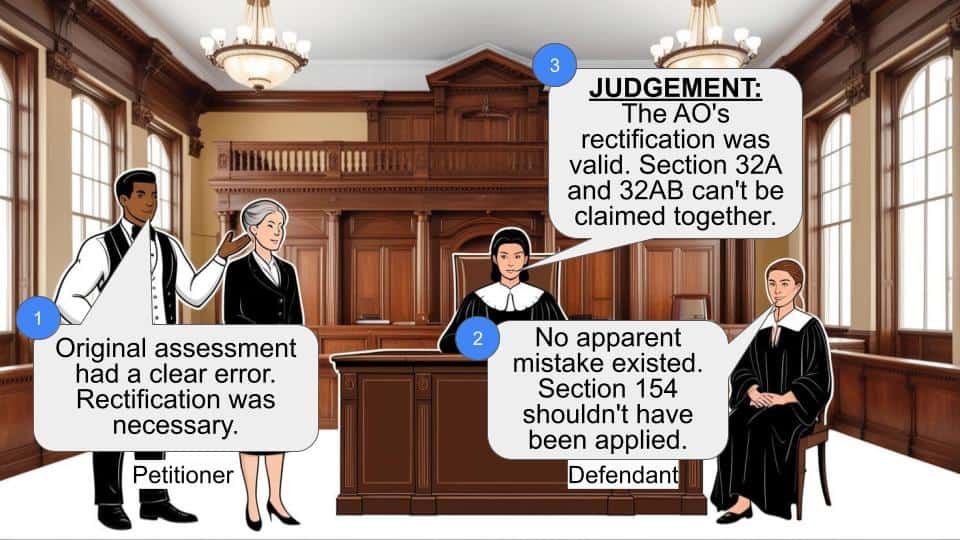
Tax deduction mix-up: Court upholds rectification, clarifies applicability of sections 32A and 32AB
Tax deduction mix-up: Court upholds rectification, clarifies applicability of sections 32A and 32AB
There the tax department (the appellant) challenged an order by the Income Tax Appellate Tribunal. The Tribunal had cancelled a rectification order issued by the Assessing Officer (AO) under section 154 (of Income Tax Act, 1961). This rectification order had withdrawn relief granted under section 32A (of Income Tax Act, 1961) in the original assessment. The High Court ended up siding with the tax department, allowing their appeal.
Get the full picture - access the original judgement of the court order here
Case Name:
Commissioner of Income Tax vs. Mathrubhumi Printing & Publishing Co. Ltd. (High Court of Kerala)
ITA. No. 45 of 2002
Date: 11th February 2008
Key Takeaways:
1. The AO's original order allowing deductions under both sections 32A and 32AB was a mistake that could be rectified under section 154 (of Income Tax Act, 1961).
2. Subsection (8C) of section 32A (of Income Tax Act, 1961), which came into effect from April 1, 1989, didn't apply to the assessment year 1988-89 in question.
3. The case clarifies that when an assessee claims deduction under section 32AB (of Income Tax Act, 1961), they can't simultaneously claim investment allowance under section 32A (of Income Tax Act, 1961).
Issue:
Was the Income Tax Appellate Tribunal justified in cancelling the rectification order issued by the Assessing Officer under Section 154 (of Income Tax Act, 1961), which withdrew relief granted under Section 32A (of Income Tax Act, 1961) in the original assessment?
Facts:
1. The assessee (Mathrubhumi Printing & Publishing Co. Ltd.) claimed investment allowance under section 32A (of Income Tax Act, 1961) and relief under section 32AB (of Income Tax Act, 1961) for the same assessment year (1988-89).
2. Initially, the AO allowed both claims in the original assessment.
3. Later, the AO realized this was a mistake because section 32A(8B) (of Income Tax Act, 1961) prohibits granting investment allowance to assessees who have claimed deduction under section 32AB (of Income Tax Act, 1961).
4. The AO then issued a rectification order under section 154 (of Income Tax Act, 1961), withdrawing the relief granted under section 32A (of Income Tax Act, 1961).
5. On appeal, the first appellate authority allowed the claim under section 32A (of Income Tax Act, 1961) but disallowed the claim under section 32AB (of Income Tax Act, 1961), relying on section 32A(8C) (of Income Tax Act, 1961).
6. The Tribunal then dismissed the department's appeal and allowed the assessee's cross-objections, holding that section 154 (of Income Tax Act, 1961) wasn't applicable as there was no apparent mistake.
Arguments:
The tax department argued:
1. There was a patent mistake in the original assessment as the AO allowed deductions under both sections 32A and 32AB, which isn't permitted under section 32A(8B) (of Income Tax Act, 1961).
2. The first appellate authority's reliance on section 32A(8C) (of Income Tax Act, 1961) was incorrect as it came into effect only from April 1, 1989, while the assessment year in question was 1988-89.
The assessee argued:
1. The proceedings under section 154 (of Income Tax Act, 1961) weren't maintainable as there was no apparent mistake that could be corrected under this section.
Key Legal Precedents:
Interestingly, this case doesn't mention any specific legal precedents. Instead, it focuses on the interpretation and application of specific sections of the Income Tax Act, particularly sections 32A, 32AB, and 154.
Judgement:
The High Court allowed the appeal filed by the tax department. Here's what they decided:
1. The AO's original order allowing deductions under both sections 32A and 32AB was indeed a mistake that could be rectified under section 154 (of Income Tax Act, 1961).
2. The first appellate authority's reliance on section 32A(8C) (of Income Tax Act, 1961) was incorrect as it wasn't applicable to the assessment year in question (1988-89).
3. The Tribunal's assumption that two views were possible on the entitlement of deduction was wrong.
4. The Court cancelled the orders of the Tribunal and the first appellate authority and restored the AO's order issued under section 154 (of Income Tax Act, 1961).
FAQs:
Q1: Why couldn't the assessee claim deductions under both sections 32A and 32AB?
A1: Section 32A(8B) (of Income Tax Act, 1961) prohibits granting investment allowance under 32A to assessees who have claimed deduction under 32AB for the same year.
Q2: Why was the first appellate authority's decision overturned?
A2: They relied on section 32A(8C) (of Income Tax Act, 1961), which came into effect from April 1, 1989, but the assessment year in question was 1988-89, so this section wasn't applicable.
Q3: What's the significance of section 154 (of Income Tax Act, 1961) in this case?
A3: Section 154 (of Income Tax Act, 1961) allows for the rectification of mistakes apparent from the record. The Court held that the original assessment allowing both deductions was such a mistake that could be rectified under this section.
Q4: Does this judgment set any new precedent?
A4: While it doesn't set a new precedent, it clarifies the application of sections 32A and 32AB and reinforces the scope of rectification under section 154 (of Income Tax Act, 1961).
Q5: What's the key lesson for taxpayers from this case?
A5: Taxpayers should be careful not to claim conflicting deductions in the same assessment year, as it may lead to rectification and withdrawal of benefits later.

1. The question raised in the departmental appeal filed under Section 260A (of Income Tax Act, 1961) is whether the Tribunal is justified in cancelling the rectification order issued by the assessing officer under Section 154 (of Income Tax Act, 1961) withdrawing relief granted in the original assessment under Section 32A (of Income Tax Act, 1961). We have heard senior counsel appearing for the appellant and counsel appearing for the respondent-assessee.
2. The assessee made a claim of investment allowance on investment in plant and machinery under Section 32A (of Income Tax Act, 1961), besides claiming relief under Section 32AB (of Income Tax Act, 1961) on investment deposit account for the same assessment year. In the original assessment completed the assessing officer allowed deduction of both the claims. However, later the assessing officer found that Section 32A(8B) (of Income Tax Act, 1961) prohibits granting of investment allowance to assessees who have claimed deduction allowable under Section 32AB (of Income Tax Act, 1961). Since respondent- assessee had claimed deduction under Section 32AB (of Income Tax Act, 1961) and in fact claim was allowed, the assessing officer found that granting of deduction of investment allowance is impermissible under Section 32A(8B) (of Income Tax Act, 1961). Consequently, he rectified the assessment withdrawing relief granted under Section 32A (of Income Tax Act, 1961). On appeal by the assessee, the first appellate authority held that only one claim is allowable, that is under Section 32A (of Income Tax Act, 1961). He allowed the claim under Section 32A (of Income Tax Act, 1961) and held that assessee is not entitled simultaneously to claim deduction under Section 32AB (of Income Tax Act, 1961). The first appellate authority relied on Section 32A(8C) (of Income Tax Act, 1961) for granting the relief moulded by him. While the department filed appeal against the order of the first appellate authority, the assessee filed cross-objections on the ground that proceedings under Section 154 (of Income Tax Act, 1961) was not maintainable. The Tribunal dismissed the departmental appeal and allowed the assessee's cross-objections by holding that Section 154 (of Income Tax Act, 1961) was not applicable in this case, as there was no mistake apparent that could be corrected under Section 154 (of Income Tax Act, 1961). It is against this order of the Tribunal that the Department has filed appeal before this Court.
3. Standing counsel contended that there was patent mistake in the original assessment in as much as the assessing officer allowed the claim of deduction under Section 32A (of Income Tax Act, 1961) as well as under Section 32AB (of Income Tax Act, 1961) which is not permissible by virtue of the provisions contained in Section 32A(8B) (of Income Tax Act, 1961). He also referred to the finding of the first appellate authority which also upheld the proceedings under Section 154 (of Income Tax Act, 1961), even though the first appellate authority wrongly moulded the relief to the assessee. We are inclined to uphold the contention of the revenue because the first appellate authority allowed the claim by relying on sub-section (8C) of Section32A (of Income Tax Act, 1961) which came into effect only on 1.4.1989 whereas the assessment involved in this case is 1988-89. In fact the very same provisions contained in sub- section (8C) of Section 32A (of Income Tax Act, 1961) are simultaneously incorporated with effect from 1.4.1989 in clause (10) of Section 32AB (of Income Tax Act, 1961). There is no need for us to consider the scope of these provisions introduced with effect from 1.4.1989 because those provisions of the Act are not applicable for the assessment in question. The scope of sub-section (8B) of Section 32A (of Income Tax Act, 1961) is that if in the course of assessment, the assessing officer notices that the assessee has claimed deduction under Section 32AB (of Income Tax Act, 1961) for the same year, there is no need to process the claim under Section 32A (of Income Tax Act, 1961) but to reject the claim of deduction of investment allowance. If relief is granted contrary to the statutory provision then such order is a mistaken order and assessing officer is entitled to rectify such order in proceedings under Section 154 (of Income Tax Act, 1961). The Tribunal interfered with the order under Section 154 (of Income Tax Act, 1961) by assuming that the view taken by the first appellate authority is also possible. Since we have already held that the first appellate authority's order based on the provision not applicable for assessment year is not tenable, the view adopted by the first appellate authority is not a possible view. Therefore the Tribunal's assumption that two views are possible on the entitlement of deduction is wrong. In this view of the matter, we allow the appeal filed by the revenue by cancelling the order of the Tribunal and that of the first appellate authority and by restoring the order issued by the assessing officer under Section 154 (of Income Tax Act, 1961).
(C.N.RAMACHANDRAN NAIR)
Judge.
(T.R.RAMACHANDRAN NAIR)
Judge.
×
Similar Ripples
Questions
Tax deduction mix-up: Court upholds rectification, clarifies applicability of sections 32A and 32AB
Write your CommentSimilar Posts
Generic
- Reportdata/4833.pdf
