


Tax Refund Delay Condoned: Co-op Society Wins Against CBDT




Full News
Tax Refund Delay Condoned: Co-op Society Wins Against CBDT
Tax Refund Delay Condoned: Co-op Society Wins Against CBDT
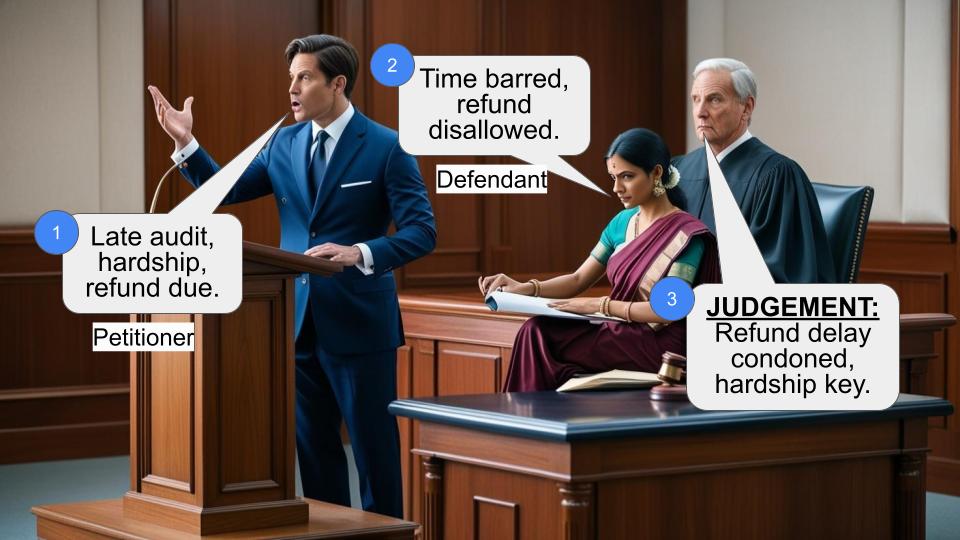
We've got this interesting case where a co-operative society went up against the Union of India, specifically the Central Board of Direct Taxes (CBDT). The society was fighting for a tax refund that they filed late, and guess what? They won! The High Court basically told the CBDT, "Hey, you need to be more understanding here," and ordered them to process the refund claim.
Get the full picture - access the original judgement of the court order here
Case Name:
Pala Marketing Co-operative Society Ltd. Vs Union of India (High Court of Kerala)
WP(C).No. 21977 of 2007(N)
Date: 26th November 2007
Key Takeaways:
1. The court emphasized that genuine hardship to the taxpayer should be the primary consideration for condoning delays in refund applications.
2. Statutory audits required by other laws (like the Co-operative Societies Act) can be a valid reason for delay in filing tax returns.
3. The CBDT's power under Section 119(2)(b) (of Income Tax Act, 1961) is not just about explaining delays, but about avoiding hardship to taxpayers.
Issue:
The main question here was: Should the delay in filing a tax refund claim be condoned when the delay was due to late statutory audit and the taxpayer faces genuine financial hardship?
Facts:
1. Our protagonist is a co-operative society that markets agricultural produce.
2. In the 1997-98 assessment year, they paid about 10 lakhs in advance tax, plus some TDS.
3. Plot twist: They were actually exempt from income tax that year!
4. Their statutory audit (required by the Kerala Co-operative Societies Act) got delayed and was only completed on January 28, 2000.
5. After the audit, they filed for a refund, but it was rejected for being late.
6. They then asked the CBDT to condone the delay under Section 119(2)(b) (of Income Tax Act, 1961).
7. CBDT said "Nope!" and that's when our society decided to take it to court.
Arguments:
The society argued:
1. "Look, we couldn't file on time because our statutory audit was delayed. That's not our fault!"
2. "We've been losing money for five years straight. If we don't get this refund, it's going to hurt us bad."
The CBDT argued:
1. "Sorry, but the time limit for scrutiny has passed. We can't investigate this now."
2. They also referred to some guidelines about when delays can be condoned.
Key Legal Precedents:
1. A.BALAKRISHNAN V. G.M., H.M.T. LTD. (2007) 290 ITR 227: The society cited this, saying belated returns should be considered on merit.
2. TEA CONSULTANCY & PLANTATION SERVICES (INDIA) PVT. LTD. V. UNION OF INDIA AND OTHERS (2005) 278 ITR 356: This case compared Section 119(2)(b) (of Income Tax Act, 1961) to Section 5 of the Limitation Act.
Judgement:
The High Court sided with the society. They said:
1. The CBDT's order refusing to condone the delay is quashed.
2. The delay should be condoned because:
a) The society had a good reason for the delay (late statutory audit).
b) They'd face genuine hardship if the refund was denied.
3. The court ordered the tax authorities to process the refund claim within three months.
FAQs:
1. Q: Does this mean all late refund claims will now be accepted?
A: Not necessarily. Each case will still be judged on its merits, but this judgment emphasizes considering the taxpayer's hardship.
2. Q: What's the significance of Section 119(2)(b) (of Income Tax Act, 1961)?
A: It gives the CBDT power to condone delays if it helps avoid genuine hardship for taxpayers.
3. Q: Can statutory audits required by other laws always be used as a reason for delay?
A: While this case gives weight to that argument, it's not a blanket rule. Each situation would be considered individually.
4. Q: Does this judgment change how refund claims are processed?
A: Not directly, but it might influence how tax authorities consider requests for condonation of delay in similar cases.

The petitioner is a co-operative society stated to be engaged in marketing agricultural produce of its members. Even though society was entitled to exemption from income tax during the assessment year 1997-98, it remitted an advance tax of Rs.10 lakhs during the accounting year. Besides this, an amount of Rs.47,957/- is recovered by others from petitioner's bills towards tax deduction at source. The petitioner's audit is done by auditor appointed under Section 63(4) of the Kerala Co-operative Societies Act, 1969. Invariably the statutory audit is delayed and in this accounting year also, petitioner's audit was completed only on 28.1.2000. After completion of audit, petitioner filed return claiming refund of advance tax and TDS remitted by others through Ext.P5 application. The Assessing Officer rejected the return as time barred and consequently declined refund.
However, petitioner filed application under Section 119(2)(b) (of Income Tax Act, 1961) before the Central Board of Direct Taxes for condonation of delay in filing the refund application. The Board though heard the petitioner, rejected the same vide Ext.P9 against which this W.P. is filed. heard counsel for the petitioner and Standing Counsel appearing for the respondents.
2. The petitioner's case is that petitioner was prevented from filing the return of refund in time on account of delay in completion of statutory audit and besides this, if refund is rejected, the same will affect petitioner's financial condition causing genuine hardship to it. Counsel for the petitioner submitted that society has suffered heavy losses in the immediately succeeding five years. Counsel for the petitioner relied on the decision of the Karnataka High Court in A.BALAKRISHNAN V. G.M., H.M.T. LTD. (2007) 290 ITR 227 and contended that a belated return under Section 139(1) (of Income Tax Act, 1961) or 139(4) has to be considered on merits and the same cannot be rejected as time barred. Standing Counsel rightly pointed out that the decision does not refer to the relevant provisions on refund which are covered by Chapter XIX of the Income Tax Act. The scheme of refund under this Chapter provides in Section 239(1)(c) (of Income Tax Act, 1961) that a claim of refund has to be made within one year from the last date of the relevant assessment year. Counsel for the petitioner submitted that when refund is claimed through a return, the process of assessment has to be completed as provided under Chapter XIV of the Income Tax Act. Even though a claim for refund made by filing a regular return involves assessment to determine liability, it cannot be said that the exercise is a regular assessment as contemplated under Chapter XIV of the Act. Section 139 (of Income Tax Act, 1961) provides for filing of return by assessees who declare themselves liable for payment of tax. Besides this, certain categories of assessees are required to file return only for the department to ensure that there is no escapement of assessable income. In other words, Chapter XIV is mainly oriented to ensure assessment and recovery of tax to protect the interest of the Revenue. On the other hand, Chapter XIX provides for refund and an application in this regard can be entertained only if it is filed within the time limit prescribed under Section 239 (of Income Tax Act, 1961). In other words, if delay is not condoned by the Board under Section 119(2)(b) (of Income Tax Act, 1961), such application cannot be processed under Section 139(1) (of Income Tax Act, 1961) or 139(4) of the Act. I am therefore of the view that in order to consider belated return for refund on merit, delay has to be necessarily condoned by the Board under Section 119(2)(b) (of Income Tax Act, 1961).
3. The next question to be considered is whether Ext.P9 order is tenable or not. Counsel for the petitioner contended that even though petitioner has explained delay and substantiated their hardship, the Board declined to condone delay in exercise of it's powers under Section 119(2)(b) (of Income Tax Act, 1961). Standing Counsel referred to Circular No.670 dated 26.10.1993 and proceedings of the Board F.No.225/208/93 dated 12.10.1993 whereunder four situations for condonation of delay are laid down by the Central Board as guidelines for them and the Assessing Officers to exercise powers under Section 119(2)(b) (of Income Tax Act, 1961). Since refund claimed by the petitioner is amount of advance tax paid and TDS recovered and remitted by others, petitioner's is a case falling under the said guidelines. Besides this,Section 119(2)(b) (of Income Tax Act, 1961) authorises the Central Board to condone the delay among other things in entertaining a return if it considers it desirable or expedient to do so for avoiding genuine hardship for the assessee. For easy reference Section 119(2)(b) (of Income Tax Act, 1961) is extracted hereunder:
"S.119(2) Without prejudice to the generality of the foregoing power:-
(b) the Board may, if it considers it desirable or expedient so to do for avoiding genuine hardship in any case or class of cases, by general or special order, authorise any income-tax authority, not being a Commissioner (Appeals) to admit an application or claim for any exemption, deduction, refund or any other relief under this Act after the expiry of the period specified by or under this Act for making such application or claim and deal with the same on merits in accordance with law."
Standing Counsel referred to the Division Bench judgment in TEA CONSULTANCY & PLANTATION SERVICES (INDIA) PVT. LTD. V. UNION OF INDIA AND OTHERS (2005) 278 ITR 356, wherein it was held that Section 119(2)(b) (of Income Tax Act, 1961) is a virtual incorporation of Section 5 of the Limitation Act which is not barred by Income Tax Act. Even though courts while considering application for condonation of delay under Section 5 of the Limitation Act may be justified in considering the merits of the case and consequences to the party for non-consideration of the case on merits, I do not think Section 119(2)(b) (of Income Tax Act, 1961) is just an incorporation of Section 5 of the Limitation Act. What is stated in Section 119(2)(b) (of Income Tax Act, 1961) is that if the Board considers desirable or expedient for avoiding genuine hardship to the assessee, it should condone the delay. In other words, what the Board should consider is hardship to the party if delay is not condoned. The Board should condone the delay if failure to condone the delay causes genuine hardship to the assessee, no matter whether the delay in filing return is meticulously explained or not. Strangely the Board has stated in it's order that it is not possible to investigate (scrutinise) the return of income because the statutory time limit has already elapsed. I do not know on what basis this statement is made because even in a case where claim of refund is made, the Assessing Officer has to examine the liability for income tax of the petitioner and refund is made only if tax is not payable or the amount paid is in excess of the tax, interest, etc., payable. In other words, once the Board allows the application under Section 119(2)(b) (of Income Tax Act, 1961), the matter goes to the Assessing Officer for considering assessee's claim for refund under Section 237 (of Income Tax Act, 1961). Section 237 (of Income Tax Act, 1961) makes it clear that the Assessing Officer while considering application for refund should consider the amount of tax chargeable on the claimant under the Act and refund arises only if payment is in excess of the tax payable under the Act. In other words, the Assessing Officer has powers of assessment under Section 237 (of Income Tax Act, 1961) while considering an application for refund. Refund is payable only if it is in excess of tax and other amounts payable under the Act. In other words, an assessee who escapes assessment invites assessment if an application for refund is made under Section 237 (of Income Tax Act, 1961).
4. So far as the merits of the assessee's claim for condonation of delay is concerned, I find the assessee is bound to get it's accounts audited under Section 64 of the Co-operative Societies Act. The delay in audit by the auditor appointed under the Act is not attributable to the assessee. Even though Standing Counsel submitted that assessee was free to get the accounts audited by any accountant defined under the Act, I do not think this contention can be accepted because audit covered by other statues are recognised under second proviso to Section 44A(b) (of Income Tax Act, 1961). Until 2001 audited accounts and report in the prescribed form could be filed through the statutory audit. However, only from 1.4.2001 report from auditor is required and even thereafter the audit report prepared by auditor appointed under the special statute could be submitted. Besides showing sufficient cause for delay in filing the return for refund, assessee has also established his case of genuine hardship in as much as it has suffered losses in the five succeeding years. The genuine hardship contemplated under Section 119(2)(b) (of Income Tax Act, 1961) obviously is financial hardship caused to the assessee if delay is not condoned. If delay in this case is not condoned, the co- operative society will be deprived of Rs.10 lakhs and odd which it was otherwise not liable to pay by virtue of the exemption claimed under Section 80P (of Income Tax Act, 1961). In the circumstances, I quash Ext.P9 declaring petitioner's entitlement for condonation of delay under Section 119(2)(b) (of Income Tax Act, 1961) and consequently direct the 4th respondent to process petitioner's claim for refund under Section 237 (of Income Tax Act, 1961) and grant refund to the extent found eligible within a period of three months from the date of production of copy of this judgment by the petitioner.
C.N.RAMACHANDRAN NAIR
Judge
×
Similar Ripples
Questions
Tax Refund Delay Condoned: Co-op Society Wins Against CBDT
Write your CommentSimilar Posts
Generic
- Reportdata/5145.pdf
