


Full News

Tax Tribunal Rules Software Expenses as Revenue, Not Capital, in Income Tax Appeal
Tax Tribunal Rules Software Expenses as Revenue, Not Capital, in Income Tax Appeal
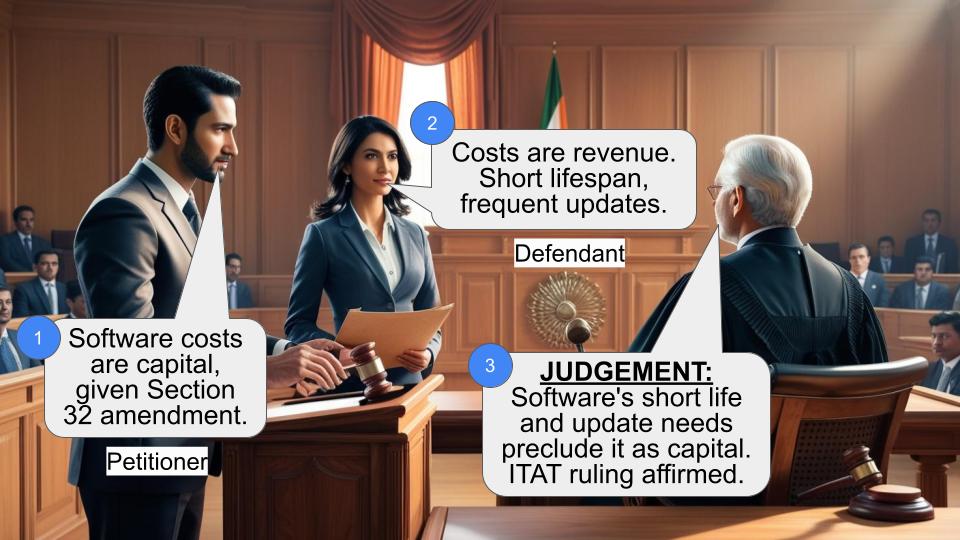
The Principal Commissioner of Income Tax appealed against a decision made by the Income Tax Appellate Tribunal (ITAT) in favor of M/s. Aker Powergas Pvt. Ltd. The main issue was whether certain software expenses should be treated as revenue or capital expenditure. The ITAT ruled in favor of the company, considering these expenses as revenue, and the High Court upheld this decision.
Get the full picture - access the original judgement of the court order here
Case Name:
Principal Commissioner of Income Tax vs M/s. Aker Power gas Pvt. Ltd. (High Court of Bombay)
Income Tax Appeal No.1276 of 2017
Date: 20th January 2020
Key Takeaways:
1. Software expenses based on actual usage are typically considered revenue expenditure, not capital.
2. Legal expenses related to capital asset transactions can still be treated as revenue expenditure.
3. The court emphasized that abstract logic doesn't always apply in tax law cases.
Issue:
The central question here was: Should the software expenses of Rs. 5,82,62,091 be treated as revenue expenditure or capital expenditure for income tax purposes?
Facts:
M/s. Aker Powergas Pvt. Ltd. claimed a deduction of Rs.5,82,62,091 as software expenses for the assessment year 2009-10. The Assessing Officer initially treated this as capital expenditure because the software was used in projects running for 1-3 years. The company appealed this decision, and it went all the way up to the Income Tax Appellate Tribunal (ITAT).
Arguments:
The tax department argued that since the software was used for projects lasting more than a year, it should be considered a capital asset, and the expenses should be treated as capital expenditure.
On the flip side, the company contended that these payments were for actual usage of the software, not for its acquisition. They argued that just because a project lasts more than a year doesn't mean the software benefit extends beyond a year.
Key Legal Precedents:
The judgment mentions a few important cases:
1. Amway India Enterprises Vs DCIT [(2008) 11ITD SB 112 (Del)]:
This was cited by the Assessing Officer but not relied upon by the ITAT.
2. CIT vs Bush Boake Allen India Ltd [(1982) 135 ITR 306 (Mad)]:
This case established that legal expenses should be judged on their own character, not based on the transaction they relate to.
3. India Cements Ltd. vs. CIT (1966) 60 ITR 52 (SC):
This Supreme Court case held that expenses incurred for obtaining a loan, regardless of its purpose, should be treated as revenue expenditure.
4. CIT vs. Kisenchand Chellaram (India) (P) Ltd. (1981) 130 ITR 385:
This case followed the India Cements Ltd. decision and held that legal charges for increasing a company's capital should be allowed as revenue expenditure.
Judgement:
The High Court upheld the ITAT's decision. They agreed that:
1. The software expenses should be treated as revenue expenditure because they were based on actual usage, not acquisition of software.
2. The legal expenses related to the sale of capital assets should also be considered revenue expenditure.
The court dismissed the appeal filed by the tax department.
FAQs:
Q1: Why were the software expenses considered revenue and not capital?
A1: Because they were payments for actual usage of the software, not for its acquisition.
Q2: Does the duration of a project determine whether an expense is capital or revenue?
A2: Not necessarily. In this case, even though the projects lasted 1-3 years, the software expenses were still considered revenue because they were based on actual usage.
Q3: Can legal expenses related to capital assets be treated as revenue expenditure?
A3: Yes, as seen in this case. The nature of the expense itself, not the asset it relates to, determines whether it's capital or revenue.
Q4: What's the significance of this judgment for businesses?
A4: It provides clarity on how software expenses and certain legal fees can be treated for tax purposes, potentially allowing for more deductions as revenue expenses.

1. Heard learned counsel for the parties.
2. This is an appeal under Section 260-A (of Income Tax Act, 1961), 1961 (briefly "the Act" hereinafter) assailing the order of the Income Tax Appellate Tribunal, Mumbai K Bench, Mumbai (briefly "the Tribunal" hereinafter) dated 06.04.2016 in Income Tax Appeal Nos.1766/Mum/ 2014 and 1355/Mum/2014 for the assessment year 2009-10.
3. The appeal has been filed on the following three questions stated to be substantial questions of law:-
“(a) Whether on the facts and the circumstances of the case and in law, the Tribunal was justified in treating computer software expenses of Rs.5,82,62,091.00 to be revenue in nature without examining the agreement between Aker Norway and the assessee and the terms regarding the usage of the software?
(b) Whether on the facts and the circumstances of the case and in law, the Tribunal was justified in treating computer software expenses of Rs.5,82,62,091.00 to be revenue in nature without appreciating the fact that the usage of software is for more than two years being enduring in nature and also that the license fees are not used up during the year but over a period of 1 to 3 years?
(c) Whether on the facts and the circumstances of the case and in law, the Tribunal was justified in allowing expenses of Rs.8,30,000/- incurred in connection with sale of capital assets without appreciating the fact that the said expenses are in the nature of advisory fees incurred during the course of business, for proposed sale of land, sold in subsequent year, which contributed to the increase in the capital?”
4. In so far question Nos.(a) and (b) are concerned, the issue is as to whether the expenses of Rs.5,82,62,091.00 incurred in the use of computer software is revenue expenditure or capital expenditure. This aspect was gone into by the Tribunal in the following manner:
“18. In ground no. 5, the assessee has raised the following grievance:
5. Disallowance of software expenses
5.1 The learned Addl. CIT/DRP erred in disallowing computer software expenses of Rs.5,82,62,091, which are revenue expenses, by treating the same as capital in nature.
5.2 The learned Addl. CIT erred in observing that since the usage of software is for more than two years the software expenses are to be regarded as an intangible capital asset, without appreciating the fact that the software payments were for actual usage for a period of less than one year.
5.3 Without prejudice to the above, the learned Addl. CIT erred in allowing depreciation at an incorrect rate of 25%, instead of 60% for computer software allowable as per the Income- tax Rules, 1962.
19. So far as this ground of appeal is concerned, the relevant material facts are as follows. During the course of assessment proceedings, the Assessing Officer noticed that the assessee has claimed a deduction of Rs 5,82,62,091 as expenditure on the software. The Assessing Officer was of the view that this software was used in certain projects, running for a period of 1-3 years, it should be treated as a capital expenditure. The Assessing Officer extensively quoted from the special bench decision in the case of Amway India Enterprises Vs DCIT [(2008) 11ITD SB 112 (Del)] to justify this conclusion. The assessee did raise an objection before the DRP but without any success. In a very brief order, and based on rather vague and sweeping generalizations, learned DRP confirmed the disallowance. While doing so, the DRP observed as follows:
We find that on the facts of the case as stated in the assessment order, the AO has correctly held this amount to be capital in nature and has allowed depreciation thereon. We are of the view that the AO has correctly treated the software expenditure as capital in nature, as it gave enduring benefit. It may be noted that from assessment year 2003-04, 'computer software' has been specially included in the depreciation table, on which depreciation is to be allowed. Hence, this objection of the assessee is rejected.
20. The assessee is not satisfied and is in appeal before us.
21. We have heard the rival contentions, perused the material on record and duly considered facts of the case in the light of the applicable legal position.
22. There is no dispute about genuineness of the expenses and the dispute before us is confined to the question whether it should be treated as revenue expenditure or as capital expenditure. We have noted that out of a total expense of Rs 5,88,62,091, an amount of Rs 5,29,32,320 is aid to the Aker Norway for actual use of software. Since the amount is paid on the basis of actual use of software, and not for acquisition of software, there cannot be any occasion for treating the same as capital expenditure. As regards the remaining amount also, as evident from the copies of invoices before us, the payment is for the licence fees on annual basis, and not for the entire project period. The fact that the licence is used in a project which has a life span of over one year does not mean that the benefit from the licence fees was more than one year. In our considered view, in the light of these facts evident from material on record, it is unambiguous that the authorities below have wrongly held the software payment to be capital expenditure in nature. We, therefore, uphold the grievance of the assessee and direct the Assessing Officer to treat the software expenses as revenue expenditure in nature.”
5. Thus, it is seen that the Tribunal has held that the only dispute before it was whether the aforesaid amount should be treated as a revenue expenditure or as a capital expenditure. It has been held that since the amount is paid on the basis of actual use of software and not for acquisition of software, there was no question of treating the said expenses as capital expenditure. Therefore, Tribunal held that the authorities below had wrongly held the software payment to be capital expenditure in nature and accordingly upheld the stand taken by the assessee directing the Assessing Officer to treat the software expenses as revenue expenditure.
6. While holding so, the Tribunal considered the views given by the Dispute Resolution Panel (DRP) as well as of the Special Bench decision of the Tribunal in the case of Amway India Enterprises Vs. DCIT, (2008) 11 ITD SB 112 (Del).
7. On due consideration, we are of the view that there is no error or infirmity in the conclusions reached by the Tribunal and no question of law arises therefrom, much less any substantial question of law.
8. In so far question No.(c) as extracted above is concerned, Tribunal held as under:
“27. On a perusal of details of expenses, as placed on page 743 of the paperbook, we find that the expenses pertains to legal expenses in connection with structuring of the transaction and related aspects. These expenses were incurred in the course of the business and for its operations, though the specific issue on which advice was sought pertained to the sale transaction. Merely because the transaction in question is a capital asset, the legal expenses will not also become capital expenditure. As we deal with this aspect of the matter, we are reminded of very well articulated views of Hon'ble Madras High Court, in the case of CIT vs Bush Boake Allen India Ltd [(1982) 135 ITR 306 (Mad)], wherein Their Lordships had observed as follows:
We think that the only merit of this argument is the apparent logical simplicity of it. But abstract logic has seldom conditioned the evolution of principles in tax law, as in other laws. Recent judgments of Courts have tended to regard the nature and allowability of legal expenses not as derivative expense taking the colour from the transactions to which they relate, but as items which are entitled to be judged in their own character. This line of approach may be said to have been firmly established as part of the law relating to allowance of expenditure, by the decision which the Supreme Court rendered in India Cements Ltd. vs. CIT (1966) 60 ITR 52 (SC). In that case, a company went in for a substantial loan of Rs. 40 lakhs from a financial house for a major expansion of its undertaking. The loan was secured by a charge on the company's fixed assets. The amount was advanced by the financial house on certain terms as to interest. For putting through this transaction the company had to incur vakil's fees for drafting the mortgage bond, other legal expenses, charges for stamps, registration charges, for obtaining the certified copy of the mortgage deed, charges for preparing an indemnity bond and the like. The expenses incurred for legal charges amounted to Rs. 84,633. The question in the relevant assessment of the company was whether the expenses can be allowed I.T.A. No. 1355 and 1766/Mum/2014 Assessment year: 2009-10 as revenue items. The stand taken by the IT Department. was that since the sum of Rs. 40 lakhs was obtained as a loan for the expansion of the company's business, the expense by way of legal fees, stamps and the like must also be similarly regarded as on the capital account, not allowable in the computation of the company's business profits. This contention, however, was negatived by the Supreme Court. They referred to an express provision in the IT Act under which interest on capital borrowed for, the purpose of the assessee's business was allowable as an item of deduction in the computation of profits under the head "Business". On the same analogy they held that any legal expenses incurred by the assessee for borrowing money, irrespective of whether the borrowing went in for a revenue purpose or for a capital purpose, must be necessarily regarded as an item of revenue outgoing. In coming to that conclusion the Supreme Court stated the principle thus :
"On the facts of this case, the money secured by the loan was the things for the use of which this expenditure was made. In principle, apart from any statutory provisions, we see no distinction between interest in respect of a loan and an expenditure incurred for obtaining the loan."
7. This decision of the Supreme Court has been followed in innumerable decisions of the Courts since then. As an example may be cited a decision of a Bench of this Court in CIT vs. Kisenchand Chellaram (India) (P) Ltd. (1980) 16 CTR (Mad) 248 : (1981) 130 ITR 385. That case too related to the claim of an assessee-company for the allowance of legal charges representing the fees paid to the Registrar of Companies for increasing the company's capital. The argument addressed before the Court on behalf of the IT Department. in that case was that the legal expenditure contributed to the increase in the capital of the company and, therefore, it could not be allowed as a revenue item. This Court rejected that contention, following the decision of the Supreme Court in India Cements Ltd. vs. CIT (1966) 60 ITR 52 (SC). The Court held that the money was spent only for the purpose of the business and there was no capital element in the expenditure. They took the view that merely because the fees paid to the Registrar of Companies related to a raising of the company's capital, the amount could not be classified as capital expenditure.
28. In view of the above discussions, as also bearing in mind entirety of the case, we uphold this grievance of the assessee as well. Ground no. 6 is thus allowed.”
9. Thus, Tribunal has taken the view that merely because the transaction in question is a capital asset, the legal expenses incurred for the same will not ipso facto become capital expenditure. While taking the above view, Tribunal referred to a decision of the Madras High Court in the case of CIT Vs. Bush Boake Allen India Ltd., (1982) 135 ITR 306 in which decision the Madras High Court followed the decision of the Supreme Court in India Cements Ltd. Vs. CIT, (1966) 60 ITR 52.
10. On due consideration, we are of the view that there is no error or infirmity in the view taken by the Tribunal and no question of law arises therefrom.
11. Consequently, this appeal filed at the stance of the Revenue is dismissed. However, there shall be no order as to costs.
(MILIND N. JADHAV, J.) (UJJAL BHUYAN, J.)
×
Similar Ripples
Questions
Tax Tribunal Rules Software Expenses as Revenue, Not Capital, in Income Tax Appeal
Write your CommentSimilar Posts


Generic
- Reportdata/6110.pdf
