


Tax Tribunal Upholds Assessee's Claims, Dismisses Revenue's Appeal


Full News
Tax Tribunal Upholds Assessee's Claims, Dismisses Revenue's Appeal
Tax Tribunal Upholds Assessee's Claims, Dismisses Revenue's Appeal
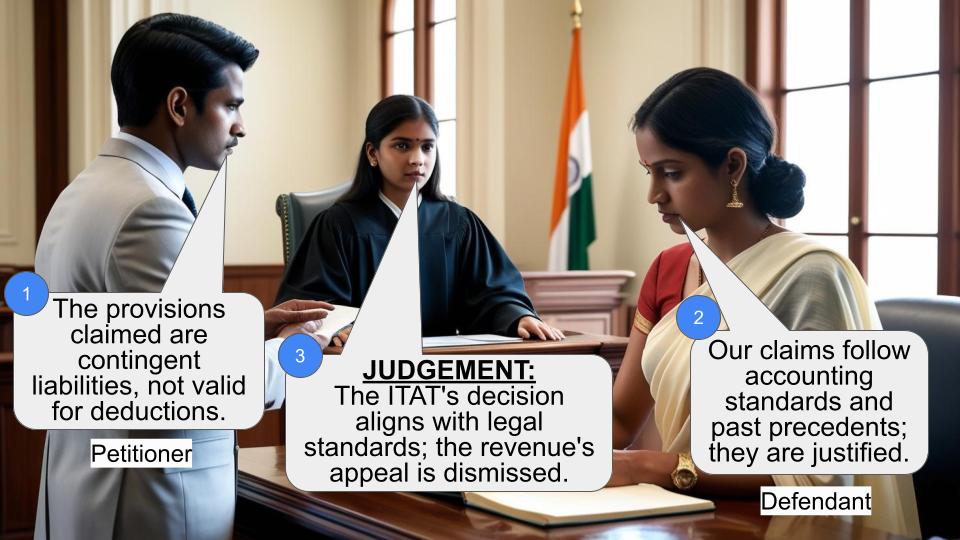
This case involves the Commissioner of Income Tax and Wipro GE Medical System Ltd., where the revenue challenged the Income Tax Appellate Tribunal's (ITAT) decision favoring the assessee. The High Court upheld the ITAT's decision, dismissing the revenue's appeal on various grounds related to tax deductions and provisions.
Get the full picture - access the original judgement of the court order here
Case Name:
Commissioner of Income Tax and Another vs. Wipro GE Medical System Ltd. (High Court of Karnataka)
ITA No. 902 of 2008
Date: 19th January 2016
Key Takeaways:
- The court upheld the ITAT's decision, which favored the assessee, Wipro GE Medical System Ltd., on multiple tax-related issues.
- The case highlights the importance of adhering to accounting standards and past precedents in tax assessments.
- The court emphasized the need for consistency in accounting methods and the recognition of provisions based on established legal principles.
Issue:
The central legal question was whether the ITAT was correct in allowing various tax deductions and provisions claimed by the assessee, which the revenue had contested.
Facts:
Wipro GE Medical System Ltd., a private company engaged in manufacturing medical equipment, filed a tax return declaring a loss for the assessment year 2002-03. The company claimed several deductions, including provisions for sales expenditure, warranty, and exchange rate fluctuations. The Assessing Officer rejected these claims, but the Appellate Commissioner and ITAT ruled in favor of the assessee. The revenue then appealed to the High Court.
Arguments:
- Revenue's Argument: The revenue argued that the provisions claimed by the assessee were contingent liabilities and not allowable as deductions. They relied on the Supreme Court's judgment in Rotork Controls India (P) Ltd. vs. Commissioner of Income Tax to support their position.
- Assessee's Argument: The assessee contended that the provisions were based on accounting standards and past experiences, and similar claims had been accepted in previous years. They argued that the ITAT's decision was consistent with legal precedents.
Key Legal Precedents:
- Rotork Controls India (P) Ltd. vs. Commissioner of Income Tax: This case set out the conditions for recognizing provisions under the Income Tax Act, which include a present obligation from a past event, probable outflow of resources, and a reliable estimate of the obligation.
- Indo Nippan Limited's Case (261 ITR 775): This case emphasized the consistency of accounting methods with accepted principles.
Judgement:
The High Court upheld the ITAT's decision, ruling in favor of the assessee. The court found that the ITAT had correctly applied legal principles and accounting standards. The court dismissed the revenue's appeal, affirming the ITAT's findings on the allowability of the provisions and deductions claimed by the assessee.
FAQs:
1. Why did the court rule in favor of the assessee?
- The court found that the ITAT had correctly applied legal principles and accounting standards, and the provisions claimed by the assessee were consistent with past precedents.
2. What was the significance of the Rotork Controls case in this judgment?
- The Rotork Controls case provided the criteria for recognizing provisions under the Income Tax Act, which the court used to evaluate the assessee's claims.
3. What does this decision mean for future tax assessments?
- This decision reinforces the importance of consistency in accounting methods and adherence to established legal principles in tax assessments.
4. Did the court remand any issues back to the Assessing Officer?
- Yes, the court remanded the issue of royalty allocation to the Assessing Officer for further examination based on pre-existing agreements.

1. This appeal is filed by the revenue assailing the order passed by the Income Tax Appellate Tribunal (ITAT), Bangalore in ITA No.810/Bang/2007 dated 16.05.2008 for the assessment year 2002-03.
2. Facts in brief are:
The respondent/assessee is a private limited company engaged in the business of manufacturing of medical diagnostic equipments and accessories, software development, trading of various products and also providing services for various medical equipments. The return of income for the assessment year 2002-03 was filed by the assessee declaring a loss of Rs.49,39,90,600/-
on 31.10.2002. Assessee claimed:
(i) provision for sale expenditure in the course of commission
received in respect of sales in the agency business.
(ii) provision for warranty of Rs.52,84,504/-
(iii) exchange gain fluctuation
(iv) Sale Proceeds not realized within time
(v) Allocation of Royalty payment
(vi) Reallocation of trading expenses-EHTP-I( Electronic hard ware
Technology Part-1)
(vii) Exclusion from export turnover of expenditure incurred in
foreign currency in providing technical services
(viii) Allowability of deduction u/s.10A (of Income Tax Act, 1961) for STPs located at Golden
Enclave
(ix) Adjustment of Prior Period exenses
3. The Assessing Officer proceeded to examine each of the
claim made by the assessee. After consideration, the Assessing
Officer concluded the assessment rejecting the claim made by the
assessee. On appeal by the assessee, Appellate Commissioner
allowed the appeal granting relief in favour of the assessee. Being
aggrieved by the said order, the revenue preferred an appeal before
the ITAT. The ITAT considering the various issues raised,
proceeded to follow the view expressed by it in the assessee’s own
case relating to the earlier assessment years and granted relief in
favour of the assessee, rejecting the appeal filed by the revenue
against which, the revenue is in appeal under Section 260A (of Income Tax Act, 1961) of the
Income Tax Act, 1961 (the “Act” for short) raising the following
substantial questions of law:
1. Whether the Appellate Authorities were correct in
holding that the provision in respect of a percentage of
sale to account for various expenses transferred to a
separate account is an allowable expenditure even
though the same is a contingent liability which has not
accrued?
2. Whether the Appellate Authorities were correct in
holding that a provision for reserves for warranty is
an allowable expenditure even though it is a
contingent liability?
3. Whether the Appellate Authorities were correct in
holding that the gain in exchange rate i.e. due to
fluctuation cannot be excluded when computing
deduction u/s.10A (of Income Tax Act, 1961) even though this amount
had not been directly arisen in the course of export?
4. “Whether the Appellate Authorities were correct in
holding that the sale proceeds not realized within the
time of 6 months granted by the Reserve Bank of India
without their being any extension cannot be excluded
from the total turnover when computation deduction
u/s.10A (of Income Tax Act, 1961)?.
5. Whether the Appellate Authorities were correct in
holding that allocation of expenditure towards royalty
for use of trade mark and logo to Wipro Ltd., and
Monogram Licencing International Incorporated at
50:50% by the assessee should be upheld and not as
worked out by the Assessing Officer based on local
sales?
6. Whether the Appellate Authorities were correct in
holding that allocation of expenditure as worked out
by the assessee on account of consumables, salary
etc., on the basis of sales based on percentage should
be accepted without taking into account the fact that
31.2% of sales were made through franchisers which
did not require the sale percentage of expenditure as
worked out by the Assessing Officer?
7. Whether the Appellate Authorities were correct in
holding that the computation of export turnover as
worked out by the Assessing Officer in accordance
with Explanation 2 to Section 10A (of Income Tax Act, 1961) by
excluding expenditure incurred in foreign currency in
providing travel, salary, rent, M and B charges,
Dialcom and others is not correct?
8. Whether the Appellate Authorities were correct in
holding that the finding of the Assessing Officer that
the deduction claimed u/s.10A (of Income Tax Act, 1961) in respect of
its unit at Golden Enclave which has commenced
business prior to 01.04.1993 in respect of one floor
and after 01.04.1993 in respect of two floors which
was shifted to Hoody Village, would amount to
reconstruction of business and the assessee would not
be entitled to claim 10A deduction was held to be not
correct?
9. Whether the Appellate Authorities were correct in
holding that the adjustment entries for prior period
expenses of Rs.25,57,54,378/- should be allowed
despite the assessee not substantiating the claim by
adducing the any proff?.
Re. question No.1:
4. Sri K V Aravind, learned counsel appearing for the revenue
placing reliance on the Judgment of the Apex Court in the case of
Rotork Controls India (P) Ltd. vs Commissioner of Income Tax
reported in ((2009) 314 ITR 62) wherein, the assessee herein was
also a party would strongly contend that, What is a provision is
elaborately considered by the Apex Court and the parameters are
set-out by the Apex Court to examine the recognition of provision
for the purposes of the Act.
The three Conditions to be satisfied for the recognition of the
provision are:
(a) an enterprise should have a present obligation as a result of
past event
(b) it is probable that an outflow of resources will be required to
settle the obligation
(c) a reliable estimate can be made out of the amount of obligation
He would contend that only if these three tests laid down by the
Apex Court are satisfied by the assessee, provision made relating to
the percentage of sale to account for various expenses transferred
to a separate account, whether is an allowable expenditure or not,
would be ascertained though the same is a contingent liability
which has not accrued. None of the authorities below have
examined this issue in the light of the Judgment pronounced by
the Apex Court in Rotork Controls Case (supra). No finding is
forth coming from the records that the assessee has satisfied the
three conditions laid down by the Apex Court to claim the benefit of
a provision. In such circumstances, he requests this Court to
remand the matter back to the Assessing Officer so as to enable
him to examine the case of the assessee in the light of the tests laid
down by the Apex Court in Rotork Controls Case (supra).
5. On the other hand Smt.Anuradha, learned counsel
appearing for the assessee would contend that all these aspects
were considered by the authorities below and it is categorically held
by the authorities that the provision is as per accounting standards
and is based on the past experience coupled with scientific and
rational basis. It is also contended that the department has
accepted the earlier order passed by the authorities for the
assessment year 1998-99 wherein similar provision was made as
per standard of accounting. Tribunal has allowed similar issue of
provision in favour of the assessee and no remand is made.
6. We have considered the submissions of the learned
counsel for the parties. This very argument was advanced by the
revenue before the ITAT to remand the matter to the Assessing
Officer to consider the issues in the light of the Judgment of
Rotork Controls Case (supra) The ITAT having observed that the
only reason why the Assessing Officer has disallowed the claim of
the assessee is on account that the provision is contingent liability,
cannot be allowed, expenditure can be allowed only on payment
basis. The ITAT having considered the adequate material placed
before it, thought it fit not to remit the matter to the Assessing
Officer. It is also noticed that the method of accounting followed by
the assessee is mercantile wherein the income and expenditure is
on accrual basis. We have examined this issue in the light of the
Judgment pronounced by the Apex Court in Rotork Controls Case
(supra,) wherein the three tests are laid down to recognize a
provision under the Act. The ITAT being a last fact finding
authority has held that all these ingredients which goes to the
recognition of provision are satisfied and as such, there is no need
to remit the matter back to the Assessing Officer. In such
circumstances, we do not see any ground made out by the revenue
to remand the matter back to the Assessing Officer. The claim of
expenditure being consistent with the method of accounting
followed and the provision has been made on concluded
transactions, the order of the Assessing Officer is held to be
incorrect. We do not see any reason to differ from this view, which
is in accordance with Section 145 (of Income Tax Act, 1961).
Re. Question No.2
7. The learned counsel Mr. K V Aravind appearing for the
revenue reiterated the grounds urged before the ITAT and sought
for remanding the matter back to the Assessing Officer to examine
the issue in the light of the Judgment of the Apex Court in Rotork
Controls Case (supra).
8. Learned counsel Smt. Anuradha appearing for the
assessee would contend that this issue is covered in favour of the
assessee in assesse’s own case by the order of this Court in ITA
438-444/12, affirmed by the Hon’ble Supreme Court in Rotork
Controls Case (supra), in none of these cases remand is made.
9. After considering the rival submissions of the learned
counsel for the parties on this issue, we are of the view that this
issue is similar to that of Question no.1. In view of the
observations made in Question No.1, we are not inclined to remit
the matter back to the Assessing Officer on this issue more
particularly, this issue being covered by the Judgment of the
Coordinate Bench of this Court in the very same assessee’s case
reported in 270 ITR 259 and 278 ITR 337 confirmed by the Apex
Court in Rotork Controls Case (supra).
Re. Question No.3
10. Both the learned counsel appearing for the parties agree
that the issue involved in this question is covered against the
revenue by the Judgment of this Court in ITA No.3202/2005
disposed of on 28.02.2012.
11. In view of the Judgment rendered by this Court in ITA
No.3202/2005 dated 28.02.2012, we answer this question against
the revenue and in favour of the assessee.
Re. Question No.4
12. Learned counsel appearing for the parties agree that this
issue is directly covered by the Judgment of this Court in ITA
No.879/2008 disposed of on 25.03.2015.
13. Following the said Judgment rendered by the Co-ordinate
Bench of this Court in ITA No.879/2008 disposed of on
25.03.2015, we answer this question in favour of the assessee and
against the revenue.
Re. Question No.5
14. Learned counsel appearing for the revenue would
contend that the ITAT negated the arguments of the revenue since
similar question was considered by the ITAT in ITA No.322-
328/B/02 and held against the revenue. A detailed inquiry is
required to be made regarding expenses allocated to royalty
payment with reference to the pre-existing agreements executed by
the assessee with M/s Wipro Limited relied on by the assessee and
accepted by the CIT. No such exercise having been done by the
authorities, he requests the matter to be remanded back to the
Assessing Officer for fresh consideration to examine on this issue.
15. Learned counsel appearing for the assessee has no
objections to the same.
16. Accordingly, we remand this issue to the Assessing
Officer to examine whether allocating a portion of the royalty to
EHTP Units as local sales is warranted or not after examining the
pre-existing agreement entered into by the assessee with M/s
Wipro Limited.
Re. Question No.6
17. Learned counsel appearing for the revenue seeks to
remand this issue also to the Assessing Officer as no adequate
material was made available before the authorities to come to a
conclusion that the allocation of expenditure as worked out by the
assessee on account of consumables, salary etc. are applicable to
the sales made through franchises.
However, learned counsel appearing for the assessee would
contend that Appellate Commissioner deleted the allocation of
expenses made by the Assessing Officer based on the order of ITAT
in the very same assessee’s case reported in 81 TTJ 455 and the
decision of the Apex Court in Indo Nipan Limited’s case (261 ITR
775). It is noticed that over 5.6% of the sales is made through
franchises, however, the assessee adopted sales as basis for
allocation. The sale made through the franchises stands on a
different footing than the sale made directly by the assessee
company. In the case of sale made through franchise, no effort is
involved by the assessee except getting commission whereas the
direct sales made by the assessee requires much more efforts and
obviously the expenditure of the nature of consumables, salary and
benefits etc., are incurred. It is also significant to observe that the
Assessing Officer has not disturbed the method adopted by the
assessee for the purpose of allocation of expenses in the trading
turnover. What the Assessing Officer has done is removing the
value of Franchise sales from the total sales as the Franchise sales
are different from direct sales. This methodology adopted by the
Assessing Officer is not properly considered by the CIT and ITAT.
CIT was of the view that the course adopted by the Assessing
Officer in allocating the expenses amounts to prescribing a new
method of estimation based on the Proportionate turnover contrary
to the method of accounting regularly followed by the assessee and
accepted by the department in earlier years. This view is confirmed
by the ITAT placing reliance on the Judgment of the Apex Court in
Indo Nippan’s case (supra). The Apex Court in Indo Nippan’s case
has held that whatever method the Assessing Officer adopts, the
method has to be consistent with the accepted principles of
accountancy.
18. In the present case, what the Assessing Officer has done
is to delete the value of franchise sales from total expenses. No
method of accountancy adopted by the assessee is disturbed. The
course adopted by the Assessing Officer to delete the franchise
sales is based on the reasoning that franchise sales differs from the
direct sales. Such being the case, this method adopted by the
Assessing Officer is no way contrary to the Judgment of the Apex
Court in Indo Nippan’s case (supra). In the circumstances, we are
of the view that CIT and ITAT proceeded on a misconception that
Assessing Officer has disturbed the consistent method of
accountancy followed by the assessee for many years. In view of
the aforesaid reasons, we are of the opinion that the finding given
by the CIT confirmed by the ITAT on this issue is not sustainable
and accordingly, we decide this question in favour of the revenue
and against the assessee. The issue is remanded to the A.O. to re-
do the assessment in the light of the observations made above,
after providing an opportunity of hearing to the assessee. All
contentions are left open to the parties.
Re. Question No.7
19. Both the parties agree that the issue involved in this
question is squarely covered by the Judgment of this Court in the
case of Tata Elexsi Ltd.’s case (349 ITR 98). In view of the same,
this question is answered against the revenue and in favour of the
assessee.
Re. Question No.8
20. The issue involved herein is covered against the revenue
in the Judgment rendered by this Court in ITA No.391/2008
disposed of on 10.06.2014 which is not disputed by the parties.
Accordingly, we answer this question in favour of the assessee and
against the revenue.
Re. Question No.9
21. The Assessing Officer proceeded to disallow the loss
claimed by the assessee on the ground that the assessee was
making various inter unit transfers, it was necessary to examine
the entries which were not recorded properly in the first instance.
The assessee has not been able to substantiate this claim despite
being given sufficient time for the credit entries made and neither
has given any background for such high value reverse entries.
Assessing Officer was of the opinion that the assessee should have
produced the certificate from auditors in this regard. The assessee
having furnished the audit certificate before the CIT, it is observed
by the CIT that the assessee’s production of audit report
establishes the credentials and accordingly, accepted the error in
the books of accounts which has crept in, as a result of genuine
mistake and such error has been disclosed by the assessee
voluntarily along with the return of income. This view of the CIT is
upheld by the Tribunal .
22. Learned counsel Sri K V Aravind appearing for the
revenue would submit that no reconciliation is made by the CIT. It
cannot be accepted that a genuine error has occurred in
accounting entry and the same is corrected by the adjustments
made in the book entry by the assessee which has been confirmed
by the ITAT. Accordingly, he seeks to remand the matter to the
Assessing Officer to examine the correctness of the auditor’s report
furnished by the assessee before the CIT.
23. We do not see any flaw in the order passed by the ITAT
for the reason that the Assessing Officer himself while deciding the
issue in question has accepted the auditor’s certificate for the
assessment year 2003-04 and has categorically held that such a
certificate of the Chartered Accountant would have been suffice to
accept the claim of the assessee towards the adjustment entries for
prior period expenses. In such view of the matter, the assessee has
cured the defects pointed out by the Assessing Officer, by filing the
necessary auditor’s report before the CIT which was properly
considered and held that it was a genuine error in the book entry
and the same is confirmed by the ITAT which in our opinion is
justifiable. We are not inclined to interfere with the factual findings
given by the authorities regarding the genuiness of the adjustments
in the book entry. It is settled law that the no income can arise by
mere book entries (vide Kedarnath Jute Manufacturing Co. Ltd. vs
CIT (Central), Calcutta reported in 1982 ITR 363). It is also noticed
by us that error occurred in the book entries for the assessment
years 2002-03 and 2003-04, revenue has not raised this question
in appeal for the assessment year 2003-04. In such
circumstances, revenue challenging this issue only in this appeal
relating to assessment year 2002-03, without just cause is not
sustainable. This view is supported by the Judgment of the Apex Court
in Berger Paint India Ltd. v/s CIT, Calcutta reported in (2004)12 SCC
42. For the aforesaid reasons, we answer this question of law in
favour of the assessee and against the revenue.
24. For the foregoing reasons, this appeal is partly allowed
answering the questions of law as indicated above.
Ordered accordingly.
Sd/-
JUDGE
Sd/-
JUDGE
×
Similar Ripples
Questions
Tax Tribunal Upholds Assessee's Claims, Dismisses Revenue's Appeal
Write your CommentSimilar Posts


Generic
- Reportdata/3163.pdf
