


Tax Tribunal's Decision Upheld: High Court Dismisses Revenue's Appeals in Incom…


Full News
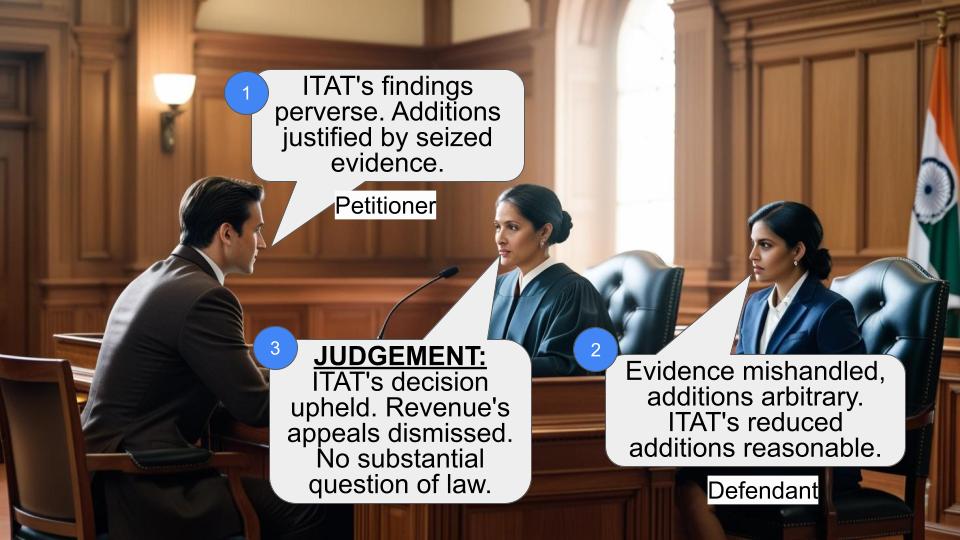
Tax Tribunal's Decision Upheld: High Court Dismisses Revenue's Appeals in Income Tax Case
Tax Tribunal's Decision Upheld: High Court Dismisses Revenue's Appeals in Income Tax Case
This is interesting case where the Income Tax Department (the Revenue) appealed against a decision made by the Income Tax Appellate Tribunal (ITAT) in favor of two taxpayers, Dipak Takwani and Lata Takwani. The High Court ended up dismissing the Revenue's appeals and agreeing with the ITAT's decision. It's a bit of a David vs. Goliath situation, with the taxpayers coming out on top.
Get the full picture - access the original judgement of the court order here
Case Name:
Commissioner of Income Tax vs. Lata Dipak Takwani (High Court of Gujarat)
Tax Appeal No. 551 & 554 of 2011
Date: 2nd August 2016
Key Takeaways:
1. The ITAT's role as a fact-finding authority was respected by the High Court.
2. The court emphasized the importance of proper handling and preservation of seized evidence.
3. The judgment highlights the need for tax authorities to provide clear justification for additions to assessed income.
4. Block assessments have limitations on what can be included, as per previous case law.
Issue:
The main question here was: Did the ITAT err in deleting substantial additions made by the Assessing Officer and replacing them with much smaller estimated additions?
Facts:
1. On June 8, 1999, the Income Tax Department conducted a search at the Takwanis' residence and business premises.
2. They seized a bunch of stuff, including papers, diaries, computer hard disks, and floppy disks.
3. The Assessing Officer (AO) made huge additions to the assessed income, totaling about Rs. 25.89 crores.
4. The case went through multiple rounds of appeals, with the ITAT initially sending it back to the AO with specific instructions.
5. In the end, the ITAT reduced the additions significantly, to Rs. 28 lakhs for Dipak Takwani and Rs. 17 lakhs for Lata Takwani.
6. The Revenue wasn't happy with this and appealed to the High Court.
Arguments:
The Revenue's side:
- They argued that the ITAT's findings were perverse and ignored evidence like small diaries and other documents.
- They claimed the AO's original additions were justified.
The Takwanis' side:
- They said the AO didn't provide documents they requested, even after filing RTI applications.
- They argued that the seized computer evidence was mishandled and lost its evidentiary value.
- They pointed out that some additions were made for already accounted transactions or based on estimates, which isn't allowed in block assessments.
Key Legal Precedents:
The judgment mentions N.R. Paper & Board Limited vs. DCIT, 234 ITR 733, a Gujarat High Court case. This case established that in block assessments, you can't make additions for accounted transactions or by estimating profits based on turnover. It's crucial to stick to the exact case name here!
Judgement:
The High Court sided with the Takwanis and the ITAT. They said:
1. The ITAT, as the fact-finding authority, had considered all the issues in detail.
2. The ITAT's reasoning, especially in paragraphs 14 and 15 of their order, was sound.
3. The court agreed that setting aside the case again would just harass the taxpayers after 11 years.
4. They dismissed all the Revenue's appeals and answered the questions in favor of the taxpayers.
FAQs:
1. Q: Why did the High Court agree with the ITAT's decision?
A: The court felt the ITAT had thoroughly examined all issues and applied relevant legal principles correctly.
2. Q: What was wrong with the original assessment by the AO?
A: The ITAT found that the AO made arbitrary additions, relied on inaccessible or unsealed evidence, and didn't allow legitimate deductions.
3. Q: Why was the handling of seized computer evidence important?
A: The hard disk was unsealed when presented in court, which made it lose its evidentiary value.
4. Q: What's the significance of the N.R. Paper & Board Limited case?
A: It established that in block assessments, you can't add income from accounted transactions or estimate profits based on turnover.
5. Q: How long did this case take to resolve?
A: The search was conducted in 1999, and this judgment came over 11 years later, showing how long tax disputes can drag on!

1. When these group of matters were called out for hearing, learned Counsel Mr. Soparkar for the assessee prays for time. However, the said request was refused since the matter is of 2006 and sufficient time was granted. Furthermore, right from the beginning, the members of the Bar have been informed that no time will be granted in the old final hearing mattes, more particularly, matters prior to 2007 and accordingly this Court has proceeded with the hearing of the matters.
2. Since the appeals preferred by the Department as well as the assessee are arising out of the commons order passed by the tribunal, they are being heard and decided together by this common oral judgment.
3. The short facts of the case are that the Department had carried out the search under Section 132 (of Income Tax Act, 1961) on 08/06/1999 at the common residence of both the assessee and at the business premises of Smt. Lata Takwani. That substantial material in hard and soft format (like several loose paper files, diaries and other records, the computer harddisc and several floppy diskettes) were found and put under seizure. It is the case of the Department that during the course of original assessment proceedings, it was seen that the assessee was non- cooperative and avoiding service of various statutory notices and letters under one pretext or the other.
4. It is the case of the assessee that it was originally assesseed in respect of the block period ending on 08/06/1999 whereby the total income at RS.25,89,63,460/ was determined and the additions were made. The appeal was preferred before the CIT (A) against the order of the AO and the additions which were made by the AO came to be confirmed by the CIT (A) vide order dated 03/09/2004.
4.1 Thereafter, the matter was carried before the Tribunal which had set aside the order of CIT (A) and restored the matter back to the file of AO by giving a specific direction to the revenue that the additions on account of cash credit are required to be restricted to the peak and the assessee is required to furnish the peak working and other relevant submission within a period of two months from the date of receipt of the order.
5. It is the case of the assessee that the assessee thereafter approached the AO. However, the AO finally passed an order assessing the income at RS.25,89,63,46/. The said order was challenged before the CIT (A) which came to be partly allowed.
6. Against the said order of the CIT (A), the Department as well as the assessee have preferred an appeal before the Tribunal and the Tribunal by its common impugned order has dismissed the appeal of the department and partly allowed the appeal of the assessee, which gave rise to the present group of appeals.
7. Tax Appeal Nos.551 to 552 of 2011 is preferred by the Department arising out of the order dated 23/09/2010 passed by the Tribunal in IT (SS) A. No.40/RJT/2010 and IT (SS) A. No.58/RJT/2010 respectively and came to be admitted on the following questions of law.
“Whether in the circumstances and facts of the case and in law, the Appellate Tribunal is right in deleting the total additions made by the Assessing Officer aggregating to Rs.2,63,11,790/- on various counts viz, on account of unexplained investment in stock, unexplained investment in M/s. Raju Cotex and undisclosed income, and replacing it with an estimated addition of Rs.17,00,000/- without any basis whatsoever?”
8. Tax Appeal Nos.553 to 554 of 2011 is preferred by the Department arising out of the order dated 23/09/2010 passed by the Tribunal in IT (SS) A. No.57/RJT/2010 and IT (SS) A. No.39/RJT/2010 respectively and came to be admitted on the following questions of law.
“Whether in the circumstances and facts of the case and in law, the Appellate Tribunal is right in deleting the total additions made by the Assessing Officer aggregating to Rs.2,63,11,790/- on various counts viz, on account of unexplained investment in stock, unexplained investment in M/s. Raju Cotex and undisclosed income, and replacing it with an estimated addition of Rs.17,00,000/- without any basis whatsoever?”
9. Tax Appeal Nos.2573 of 2010 is preferred by the assessee against the order dated 23/09/2010 passed by the Tribunal in IT (SS) A. No.39/RJT/2010 and came to be admitted on the following questions of law:
“Whether in the facts and circumstances of the case, the finding of tribunal that an addition of Rs.28,00,000/- was to be sustained is not illegal, contrary to facts on record, completely unsupported by any evidence whatsoever and is not perverse?”
10. Tax Appeal Nos.2574 of 2010 is preferred by the assessee against the order dated 23/09/2010 passed by the Tribunal in IT (SS) A. No.40/RJT/2010 and came to be admitted on the following questions of law: “Whether in the facts and circumstances of the case, the finding of tribunal that an addition of Rs.17,00,000/- was to be sustained is not illegal, contrary to facts on record, completely unsupported by any evidence whatsoever and is not perverse?”
11. Learned Counsel appearing for the Department has taken this Court to the order passed by the tribunal and contended that the findings of the tribunal are perverse and contrary to evidence on record. He has further contended that the findings which were arrived at by the AO in its order more particularly paragraph Nos.7 and 8 and concluding paragraph while summarizing the addition, the Tribunal has not considered any of such findings, more particularly such as the small diaries and other diaries and documentary evidence which the assessee had failed to explain. He, therefore, contended that the appeals preferred by the Department may be allowed by answering the questions in favour of the department and against the assessee.
12. On the other hand, learned Counsel Mr.Soparkar appearing for the assessee has also taken this Court to the order passed by the tribunal and contended that in spite of the several requests made by the assessee, the AO has not supplied any of the documents which were sought to be relied upon while passing the order of assessment and additions were made. Mr.Soparkar, learned Counsel has also taken us to the detailed reasoning given by the Tribunal in its order, more particularly, paragraph Nos.5, 9 and 10.2. He has further contended that in spite of the applications were made under Right to Information Act, no such information / particulars were supplied. He has further contended that the basis on which the documents which were available with him, he has shown that pick method which was suggested by the Tribunal on remand has come to loss and therefore he requested to supply the material so as to reach to the correct figure. He, therefore, contended that the AO has passed the order in haste without following the original directions given by the Tribunal. He, therefore, contended that the appeal preferred by the department may be dismissed by answering the questions in favour of the assessee.
13. We have heard the learned Counsel appearing for the Department and the assessee.
14. Having gone through the order passed by the AO, CIT (A) and the order of the Tribunal, this Court is of the opinion that the Tribunal being the fact finding authority has in detail considered the issues raised before it and taking into considering the relevant principle of law has reached to the correct conclusion. The relevant discussions made by the Tribunal in its order at paragraph nos.14 to 15 reads thus:
“14. We have perused the counter arguments and contents of the common paper book filed by the Appellants. We have also perused about the applicability or otherwise of the ratio of various judicial citations relied upon by the AR. We have also seen that the aluminum box containing the seized hard disc which was produced by the CIT – DR at the time of hearing was unsealed. We are thus in complete agreement with the contention of the AR that it has clearly lost its evidentiary value. We have also appreciated the position of the assessees that they are clearly put in irreparable and defenseless position for no fault on them. We also understand that there is no practical sense in setting aside the matter all over again, so as to give the department a third inning to play, as the same would unnecessarily result in continued harassment to the assessees even after a lapse of over eleven years from the date of search. Even otherwise, setting aside is not going to serve any useful purpose where we have clearly noticed that arbitrary and high handed additions have been made in the assessment order and partly sustained by CIT (A), even though substantial portion of the seized material was admittedly never available with the AO. Huge additions were also made on the basis of the computer hard disc and floppy diskettes which are admittedly no longer accessible and even without taking print out of the content of the same. Further, the fact of the computer hard disc having been kept in open condition without replacing the seals thereon and that too, without even taking the print out of the data stored therein has also not been taken. We have also noticed from the show cause notice issued by the AO in the first inning, which is placed in the paper book filed by the Appellants, that deductible expenses of crores of rupees were very much recorded in the hard disc and this fact was admitted by the AO in the said notice. These are also recorded in various physical seized documents, as listed by the assessees at page 26 of their common paper book. Despite this, deduction has been allowed only in relation to the same recorded on the first page of the show cause notice while the same was denied in respect of the rest. We have also noticed that the AO has clearly gone by the content of the appraisal report alone and in the first round of litigation, certain annexures forming part of his order in fact contained the seal of the investigation wing. This fact was also placed by us in the order passed in the first round of litigation. We also understand that the deduction in respect of purchases and other expenses of revenue nature had clearly and admittedly not been given, even though the same is impliedly agreed by the AO in the remand report sent by him to the CIT (A). We have further seen that huge additions have also been made either in respect of the accounted transactions, for which return of income under section 139 (of Income Tax Act, 1961) was very much finished (addition of Rs.54,50,000/ shares) or by estimating the profit in connection with the turn over. These are clearly not permissible in the block assessment as clearly held by Hon'ble Gujarat High Court in N.R. Paper & Board Limited vs. DCIT, 234 ITR 733. We have transactions of the third party as those of the assessee, despite that fact that necessary information in this regard was very much furnished by the assessee at the time of assessment proceeding itself.
15. While appreciating about what has been mentioned above, we are still required to give justice to our role as the last fact finding authority wherein we have to try to impart justice on either side. Appreciating the fact that the actual quantification of undisclosed income is an impossible task, in view of what has been mentioned above, we are still not very comfortable in fully accepting the contention of the assessees that their total income for the block period is running in negative (on provisional basis and relying on the datat to the extent available with them, as interpreted by the AO), so as to justify the returned income of Rs.NIL in both the cases. We are at the same time not in agreement with the view of the CIT – DR that the order of the CIT (A) is required to be reversed in so far as he has deleted the additions made by the AO. In view of this, we deem it proper to restrict the overall total addition at RS.28,00,000/ in the case of Dipak Takwani and at Rs.17,00,000/ in the case of Smt. Lata Takwani on lump sum basis, which work out to approximately 10% of the main addition sustained by CIT (A). We delete all other additions made by the AO, referrable to various grounds subject matter of these appeals. Regarding the other grounds taken by both the parties, which do not result in any addition per say, we do not find it necessary to separately adjudicate the same in view of the what has been mentioned above and the same stand disposed off accordingly.”
15. In our view, the view taken by the Tribunal is just and proper and germane to the peculiar facts of the case and no interference is required to be made.
16. In aforesaid view of the matter, all the appeals preferred by the Department deserve dismissal and accordingly they are dismissed while answering the questions posed therein in favour of the assessee and against the Department.
17. Now, so far as the Tax Appeal Nos.2573 to 2574 of 2010 preferred by the assessee are concerned, since the order passed by the Tribunal came to be confirmed by this Court dismissing the appeal of the department, these two Tax Appeals also stand dismissed.
18. In so far as the Tax Appeal No.1937 of 2006 preferred by the department is concerned, when the Tax Appeal No.551 of 2011 and allied matters preferred by the department stands dismissed by this Court as referred herein above, Tax Appeal No.1937 of 2006 would become academic and stands disposed of accordingly.
(K.S.JHAVERI, J.)
(G.R.UDHWANI, J.)
×


