


Tax Tribunal's Factual Findings Upheld: No Substantial Question of Law Arises


Full News

Tax Tribunal's Factual Findings Upheld: No Substantial Question of Law Arises
Tax Tribunal's Factual Findings Upheld: No Substantial Question of Law Arises
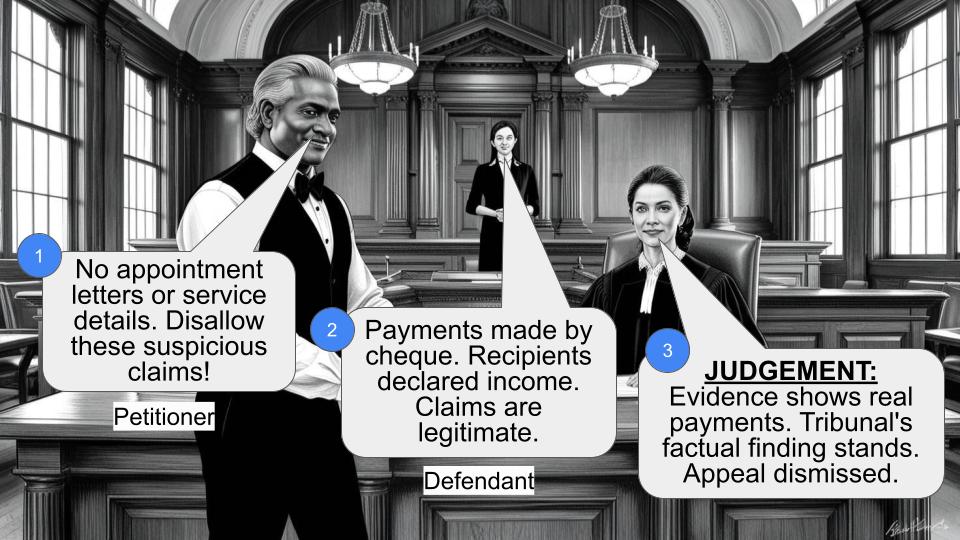
This case involves the Commissioner of Income Tax challenging the Income Tax Appellate Tribunal's decision to delete certain additions made by the Assessing Officer to the income of Smt. Urmila Chadha. The High Court dismissed the appeal, affirming the Tribunal's findings as purely factual and not giving rise to any substantial question of law.
Get the full picture - access the original judgement of the court order here
Case Name:
Commissioner of Income Tax Vs Smt. Urmila Chadha (High Court of Punjab and Haryana)
I.T.A. No. 442 of 2007
Date: 20th December 2007
Key Takeaways:
1. Tribunal's factual findings, if based on evidence, are generally not interfered with by higher courts.
2. Additions made by Assessing Officers without substantial evidence can be struck down.
3. The case highlights the importance of thorough investigation and evidence gathering by tax authorities.
Issue:
Did the Income Tax Appellate Tribunal err in deleting the additions made by the Assessing Officer, and does this decision give rise to a substantial question of law under Section 260A (of Income Tax Act, 1961)?
Facts:
- Smt. Urmila Chadha, the assessee, was trading in pig-iron and cast-iron scrap.
- She filed a return on 31.10.1996 declaring a total income of Rs.64,460.
- The Assessing Officer made an assessment on 30.12.1998, revising the income to Rs.17,49,270.
- After appeals and reassessment, two additions of Rs.1,20,000 and Rs. 13,33,118 were made on account of unaccounted sales.
- The Commissioner of Income Tax (Appeals) deleted both additions.
- The Income Tax Appellate Tribunal upheld the CIT(A)'s decision.
- The revenue department appealed to the High Court under Section 260A (of Income Tax Act, 1961).
Arguments:
Revenue's Arguments:
1. The Tribunal erred in upholding an incorrect method of accounting followed by the assessee.
2. The Tribunal ignored audited accounts and accepted 'rectified' accounts filed four years later.
Assessee's Arguments:
1. The additions were not justified as there was no unexplained investment or unaccounted sales.
2. The assessee had provided explanations and requested the Assessing Officer to summon relevant parties for statements.
Key Legal Precedents:
The judgment doesn't explicitly cite any legal precedents. However, it relies on the principle that findings of fact by the Tribunal, if based on evidence, do not give rise to substantial questions of law under Section 260A(1) (of Income Tax Act, 1961).
Judgement:
1. The High Court dismissed the appeal, upholding the Tribunal's decision.
2. The court found that the Tribunal's findings were based on evidence and were purely factual in nature.
3. The court noted that the Assessing Officer couldn't controvert the factual position presented by the assessee.
4. The court criticized overzealous Assessing Officers making unwarranted additions, leading to prolonged litigation.
5. The court suggested that the Government of India, Ministry of Finance, Income Tax Wing should develop mechanisms to sensitize Assessing Officers.
FAQs:
Q1: What is a "substantial question of law"?
A1: It's a significant legal issue that can be grounds for appeal in higher courts. In this case, the court found no such question arose from the Tribunal's factual findings.
Q2: Why did the court criticize the Assessing Officer?
A2: The court felt the officer made unwarranted additions without sufficient evidence, leading to unnecessary and prolonged litigation.
Q3: What is the significance of Section 260A (of Income Tax Act, 1961)?
A3: This section allows for appeals to the High Court against orders of the Income Tax Appellate Tribunal, but only on substantial questions of law.
Q4: How long did this case take to reach the High Court?
A4: About nine years. The return was filed in 1996, and the High Court judgment was in 2007.
Q5: What recommendation did the court make?
A5: The court suggested that the Ministry of Finance should develop mechanisms to sensitize Assessing Officers, possibly through case studies of similar situations.

The revenue has filed the instant appeal under Section 260A (of Income Tax Act, 1961) (for brevity, ‘the Act’), challenging order dated 18.5.2007, passed by the Income Tax Appellate Tribunal, Amritsar Bench, Amritsar (for brevity, ‘the Tribunal’), in I.T.A. No. 120(ASR)/2004, in respect of the assessment year 1996-97, claiming that the following substantial questions of law would arise for determination of this Court:-
a) Whether in the facts and in the circumstances of the case the Tribunal erred in upholding the incorrect method of accounting followed by the assessee?
(b) Whether the Tribunal has erred in law in ignoring the audited accounts submitted by the assessee and accepting the ‘rectified’ accounts filed four years later before the CIT (A)?
Brief facts of the case are that the assessee is trading in pig-iron and cast-iron scap. Return of income was filed by the assessee on 31.10.1996 declaring total income at Rs. 64,460/-. On 30.12.1998, assessment under Section 143(3) (of Income Tax Act, 1961) was framed at an income of Rs. 17,49,270/-. On 3.8.1999, income was further revised to 18,49270/-, under Section 154 (of Income Tax Act, 1961). The assessee filed an appeal against the assessment order before the CIT (A), who vide his order dated 3.4.2000 deleted addition of Rs. 10,000/- made in the trading account, however, confirmed addition of Rs. 2,046/- being not pressed by the assessee and also set aside the remaining order to be passed afresh. Thereafter, notice under Section 143(2) (of Income Tax Act, 1961) was issued to which the assessee filed reply. After re-assessment, the Assessing Officer vide order dated 26.3.2002 (A-1) made two additions of Rs. 1,20,000/- and Rs. 13,33,118/- on account of unaccounted sales.
Feeling aggrieved, the assessee again preferred an appeal before the CIT (A) who deleted both the additions vide order dated 30.12.2003, passed under Section 250(6) (of Income Tax Act, 1961) (A-2). The revenue then filed further appeal before the Tribunal, which has been dismissed vide order dated 18.5.2007 (A-3), which is subject matter of present appeal. On the first issue regarding deletion of Rs. 1,20,000/- by the CIT (A), which was made by the Assessing Officer on account of unexplained investment, the Tribunal has held as under:-
“11. We have heard the parties on this issue and have gone through the material brought on record in this regard. The case of the department is that the assessee has failed to give any satisfactory explanation about the third draft of M/s. Arihant Castings, which was not recorded in the books of account; rather, the assessee has claimed credit for the same entry twice, by debiting the same draft in the assessee’s account on 9-12-1995 and 31-3-99: that the draft dated 19-9-1995 had never been confirmed by M/s. Arihant Castings that, ‘in fact, the said draft had been utilized by the assessee for supply of material vide bill dated 25-12-1995 and not through M/s. Eastern Enterprises, thereby falsifying the story put up by the assessee.
12. As per the account statement of SAIL in the books of M/s. Arihant Castings, as certified by M/s. Arihant Castings themselves, (APB 17), the aforesaid mistake is evident. M/s. Arihant Casting had certified that had it (had?) mistakenly debited all the three drafts to the account of SAIL. From the said account statement, it is also clear that three debits were made on 28-3-1996, transferred to M/s. Eastern Enterprises and M/s. Gaurav Enterprises, respectively. In the case of such confirmation by M/s. Arihant Castings, there was no reason to conclude that there was any unexplained investment of the assessee.
Evidently, therefore, the A.O. erroneously observed that draft dated 8.12.1995 had been debited by M/s. Arihant Castings to the assessee’s account on 28-3-1996. Rather, as seen, this draft was debited to the account of M/s. Eastern Enterprises on 29-3-1996. This wrong entry was later rectified, by M/s. Arihant Castings, on 31-3- 1999, by debiting the account of the assessee and crediting the account of M/s. Eastern Enterprises. That being so, it cannot be said that the assessee had claimed credit of the same entry twice. Further, the account statement of M/s. Arihant Casting in the books of the assessee (APB 27) and the copies of draft dated 21.5.1999 for Rs. 75,000/- and draft dated 1.6.1999 for Rs. 48,263/- in the names of M/s. Gaurav Udyog (APB 28) support the assessee’s stand. The said amounts of Rs. 75,000/- and 48,263/- appear in the accounts statement of M/s. Arihant Castings, for the assessment year 2000-01, in the books of M/s. Gaurav Delux. These drafts have been credited as on 4-6-1999 and 5-6-1999 respectively, against the reopening balance of Rs. 1,23,263/-. This factual position has not been controverted by the A.O.
13. In view of the above, we hold that the learned CIT (A) has correctly deleted the addition made by the A.O. Accordingly, ground No. 1 raised by the department stands rejected.
On the second issue of deletion of Rs. 13,33,118/- by the CIT (A), which was made by the Assessing Officer on account of unaccounted sales, the Tribunal has held as under:-
“24. Having heard the parties on this issue and having perused the material on record, we find that the balance sheet shows that the Batala parties appear in the list of sundry debtors in the balance sheet of the assessee. That being so, it has been rightly held by the learned CIT (A) that section 41(1) (of Income Tax Act, 1961) can not be invoked. As pointed out by the learned counsel, section 41(1) (of Income Tax Act, 1961) comes into play only if there is a credit balance and not if there is a debit balance. In the present case, as observed, the Batala parties appears as sundry debtors and not as sundry creditors in the balance sheet of the assessee. Further, the learned CIT (A) has categorically observed in para 3.4 of the impugned order, that this position could not be denied on verification of the details from the assessee’s balance sheet, by the A.O., who attended the appeal proceedings. It has been found as a fact that the name of the assessee does not occur in any transactions. The facts placed on record show that both the bank drafts were sent by M/s Jagannath Processors to SAIL. The goods were also supplied by the said party.
The name of the assessee nowhere appears in these transactions. If the parties to whom goods were sold denied having purchases the goods from M/s Jagannath Processors, how the assessee was to account for these goods. Those parties have nowhere stated that gods were purchased from the assessee. Under these circumstances, it as (is?) the duty of A.O. to collect more facts from the SAIL as to how the drafts were shown to have been received from M/s Jagannath Processors. No such exercise by the A.O. The drafts, after being routed through the bank account of the Batala parties, were sent directly to the SAIL and the goods were supplied by the Rourkela party in the account of the Batala parties. Merely because the drafts were debited in the name of the assessee in the accounts of the Batala parties, the assessee can not be held liable. The drafts in question were undeniably not routed through or received in the assessee’s books of account. The receipt of SAIL was in the name of M/s Shri Jagannath Processors. All drafts were prepared from their accounts. In such a situation, it certainly cannot be said that the assessee is to be held liable. As available from the APB38 and 39, which is a copy of letter dated 04.06.1999, addressed to the A.O. by the assessee along with the copy of the money receipts by the SAIL regarding M/s Shri Jagannath Processors and Suppliers, Sundergarh, concerning the demand drafts dated 30-08-1995 and 29- 08-1995, of Rs. 6,62,000/- and Rs. 6,50,000/- respectively, the assessee had pointedly denied, before the A.O., of having received any drafts made by these parties in favour of the SAIL. Rather, SAIL had issued the money receipts in favour of M/s Shri Jagannath Processors and Suppliers, Sundergarh. This position was again explained to the A.O. by the assessee vide reply dated 24-03-2001. Further, vide reply dated 20-03-2002 (APB 29 to 33), the assessee not only denied having received any payment against sales made to the said two parties, but also requested to the A.O. to summon them and to record their statement in this regard. The A.O., however, failed to consider this aspect of the matter. Further-more, the A.O. had not brought any material on record to the effect that the assessee had effected any sales or purchases outside her books of account. The findings of fact recorded by the CIT (A) are, as such, well reasoned not requiring any interference at our hands.
After hearing learned counsel for the appellant-revenue and perusing various orders placed on record, we are of the considered view that the aforementioned findings recorded by the Tribunal are unassailable. The Tribunal has categorically held that there was no question of making addition on account of unexplained investment because it could not have concluded that the assessee had claimed credit of the same entry twice. In the process of recording the finding the Tribunal has gone into various entries of accounts and the findings are based on the evidence available on record.
Therefore, on the first issue of deleting the addition made by the Assessing Officer for a sum of Rs. 1,20,000/-, no occasion is provided to interfere in the findings of fact. Moreover, the Tribunal has recorded that the Assessing Officer was not able to controvert the factual position. Likewise, on the second issue the Tribunal has concluded that the assessee-respondent in his reply dated 20.3.2002 has categorically denied having received any payment against the sales made to the parties like M/s Jagannath Processors and Suppliers, Sundernagar and the other firms. The assessee-respondent had also requested the Assessing Officer to summon those parties for recording their statements in that regard which was not done. The Assessing Officer could not bring on record any material showing that the assessee-respondent had effected any sale or purchase outside the books of accounts. Therefore, the addition of Rs. 13,33,118/- made by the Assessing Officer has been rightly deleted. Even these are pure findings of fact and would not give rise to any substantial questions of law as per the requirement of Section 260A(1) (of Income Tax Act, 1961).
Before parting we are left with the impression that that an over jealous Assessing Officer tends to overstep his jurisdiction by making unwarranted additions, which result into litigation engaging the assessee-respondent for a long period. In the present case, the return was filed on 31.10.1996 and assessment order was passed on 30.12.1998, under Section 143(3) (of Income Tax Act, 1961). The appeal has reached this Court after about nine years, thus, we are of the view that some mechanism have to be developed by the Government of India, Ministry of Finance, Income-tax Wing, to sensitise the Assessing Officer by furnishing the case study as this is the trend available in a large number of cases.
A copy of this order be sent to the Government of India, through Secretary, Ministry of Finance, New Delhi.
In view of above, this appeal fails and the same is dismissed.
(M.M. KUMAR)
JUDGE
(RAKESH KUMAR JAIN)
December 20, 2007 JUDGE
×
Similar Ripples
Questions
Tax Tribunal's Factual Findings Upheld: No Substantial Question of Law Arises
Write your CommentSimilar Posts


Generic
- Reportdata/5067.pdf
