


TDS non-compliance doesn't affect 80IB deduction eligibility on gross income


Full News
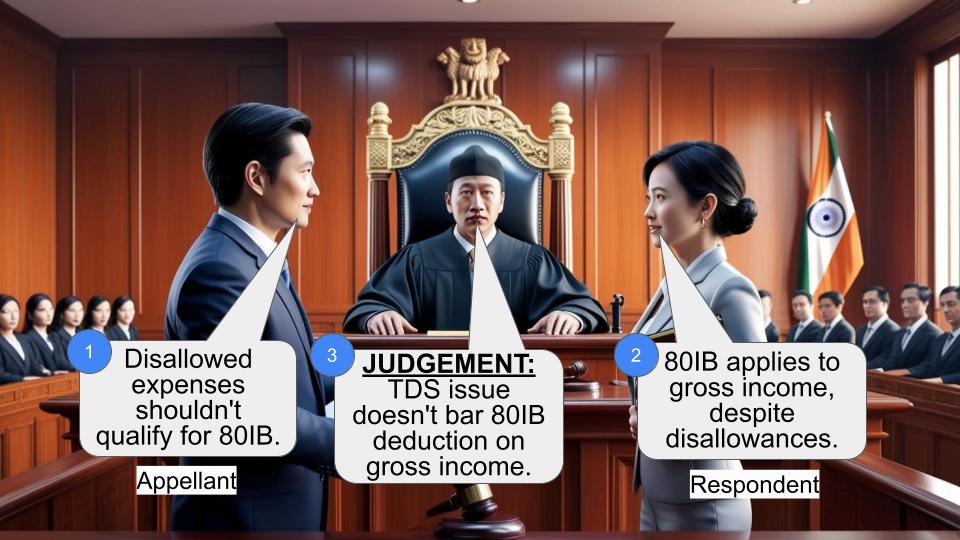
TDS non-compliance doesn't affect 80IB deduction eligibility on gross income
TDS non-compliance doesn't affect 80IB deduction eligibility on gross income
This case involves the Commissioner of Income Tax (appellant) challenging a decision made by the Income Tax Appellate Tribunal (ITAT) regarding an assessee's (Sunil Vishwambharnath Tiwari) eligibility for deduction under Section 80IB(10) (of Income Tax Act, 1961). The main dispute was whether disallowances made under Section 40(a)(ia) (of Income Tax Act, 1961) for non-deduction of TDS should affect the calculation of deduction under Section 80IB (of Income Tax Act, 1961). The High Court dismissed the appeal, upholding the ITAT's decision that the entire gross total income is eligible for deduction under Section 80IB (of Income Tax Act, 1961).
Get the full picture - access the original judgement of the court order here
Case Name:
Commissioner of Income Tax Vs Sunil Vishwambharnath Tiwari (High Court of Bombay)
Income Tax Appeal No. 2 of 2011
Date: 11th September 2015
Key Takeaways:
1. Disallowances under Section 40(a)(ia) (of Income Tax Act, 1961) for non-deduction of TDS do not affect the eligibility for deduction under Section 80IB(10) (of Income Tax Act, 1961).
2. The gross total income, including disallowed expenditures, is considered for Section 80IB (of Income Tax Act, 1961) deduction.
3. Technical violations like non-deduction of TDS do not change the nature of income for deduction purposes.
Issue:
Whether the entire amount of gross total income of the assessee is eligible for deduction under Section 80IB (of Income Tax Act, 1961), despite disallowances made under Section 40(a)(ia) (of Income Tax Act, 1961)?
Facts:
1. The assessee, Sunil Vishwambharnath Tiwari, filed a return for the Assessment Year 2006-07, claiming a deduction of Rs.16,82,121 under Section 80IB(10) (of Income Tax Act, 1961).
2. During scrutiny, the Assessing Officer disallowed expenses under Section 40(a)(ia) (of Income Tax Act, 1961) for not deducting TDS at source.
3. Disallowed amounts included Rs.83,00,738 for subcontract payments, Rs. 1,75,000 for commission payments, and Rs.7,96,375 for advertisement payments.
4. The Assessing Officer allowed deductions under Section 80IB(10) (of Income Tax Act, 1961) but assessed a total income of Rs.92,71,375 due to the disallowances.
Arguments:
Appellant (Income Tax Department):
1. Disallowed expenses were not arising out of eligible business.
2. The term "derived from" in Section 80IB (of Income Tax Act, 1961) should not have such a wide impact.
3. The assessee can claim these expenses in later years if TDS is paid, which defeats the purpose of Section 40(a)(ia) (of Income Tax Act, 1961).
Respondent (Assessee):
1. The assessee has no other source of income except eligible business.
2. Disallowance of expenditure only adds to the eligible income and doesn't become taxable.
3. Technical violation doesn't change the nature of income.
Key Legal Precedents:
1. CIT v. Shirke Constructions and Equipments Ltd. (246 ITR 429): This case explained the distinction between certain sections of Chapter VIA that refer to deduction out of gross total income and others that don't.
Judgement:
1. The High Court dismissed the appeal, finding no substantial questions of law arising in the matter.
2. The court agreed that as TDS was not deducted, the payments to contractors became inadmissible under Section 40 (of Income Tax Act, 1961).
3. However, these disallowed expenditures are added back to the eligible income, increasing the amount eligible for deduction under Section 80IB(10) (of Income Tax Act, 1961).
4. The court upheld that deduction under Section 80IB(10) (of Income Tax Act, 1961) is with reference to the assessee's gross total income, and disallowance under Section 40(a)(ia) (of Income Tax Act, 1961) cannot be treated separately.
FAQs:
1. Q: Does non-deduction of TDS make the income ineligible for Section 80IB (of Income Tax Act, 1961) deduction?
A: No, it doesn't. The disallowed expenditure is added back to the eligible income.
2. Q: Can the assessee claim these disallowed expenses in future years?
A: Yes, if TDS is paid in later years, the assessee can claim deduction for these expenses.
3. Q: What is the significance of this judgment for other taxpayers?
A: This judgment clarifies that technical violations like non-deduction of TDS don't change the nature of income for deduction purposes under Section 80IB (of Income Tax Act, 1961).
4. Q: How does this judgment interpret the term "derived from" in Section 80IB (of Income Tax Act, 1961)?
A: The judgment takes a broad view, including income that can be attributed to the eligible business, even if it results from disallowances.
5. Q: What is the key difference between this case and others with multiple income sources?
A: In this case, the assessee had only one source of income (eligible business), which influenced the court's decision to consider the entire gross income for deduction.

1. Heard Shri Anand Parchure, learned Counsel for the appellant and Shri N.S. Bhattad, learned Counsel for the respondent.
2. By this appeal filed under Section 260A (of Income Tax Act, 1961), the appellant Income Tax Department has sought to raise following two questions, as substantial questions of law :
“(1) Whether on the facts and in the circumstances of the case that ITAT was correct in holding that the entire amount of gross total income of the assessee is eligible for deduction under section 80IB (of Income Tax Act, 1961) ?
(2) Whether on the facts and in the circumstances of the case, the ITAT was justified in holding that the disallowance made under section 40(a)(ia) (of Income Tax Act, 1961) separately is not permissible under the scheme of the Income Tax Act ?”
3. The facts in brief are, that the assessee whose eligibility to claim deduction under Section 80IB(10) (of Income Tax Act, 1961), 1961 (hereinafter referred to as “the Act” for short), is not in dispute, filed a return in Assessment Year 200607 for accounting period 01.04.2005 to 31.03.2006, claiming deduction of Rs. 16,82,121/ under that provision. It was taken up for scrutiny, and an order under Section 143(3) (of Income Tax Act, 1961) came to be passed, disallowing the expenses under Section 40 (of Income Tax Act, 1961)[a][ia] of the Act for not deducting TDS at source. Thus, payment of Rs.83,00,738/ under the head Subcontract payment; Rs. 1,75,000/ as Commission payments and Rs.7,96,375/ as Advertisement Payment was disallowed.
4. The Assessing Officer though allowed deductions under Sections 80IB(10) (of Income Tax Act, 1961), assessed total income of Rs.92,71,375/ on account of above disallowance. The assessee filed an appeal before the CIT (Appeals), which held that there could not have been such separate treatment to income and deductions under Section 80IB (of Income Tax Act, 1961) needed to be allowed on gross total income of the assessee. Income Tax Department preferred further appeal before the ITAT, which rejected that appeal.
5. Shri Parchure, learned counsel appearing on behalf of the appellant/department submits that the correctness or otherwise of dis- allowance is not in dispute before this Court. Violation of Section 194C (of Income Tax Act, 1961) and 194H (of Income Tax Act, 1961) is accepted, and as such, the disallowance was not arising out of eligible business. He states that the word “derived from” cannot have such wide impact, so as to include any income which can in some manner be attributed to the business. It is further submitted that in present matter, the assessee can claim these expenses as per the provisions in Section 40 (of Income Tax Act, 1961)[a][ia], if TDS is paid in later year. Thus, in subsequent assessment years, the assessee would be able to claim deduction from his profit, on account of these expenses, hence, purpose of having Section 40 (of Income Tax Act, 1961)[a][ia] itself gets defeated. He submits that the judgment of this High Court in CIT / Shirke Constructions and Equipments Ltd. (246 ITR 429) is not attracted here.
6. Shri Bhattad, learned counsel for the respondent – assessee on the other hand states that in said matter decided by this Court, the assessee M/s. Shirke Constructions and Equipments Ltd., also had other sources of income, and hence application of mind therein needs to be understood properly. Here, the respondent – assessee (Sunil Vishambharnath Tiwari) does not have any other source of income, except eligible business and this fact is not in dispute. Therefore, the deduction of payment made to contractor is out of eligible profits and even if ignored for the purpose of computing net income, it gets added only to the eligible income. Disallowance of expenditure only adds to it and that income does not become taxable. The fact that the assessee had filed 'nil' return, cannot be lost sight of.
7. According to him, technical violation pointed by Shri Parchure, learned counsel does not result in change of nature of income and as such, the concurrent view of CIT (Appeals) and ITAT needs to be upheld.
8. After hearing the respective counsel, we find that the fact that TDS was not effected by the respondent assessee, is not in dispute. In view of the scheme of Section 40 (of Income Tax Act, 1961), as TDS is not effected, payment to contractors cannot be deducted, as those expenditure become inadmissible. The expenditures therefore are added back to the income, which is nothing but, eligible income. This income which is eligible for deduction in terms of Section 80IB(10) (of Income Tax Act, 1961), therefore, only increases by said figure of disallowed expenditure.
9. CIT (Appeals) has in this background referred to the above referred judgment in case of Shirke Constructions and Equipments Ltd (supra), wherein distinction between certain Sections of Chapter VIA, which refer to deduction out of gross total income and other sections of Chapter VIA, which do not make such reference to gross total income, has been explained. CIT (appeals) has correctly pointed out that the deduction allowable under Section 80IB(10) (of Income Tax Act, 1961) is with reference to the respondents gross total income. Hence, disallowance under Section 40 (of Income Tax Act, 1961)[a] [ia] cannot be treated separately and it gets added back to the gross total income of the assessee. Section 40 (of Income Tax Act, 1961) itself points out that due to error of assessee, such expenditure cannot be deducted while computing income chargeable under the head “profit and gains of business or profession”. That is the only limited effect of the lapse on the part of the respondent assessee in the present matter.
10. ITAT has considered these facts and upheld the same.
11. We therefore, do not find any substantial questions of law arising in the matter. Appeal is accordingly, dismissed. No costs.
JUDGE JUDGE
×
Similar Ripples
Questions
TDS non-compliance doesn't affect 80IB deduction eligibility on gross income
Write your CommentSimilar Posts
Generic
- Reportdata/3450.pdf
