Third-party statements in searches need corroboration for tax assessments


Full News
Third-party statements in searches need corroboration for tax assessments
Third-party statements in searches need corroboration for tax assessments
It's about the Revenue Department (that's the tax folks) appealing against some deletions ordered by the CIT(A) and confirmed by the ITAT. The main issue? Whether statements made during a search of one party can be used against another party in tax assessments. Spoiler alert: The court said nope, not without some solid connection or backup evidence
Get the full picture - access the original judgement of the court order here
Case Name :
Principal Commissioner of Income Tax Vs Manoj Hora (High Court of Delhi)
ITA 1045/2017 & CM No.42537/2017
Date: 27th November 2017
Key Takeaways:
1. Statements made under Section 132(4) (of Income Tax Act, 1961) during a search can't automatically bind a third party.
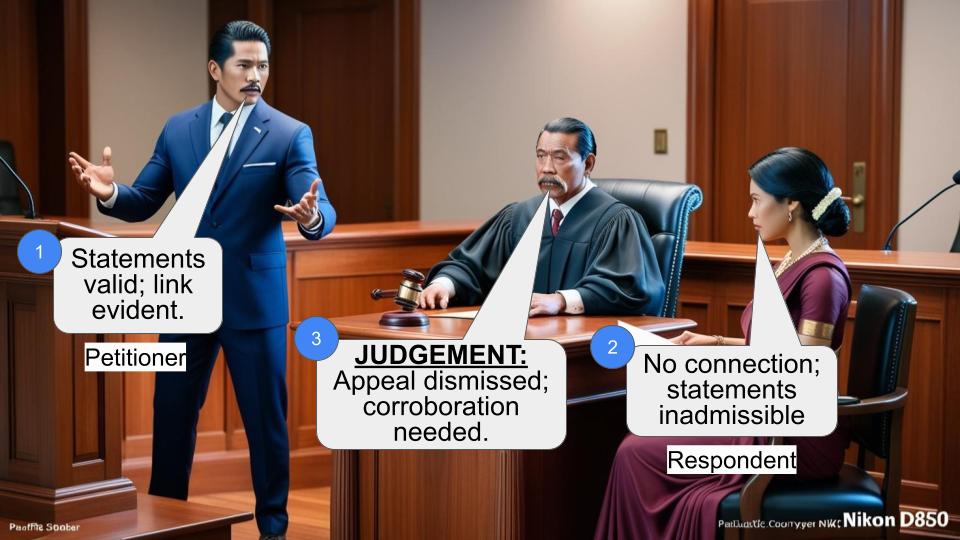
2. For such statements to be used against a third party, there needs to be a clear connection or corroborating evidence.
3. If no incriminating material is found during a search of an assessee's premises, it can't be used for assessment.
4. The court reinforced the principle from the Kabul Chawla case about the limits of search assessments.
Issue:
Can statements made by one party during a search under Section 132 (of Income Tax Act, 1961) be used as evidence against a third party in tax assessments without any corroborating evidence?
Facts:
1. There was a search and seizure operation at M/s Rajdarbar Group's premises under Section 132 (of Income Tax Act, 1961).
2. During this search, statements were made by the proprietor of M/s Supariwala & Co., a supplier to Rajdarbar Group.
3. The Assessing Officer (AO) used these statements to bring various amounts to tax for our assessee, Manoj Hora.
4. Here's the kicker: Manoj Hora wasn't the one being searched, and no incriminating material was found at his premises.
5. Hora argued that these statements couldn't be used against him as he was a third party.
6. The CIT(A) agreed with Hora and granted relief, which was then upheld by the ITAT.
7. The Revenue Department wasn't happy with this and appealed to the High Court.
Arguments:
Manoj Hora's side:
1. The statements made during the search of Rajdarbar Group couldn't be binding on him as per Section 132(4) (of Income Tax Act, 1961).
2. He was a stranger to the whole search process, so how could it affect him?
3. No incriminating material was found at his premises, so the assessment based on the search was untenable.
Revenue Department's side:
They basically disagreed with the deletions ordered by the CIT(A) and ITAT, arguing that the statements could be used for assessment.
Key Legal Precedents:
1. Commissioner of Income Tax v. Kabul Chawla 380 ITR 573: This case was cited by the ITAT and deals with the limits of search assessments.
2. Section 132(4) (of Income Tax Act, 1961): This section talks about the presumption arising from statements made during a search.
Judgement:
The High Court sided with Manoj Hora. Here's why:
1. They agreed that statements under Section 132(4) (of Income Tax Act, 1961) can't automatically bind a third party.
2. For such statements to be used against someone not being searched, there needs to be a clear connection or corroborating evidence.
3. In this case, there was no such connection or evidence.
4. The court also noted that no incriminating material was found at Hora's premises.
5. They applied the principle from the Kabul Chawla case, which supports this view.
In the end, the court dismissed the Revenue's appeals, saying no substantial question of law arose from them.
FAQs:
1. Q: What does this judgment mean for taxpayers?
A: It means that tax authorities can't use statements made during a search of one party against another party without clear evidence connecting the two.
2. Q: Does this apply to all search and seizure operations?
A: While it sets a precedent, each case would be judged on its own merits. But it does strengthen the protection for third parties not directly involved in a search.
3. Q: What's the significance of the Kabul Chawla case here?
A: The Kabul Chawla case set limits on what can be assessed based on a search. This judgment reinforces those limits, especially when it comes to third parties.
4. Q: Could the Revenue Department appeal this decision further?
A: They could potentially appeal to the Supreme Court, but given that the High Court found no substantial question of law, it might be challenging.
5. Q: What should taxpayers do if they find themselves in a similar situation?
A: If you're facing an assessment based on statements made during a search of someone else's premises, it's crucial to highlight the lack of connection or corroborating evidence. However, always consult with a qualified tax professional for specific advice.

1. In these appeals, the Revenue’s grievance is with respect to the deletions ordered by the CIT(A) and affirmed by the ITAT.
2. The facts necessary for this case are that a search assessment was completed in respect of M/s Rajdarbar Group whose premises were subjected to search and seizure proceedings under Section 132 (of Income Tax Act, 1961) (hereafter referred to as ‘the Act’). The assessee’s contention before the Revenue authorities was two-fold i.e. that the statements made in the course of the search and seizure operations, having regard to Section 132(4) (of Income Tax Act, 1961), could not be binding upon it. The argument was that the statement made by one supplier to M/s Rajdarbar Group i.e. the proprietor of M/s Supariwala & Co., was in any case not binding upon the assessee who was a stranger and a third party. The AO had disregarded his contention and brought to tax various amounts on the basis of that statement. The assessee’s second contention that in the absence of any incriminating material recovered from its premises, the search completed in the facts of this case was untenable. The CIT(A) granted relief on the merits holding that the statement made by a stranger/third party in the course of a search, could not be attributed to or lead to adverse consequences as far as the assessee was concerned. It was further held that there was no corroborative material to connect those statements to the assessee’s assessments. The ITAT affirmed the CIT(A)’s views and also cited a decision of this Court in Commissioner of Income Tax v. Kabul Chawla 380 ITR 573.
3. We have considered the materials on record.
4. The CIT(A) view that the statement under Section 132(4) (of Income Tax Act, 1961) could not bind the assessee is, in the opinion of this Court, correct. The text of Section 132(4) (of Income Tax Act, 1961), clarifies that the presumption arises in the case of the searched party. In case the statements by the party whose premises are searched, or to be attributed to a third party – as in the case of the assessee, there has to be a connect or corroboration. Clearly, there was none in the present case. On this score, the addition made by the AO was unsustainable; the CIT(A) correctly directed the cancellation.
5. The other factual detail is that no incriminating material was found from the assessee’s premises. In the circumstances, the ruling in Kabul Chawla (supra) squarely applies.
6. For the above reasons, no substantial question of law arises in these appeals; they are dismissed.
S. RAVINDRA BHAT, J
SANJEEV SACHDEVA, J
NOVEMBER 27, 2017
×