


Transfer Pricing Penalty Overturned: ITAT Rejects AO's Capacity Utilization Hyp…



Full News
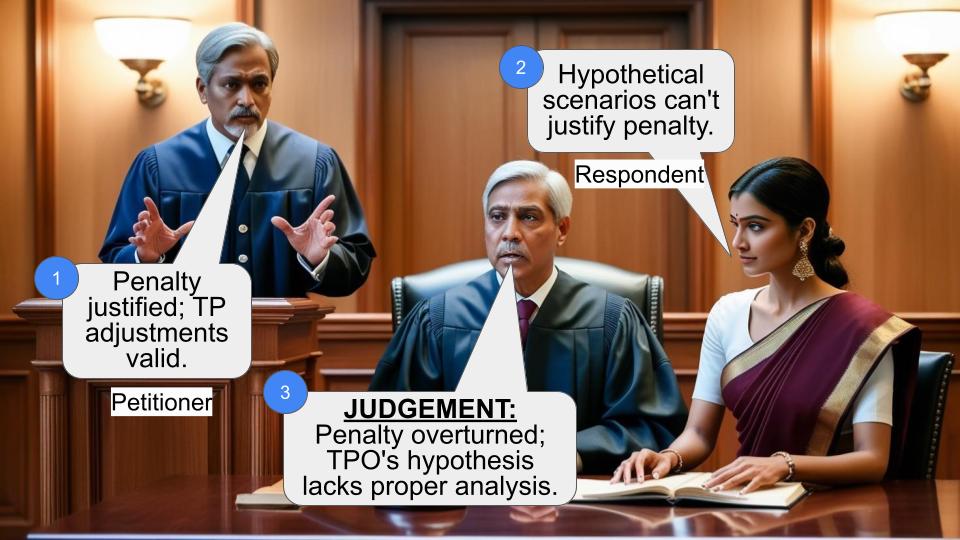
Transfer Pricing Penalty Overturned: ITAT Rejects AO's Capacity Utilization Hypothesis
Transfer Pricing Penalty Overturned: ITAT Rejects AO's Capacity Utilization Hypothesis
This case involves a dispute between the Income Tax Department and Royal and Sun Alliances IT Solutions (India) Pvt. Ltd. The main issue was the imposition of a penalty under Section 271(1)(c) (of Income Tax Act, 1961) based on transfer pricing adjustments made by the Transfer Pricing Officer (TPO). The Income Tax Appellate Tribunal (ITAT) set aside the penalty, and the High Court upheld this decision, dismissing the Revenue's appeal.
Get the full picture - access the original judgement of the court order here
Case Name:
Principal Commissioner of Income Tax Vs Royal and Sun Alliances It Solutions (India) Pvt. Ltd. (High Court of Delhi)
ITA 422/2019 & CM APPL. 19849/2019
Date: 29th April 2019
Key Takeaways:
1. The AO cannot impose a penalty under Section 271(1)(c) (of Income Tax Act, 1961) solely based on TP adjustments made by the TPO without independent analysis of comparable uncontrolled transactions.
2. Hypothetical scenarios and presumptions about capacity utilization are not valid grounds for transfer pricing adjustments.
3. The case highlights the importance of proper benchmarking and FAR (Functions, Assets, and Risks) analysis in transfer pricing cases.
Issue:
Can a penalty under Section 271(1)(c) (of Income Tax Act, 1961) be imposed based on transfer pricing adjustments made by the TPO without independent analysis of comparable uncontrolled transactions?
Facts:
1. Royal and Sun Alliances IT Solutions (India) Pvt. Ltd. is a wholly-owned subsidiary of a foreign Associated Enterprise (AE).
2. The company was set up as a 100% captive service provider for IT services and software development to the RSA group of companies.
3. The assessee reported an operating loss of 13.23% on costs.
4. The Transfer Pricing documentation suggested an arm's length price target of 13.41%.
5. The TPO made upward adjustments based on the hypothesis of underutilization of capacity.
6. The Assessing Officer (AO) imposed a penalty under Section 271(1)(c) (of Income Tax Act, 1961) based on the TPO's adjustments.
7. The assessee appealed to the Commissioner and then to the ITAT, which set aside the penalty.
8. The Revenue filed an appeal under Section 260A (of Income Tax Act, 1961) to the High Court.
Arguments:
Revenue's Arguments:
1. The assessee's Transfer Pricing Report showed a profit margin of 13.41%, but the assessee offered a lower amount based on actual income.
2. The TPO rejected this and brought all transactions to tax, including those not offered in the ALP.
3. The penalty was justified under Explanation (7) to Section 271(1)(c) (of Income Tax Act, 1961) for international transactions undergoing transfer pricing.
Assessee's Arguments:
1. The TPO's adjustment was based on hypothetical scenarios and not on proper benchmarking with comparable uncontrolled transactions.
2. The AO's computation of income was flawed, as it gave deduction under Section 10A (of Income Tax Act, 1961) on transfer pricing adjustments, which is against the law.
3. The manner of determining arm's length price and TP adjustment by the TPO was unsustainable in law.
Key Legal Precedents:
While no specific legal precedents were cited in the judgment, the case relied heavily on the interpretation of Sections 92C, 92CA, and 271(1)(c) of the Income Tax Act, as well as the principles of transfer pricing regulations.
Judgement:
1. The High Court dismissed the Revenue's appeal, upholding the ITAT's decision to set aside the penalty.
2. The Court found that the issue was at best debatable and that the setting aside of the penalty was not unreasonable.
3. The Court noted that the assessee had wound up operations, and the TPO and AO were essentially asking the assessee to include hypothetical income it had not received.
4. No substantial question of law was found to arise from the case.
FAQs:
1. Q: What was the main issue in this case?
A: The main issue was whether a penalty under Section 271(1)(c) (of Income Tax Act, 1961) could be imposed based on transfer pricing adjustments made by the TPO without proper analysis of comparable uncontrolled transactions.
2. Q: Why did the ITAT and High Court rule in favor of the assessee?
A: They ruled in favor of the assessee because the TPO's adjustments were based on hypothetical scenarios and presumptions about capacity utilization, rather than proper benchmarking and analysis of comparable uncontrolled transactions.
3. Q: What does this judgment mean for transfer pricing cases?
A: This judgment emphasizes the importance of proper benchmarking and FAR analysis in transfer pricing cases. It also suggests that hypothetical scenarios and presumptions about capacity utilization are not valid grounds for transfer pricing adjustments.
4. Q: Can the AO impose a penalty based solely on the TPO's adjustments?
A: No, this judgment indicates that the AO cannot impose a penalty under Section 271(1)(c) (of Income Tax Act, 1961) merely on the basis of TP adjustments made by the TPO without carrying out an independent analysis with comparable uncontrolled transactions.
5. Q: What is the significance of Explanation (7) to Section 271(1)(c) (of Income Tax Act, 1961) in this case?
A: While the Revenue argued that Explanation (7) justified the penalty for international transactions undergoing transfer pricing, the Court found that the issue was debatable and that the setting aside of the penalty was not unreasonable.

1. The Revenue’s appeal under Section 260A (of Income Tax Act, 1961) complains that the ITAT fell into error in setting aside the penalty under Section 271(1)(c) (of Income Tax Act, 1961) read with Explanation (7). It is contended that the assessee had in its Transfer Pricing Report – furnished for the purpose of ALP determination to the TPO, showed that the arithmetic mean of the profit margin of the comparable was at 13.41% only. However, the assessee offered the amount lower than that, on the basis of its actual income to the profit margin. The TPO rejected it and in the report brought all the transactions to tax, including those not offered in the ALP stating as follows:-
“7.1 The assessee has submitted revenue projections showing that if the capacity of the assessee had been utilized as per industry norms it would have earned 24% margin on costs. The crucial question is not whether the capacity was utilized but whether the under utilization was due to the market conditions or due to the control exercised by the Associated Enterprises. At a theoretical level, it can be argued that even if lucrative contracts would have come the assessee‟s way, it could not have taken them up due to its status of being a subsidiary of RSA group. This is contrary to risk reward matrix of an independent company operating in a free market scenario. Therefore, the assessee ought to be remunerated not only for the projects carried out but also for the costs incurred on keeping itself ready to perform services to only to its AEs”
2. The AO applied the TPO’s logic and proceeded to impose penalty by invoking Explanation (7) to Section 271(1)(c) (of Income Tax Act, 1961). The assessee’s appeal to the Commissioner was unsuccessful. The Tribunal by its impugned order set aside the penalty and held as follows:-
“10. We have heard the rival submissions and also perused the relevant finding given in the impugned orders. It is not in dispute that assessee is a wholly owned subsidiary of its foreign AE was set up as a 100% captive service provider to cater information technology services and software development/ IT solutions to RSA group of companies. There was an operating loss of 13.23% on the cost. Though TP documentation suggested the arms length price target of 13.41% however, it is not clear from the records as to whether any king of adjustment was proposed in such TP documentation. Ld. TPO, however has proceeded to make the TP adjustment in a completely erroneous manner. His main plank for making the upward adjustment was that there was underutilisation of capacity by the assessee because of less orders given by the AE to assessee; and therefore, assessee should have been remunerated for idle capacity utilisation by the AE; and assessee should have been allowed to operate in an independent manner and it did not had any option to optimise its return on capital and cost by obtaining third party contracts. Such a reasoning for making the TP adjustment without carrying out independent analysis with comparable uncontrolled transactions cannot be sustained. Ld. TPO instead of benchmarking the transaction under the prescribed method and FAR analysis with uncontrolled transactions has proceeded with the hypothesis that if the full capacity of the assessee had been utilised it would have earned 24% margin on the cost and therefore, it is presumed that such an under capacity utilisation was due to the control exercised by the AE. Such an interpretation for determining of arm‟s length price unknown under the transfer pricing regulations either under the Income Tax Act or under the Rules. In case under utilization of capacity was the factor triggering ALP determination, then the ld. TPO should have identified the comparable in similar line then would have analysed the capacity utilisation and made suitable adjustment without such analysis the entire basis adopted by the TPO to make the TP adjustment is wholly vitiated not only on facts but also under the law.
11. Another bizarre approach of the AO while computing the income of the assessee is that, he has given deduction u/s 10A (of Income Tax Act, 1961) on such transfer pricing adjustment which is against the provision of law as proviso below section 92C(4) (of Income Tax Act, 1961) categorically provides that no such deduction u/s 10A (of Income Tax Act, 1961) is allowable for transfer pricing adjustments made u/s 92C (of Income Tax Act, 1961). Be that as it may be, if the computation of the AO is taken into consideration, then addition for ALP to the extent of Rs. 2.21 crores has been given exemption and income has been computed at „nil‟ in so far as STPL unit is concerned; and only Rs. 43.94 lacs addition has been made on account of TP adjustment in the assessment order. Under these facts ostensibly the penalty of Rs. 2.21 crores neither could have been levied nor could have been computed by the AO, because there is no tax sought to be evaded to the extent of this amount of adjustment. In any case the manner in which arm‟s length price has been determined and TP adjustment has been made by the TPO, same is unsustainable in law and consequently there cannot be any question of furnishing of inaccurate particulars of income or any concealment of income. Further there is no finding or observation by the AO that the loss margin of 13.23% has been found to be incorrect. Simply because adjustment has been made on certain hypothesis that AE should have remunerated idle capacity utilisation and assessee was not allowed to carry out any contract with the third party in the open market and therefore, it should have earned more margin cannot be the basis for levy of penalty u/s 27(1)(c) (of Income Tax Act, 1961). Hence under these facts and circumstances, we hold that the penalty of Rs. 94,58,080/- is unsustainable and is directed to be deleted.”
3. Learned counsel for the Revenue emphasised that Explanation (7) was for the purpose of international transactions undergoing transfer pricing. Under Section 92CA (of Income Tax Act, 1961), if a larger amount was determined by the TPO, the difference between what is offered and what ought to have been offered becomes not only taxable but subject to penalty.
4. This Court is of the opinion that in the given facts of this case, the issue at best is debatable. It is also important to notice that during the proceedings, it became evident that the assessee had wound up the operations. What the TPO and later the AO desired the assessee to do, was to include in hindsight, the income amounts which it had not received and offer a higher rate of return or profit.
5. In these circumstances, the Court is of the opinion that the setting aside of the penalty amount cannot be characterised as unreasonable. No substantial question of law arises.
6. The appeal is dismissed.
S. RAVINDRA BHAT, J.
PRATEEK JALAN, J.
APRIL 29, 2019
×
Similar Ripples
Questions
Transfer Pricing Penalty Overturned: ITAT Rejects AO's Capacity Utilization Hypothesis
Write your CommentSimilar Posts


Generic
- Reportdata/1022.pdf
