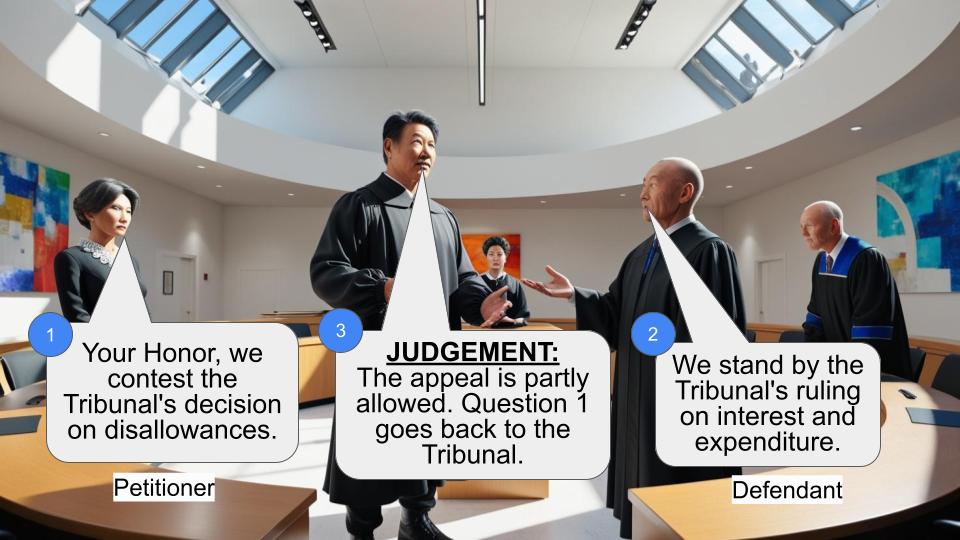
Tribunal Can Consider New Legal Questions for Correct Tax Assessment


Full News

Tribunal Can Consider New Legal Questions for Correct Tax Assessment
Tribunal Can Consider New Legal Questions for Correct Tax Assessment
This case involves appeals by Ravindra Arora and Praveen Arora against an order of the Income-tax Appellate Tribunal, Jodhpur. The Tribunal had dismissed their appeals, refusing to consider a new legal issue raised at the appellate stage. The High Court, citing a Supreme Court precedent, ruled that the Tribunal should consider new legal questions when necessary for correct tax assessment, even if raised late.
Case Name:
Ravindra Arora vs Assistant Commissioner of Income Tax (High Court of Rajasthan)
D.B. Income Tax Appeal No. 116 of 2008
Date: 27th February 2018
Key Takeaways:
1. The Income-tax Appellate Tribunal has discretion to allow new grounds to be raised.
2. Legal issues can be raised at any point in tax proceedings.
3. Tribunals should consider new legal questions if they arise from facts on record and are necessary for correct tax assessment.
Issue:
Can the Income-tax Appellate Tribunal consider a new legal question raised at the appellate stage if it's necessary for correctly assessing an assessee's tax liability?
Facts:
1. Ravindra Arora and Praveen Arora filed appeals against an order dated August 17, 2007, by the Income-tax Appellate Tribunal, Jodhpur Bench.
2. The appellants raised a question of law regarding their rights under section 2(22)(e) of the Income Tax Act, 1961, 1961 before the Tribunal.
3. The Tribunal refused to decide on this issue because it was raised at the appellate stage.
4. The appellants challenged this decision in the High Court.
Arguments:
Appellants:
- The Tribunal should have considered the legal issue raised, even if it was at the appellate stage.
- They cited the Supreme Court judgment in National Thermal Power Co. Ltd. v. CIT (1998) to support their argument.
Respondent:
- The Tribunal gave detailed reasons in paragraphs 7 and 8 of its judgment for refusing to consider the new issue.
- No interference was necessary in the writ petition.
Key Legal Precedents:
1. National Thermal Power Co. Ltd. v. CIT (1998) 229 ITR 383 (SC) decided on December 4, 1996:
This Supreme Court judgment held that the Tribunal has discretion to allow new grounds to be raised, especially when considering questions of law arising from facts on record.
2. Other cases cited:
- CIT v. Anand Prasad (1981) 128 ITR 388 (Delhi)
- CIT v. Karainchand Premchand P. Ltd. (1969) 74 ITR 254 (Guj)
- CIT v. Cellulose Products of India Ltd. (1985) 151 ITR 499 (Guj) (FB)
Judgement:
The High Court allowed both appeals, quashing and setting aside the Tribunal's order dated August 17, 2007. The cases were remitted back to the Income-tax Appellate Tribunal, Jodhpur, with instructions to decide on the legal issue raised by the appellants within two months of receiving the certified copy of the High Court's order.
FAQs:
Q1: What was the main issue in this case?
A1: The main issue was whether the Income-tax Appellate Tribunal should consider a new legal question raised at the appellate stage.
Q2: What did the Supreme Court say about raising new grounds before the Tribunal?
A2: The Supreme Court held that the Tribunal has discretion to allow new grounds, especially when they involve questions of law arising from facts on record and are necessary for correct tax assessment.
Q3: What section of the Income-tax Act was in question?
A3: The appellants raised a question about their rights under section 2(22)(e) of the Income Tax Act, 1961, 1961.
Q4: What was the final decision of the High Court?
A4: The High Court allowed the appeals, quashed the Tribunal's order, and sent the cases back to the Tribunal to decide on the legal issue within two months.
Q5: Does this judgment mean that any new issue can be raised at any time in tax proceedings? A5: Not exactly. The judgment emphasizes that new legal questions arising from facts already on record should be considered if they're necessary for correct tax assessment. The Tribunal still has discretion in allowing new grounds.

In these income-tax appeals common issue is involved, therefore, they are disposed of by this common order.
In both the appeals filed by the assessees, Shri Ravindra Arora and Shri Praveen Arora challenge is made to the order dated August 17, 2007, passed by the learned Income-tax Appellate Tribunal, Jodhpur Bench, Jodhpur whereby the appeals filed by the appelitmts were dismissed.
The learned counsel for the appellants submits that a question of law with regard to their right under section 2(22)(e) of the Income Tax Act, 1961, 1961 was raised before the learned Income-tax Appellate Tribunal but the learned Income-tax Appellate Tribunal, Jodhpur refused to decide the issue with regard to the claim of the appellants for deemed dividend because it was raised at the appellate stage. Learned counsel for the appellants invited our attention towards the judgment of the learned Supreme Court in the case of National Thermal Power Co. Ltd. v. CIT (1998) 229 ITR 383 (SC) decided on December 4, 1996, in which the hon'ble Supreme Court held that there is no doubt that the Tribunal has discretion to allow or not to allow a new ground to be raised but where the Tribunal is only required to consider a question of law arising from the facts which are not on record in the assessment proceedings, such a question should be allowed to be raised and decided by the Tribunal in order to assess the correctness of the tax liability of an assessee.
Learned counsel for the appellants submits that in view of the aforesaid judgment it was incumbent upon the respondent-income-tax Appellate Tribunal to decide the legal issue raised by the appellants, therefore, the matters may be remitted to the Income-tax Appellate Tribunal for deciding the question of law afresh while taking into account section 2(22)(e) (of Income Tax Act, 1961).
Learned counsel for the respondent vehemently submits that detailed reasons are given by the Income-tax Appellate Tribunal in para Nos. 7 and 8 of the judgment, therefore, it is obvious that the Income-tax Appellate Tribunal has rightly refused to decide the fresh issue raised by the appellants hence no interference is called for in the writ petition.
After considering the entire facts of the case, we are of the opinion that legal issue can be raised at any point of time, in view of the judgment in the case of National Thermal Power Co. Ltd. v. CIT in which the following adjudication is made by the hon'ble Supreme Court in para Nos. 7 and 8 of the judgment which are as follows (page 387 of 229 ITR) :
"The view that the Tribunal is confined only to issues arising out the appeal before the Commissioner of Income-tax (Appeals) takes too narrow a view of the powers of the Appellate Tribunal (vide, e.g., CIT v. Anand Prasad (1981) 128 ITR 388 (Delhi), CIT v. Karainchand Premchand P. Ltd. (1969) 74 ITR 254 (Guj) and CIT v. Cellulose Products of India Ltd. (1985) 151 ITR 499 (Guj) (FB). Undoubtedly, tire Tribunal will have tire discretion to allow or not to allow a new ground to be raised. But where the Tribunal is only required to consider a question of law arising from the facts which are on record in the assessment proceedings, we fail to see why such a question should not be allowed to be raised when it is necessary to consider that question in order to correctly assess the tax liability of an assessee.
The refrained question, therefore, is answered in the affirmative, i.e., the Tribunal has jurisdiction to examine a question of law which arises from the facts as found by the authorities below and having a bearing on the tax liability to the assessee. We remand the proceedings to the Tribunal for consideration of the new grounds raised by the assessee on the merits."
In view of the aforesaid legal position of law, both the appeals are hereby allowed. The order impugned dated August 17, 2007 passed by the learned Income-tax Appellate Tribunal is hereby quashed and set aside and both the cases are remitted to the learned Income-tax Appellate Tribunal, Jodhpur for deciding the legal issue raised by the learned counsel for the appellants within a period of two months from the date of receiving certified copy of this order.
×