Tribunal Cannot Recall Its Own Order Without Pointing Out Mistake


Full News
Tribunal Cannot Recall Its Own Order Without Pointing Out Mistake
Tribunal Cannot Recall Its Own Order Without Pointing Out Mistake
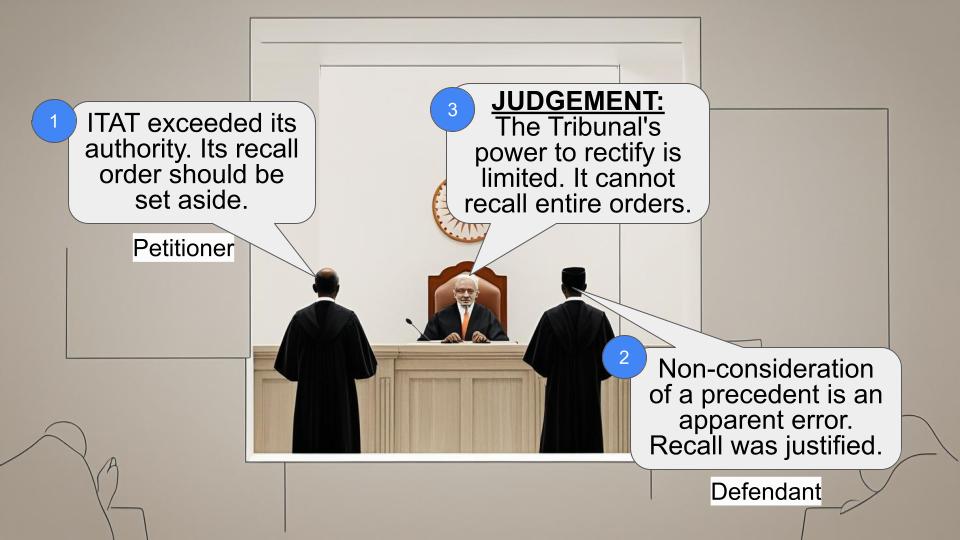
This case involves a dispute between the Commissioner of Income Tax (CIT) and the U.S. Srivastava Memorial Educational Society (the Society) over the Society's tax exemption status. The CIT initially disallowed the Society's tax exemption, but the Society successfully appealed this decision. The CIT then tried to get the Tribunal to recall its earlier order in favor of the Society, which the Tribunal did. However, the High Court found that the Tribunal could not do this without clearly identifying a mistake in its original order, which it had failed to do. The High Court therefore set aside the Tribunal's order recalling its earlier decision.
Get the full picture - access the original judgement of the court order here
Case Name:
Commissioner of Income Tax vs U.S. Srivastava Memorial Educational Society (High Court of Allahabad)
Income Tax Appeal No.35 of 2009
Date: 2nd February 2017
Key Takeaways:
1. The Tribunal can only recall its own order under Section 254(2) (of Income Tax Act, 1961) if there is a clear, apparent mistake in the original order.
2. The Tribunal cannot simply re-evaluate the entire case and reach a different conclusion without identifying a specific error in its previous judgment.
3. The power of rectification under Section 254(2) (of Income Tax Act, 1961) does not include a general power of review or re-hearing the entire case.
Issue:
Can the Tribunal recall its own order under Section 254(2) (of Income Tax Act, 1961) without identifying a specific mistake in the original order?
Facts:
- The U.S. Srivastava Memorial Educational Society is a registered charitable trust that was initially denied tax exemption by the Assessing Officer (AO).
- The Society appealed this decision, and the Commissioner of Income Tax (Appeals) [CIT(A)] ruled in favor of the Society, granting the tax exemption.
- The CIT then appealed the CIT(A)'s decision to the Income Tax Appellate Tribunal (Tribunal), which ruled in favor of the CIT, disallowing the Society's tax exemption.
- The Society then filed an application under Section 254(2) (of Income Tax Act, 1961) to rectify the Tribunal's order, but this was rejected by the Tribunal.
- The Society then filed a second application under Section 254(2) (of Income Tax Act, 1961), which the Tribunal allowed, recalling its earlier order in favor of the CIT.
- The CIT appealed the Tribunal's order recalling its previous decision.
Arguments:
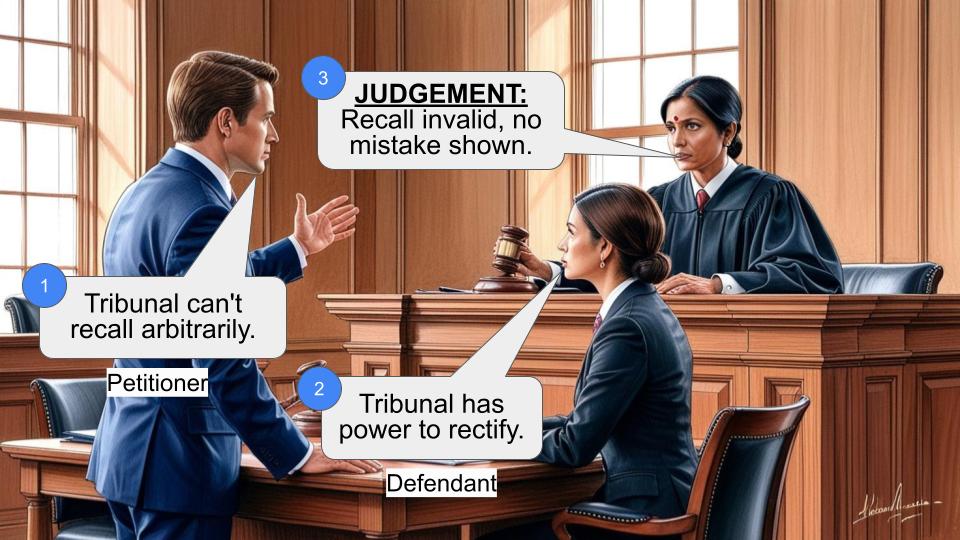
- CIT's Argument: The Tribunal acted beyond its jurisdiction in recalling its earlier order without identifying any specific mistake in the original order. The Tribunal cannot review its own judgment under the guise of rectification.
- Society's Argument: The Tribunal has the power under Section 254(2) (of Income Tax Act, 1961) to rectify any mistake apparent on the record, which includes the ability to recall its own order. The Tribunal found errors in its previous judgment that warranted a recall.
Key Legal Precedents:
- Assistant Commissioner, Income Tax, Rajkot Vs. Saurashtra Kutch Stock Exchange Ltd. (2008) - Established that the Tribunal can rectify a mistake apparent on the record under Section 254(2) (of Income Tax Act, 1961), which may include recalling its own order.
- Hari Vishnu Kamath v. Syed Ahmad Ishaque (1955) - Defined "mistake apparent on the record" as an error that is manifest and self-evident, not requiring a long drawn-out process of reasoning.
- Satyanarayan Laxminarayan Hegde v. Mallikarjun Bhavanappa Tirumale (1960) - Held that an error that requires examination or argument to establish it cannot be considered a "mistake apparent on the record."
Judgment:
The High Court ruled in favor of the CIT, setting aside the Tribunal's order recalling its earlier decision. The High Court held that the Tribunal cannot recall its own order under Section 254(2) (of Income Tax Act, 1961) without clearly identifying a mistake apparent on the record. The Tribunal had failed to do so in this case, and had instead simply re-evaluated the entire case and reached a different conclusion, which was not permissible under the law.
FAQs:
Q: Can the Tribunal always recall its own order under Section 254(2) (of Income Tax Act, 1961)?
A: No, the Tribunal can only recall its order if there is a clear, apparent mistake in the original order. The Tribunal cannot simply re-evaluate the entire case and reach a different conclusion without identifying a specific error in its previous judgment.
Q: What is the difference between rectification and review under Section 254(2) (of Income Tax Act, 1961)?
A: Rectification under Section 254(2) (of Income Tax Act, 1961) is limited to correcting mistakes that are apparent on the face of the record. It does not allow the Tribunal to engage in a full review or re-hearing of the entire case. The power of review is not inherent in Section 254(2) (of Income Tax Act, 1961).
Q: Can the Tribunal's order recalling its previous decision be appealed?
A: Yes, the High Court found that an order passed by the Tribunal under Section 254(2) (of Income Tax Act, 1961) recalling its earlier order is appealable under Section 260A (of Income Tax Act, 1961), as it involves a substantial question of law.

1. Heard Sri Alok Mathur, Advocate for appellant and Sri Mudit Agarwal, Advocate respondent.
2. Both these appeals filed under Section 260A (of Income Tax Act, 1961) (hereinafter referred to as the "Act, 1961"), relate to same Assessment Year, i.e., 200001, based on same facts, involve common questions of law, therefore, as agreed by learned counsel for the parties, have been heard together and are being decided by this common judgment.
3. Appeal No. 35 of 2009 has arisen from judgment and order dated 05.12.2008 passed by Income Tax Appellate Tribunal, Lucknow Bench, Lucknow (hereinafter referred to as the “Tribunal”) in Misc. Application No. 119 and 120/Luc/2008, arising out of I.T.A. No. 218/Luc/2005 and was admitted on following substantial questions of law:
"I. Whether the Income Tax Appellate Tribunal is empowered under Section 254(2) (of Income Tax Act, 1961) to recall its order finally deciding appeal for the reasons other than those dealt in under Rules 24 (of Income Tax Rules, 1962) and 25 (of Income Tax Act, 1961) of Appellate Tribunal Rules, 1963.
II. Whether under the facts and in the circumstances of the Income Tax Appellate Tribunal has erred in law in recalling its order dated 21.09.2007 without appreciating that issues raised in Misc. Applications are outside the scope of mistake apparent from record.
III. Whether under the facts and in circumstances, Income Tax Appellate Tribunal has erred in law in recalling their order dated 21.09.2007 without appreciating that recalling of order necessitates rehearing, readjudication and passing of fresh order. Income Tax Appellate Tribunal failed to appreciate that readjudication is not permissible within parameters of mistake apparent from record and the order dated 21.09.2007 of Income Tax Appellate Tribunal which stood merged in the order dated 18.07.2008 of Income Tax Appellate Tribunal could not have been recalled as the same stood merged in subsequent order dated 18.07.2008 and is also against the doctrine of judicial discipline."
4. Further, Appeal No. 100 of 2009 has arisen from judgment and order dated 31.03.2009 passed by Tribunal in I.T.A. No. 218/Luc/2005 and was admitted on following substantial question of law: "Whether Income Tax Appellate Tribunal has erred in law in upholding the order passed by Commissioner of Income Tax (Appeals) allowing exemption under Section 11 (of Income Tax Act, 1961) by holding that there has not been any infringement of Section 13 (of Income Tax Act, 1961) by the Assessee."
5. The brief facts giving rise to both appeals are that Respondent- Assessee, namely, M/s U.S. Srivastava Memorial Educational Society (hereinafter referred to as the “Society”) is an educational Society registered under Section 12 (of Income Tax Act, 1961)AA of Act, 1961. Sri K.B. Lal is the Secretary of Society and he has one daughter, namely, Pallavi Lal and wife, namely, Smt. Indu Lal.
6. During the course of assessment of year 200001, K.B. Lal, Trustee of Society, stated that his only source of income including remuneration received from Society is Rs. 5000/ per month, since 199798, which was increased subsequently to the tune of Rs. 7500/ per month. According to K.B. Lal, he neither owned a house nor had any bank balance nor had any Fixed Deposit. In Assessment Year 2000 01. Trustee had received loan of Rs. 4050 lacs from Member of Parliament, Rajya Sabha. Family of K.B. Lal owned two vehicles, a UNO car by his wife, Smt. Indu Lal and another Matiz car by his daughter, Pallavi Lal.
7. On the statement given by K.B. Lal, Assessing Officer (hereinafter referred to as the “AO”) has some doubt in his mind, when family of K.B. Lal has no income, how two cars were kept and managed by him and his family members. Therefore, in the opinion of AO, it might be a case of misutilization of funds of Society by K.B. Lal and his family members. The amount received from political parties as loan was not shown in the return of relevant year. Consequently, AO was of the opinion that income had escaped and, therefore, AO issued notice under Section 148 (of Income Tax Act, 1961). Reply to the same was submitted by Assessee during assessment proceedings stating that Society is registered under Section 12 (of Income Tax Act, 1961)AA of Act, 1961 hence entire income is exempted as per provisions of Section 11 (of Income Tax Act, 1961), since purpose and object of Society was charitable in nature and primary object of Society is to impart education.
8. During course of assessment proceedings, a notice under Section 131 (of Income Tax Act, 1961) issued to K.B. Lal, Secretary of Society, asking for certain information including transfer of funds from Society. On the basis of information provided in pursuance of notice, it was found that a sum of Rs. 1,96,400/ was transferred from the account of Society to the account of K.B. Lal though according to K.B. Lal his income was only Rs. 7500/ per month, equivalent to Rs. 90,000/ per month as salary which he received from Society. This information was collected by AO after getting it verified from the Bank.
9. K.B. Lal was asked to explain about Maruti Car 800, which was purchased by him in the name of Society after getting it financed from one M/s Apple Finance. In reply to it, Sri K.B. Lal submitted that M/s Apple Finance expressed some difficulty to finance vehicle in the name of Trust and in order to meet such problem, vehicle was transferred in his name and K.B. Lal, Secretary of Society has paid installments to Financier, M/s Apple Finance Limited from his Savings bank account through transfer of funds from the accounts of Society. AO also found that family of K.B. Lal is residing in guest house of Society and using property of Society in violation of Section 13(3) (of Income Tax Act, 1961). The explanation submitted in this regard by Trustee, K.B. Lal that family is involved in the work of Trust and getting honorarium of Rs. 7500/ per month by K.B. Lal, Rs. 1000/ per month by Smt. Indu Lal, wife and Rs. 2000/ per month by Pallavi Lal, daughter. This explanation was not accepted by AO and on this count AO found that Trustee is using property of Trust for his own benefit in violation of provisions of Section 13 (of Income Tax Act, 1961). Being not satisfied with explanation submitted by K.B. Lal, AO passed order dated 25.05.2004 stating therein that since there had been a definite violation of provisions of Section 13 (of Income Tax Act, 1961), benefit of Section 11 (of Income Tax Act, 1961) is not available to Assessee for this year. By the said order, AO charged interest on total income of Rs. 16,75,791/ and issued notice of demand and penalty and also penalty proceeding under Section 271(1)(c) (of Income Tax Act, 1961) was initiated.
10. The order of AO dated 25.03.2004 was assailed by Assessee before Commissioner of Income Tax (Appeals)1 (hereinafter referred to as the “CIT(A)”). CIT(A) accepted explanation of Assessee and allowed appeal vide order dated 30.11.2004. Aggrieved by order dated 30.11.2004, Revenue preferred appeal before Tribunal in which cross objection was also filed by Assessee against order of CIT(A) and departmental appeals. Tribunal passed order dated 21.09.2007 allowing appeal of Revenue and dismissing cross objections of Assessee by observing that there had been a definite violation of provisions of Section 13 (of Income Tax Act, 1961) by Assessee and AO has rightly disallowed benefit of Section 11 (of Income Tax Act, 1961) to Assessee.
11. Assessee then moved a miscellaneous application under Section 254(2) (of Income Tax Act, 1961) before Tribunal against order dated 21.09.2007 on the ground that Tribunal has committed certain factual mistakes and has not given opportunity of hearing and not discussed law cited by Assessee while deciding appeal and crossobjection. This application was considered and after giving opportunity of hearing to both the parties, Tribunal dismissed same by a detailed order dated 18.07.2008.
12. Assessee again moved two applications, one against order dated 21.09.2007 and another against order dated 18.07.2008, on similar grounds, under Section 254(2) (of Income Tax Act, 1961). During pendency of application moved against order dated 18.07.2008, Tribunal on application moved against ordr dated 21.09.2007, vide its order dated 05.12.2008 allowed the same and recalled order dated 21.09.2007 and listed matter for hearing.
13. Aggrieved by order dated 05.2.2008, Revenue preferred ITA No. 35 of 2009 before this Court.
14. Thereafter Tribunal heard the matter again and vide order dated 31.03.2009 dismissed Revenue's appeal No. 218/Luc/2005. Thereafter ITA No. 1000 of 2009 has been filed by Revenue challenging order dated 31.03.2009.
15. The submission of learned counsel for Revenue is that Tribunal has acted wholly without jurisdiction. It had no authority to recall or review its own order under the garb of Section 254(2) (of Income Tax Act, 1961), specially when application moved under Section 254(2) (of Income Tax Act, 1961) was already rejected by Tribunal with a detailed order dated 18.07.2008, after examining merit of the objections raised by Assessee against order dated 21.09.2007. It was further submitted that principle of res judicata is applicable in this case and once order rejecting application under Section 254(2) (of Income Tax Act, 1961) is passed on merit, Tribunal had no authority to entertain any subsequent application again under Section 254(2) (of Income Tax Act, 1961) against order dated 21.09.2007 passed in appeal. It was further contended that order passed by Tribunal on 05.12.2008 amounts to review of its own order without any valid basis as there was no case of mistake apparent from record. In support of his contention, learned counsel for appellant placed reliance on Supreme Court’s judgment in Bharat Sanchar Nigam Ltd. and another Vs. Union of India, 2006(3) SCC 1.
16. It is further contended that under Section 254(2) (of Income Tax Act, 1961), it is only error which can be rectified and not the power of review which can be exercised to recall earlier judgment, passed in appeal, and to pass a different order. Thus Tribunal has clearly misdirected itself in exercise of power under Section 254(2) (of Income Tax Act, 1961) as review which it did not have and, therefore, impugned judgment in both these appeals are patently illegal and without jurisdiction.
17. It is not in dispute before us that Tribunal vide judgment dated 21.09.2007 decided appeal of Revenue and allowed same. Cross objections of Assessee were dismissed. Thereafter application filed under Section 254(2) (of Income Tax Act, 1961) by Assessee was rejected by a detailed order on 18.07.2008.
18. Question up for consideration is, whether any further application under Section 254(2) (of Income Tax Act, 1961) for recalling order dated 21.09.2007 was maintainable and whether any application for recalling order dated 18.07.2008 was also maintainable or not.
19. Both these applications filed for recalling orders dated 18.07.2008 and 21.09.2007 were registered as Misc. Applications No. 119 and 120/Luc/2008 respectively and have been allowed vide order dated 05.12.2008. The entire order runs in seven paragraphs and only para 6 deals with discussion and so called findings, read as under: “6. Having heard both the parties, and after going through the submissions of the learned A.R. we are of the view that there appears to be some substance in the submissions of the learned A.R. As the above referred grounds were not adjudicated in their correct perspective and the assessee was not given proper opportunity during the hearing. Besides, case law relied upon by him have not been discussed nor distinguished while deciding the ITA No. 218/L/08. Thus there appears to to be a mistake apparent from the record and submissions of the ld. A.R. We, therefore, recall our order dated 21.09.07 and direct the registry to fix the appeal for fresh hearing in due course.
7. In the result, the misc. applications are allowed.”
(emphasis added)
20. Judgment dated 21.09.2007 is running in 22 paragraphs. After discussing issues in detail, findings commenced from para 10. The ultimate conclusion drawn in paras 20 and 21 of the judgment, read as under:
“20. In view of above discussion, we are also of the view that there had been a definite violation of provisions of section 13 (of Income Tax Act, 1961) by the assessee and the Assessing Officer has rightly held that benefit of the provisions of section 11 (of Income Tax Act, 1961) are not available to the assessee in the assessment year under consideration. We, therefore, set aside the order of the ld. C.I.T.(A) and restore that of the Assessing Officer by allowing the grounds of appeal taken by the Department.
21. In the result, appeal of the Department is allowed and cross objection of the assessee is dismissed.”
21. This order dated 21.09.2007 did not find to contain any such mistake so as to require rectification and for that reason application earlier filed by Assessee under Section 254(2) (of Income Tax Act, 1961) was rejected vide order dated 18.07.2008. We enquired from learned counsel appearing for Assessee as to whether any fresh application under Section 254(2) (of Income Tax Act, 1961) which has the effect of reviewing the order dated 18.07.2008 passed on rectification application filed under Section 254(2) (of Income Tax Act, 1961) is maintainable under law or not, to which he could not reply at all. However, what he submitted is that against orders passed under Section 254(2) (of Income Tax Act, 1961) an appeal under Section 260A (of Income Tax Act, 1961) is not maintainable and for that purpose placed reliance on judgments in Madhav Marbles & Granites Vs. Income Tax Appellate Tribunal, 2012(246 CTR 243 (Raj.); Chem Amit Vs. Assistant Commissioner of Income Tax, 2005(272) ITR 397 (Bom.); Shaw Wallace and Co. Ltd. Vs. Income Tax Appellate Tribunal and others, 1999(240) ITR 579; M/s Samant Singh Vs. Commissioner of Income Tax and another, (Income Tax Appeal No. 9 of 2012), decided on 10.09.2013; and, Visvas Promoters P. LTD. Vs. The Income Tax Appellate Tribunal, Chennai, 2010(323) ITR 114 (Mad.).
22. It is also argued on behalf of RespondentAssessee that in exercise of powers under Section 254(2) (of Income Tax Act, 1961), rectification includes recall of order and for this purpose reliance is placed on judgments in Commissioner of Income Tax vs. U.P. Shoe Industries, 1999(152) CTR 205 (All) and Assistant Commissioner, Income Tax, Rajkot Vs. Saurashta Kutch Stock Exchange Ltd., 2008(14) SCC 171. It is submitted that Tribunal has found error apparent on the face of record in order dated 21.09.2007 and, therefore, same has rightly been recalled and support has been drawn from the authorities in Honda Siel Power Products Ltd. vs. Commissioner of Income Tax, 2007(12) SCC 596; Assistant Commissioner, Income Tax, Rajkot Vs. Saurashta Kutch Stock Exchange Ltd. (supra); Suhrid Geigy Limited v. Commissioner of Surtax, Gujarat, 1999(237) ITR 834(Guj); and, S. Nagaraj and Ors. vs. State of Karnataka and Anr., 1993(4) SCC (Supp.) 595.
23. Section 254 (of Income Tax Act, 1961) deals with the order of Appellate Tribunal and under Section 254(2) (of Income Tax Act, 1961) Tribunal possess power to rectify any mistake apparent from record, amend any order passed by it under subsection (1) and make such amendment if mistake is brought to its notice by Assessee or Revenue at any point of time within four years from the date of order. It reads as under:
“254. Orders of Appellate Tribunal.(1) The Appellate Tribunal may, after giving both the parties to the appeal an opportunity of being heard, pass such orders thereon as it thinks fit. (2) The Appellate Tribunal may, at any time within four years from the date of the order, with a view to rectifying any mistake apparent from the record, amend any order passed by it under subsection (1), and shall make such amendment if the mistake is brought to its notice by the assessee or the Assessing Officer: Provided that an amendment which has the effect of enhancing an assessment or reducing a refund or otherwise increasing the liability of the assessee, shall not be made under this subsection unless the Appellate Tribunal has given notice to the asessee of its intention to do so and has allowed the assessee a reasonable opportunity of being heard:
Provided further that any application filed by the assessee in this subsection on or after the 1st day of October, 1998, shall be accompanied by a fee of fifty rupees.
(2A) In every appeal, the Appellate Tribunal, where it is possible, may hear and decide such appeal within a period of four years from the end of the financial year in which such appeal is filed under sub- section (1) or subsection (2) or subsection (2A) of Section 253 (of Income Tax Act, 1961): Provided that the Appellate Tribunal may, after considering the merits of the application made by the assessee, pass an order of stay in any proceedings relating to an appeal filed under subsection (1) of Section 253 (of Income Tax Act, 1961), for a period not exceeding one hundred and eighty days from the date of such order and the Appellate Tribunal shall dispose of the appeal within the said period of stay specified in that order:
Provided further that where such appeal is not so disposed of within the said period of stay as specified in that order of stay, the Appellate Tribunal may, on an application made in this behalf by the assessee and on being satisfied that the delay in disposing of the appeal is not attributable to the assessee, extend the period of stay, or pass an order of stay for a further period or periods as it thinks fit; so, however, that the aggregate of the period originally allowed and the period or periods so extended or allowed shall not, in any case, exceed three hundred and sixtyfive days and the Appellate Tribunal shall dispose of the appeal within the period or periods of stay so extended or allowed.
Provided also that if such appeal is not so disposed of within the period allowed under the first proviso or the period or periods extended or allowed under the second proviso, the order of stay shall stand vacated after the expiry of such period or periods. (2B) The cost of any appeal to the Appellate Tribunal shall be at the discretion of that Tribunal.
(3) The Appellate Tribunal shall send a copy of any orders passed under this section to the assessee and to the Principal Commissioner or Commissioner.
(4) Save as provided in Section 256 (of Income Tax Act, 1961) or Section 260A (of Income Tax Act, 1961), orders passed by the Appellate Tribunal on appeal shall be final.”
24. This provision has been considered by Supreme Court at length in Assistant Commissioner, Income Tax, Rajkot Vs. Saurashta Kutch Stock Exchange Ltd. (supra). An order passed under subsection (1) of Section 254 (of Income Tax Act, 1961) would be final save as provided otherwise in Section 256 (of Income Tax Act, 1961) or 260A. Subsection (2) of Section 254 (of Income Tax Act, 1961) enables Tribunal to rectify any mistake apparent from record, suo motu. However, whether such mistake is brought to its notice by Revenue or Assessee, it says that Tribunal shall rectify such mistake. Therefore, power of rectification suo motu is enabling one while rectification is obligatory if brought to the notice of Tribunal by Assessee or Revenue.
25. Before us also learned counsel for Revenue did not dispute, if there is a mistake apparent from record and RespondentAssessee brought it to the notice of Tribunal, it must have exercised such power under Section 254(2) (of Income Tax Act, 1961). However what he argued is that in the guise of exercise of power under Section 254(2) (of Income Tax Act, 1961), Tribunal cannot review its own judgment by clothing such power upon it though not vested on it but that is what has been done in the case in hand.
26. Per contra, learned counsel for Assessee argued otherwise.
27. Court in Assistant Commissioner, Income Tax, Rajkot Vs. Saurashta Kutch Stock Exchange Ltd. (supra) while analyzing scope and ambit of Section 254(2) (of Income Tax Act, 1961), has observed, that there is no inherent power of review of adjudicating authority if it is not conferred by law. It placed reliance on an earlier judgment in Patel Narshi Thakershi and Ors. vs. Shri Pradyumansinghji Arjunsinghji, AIR 1970 SC 1273 which was in the context of Order 47, Rule 1 (of Income Tax Rules, 1962) C.P.C. and Court said that law is well settled that power of review is not an inherent power and it must be conferred by law either specifically or by necessary implication.
28. Then Court has examined meaning of phrase “mistake apparent from record”, which is condition precedent to attract Section 254(2) (of Income Tax Act, 1961). It has referred to a Constitution Bench judgment in Hari Vishnu Kamath v. Syed Ahmad Ishaque, AIR 1955 SC 233 observing that no error can be said to be apparent on the face of record if it is not manifest or selfevident and requires an examination or argument to establish it. There cannot be any rule of thumb to define the term “error apparent on the face of record” since there being an element of indefiniteness inherent in its very nature, it must be left to be determined by authority concerned.
29. In Satyanarayan Laxminarayan Hegde and Ors. v. Mallikarjun Bhavanappa Tirumale, AIR 1960 SC 137, Court said: “An error which has to be established by a long drawn process of reasoning on points where there may conceivably be two opinions can hardly be said to be an error apparent on the face of the record.”
30. A patent, manifest and self evident error which does not require elaborate documents or argument to establish it can be said to be an error apparent on the face of record and can be corrected while exercising certiorari jurisdiction. An error cannot be said to be apparent on the face of record if one has to travel beyond the record, to see, whether judgment is correct or not. An error apparent on the face of record means an error which strikes on mere looking and does not need long drawn out process of reasoning on points where there may conceivably be two opinions. Such error should not require any extraneous matter to show its incorrectness. To put it differently, it should be so manifest and clear that no Court would permit it to remain on record. If the view accepted by Court in the original judgment is one of the possible views, the case cannot be said to be covered by an error apparent on the face of the record.
31. In Assistant Commissioner, Income Tax, Rajkot Vs. Saurashta Kutch Stock Exchange Ltd. (supra) it was brought to the notice of Court that a decision of jurisdictional Court, if not considered, it is a mistake apparent on record and for said purpose power could have been exercised under Section 254(2) (of Income Tax Act, 1961).
32. Supreme Court upheld Gujarat High Court's judgment in Suhrid Geigy Limited v. Commissioner of Surtax, Gujarat (supra) in Assistant Commissioner, Income Tax, Rajkot Vs. Saurashta Kutch Stock Exchange Ltd. (supra), wherein it was held, if a point is covered by a decision of Jurisdictional Court rendered prior or even subsequent to order of rectification, it could be said to be "mistake apparent from record" under Section 254(2) (of Income Tax Act, 1961) and could be corrected by Tribunal. Supreme Court held that rectification of an order stems from fundamental principle that justice is above all. It is exercised to remove error and to disturb finality.
33. This Court has also dealt with this aspect and held that there is no power of review under Section 254(2) (of Income Tax Act, 1961) in Commissioner of Income Tax, Kanpur Vs. M/s Sahara India Financial Corporation Ltd., Lucknow (Income Tax Appeal Defective No. 44 of 2000), decided on 29.11.2013.
34. In the light of above judgment learned counsel for Revenue could not dispute, if there is an apparent mistake while exercising power of rectification, Tribunal can also recall its order and, therefore, view taken by Orissa High Court in Commissioner of Income Tax and another Vs. Income Tax Appellate Tribunal and another, 1992(4) ITR 640 that under Section 254(2) (of Income Tax Act, 1961) order cannot be recalled cannot be said to be a good law. However, he argued that in the garb of correction, Tribunal cannot reevaluate entire facts and give an opportunity of reargument of entire case and for that relied on Commissioner of Income Tax vs. Gokul Chand Agarwal, 1993(202) ITR 14 (Cal.).
35. In our view it is not necessary to look into this aspect of the matter further for the reason that we are satisfied that if there is a mistake apparent from record it has to be rectified by Tribunal if other conditions of Section 254(2) (of Income Tax Act, 1961) regarding limitation etc. are satisfied and if this mistake is brought to the notice by Revenue or Assessee. Such power includes within its ambit even recall of order.
36. In the present case, however, it is not a simple case of allowing application under Section 254(2) (of Income Tax Act, 1961) for the reason that such an application was already rejected by Tribunal vide order dated 18.07.2008. Tribunal has exercised a power of recall on second application moved by Assessee under Section 254(2) (of Income Tax Act, 1961) by recalling not only order dated 18.07.2008 passed on Assessee's application under Section 254(2) (of Income Tax Act, 1961) but has also taken a different view than taken in earlier judgment dated 21.09.2007 without pointing out any such mistake. In our view, this was not permissible at all and, therefore, order dated 05.12.2008 is patently erroneous and not sustainable.
37. Now comes the question of maintainability of appeal which has been heavily pressed by learned counsel for Assessee. He could not dispute that ITA No. 100 of 2009 has arisen from judgment dated 31.03.2009, whereby after recalling order dated 21.09.2007 appeal of Revenue has been dismissed by Tribunal, therefore, the said appeal is maintainable. Objection is only with regard to ITA No. 35 of 2009 which is against the order dated 05.12.2008. Sri Mudit Agarwal, learned counsel for Assessee placed reliance on Calcutta High Court's judgment in Shaw Wallace and Co. Ltd. Vs. Income Tax Appellate Tribunal and others (supra) and another judgment, i.e., Shaw Wallace and Co. Ltd. vs. Assistant Commissioner Income Tax, 1999(238) ITR 13 (Cal.).
38. We find that para 17 of the judgment in Shaw Wallace and Co. Ltd. Vs. Income Tax Appellate Tribunal (supra) itself goes against Assessee inasmuch as therein Calcutta High Court has taken a view that under Section 254(2) (of Income Tax Act, 1961) Tribunal cannot absolutely obliterate its earlier order by recalling it and proceed to rehear the matter on de novo arguments. Para 17 reads as under:
“17. Regarding total recall of the Tribunal's own order, my view is that this type of absolute obliteration of its earlier order is not within the jurisdiction of the Tribunal. It cannot totally recall its order under Section 254(2) (of Income Tax Act, 1961) and proceed to rehear the matter on de novo arguments.”
39. In para 18 of the judgment Court has also said as under:
“18. ....It is conceivable, if Section 254(2) (of Income Tax Act, 1961) were to clothe the Tribunal with a power of total recall that it decides in one way, then recalls the order and an absolutely different decision is reached on a second hearing after equally protracted arguments, This would be neither amendment nor rectification but a type of rehearing which even ordinary courts of law can hardly indulge in.”
40. With regard to maintainability of appeal, Calcutta High Court, in para 19 of judgment, has taken a view that from any and every order of Tribunal appeal under Section 260A (of Income Tax Act, 1961) would not lie and has given illustration that an order of adjournment would not give rise to appeal under Section 260A (of Income Tax Act, 1961). Court has said that an order passed by Tribunal not in appeal but on a miscellaneous application, rectifying mistake or order of recall is not appeallable.
41. Sri Agarwal also relied on a Division Bench judgment of this Court in M/s Samant Singh Vs. Commissioner of Income Tax (supra), where judgment of Calcutta High Court in Shaw Wallace and Co. Ltd. Vs. Income Tax Appellate Tribunal (supra) has been referred and quoted but therein we find that having referred to same, no view has been expressed by Court regarding maintainability of appeal. Therefore, this is not an authority on the question of maintainability of appeal.
42. Sri Agarwal, then relied on a Madras High Court's judgment in Visvas Promoters P. LTD. Vs. The Income Tax Appellate Tribunal, Chennai (supra) wherein Court held that against an order passed under Section 254(2) (of Income Tax Act, 1961), if a writ petition is filed it is not to be thrown on the ground of alternative remedy of appeal under Section 260A (of Income Tax Act, 1961).
43. From aforesaid judgment we find that Court has clearly observed that an appeal under Section 260A (of Income Tax Act, 1961) does not lie merely on rejection of an application which does not decide substantial issue involved between the parties but precondition is that a substantial question of law must have arisen. If no substantial question of law arisen, no appeal would lie under Section 260A (of Income Tax Act, 1961). Referring to a Division Bench judgment of Bombay High Court in Chem Amit vs. Assistant Commissioner of Income Tax (supra), Court observed that if an application under Section 254(2) (of Income Tax Act, 1961) is allowed mistake is rectified in original order, it amounts to an order passed under Section 254(1) (of Income Tax Act, 1961) against which appeal would lie. Court, in para 15 of the judgment, in fact, has said that appeal under Section 260A (of Income Tax Act, 1961) would not lie where application for rectification under Section 254(2) (of Income Tax Act, 1961) is rejected for the reason that such order cannot be treated to be an order passed in appeal by Tribunal but where order passed in appeal is recalled, it is an order passed in appeal and, therefore, in our view, appeal would be maintainable. Aforesaid judgment of Madras High Court also does not help Assessee in this case.
44. However, aforesaid judgment shows that an appeal under Section 260A (of Income Tax Act, 1961) would lie against an order of Tribunal if a substantial question of law has arisen and for that purpose it would not be material whether it is a judgment deciding appeal or otherwise. Moreover, if an order is passed on an application under Section 254(2) (of Income Tax Act, 1961) so as to recall the judgment of Tribunal which is otherwise final and referable to Section 254(1) (of Income Tax Act, 1961) and (4), it would be an order whereagainst appeal would lie under Section 260A (of Income Tax Act, 1961) but the precondition is that there must have been arisen a substantial question of law. In taking the above view we are fortified with some authorities, as may be referred, hereinbelow.
45. This Court in Jagdish Chand and Sons vs. Income Tax Appellate Tribunal and Anr., 2004(266) ITR 165 (All.) has held that an appeal is maintainable wherein Tribunal dismiss appeal by an ex parte order and Assessee's application for recall of such order was also rejected.
46. Before Karnataka High Court in L. Sohanraj and others Vs. Deputy Commissioner of Income Tax and another, 2003(260) ITR 147 a similar question arose wherein applications filed under Section 254(2) (of Income Tax Act, 1961) by Assessee were rejected by Tribunal observing that Assessee is seeking review which is not permissible. Karnataka High Court held that such an order passed by Tribunal is appealable under Section 260A (of Income Tax Act, 1961) and writ petitions filed by Assessee challenging such order of Tribunal passed under Section 254 (of Income Tax Act, 1961) were dismissed on the ground of alternative remedy of appeal under Section 260A (of Income Tax Act, 1961). Madras High Court also took same view in Lakshmi Vilas Bank Ltd. vs. Income Tax Appellate Tribunal and Ors., 2010(329) ITR 564.
47. In view of above discussion we are of the view that ITA No. 35 of 2009 filed against judgment and order dated 05.12.2008 passed under Section 254(2) (of Income Tax Act, 1961) recalling orders dated 18.07.2008 and 21.09.2007 is maintainable.
48. Substantial questions of law formulated above in ITA No. 35 of 2009, therefore, are answered in favour of Revenue and against Assessee. ITA No. 35 of 2009 is allowed and judgment of Tribunal dated 05.12.2008 is hereby set aside. Orders dated 21.09.2007 and 18.07.2008 passed by Tribunal are hereby restored.
49. In view of fate of ITA No. 35 of 2009, order dated 31.03.2009 passed by Tribunal and subject matter of ITA No. 100 of 2009, since founded on order dated 05.12.2008, also vanishes. The substantial question of law framed in ITA No. 100 of 2009, which is on merits of claim of Assessee, regarding exemption, need not be answered since judgment of Tribunal cannot be sustained as basic order whereupon it is founded has already fallen to the ground as a result of our decision in ITA No. 35 of 2009. Hence ITA No. 100 of 2009 is also allowed and judgment dated 31.03.2009, impugned in this appeal, is set aside.
Order Date : 02.02.2017
×