


Tribunal Must Consider New Legal Questions if Facts Are on Record, Rules High C…


Full News
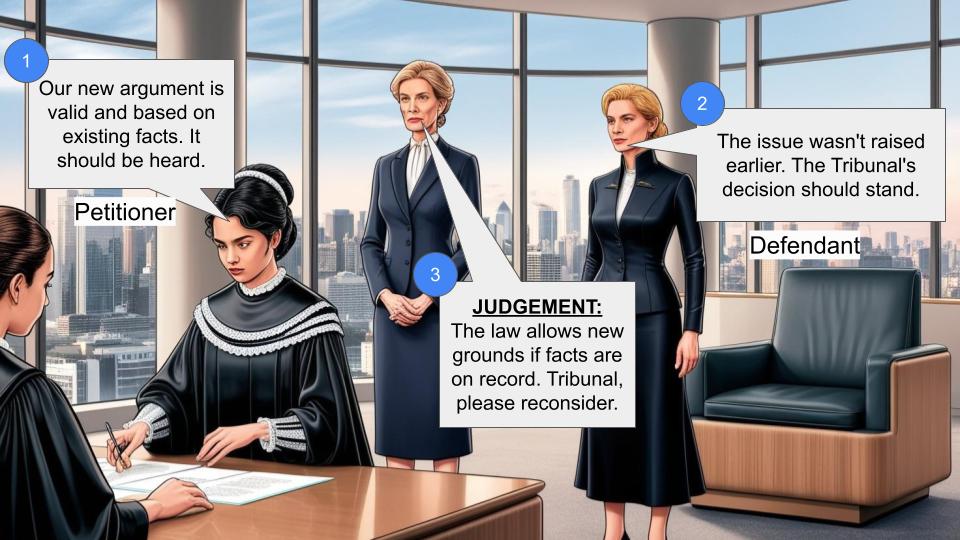
Tribunal Must Consider New Legal Questions if Facts Are on Record, Rules High Court
Tribunal Must Consider New Legal Questions if Facts Are on Record, Rules High Court
This case involves an appeal by an assessee (taxpayer) against the Income Tax Appellate Tribunal's decision to disallow the raising of an additional ground related to tax deduction at source. The High Court ruled in favor of the assessee, stating that the Tribunal should have allowed the new ground to be raised as long as the relevant facts were on record.
Case Name** JEHANGIR H C JEHANGIR VS INCOME TAX OFFICER **Key Takeaways** 1. The Tribunal has wide powers under Section 254 (of Income Tax Act, 1961) to consider new questions of law, even if not raised earlier. 2. The purpose of assessment proceedings is to correctly assess tax liability in accordance with the law. 3. The Tribunal's discretion to allow new grounds should be exercised in line with legal precedents and reasoning. 4. Restricting the Tribunal's power only to issues arising from the Commissioner's order is too narrow an interpretation. **Issue** Was the Income Tax Appellate Tribunal (ITAT) correct in rejecting the additional grounds of appeal raised by the appellant (assessee)? **Facts** 1. The assessee challenged a part of the Tribunal's order that refused to admit an additional ground related to payment of Rs. 7.41 lakhs under sections 194 (of Income Tax Act, 1961) and 194J of the Income Tax Act, 1961. 2. The Tribunal refused to admit this question, stating it did not arise from the order of the First Appellate Authority (Commissioner of Income Tax (Appeals)). 3. The assessee appealed to the High Court against this decision. **Arguments** Assessee's Argument: - The Tribunal's approach contradicts the binding judgment of the Supreme Court in the case of National Thermal Power Limited Company V/s. Commissioner of Income Tax. Revenue's Argument: - The Tribunal was justified in its conclusion because the issue wasn't raised or controversial before the Assessing Officer or Commissioner. - The assessee had accepted before the Assessing Officer that the payment would attract the provision and they were obliged to deduct tax at source. **Key Legal Precedents** 1. National Thermal Power Limited Company V/s. Commissioner of Income Tax, (1998) 229 ITR 383: - The Supreme Court held that the Tribunal has wide powers under Section 254 (of Income Tax Act, 1961). - The Tribunal should not be prevented from considering questions of law arising in assessment proceedings, even if not raised earlier. 2. Jute Corporation of India Ltd. V/s. CIT (1991) 187 ITR 688: - The Supreme Court observed that an appellate authority has all the powers of the original authority, subject to statutory limitations. - The appellate authority should exercise discretion in permitting new grounds in accordance with law and reason. **Judgement** 1. The High Court ruled in favor of the assessee, answering the question of law in their favor and against the Revenue. 2. The Tribunal's order dated 16th May, 2012, was quashed and set aside. 3. The ground was restored to the Tribunal's file, and Income Tax Appeal No. 2050/Mum/2009 for the assessment year 2005-06 was to be re-heard by the Tribunal on merits and in accordance with law. 4. The court emphasized that the Tribunal should have allowed the new ground to be raised, as it was only required to consider a question of law arising from facts already on record. **FAQs** 1. Q: Why did the High Court rule in favor of the assessee? A: The High Court ruled in favor of the assessee because the Tribunal's decision to disallow the new ground contradicted the Supreme Court's judgment in the National Thermal Power case, which allows for consideration of new legal questions if the facts are on record. 2. Q: Does this mean that any new ground can be raised before the Tribunal? A: Not necessarily. The Tribunal still has discretion, but it should allow new grounds when they involve questions of law arising from facts already on record, especially if it's necessary to correctly assess the tax liability. 3. Q: What impact does this judgment have on future cases? A: This judgment reinforces the principle that tax tribunals should have a broader approach in admitting new grounds of appeal, focusing on correct assessment of tax liability rather than procedural limitations. 4. Q: Does this decision apply only to Income Tax cases? A: While this specific case deals with Income Tax, the principle of allowing new grounds in appellate proceedings could potentially be applied in other areas of law as well. 5. Q: What should taxpayers take away from this judgment? A: Taxpayers should be aware that they may have the opportunity to raise new legal grounds before the Tribunal, even if not raised earlier, as long as the relevant facts are on record and it's necessary for correct tax assessment.

This Appeal by the Assessee challenges that part of the Tribunal's order by which it refused to admit an additional ground and raised by the Assessee. That was in relation to payment of Rs.7.41 lakhs and traceable to section 194 (of Income Tax Act, 1961) and 194J of the Income Tax Act, 1961. The Tribunal refused to admit this question as in its opinion, it does not arise out of the order of the First Appellate Authority.
2] After hearing Mr. Irani, learned counsel, appearing on behalf of the Assessee, in support of this Appeal and Mr. Chhotaray, learned counsel, appearing for the Revenue, we are of the opinion that the Appeal deserves to be admitted. It is admitted on the following substantial question of law:
“Whether on the facts and the circumstances of the case and in law, the ITAT was right in rejecting the Additional Grounds of Appeal raised by the Appellant?”
3] Since the Tribunal has not allowed the Assessee to raise this additional ground, no useful purpose will be served by keeping this Appeal pending on our file. That is why we have heard it and with the consent of the parties, we dispose of it finally.
4] Mr. Irani, submits that the Tribunal's approach is in direct contradiction with the binding judgment of the Hon'ble Supreme Court in the case of National Thermal Power Limited Company V/s. Commissioner of Income Tax. The said decision is reported in (1998) 229 ITR 383.
5] On the other hand, Mr. Chhotaray, would submit that the Tribunal was justified in the conclusion that it reached because really speaking there was no controversy or issue raised on this question or ground. Inviting our attention to the findings of the Assessing Officer, Mr. Chhotaray submits that the Assessee cannot make any grievance because it has accepted before the Assessing Officer that the payment would attract this provision and they were obliged to deduct the tax at source. In such circumstances, it was not an issue before the Commissioner. If it was not an issue raised, then, the same has been rightly disallowed to be raised by the Tribunal. No substantial question of law, therefore, arises for determination in this Appeal and it should be dismissed.
6] The Hon'ble Supreme Court in the case of National Thermal Power (supra) has held that under section 254 (of Income Tax Act, 1961), the Tribunal after giving an opportunity of being heard to both parties, pass such orders as it thinks fit. In dealing with power of the Tribunal under section 254 (of Income Tax Act, 1961), the Hon'ble Supreme Court held as under:
“Under section 254 (of Income Tax Act, 1961), the Appellate Tribunal may, after giving both the parties to the appeal an opportunity of being heard, pass such orders thereon as it thinks fit. The power of the Tribunal in dealing with Appeals is thus expressed in the widest possible terms. The The purpose of the assessment proceedings before the taxing authorities is to assess correctly the tax liability of an Assessee in accordance with law. If, for example, as a result of a judicial decision given while the Appeal is pending before the Tribunal, it is found that a nontaxable item is taxed or a permissible deduction is denied, we do not see any reason why the Assessee should be prevented from raising that question before the Tribunal for the first time, so long as the relevant facts are on record in respect of that item. We do not see any reason to restrict the power of the Tribunal under section 254 (of Income Tax Act, 1961) only to decide the ground which arise from the order of the Commissioner of Income Tax (Appeals). Both the Assessee as well as the Department have a right to file an Appeal/Cross objections before the Tribunal. We fail to see why the Tribunal should be prevented from considering questions of law arising in assessment proceedings although not raised earlier.
In the case Jute Corporation of India Ltd. V/s. CIT (1991) 187 ITR 688, this Court, while dealing with the powers of the Appellate Assistant Commissioner observed that an appellate authority has all the powers which the original authority may have in deciding the question before it subject to the restrictions or limitations, if any, prescribed by the statutory provisions. In the absence of any statutory provision, the appellate authority is vested with all the plenary powers which the subordinate authority may have in the matter. There is no good reason to justify curtailment of the power of the Appellate Assistant Commissioner in entertaining an additional ground raised by the Assessee in seeking modification of the order of assessment passed by the Income Tax Officer. This Court further observed that there may be several factors justifying the raising of a new plea in an Appeal and each case has to be considered on its own facts. The Appellate Assistant Commissioner must be satisfied that the ground raised was bona fide and that the same could not have been raised earlier for good reasons. The Appellate Assistant Commissioner should exercise his discretion in permitting or not permitting the Assessee to raise an additional ground in accordance with law and reason. The same observations would apply to Appeals before the Tribunal also.
The view that the Tribunal is confined only to issues arising out of the Appeal before the Commissioner of Income Tax (Appeals) takes too narrow a view of the powers of the Appellate Tribunal [vide, e.g. CIT V/s. Anand Prasad (1981) 74 ITR 254 (Guj) and CIT V/s. Cellulose Products of India Ltd. (1985) 151 ITR 499 (Guj) (FB)]. Undoubtedly, the Tribunal will have the discretion to allow or not allow a new ground to be raised. But where the Tribunal is only required to consider a question of law arising from the facts which are on record in the assessment proceedings we fail to see why such a question should not be allowed to be raised when it is necessary to consider that question in order to correctly assess the tax liability of an Assessee.”
7] In the light of authoritative pronouncement and which was binding on the Tribunal, in terms of Article 141 of the Constitution of India, we do not see how the Tribunal could have disallowed the Assessee from raising this ground. It may be that the Tribunal is inclined not to grant the request of the Assessee because eventually the ground may have to be answered against the Assessee on merits. However, that is a totally irrelevant consideration. We are on the power of the Tribunal to permit raising of such ground and which may or may not be arising from the order of the First Appellate Authority. In the instant case, that issue is specifically taken up before the Assessing Officer. That the Commissioner may or may not have rendered any view on it as the First Appellate Authority, does not mean that the Tribunal was precluded in law from considering the same after it was specifically raised by the Assessee before it. This approach of the Tribunal and being contrary to the express language of the statute and interpreted in a binding judgment of the Hon'ble Supreme Court that we are of the opinion that the Tribunal's order cannot be sustained in law. The question of law as framed above, is answered in favour of the Assessee and against the Revenue. The Tribunal's order dated 16th May, 2012 and impugned in this Appeal is quashed and set aside. This ground is restored to the file of the Tribunal and as a result thereof, Income Tax Appeal No.2050/Mum/2009 for the assessment year 200506 shall be reheard by Tribunal on merits and in accordance with law. We keep open all contentions of the parties on the same. Since, Mr. Irani has fairly stated that the Tribunal need not reopen the issue formulated by it with regard to the applicability under section 80IB(10) (of Income Tax Act, 1961), our direction shall stand confined to the question formulated by us above. The Tribunal shall admit this question only to its file and hear and decide the Appeal in accordance with law after giving an opportunity to both sides. Income Tax Appeal No.2050/Mum/2009 stands restored to the file of the Tribunal only for this limited purpose. Our order and direction does not express any opinion on the merits of this ground.
(A. A. SAYED, J.) (S.C. DHARMADHIKARI, J.)
×
Questions
Tribunal Must Consider New Legal Questions if Facts Are on Record, Rules High Court
Write your CommentSimilar Posts


Generic
- Reportdata/4417.pdf
