


Tribunal Upholds Assessee's Appeal, Overturns Commissioner's Section 263 (of In…


Full News

Tribunal Upholds Assessee's Appeal, Overturns Commissioner's Section 263 (of Income Tax Act, 1961) Order
Tribunal Upholds Assessee's Appeal, Overturns Commissioner's Section 263 (of Income Tax Act, 1961) Order
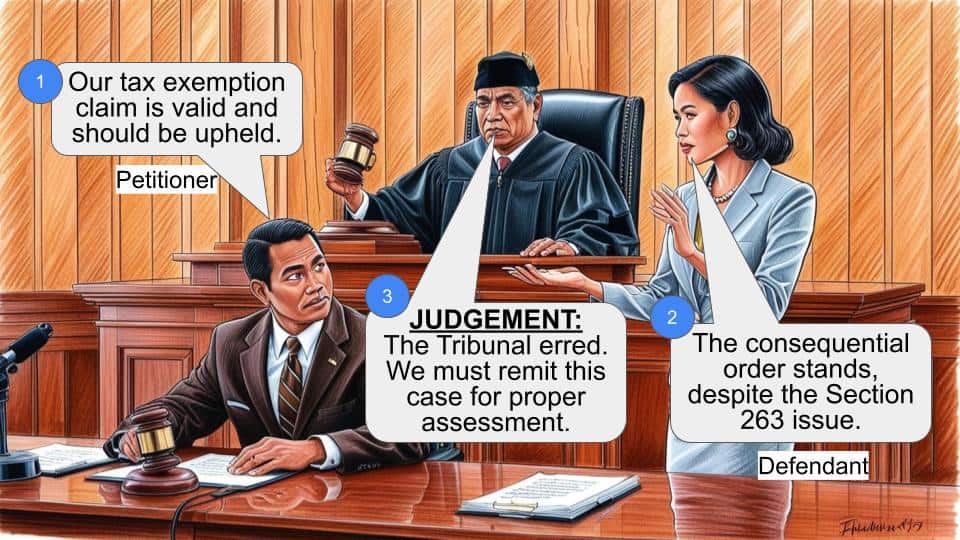
The Income Tax Appellate Tribunal reversed the Commissioner's order under section 263 (of Income Tax Act, 1961), which had set aside an Assessing Officer's assessment. The High Court upheld the Tribunal's decision, finding that the Commissioner's action was based merely on a change of opinion rather than on erroneous assessment prejudicial to the Revenue's interests.
Get the full picture - access the original judgement of the court order here.
Case Name:
Commissioner of Income Tax Vs Ms. Bina Indra kumar (High Court of Bombay)
Income Tax Appeal No.24 of 2013
Date: 17th December 2014
Key Takeaways:
1. The Tribunal's decision to reverse the Commissioner's order was justified.
2. The Commissioner's power under section 263 (of Income Tax Act, 1961) cannot be exercised based solely on a change of opinion.
3. An agreement for sale in Mumbai confers enforceable rights, recognized by the Maharashtra Ownership of Flats Act, 1963.
4. The High Court emphasized the importance of considering the entire transaction context in such cases.
Issue:
Whether the Income Tax Appellate Tribunal was justified in reversing the Commissioner's order under section 263 (of Income Tax Act, 1961), which had set aside the Assessing Officer's assessment order?
Facts:
1. The case pertains to the Assessment Year 2006-07.
2. The Commissioner invoked power under section 263 (of Income Tax Act, 1961) to set aside an assessment order dated 15 December 2008.
3. The transaction involved the purchase and sale of three flats by the Assessee.
4. Key dates in the case:
- 14 March 2001: Initial agreement for sale
- 9 October 2002: Deed of Rectification
- 24 October 2002: Agreements registered for stamp duty
- 20 January 2003: Occupation Certificate issued
Arguments:
Revenue's Arguments:
1. The Assessee was not entitled to claim long-term capital gains as the asset was not held for the minimum period of 36 months.
2. The Occupation Certificate date (20 January 2003) indicated that the flats were not ready for occupation earlier.
3. The Commissioner's inquiry into the agreement details was crucial and should have been made.
Assessee's Arguments (implied from the judgment):
1. The requisite details of the transaction were placed before the Assessing Officer.
2. The agreement for sale conferred enforceable rights recognized by law.
3. The transaction was complete with the initial agreement and Rectification Deed together.
Key Legal Precedents:
1. Maharashtra Ownership of Flats (Regulation of the Promotion of Construction Sale Management and Transfer) Act, 1963:
Recognizes rights conferred by agreements for sale of immovable property in Mumbai.
2. Commissioner of Income Tax vs. Smt.Beena K.Jain, 1996 (217) ITR 363:
The court found this precedent inapplicable to the current case as it was based on specific facts rather than laying down a principle of law.
Judgement:
1. The High Court dismissed the Revenue's appeal, upholding the Tribunal's decision.
2. The Court found that the Commissioner's order was based merely on a change of opinion, which is not sufficient to invoke section 263 (of Income Tax Act, 1961) powers.
3. The Tribunal was justified in reversing the Commissioner's view and allowing the Assessee's appeal.
4. The Court emphasized that an agreement for sale in Mumbai confers enforceable rights recognized by law.
FAQs:
Q1: What is the significance of section 263 (of Income Tax Act, 1961)?
A1: Section 263 (of Income Tax Act, 1961) allows the Commissioner to revise any order passed by the Assessing Officer if it is erroneous and prejudicial to the interests of the Revenue. However, this power cannot be exercised merely on a change of opinion.
Q2: Why did the Court emphasize the nature of property transactions in Mumbai?
A2: The Court highlighted that agreements for sale in Mumbai confer enforceable rights, recognized by the Maharashtra Ownership of Flats Act, 1963. This understanding is crucial for determining when property ownership begins for tax purposes.
Q3: What was the main reason for dismissing the Revenue's appeal?
A3: The Court found that the Commissioner's order was based merely on a change of opinion rather than on the assessment being erroneous and prejudicial to the Revenue's interests, which is not sufficient grounds for invoking section 263 (of Income Tax Act, 1961) powers.
Q4: How did the Court view the multiple agreements and dates in this case?
A4: The Court considered the entire transaction context, including the initial agreement, Rectification Deed, and registration dates. It emphasized that these documents together constituted a complete transaction, rather than separate events for tax purposes.
Q5: What precedent does this judgment set for similar cases?
A5: This judgment reinforces that the Commissioner's powers under section 263 (of Income Tax Act, 1961) cannot be exercised based solely on a difference of opinion. It also highlights the importance of considering the full context of property transactions, especially in cities like Mumbai with specific property laws.

1. This Appeal by the Revenue challenges the order passed by the Income Tax Appellate Tribunal on 15 June 2012 in Income Tax Appeal No.4106/Mum/2011 for the Assessment Year 2006-07. The Tribunal was considering the challenge to the order passed by the Commissioner of Income Tax dated 29 March 2011. The Commissioner invoked his power under section 263 (of Income Tax Act, 1961) to set aside the assessment order dated 15 December 2008, as in the opinion of the Commissioner the same is erroneous and in so far as it is prejudicial to the interest of the Revenue.
2. The Tribunal, Mumbai Bench, found that the Commissioner’s power under section 263 (of Income Tax Act, 1961) could not have been exercised in the given facts and circumstances. The exercise of powers was based merely on change of opinion. If the Commissioner held the particular opinion, but on the same transaction and same dealing, then that was not enough to enable him to exercise this power, is the conclusion reached.
3. Mr.Chhotaray, learned Counsel appearing on behalf of the Revenue, would submit that this conclusion of the Tribunal is vitiated by error of law apparent on the face of the record. He took us through the order of the Assessing Officer and that of the Commissioner. He showed us relevant dates. He submits that on 14 March 2001 three flats/immoveable property are stated to have been acquired by the Assessee, but that is incorrect. There was a
deed of rectification dated 9 October 2002. There is another date, i.e. 24 October 2002, which is when the agreements were registered with the authorities for stamp duty purpose. In such circumstances, he submits that the Assessee is not entitled to claim long term capital gains if the asset was not held for the minimal period of 36 months. There is another date and which is the date of the Occupation Certificate issued by the Municipal Corporation in this case and that is stated to be 20 January 2003. This only means that the flats were not ready for occupation and could never have been in possession of the Assessee.
4. The Tribunal held that this was not relevant consideration at all. If the requisite details and pertaining to the transaction of purchase and sale of three flats by the Assessee were placed on record before the Assessing Officer, then computation of capital gains by the Assessing Officer was a
possible exercise. The Commissioner merely held a different opinion. In his opinion, what is relevant for the purpose of such inquiry and scrutiny is that the agreements should have been referred to in detail with their clauses. If they had been referred to, it would be apparent to the Assessing Officer that the first agreement dated 14 March 2001 is mere an agreement for sale. This means neither the property was handed over nor the transaction was registered. It contains number of dates regarding payment made or to be received, talks of possession by 31 December 2002. Then
there is a Rectification Agreement dated 9 October 2002 and styled
as Deed of Rectification, which not only changes number of flats under the Agreement but also enhances the area. The additional consideration of Rs.32,87,000/- was also stated to be paid. Therefore, this is not extension of the earlier agreement but a fresh agreement. In any event, this does not talk of possession with the Assessee. There there is another date for registration of the agreement for the purpose of stamp duty, namely 22 October 2002. The rest of the dates are including a date of certificate styled as Occupation Certificate' issued by the Municipal Corporation.
5. If all these dates are taken together, then the property has not been held for the stipulated period. This inquiry was crucial and should have been made is the submission.
6. Having perused the Commissioner’s order in its
entirety, what we find is that firstly the Commissioner rendered a
particular finding. In his opinion, an agreement for sale confers no
title in the immoveable property. The Commissioner possibly is not
aware of the nature of the transaction and in immoveable property
in the city of Mumbai. This agreement for sale definitely confers
rights and which are capable of being enforced. They have been
statutorily recognized in a Legislation styled as Maharashtra
Ownership of Flats (Regulation of the Promotion of Construction
Sale Management and Transfer) Act, 1963 ( in short `MoFA”) .
Secondly, the consideration thereunder had been paid and what
remained was a rectification or change in flat numbers and the area.
The transaction or deal was, thus, complete, but when the area
increased, additional consideration was paid. If there was no final
or concluded contract, then possibly there was no requirement of
styling subsequent document or agreement as `Rectification Deed'.
The mere agreement for sale and without anything more would not
require registration. However, when the agreement for sale with the
Rectification Deed together were taken as a document conveying
immoveable property that the stamp authority or authorities under
the Bombay Stamp Act, 1958 levy assess and recover stamp duty.
The registration of the agreement is also, therefore, on the footing
that it is a conveyance. In such circumstances, it is not clear as to
why the Commissioner held another opinion. Apart therefrom only
his view and opinion will not enable him to exercise the power u/s
263 of the I.T.Act, that is not found to be permissible in law by the
Tribunal. Secondly, we find very strange mode of exercise of power
by the Commissioner. In six paragraphs, he faults the Assessing
Officer for not holding any inquiry or doing proper inquiry and
collecting the relevant information. In para 7, he holds that without
prejudice to what has been observed by him earlier, even if the
Assessee's version is to be accepted, the Assessing Officer failed to
apply a proper indexation because separate indexation were
needed for two separate sets of agreement, the original agreement
to sale and the deed of rectification, which contained different areas
and different negotiated prices. This is also nothing, but his view. If
his view on the same set of facts pertaining to the transaction alone
have gone into in the exercise undertaken by him and for invoking
the power under section 263 (of Income Tax Act, 1961), then, we do not find that the
Tribunal was in error in reversing his order and not upholding his
view. The Tribunal has considered the matter in its entirety and has
held that the Assessing Officer's order is not erroneous and in so far
as it is prejudicial to the interest of the Revenue, but the
Commissioner proceeded to exercise his power on mere change of
opinion. In these circumstances, the Tribunal was completely
justified in reversing the Commissioner’s view and allowing the
Assessee's Appeal. Such an order of the Tribunal can hardly be
termed as perverse or vitiated by any error of law apparent on the
face of the record.
7. Reliance placed by Mr.Chhotaray on the Division Bench
judgment of this Court in the case of Commissioner of Income Tax
vs. Smt.Beena K.Jain, 1996 (217) ITR 363 is completely
misplaced. There the Court upheld the order of the Tribunal,
because the residential house purchased by the Assessee could not
have been said to be acquired and when the full consideration was
not paid. The relevant date taken by the Court and namely payment
of the consideration on 29 July 1988 and the subsequent date, that
is immediately on the next day, the Assessee was put in
possession, which enables it to uphold the conclusion of the
Tribunal. It is, therefore, the Court dismissed the Revenue's
Application. It is not laying down any principle of law. It is essentially
on the facts and taken cumulatively that the Revenue's
Appeal/Application was dismissed. In such circumstances, we do
not find that this judgment can be of any assistance to the Revenue.
8. The Appeal is dismissed. No order as to costs.
(A.A. SAYED, J.) (S.C.DHARMADHIKARI,J.)
×
Questions
Tribunal Upholds Assessee's Appeal, Overturns Commissioner's Section 263 (of Income Tax Act, 1961) Order
Write your CommentSimilar Posts


Generic
- Reportdata/4223.pdf
