Full News
Tribunal’s Duty: Follow Precedent or Explain Departure in Co-op Society Tax Case
Tribunal’s Duty: Follow Precedent or Explain Departure in Co-op Society Tax Case
A case involving Hatkesh Co-op. Hsg. Society Ltd. and the Assistant Commissioner of Income Tax. The main issue was about how the Income Tax Appellate Tribunal (ITAT) handled a case that had already been decided by another bench of the same tribunal. The High Court basically said, “Hey, ITAT, you can’t just ignore your own previous decisions without a good reason.
Get the full picture - access the original judgement of the court order here
Case Name:
Hatkesh Co.op. HSG Society Ltd. Vs Assistant Commissioner of Income Tax (High Court of Bombay)
Income Tax Appeal No. 328, 372, 407, 636, 961 and 1079 of 2014
Date: 22nd August 2016
Key Takeaways:
- Tribunals should follow their own previous decisions on similar issues.
- If a tribunal wants to deviate from a previous decision, they need to explain why.
- Judicial discipline is crucial for consistency in legal decisions.
- If there’s a disagreement with a previous decision, the tribunal should request a larger bench to review the issue.
Issue:
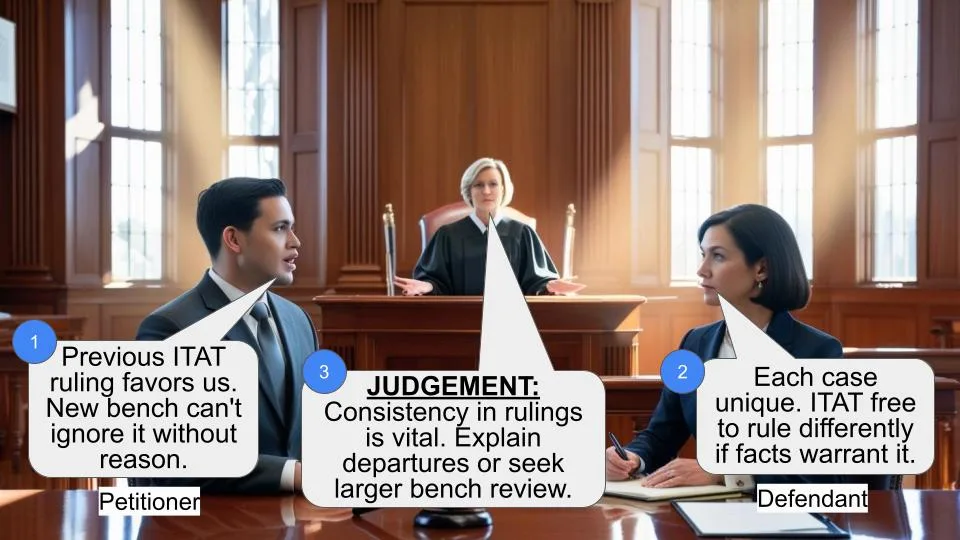
Was the Income Tax Appellate Tribunal justified in taking a view contrary to the decision of its own coordinate bench on identical facts without making a reference to a larger bench?
Facts:
- Hatkesh Co-op. Hsg. Society Ltd. was involved in a tax dispute for multiple assessment years (1996-97, 2000-01, 2001-02, 2002-03, 2006-07, and 2007-2008).
- The dispute was about whether transfer fees and TDR (Transferable Development Rights) premium received by the society from its members should be taxed.
- An earlier ITAT bench had ruled on June 24, 2011, that these fees were covered by the principle of mutuality (meaning they shouldn’t be taxed).
- In the current case, another ITAT bench decided differently without explaining why they were departing from the previous decision.
Arguments:
The appellant (Hatkesh Co-op. Hsg. Society) argued that:
- The issue was already covered by the earlier ITAT decision from June 24, 2011.
- The principle of mutuality should apply to transfer fees and TDR premiums.
The tax department likely argued against applying the principle of mutuality, but the specific arguments aren’t detailed in the judgment.
Key Legal Precedents:
- Sind Co. Op. Hsg. Society vs. ITO, (2009) 317 ITR 47 (Bom.) (High Court): This case was considered in both the earlier ITAT decision and the current disputed order.
- The judgment also refers to general principles of judicial discipline and the binding nature of coordinate bench decisions.
Judgement:
The High Court ruled in favor of Hatkesh Co-op. Hsg. Society. They said:
- The ITAT’s order was not legally sustainable.
- When a coordinate bench has already decided an identical issue, subsequent benches should follow that decision.
- If a bench wants to take a different view, they must record their reasons for not following the earlier order.
- If there’s disagreement with a binding decision, the bench should request the ITAT President to constitute a larger bench.
- The case was sent back to the ITAT for fresh disposal, considering these points.
FAQs:
Q: What’s the “principle of mutuality” mentioned in the case?
A: It’s a tax concept where certain transactions between a cooperative society and its members are not considered taxable income.
Q: Why is this case important?
A: It emphasizes the importance of consistency in tribunal decisions and sets guidelines for when tribunals can deviate from previous rulings.
Q: Does this mean tribunals can never change their minds?
A: No, they can, but they need to explain their reasons or ask for a larger bench to review the issue.
Q: What happens next in this case?
A: The ITAT will have to reconsider the case, taking into account the High Court’s guidance about following previous decisions.
Q: Could this decision affect other tax cases?
A: Yes, it could influence how tribunals handle similar situations where they’re considering departing from previous decisions.

1. All these appeals under Section 260 (of Income Tax Act, 1961)A of the Income Tax Act 1961 (Act) challenge the common order dated 4 September 2013 of the Income Tax Appellate Tribunal (Tribunal). The common impugned order is in respect of Assessment Years 1996-97, 2000-01, 2001-02, 2002-03, 2006-07 and 2007-2008 which are taken exception to in all these six appeals.
2. After hearing the Counsel, we admit all the six appeals on the following substantial question of law:
“Whether in the facts and circumstances of the case the Tribunal was justified in taking a view contrary to the decision of the coordinate bench of the Tribunal in appellants own case on identical facts without making a reference to the larger bench?”
3. The Counsel appearing for parties request that the appeal itself be disposed of at the stage of admission as the issue is within a narrow compass. Therefore, the appeals are being considered and disposal of finally.
4. We find that the impugned order makes reference to the appellant's submission that the issue arising in the appeal before it is covered by the order of a Coordinate Bench of the Tribunal dated 24 June 2011 in its own case in respect of Assessment Years 200304 2004 05 and 200506. The order dated 24 June 2011 of the Tribunal was with regard to the two issues, which arose for consideration before the Tribunal in these six Assessment Years, namely, the application of principle of mutuality in respect of transfer fees and TDR premium received by the Assessee from its members. The order dated 24 June 2011 inter alia considered the decision of this Court in Sind Co. Op. Hsg. Society vs. ITO1 before coming to the conclusion that transfer fees as well as TDR premium received from Cooperative Societies is covered by the principle of mutuality.
5. The impugned order of the Tribunal after making a note of its Coordinate Bench's order dated 24 June 2011 seeks to take a different view. This different view was taken in the impugned order inter alia by relying upon the decision of this Court in Sind Co.Op. Hsg. Society (supra) which was also subjected to consideration in its order dated 24 June 2011. We are of the view that when an identical issue, which had earlier arisen before the Coordinate Bench of the Tribunal on identical facts and a view has been taken on the issue then judicial discipline would demand that a subsequent bench of the Tribunal hearing the same issue should follow the view taken by its earlier Coordinate Bench. No doubt this discipline is subject to the well settled exceptions of the earlier order being passed per incurim or sub silentio or in the meantime, there has been any change in law, either statutory or by virtue of judicial pronouncement. If the earlier order does not fall within the exception which affects its binding character before a coordinate bench of the Tribunal, then it has to follow it. However, if the Tribunal has a view different then the view taken by its Coordinate Bench on an identical issue, then the order taking such a different view must record its reasons as to why it does not follow the earlier order of the Tribunal on an identical issue, which could only be on one of the well settled exceptions which affect the binding nature of the earlier order. It could also depart from the earlier view of the Tribunal if there is difference in facts from the earlier order of Coordinate Bench but the same must be recorded in the order. The impugned order is blissfully silent about the reason why it choses to ignore the earlier decision of the Tribunal rendered after consideration of Sind Co. Op. Hsg. Society (supra), and take a view contrary to that taken by its earlier Coordinate Bench. It is made clear that in case a subsequent bench of the Tribunal does not agree with the reasons indicated in a binding decision of a coordinate bench, then for reason to be recorded, it must request the President of the Tribunal to constitute a larger bench to decide the difference of view on the issue.
6. In the present facts, the impugned order of the Tribunal is not legally sustainable. We, therefore, set aside the impugned order and restore the appeal to the Tribunal for fresh disposal.
7. It is made clear that we have not considered the merits of the appeal before the Tribunal. Thus all contentions left open to be urged before the Tribunal.
8. Accordingly, while restoring the issue to the Tribunal, the substantial question is answered in the negative, i.e. in favour of the Appellant Assessee and against the Respondent Revenue.
9. Appeals disposed of in above terms. No order as to costs.
(S.C. GUPTE,J.) (M.S.SANKLECHA,J.)
×