Full News

Tribunal’s Power to Rectify Mistakes: Ensuring Justice Over Technicalities
Tribunal’s Power to Rectify Mistakes: Ensuring Justice Over Technicalities
The case involves the Income Tax Appellate Tribunal’s ability to rectify its own orders when a mistake is apparent on the record, even in the absence of explicit review powers. The Tribunal initially made an error by misapplying legal principles, which caused prejudice to the assessee. The court ruled in favor of the assessee, allowing the Tribunal to correct its mistake to ensure justice.
Get the full picture - access the original judgement of the court order here
Case Name:
Commissioner of Income Tax Vs Quality Steel Tubes Ltd. (High Court of Allahabad)
Income Tax Reference No. 91 of 1998
Date: 16th July 2012
Key Takeaways:
- The Tribunal can rectify mistakes apparent on the record under Section 254(2) (of Income Tax Act, 1961), even without explicit review powers.
- The case emphasizes the principle that justice should prevail over procedural technicalities.
- Misapplication of legal principles or overlooking jurisdictional court judgments can be grounds for rectification.
Issue
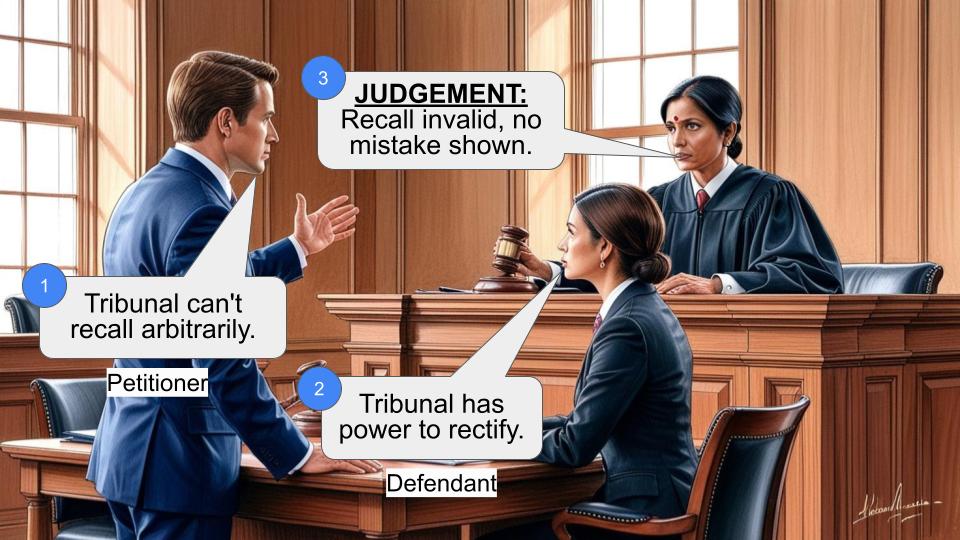
Can the Income Tax Appellate Tribunal recall its order to rectify an apparent mistake, even without explicit review powers, when such a mistake causes serious prejudice to the assessee?
Facts
- The assessee, a private limited company, filed a return declaring a loss, but the assessment resulted in a significant addition to its income due to discrepancies in stock statements.
- The Tribunal initially upheld the addition based on a misapplication of legal principles regarding hypothecation versus pledge.
- The assessee filed a Miscellaneous Application, leading the Tribunal to realize its mistake and recall its order for rectification.
Arguments
- Revenue’s Argument: The Tribunal should not have reviewed its order under Section 254(2) (of Income Tax Act, 1961) as it lacks explicit review powers.
- Assessee’s Argument: The Tribunal can rectify mistakes apparent on the record to prevent injustice, as supported by Supreme Court judgments in “Honda Siel Power Products Ltd” and “Saurashtra Kutch Stock Exchange Ltd.”
Key Legal Precedents
- Honda Siel Power Products Ltd vs. CIT: The Supreme Court held that rectification is permissible to prevent prejudice, even if it involves recalling an order.
- Saurashtra Kutch Stock Exchange Ltd: The Supreme Court emphasized that non-consideration of jurisdictional court decisions constitutes a mistake apparent on the record.
Judgement
The court decided in favor of the assessee, allowing the Tribunal to rectify its mistake. The judgment highlighted that justice should not be hindered by procedural technicalities, and the Tribunal’s action was justified to correct an apparent error.
FAQs
Q1: What does this case mean for the Tribunal’s powers?
A1: It clarifies that the Tribunal can rectify mistakes apparent on the record to ensure justice, even without explicit review powers.
Q2: Why was the Tribunal’s initial decision considered a mistake?
A2: The Tribunal misapplied legal principles regarding hypothecation versus pledge, leading to an incorrect decision that prejudiced the assessee.
Q3: How does this case impact future Tribunal decisions?
A3: It reinforces the importance of considering jurisdictional court judgments and allows for rectification of apparent mistakes to prevent injustice.

1. We have heard Sri Shambhu Chopra for the Revenue. Sri R.S. Garg appears for the Assessee.
2. In this Income Tax Reference, under Section 256(2) (of Income Tax Act, 1961), the Court directed the Income Tax Appellate Tribunal, to draw up statement of the case, and to refer the following question of law, for its consideration.
"Whether on the facts and in the circumstances of the case the Hon'ble Tribunal was right in law in recalling its order dated 6.11.1990, which had become final u/s 254(2) (of Income Tax Act, 1961) in exercise of its inherent power and in restoring the appeal of its file? "
3. The Income-tax Appellate Tribunal has drawn up the statement of case, and forwarded the reference application on 30.04.1997.
4. The facts leading to this reference are as follows:-
"The assessee, by status a private limited company was engaged in the manufacture and sale of black and galvanized steel tubes. For the year under consideration, it had filed its return declaring a loss of Rs.2,67,520/-. The relevant assessment was completed by the Income-tax Office, Central Circle IV, Kanpur (A.O.) vide order u/s 143(3) (of Income Tax Act, 1961) read with Section 144 (of Income Tax Act, 1961) B of I.T. Act, 1961 dated 25.9.1994 on a total income of Rs.10,92,020/-. The major addition made by the A.O. was of Rs.10,78,886/- on account of difference in respect of three items of stock in the stock statements submitted to the Hindustan Commercial Bank with whom such stocks had been hypothecated for obtaining the overdraft facility and the stocks as per the book of account. The A.O. took the 'peak' of each items as the base for making the addition.
The entire addition was deleted by the Commissioner of Income-Tax (C.I.T.) (Appeals), Kanpur vide order dated 14.03.1985.
On appeal by the Department, The Tribunal vide is order dated 30.10.1985, in I.T.A. No. 919 (Alld) of 1985, set aside the order of the C.I.T. (Appeals) on this issue, with specific directions. Vide his order dated 22.12.1986, passed in pursuance of the directions of the Tribunal, the C.I.T. (Appeals) found the entire addition of Rs.10,78.886/- to be unsustainable and hence the same was deleted.
In appeal by the department, the Tribunal in its order dated 6.11.1990, rendered in I.T.A. No. 447 (Alldd) of 1987 observed that in the circumstances of the case it was the responsibility of the assessee to explain each and every ounce of the discrepancy but it had failed to discharge this onus. The tribunal held that the conclusion of C.I.T. (Appeals) that the addition was not merited could not be sustained by it. It was concluded that this was a fit case where provisions of Sec. 69 (of Income Tax Act, 1961) B of the Act could be applied for sustaining the addition arising out of the discrepancy of stocks. It was further held that the binding decision of the Allahabad High Court in the case of Swadeshi Cotton Mills Co. Ltd reported in 125 ITR 33 squarely covered the facts of the present case. Following this decision, the Department's appeal was allowed and the order of the A.O. restored.
On a Miscellaneous Application moved by the assessee in relation to the Tribunal's order dated 6.11.1990, the Tribunal observed that the assessee's case was that of hypothecation of stocks whereas a plain reading of the Allahabad High Court judgment in the case of Swadeshi Cotton Mills Co. Ltd (125 ITR 33), which was held to be binding on the Tribunal while deciding this case, showed that it was that of pledge and even in that situation the Hon'ble High Court had held that it can at the worst lead to rejection of accounts and estimation of profits and not that the entire irregularity itself could be converted into money value and added to the income of the assessee. Therefore, with a view to ensuring that the principle laid down by the jurisdictional High Court in the case of Swadeshi Cotton Mills (supra) was followed in this case also both in letter and spirit, the Tribunal, vide its order dated 30.07.1993 in M.A. No. 67 (Alld) of 1991 recalled its order dated 6.11.1990 for the limited purpose of finding out as to what was the quantum of addition called for on account of excess stocks declared to the Bank."
5. The paper book has been filed in this case, and the matter was heard.
6. Sri Shambhu Chopra for the Revenue submits that the Tribunal has, in exercise of its power under Section 254(2) (of Income Tax Act, 1961) (hereinafter referred to as "the Act"), with a view to rectifying mistake apparent from the record, reviewed its judgment, which is not permissible.
7. Sri Chopra submits that the Tribunal had considered the judgment of this Court, which is a jurisdictional court to the Tribunal, in Swadeshi Cotton Mills Co. Ltd., reported in 125 ITR 3, and held that the decision is binding upon it, which according to the Tribunal covers the facts of the case. The Tribunal allowed the department's appeal and restored the order of the Assesssing Officer. The Tribunal thereafter had entertained the application of the assessee and passed an order on 30.07.1993, whereby exercising its power conferred under Section 254(2) (of Income Tax Act, 1961), it recalled its order dated 6.11.1990 on the same facts and considering the same judgment in M/s. Swadeshi Cotton Mills.
8. Sri Chopra, submits that the Tribunal while exercising powers conferred under Section 254(2) (of Income Tax Act, 1961), could not have reviewed its order. He has relied upon judgment of Delhi High Court in J.N. Sahni Vs. Income Tax Appellate Tribunal and others [2002 ITR (257) 17]; judgment of Rajasthan High Court in Champa Lal Chopra Vs. State of Rajasthan [2002 ITR (257) 74] and judgment of Madhya Pradesh High Court in Agarwal Warehousing and Leasing Ltd Vs. Commissioner of Income Tax [2002 ITR (257) 235].
9. Sri R.S. Garg, learned counsel appearing for the assessee, per contra, submits that the question as to whether the Income Tax Tribunal could recall its order, where it has wrongly considered/not considered the judgment of the jurisdictional court, is no longer res integra. The Supreme Court in ACIT Vs. Saurashtra Kutch Stock Exchange Ltd [2008 (305) ITR 227 (SC.) and Honda Siel Power Products Ltd Vs. CIT [(2007 (295) ITR 466 (S.C.)] has explained the legal position, that in the absence of power of review, the order of rectification stems from the fundamental principle that justice is above all. The power under Section 254(2) (of Income Tax Act, 1961) can be exercised to remove the error apparent on record. By invoking the jurisdiciton under sub-section (2) of the said section, the statutory finality cannot be destroyed or the provision cannot be made nugatory.
10. In Honda Siel Power Products Ltd (Supra), the Supreme Court held that where the Tribunal gave a finding that the earlier decision of a coordinate Bench was cited before it, but through oversight it had missed the judgment while dismissing the appeal filed by assessee on the question of admissibility/allowability of the claim of the assessee for enhanced depreciation under Section 43-A (of Income Tax Act, 1961), the Tribunal was justified in rectifying the mistake by recalling the order. The Supreme Court held that one of the important reasons for giving the power of rectification to the Tribunal under Section 254(2) (of Income Tax Act, 1961), is to ensure that no prejudice is caused to either of parties appearing before it.
11. Sri R.S. Garg also relied upon judgment of this Court in CIT Vs. Khan Sirohi Steel Rolling Mills in which this Court has held that where the Tribunal has already found that there was no verification of stock made by any bank official, and that no contrary decision was pointed out to show that a practice to inflate stocks hypothecated with the bank, with a view to avail higher overdraft facilities, was not found to be prevalent in business community, the court could decide the matter on such presumption.
12. The Delhi High Court in Lachman Dass Bhatia Hingwala (P) Ltd Vs. Assistant Commissioner of Income-Ta [2011 (330) ITR 243], relying upon both the judgements, namely, Saurashtra Kutch Stock Exchange Ltd (Supra) and in Honda Siel Power Products Ltd (Supra) and Saurashtra Kutch Stock Exchange Ltd (Supra), has elaborated the powers of the Tribunal under Section 254(2) (of Income Tax Act, 1961). The discussion in the judgment is quoted as follows:-
But what has been stated by the apex court in Honda Siel Power products Ltd [2007] 295 ITR 466 (SC) is based on the doctrine of prejudice. Their Lordships have clarified that they were not proceeding on the doctrine or concept of inherent power. Analyzed from this perspective, there can be no trace or shadow of doubt that the said decision is an authority for the proposition that the tribunal in certain circumstances can recall its own order and section 254(2) (of Income Tax Act, 1961) does not totally prohibit so.
In this context, we may refer with profit to the decision to Asst. CIT Vs. Saurashtra Kutch Stock Exchange ltd [2003] 262 ITR 146 wherein a Division Bench of the Gujarat high Court was dealing with a writ petition preferred under articles 226 and 227 of the Constitution of India. In the said case, the assail was to the order dated September 5, 2001, passed by the tribunal whereby the Tribunal had recalled the earlier order dated October 27, 2000. The Division Bench dealt with the contention canvassed by the revenue that the tribunal cannot obliterate its earlier findings/reasoning/order and the original order cannot be wiped out and came to hold as follows (page 162):
"(a) The Tribunal has power to rectify a mistake apparent from the record on its own motion or on an application by a party under section 254(2) (of Income Tax Act, 1961)'
(b) An order on appeal would consist of an order made under section 254(1) (of Income Tax Act, 1961) or it could be an order made under sub-section (1) as amended by an order under sub-section (2) of Section 254 (of Income Tax Act, 1961);
(c) The power of rectification is to be exercised to remove an error or correct a mistake and not for disturbing finality, the fundamental Principe being, that power of rectification is for justice and fair play;
(d) that power of rectification can be exercised even if a mistake is committed by the tribunal or even if a mistake has occurred at the instance of party to the appeal;
(e) A mistake apparent from record should be self-evident, should not be a debatable issue, but this test might break down, because judicial opinions differ, and what is a mistake apparent from the record cannot be defined precisely and must be left to be determined judicially on the facts of each case;
(f) Non-consideration of a judgment of the jurisdictional high court would always constitute a mistake apparent from the record, regardless of the judgment being rendered prior to or subsequent to the order proposed to be rectified;
(g) After the mistake is corrected, consequential order must follow, and the tribunal has power to pass all necesary consequential orders."
On the basis of the said conclusions, the writ court affirmed the order of recall passed by the tribunal. the aforesaid decision was challenged by the Revenue before the apex court and their Lordships in Asstt. CIT. Saurashtra Kutch Stock Exchange Ltd [2008] 305 ITR 227 (SC) cam to hold as follows (page 240):
"The core issue, therefore, is whether non-consideration of a decision of jurisdictional court (in this case a decision of the high Court of Gujarat) or of the Supreme Court can be said to be a 'mistake apparent from the record'? In our opinion, both - the Tribunal and the High Court - were right in holding that such a mistake can be said to be a 'mistake apparent from the record' which could be rectified under section 254(2) (of Income Tax Act, 1961)." (emphasis supplied]
Thereafter, their Lordships proceeded to state as follows (page 21):
"Rectification of an order stems for the of an order stems from the fundamental principle that justice above all. It is exercised to remove the error and to disturb the finality.
In S. Nagraj Vs. State of Karnataka [1993] Supp 4 SCC 595, 618, Sahai J stated:
'Justice is virtue which transcends all barriers. Neither the rules of procedure nor technicalities of law can stand in its way. The order of the court should not be prejudicial to anyone. Rule of stare decisis is adhered for consistency but it is not as inflexible in Administrative law as in Public Law. even the law bends before justice. entire concept of writ jurisdiction exercised by the higher courts is founded on equity and fairness. If the court finds that the order was passed under a mistake and it would not have exercised the jurisdiction but for the erroneous assumption which in fact did not exist and its perpetration shall result in miscarriage of justice then it cannot on any principle be precluded from rectifying the error. mistake is accepted as valid reason to recall an order. Difference lies in the nature of mistake and scope of rectification, depending on if it is of fact or law. But the root from which the power flows is the anxiety to avoid injustice. It is either statutory or inherent. The latter is available where the mistake is of the court. In Administrative Law, the scope is still wider. Technicalities apart if the court is satisfied of the injustice then it is its constitutional and legal obligation to set it right by recalling its order.'
In the present case, according to the assessee, the tribunal decided the matter on October 27,2000. Hiralal Bhagwati [2000] 246 ITR 188 (Guj.) was decided a few months prior to that decision, but it was not brought to the attention of the Tribunal. In our opinion, in the circumstances, the Tribunal has not committed any error of law or of jurisdiction in exercising power under sub-section (2) of section 254 (of Income Tax Act, 1961) and in rectifying the 'mistake apparent from the record'. Since no error was committed by the tribunal in rectifying the mistake, the high court was not wrong in confirming the said order. Both the orders, therefore, in our opinion, are strictly in consonance with law and no interference is called for."
We will be failing in our duty if we do not address to the submission canvassed by Mr. Mehta that the said decision in Honda Siel Power Products Ltd., (supra) has been distinguished by many High Courts as well as by the Apex court in Saurashtra Kutch Stock Exchange Ltd [2008] 305 ITR 227 and Hindustan Coca Cola Beverages (P) Ltd [2007] 293 ITR 226 (SC). We have carefully perused the decisions rendered by the High Courts of Madras, Bombay, Karnakata and Rajasthan which have been commended to us by Mr. Mehta and we notice that the decision was distinguished on the factual score and none of the decisions have proceeded to say that it is not a precedent for the proposition that the tribunal under no circumstances can recall its own order.",
13. In the present case though the Tribunal had referred to the judgment in M/s. Swadeshi Cotton Mills (Supra), but later on, on the application given by the assessee that it wrongly applied the principle of law in M/s. Swadeshi Cotton Mills to the present case, found that there is difference between hypothecation and pledge of the stock. The hypothecation of the goods could not be treated as same as in the case of pledge. The Tribunal realized its mistake in wrongly applying the principles laid down in M/s. Swadeshi Cotton Mills, and rectified the mistake. In the absence of power of review, where the tribunal finds that there was apparent mistake in its order, which has caused serious prejudice to the assessee, in view of the judgments in Honda Siel Power Products Ltd (Supra) and Saurashtra Kutch Stock Exchange Ltd (Supra), it could have rectified the mistake, which was apparent on record.
14. We do not find any difference in the circumstances where the Tribunal ignores the judgment of the jurisdictional court, or wrongly relies upon the principle of law laid down by the jurisdictional court. In case of misreading or relying upon a principle, which was never laid down in such judgment, the reasoning would be the same as if the Tribunal had not noticed the judgment.
15. In view of discussion, we decide the question of law in favour of the assessee and against the revenue. The department will proceed accordigly.
×