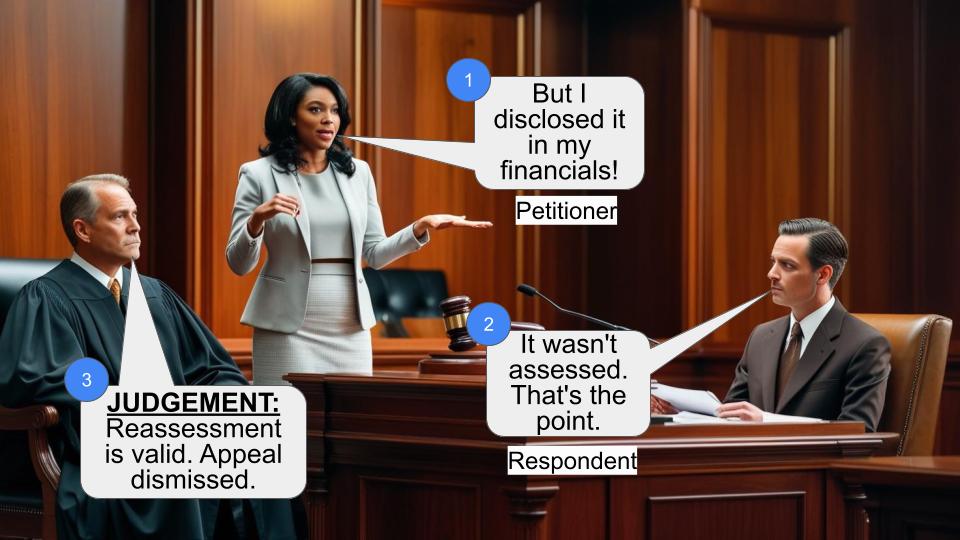
"Court Upholds VDIS Protection: Income Disclosed Can't Be Taxed Again"


Full News

"Court Upholds VDIS Protection: Income Disclosed Can't Be Taxed Again"
"Court Upholds VDIS Protection: Income Disclosed Can't Be Taxed Again"
This case involves the Commissioner of Income Tax appealing against Rajeev Gupta. The dispute centered around whether income disclosed under the Voluntary Disclosure of Income Scheme (VDIS) could be taxed again. The High Court ruled in favor of the assessee (Rajeev Gupta), stating that income disclosed under VDIS cannot be taxed again, either for the declarant or any other person.
Get the full picture - access the original judgement of the court order here.
Case Name:
Commissioner of Income Tax Vs Rajeev Gupta (High Court of Allahabad)
Income Tax Appeal No.375 of 2006
Key Takeaways
1. Income disclosed under VDIS cannot be taxed again, even in the hands of a different person.
2. VDIS certificates, once issued and in force, protect the disclosed income from further taxation.
3. The proper course for challenging a VDIS certificate is to recall it, not to reassess the income.
Issue
Can income that has been disclosed and taxed under the Voluntary Disclosure of Income Scheme (VDIS) be reassessed and taxed again in the hands of another person?
Facts
- A search was conducted on the business and residential premises of the assessee on 19.12.1997.
- The Assessing Officer issued a notice under Section 158BC (of Income Tax Act, 1961) on 24.7.1998.
- The assessee filed a return for the block period on 7.7.1999, showing nil undisclosed income.
- After the search, the assessee's wife opted for VDIS on 31.12.1997, which was accepted by the Department.
- The case relates to the Block Period of Financial Year 1987-88 to 1996-1997 and 1.4.1997 to 19.12.1997.
Arguments
The Department argued that certain undisclosed incomes (Rs.10,50,000 for unexplained investment in a residential house and Rs.36,83,000 for undisclosed shares) should be added to the assessee's income. The assessee contended that these incomes were already disclosed under VDIS and couldn't be taxed again.
Key Legal Precedents
The court cited the case of Commissioner of Income Tax & others Vs. Sri Kundanmal Babulal Jain (Income Tax Appeal No. 519 of 2008, Karnataka High Court, decided on 8.7.2014). This precedent established that income disclosed under VDIS cannot be taxed again, even in the hands of a different person.
Judgement
The High Court dismissed the appeal, ruling in favor of the assessee. It held that since the VDIS declarations were accepted as correct and genuine, the income could not be added again in the hands of the assessee. The court emphasized that as long as a VDIS certificate is in force, the income subject to the certificate cannot be taxed again, either for the declarant or any other person.
FAQs
Q1: What is VDIS?
A1: VDIS stands for Voluntary Disclosure of Income Scheme, a program that allowed people to disclose previously undeclared income and pay taxes on it without further penalties.
Q2: Can income disclosed under VDIS be taxed again?
A2: No, according to this judgment, income disclosed under VDIS cannot be taxed again, either for the person who disclosed it or anyone else.
Q3: What happens if a VDIS certificate was obtained through misrepresentation?
A3: The proper course would be to recall the certificate, not to reassess the income.
Q4: Does this judgment apply only to the specific case or more broadly?
A4: While the judgment is specific to this case, it relies on and reinforces a precedent from the Karnataka High Court, suggesting a broader application of this principle.
Q5: What sections of the Income Tax Act were relevant in this case?
A5: The case mentions Section 260-A (of Income Tax Act, 1961) (for filing the appeal) and Section 158BC (of Income Tax Act, 1961) (for issuing notice to file returns).

Service is deemed to be completed.
This is an appeal under Section 260-A (of Income Tax Act, 1961), 1961 filed by the Commissioner of the Income Tax Appellate Tribunal, New Delhi in I.T. (S.S.)A. No. 146/Del/2001.
The appeal relates to the Block Period of Financial Year 1987-88 to 1996-1997 and 1.4.1997 to 19.12.1997.
The questions of law referred to are hereunder:-
"1. Whether on the facts and circumstances, the Tribunal is legally justified in confirming the order of CIT (Appeals) in deleting the addition of Rs.10,50,000/- on account of unexplained investment in the residential house at Vapi?
2. Whether the Tribunal is legally justified in deleting the addition of Rs.36,83,000/- in respect of undisclosed share of Omega Laboratories Ltd. in various names, which were found and seized from the residence of the assessee at Vapi"
The facts of the case are that the search was conducted under Section 132 (of Income Tax Act, 1961) on the business and residential premises of the assessee on 19.12.1997. The A.O. issued a notice under Section 158BC (of Income Tax Act, 1961) on 24.7.1998 requesting the assessee to file return on Form No. 2B within 20 days of service of the notice. The assessee filed the return for the block period of 7.7.1999 and in the return so filed an undisclosed income was shown as NIL. Subsequently, the wife of the assessee after search and seizure opted for the Voluntary Disclosure of Income Scheme, 1997 (in short 'VDIS') on 31.12.1997 which was accepted by the Department as genuine and good.
In view of the aforesaid, the Tribunal has taken view that once VDIS was accepted as good and true then the same could not be assessed in the hands of the assessee once again.
Learned counsel for the Department, Sri Subham Agarwal has very fairly placed before this Court the decision of Karnataka High Court in Income Tax Appeal No. 519 of 2008 (Commissioner of Income Tax & others Vs. Sri Kundanmal Babulal Jain) decided on 8.7.2014, wherein these very questions were answered in favour of the assessee. Paragraph Nos. 11 and 12 of the judgement are hereunder:-
"11. From the aforesaid provisions, it is clear, once a person files an application under Section 64 (of Income Tax Act, 1961) in accordance with the provisions of Section 65 (of Income Tax Act, 1961) in respect of any income chargeable to tax under the Act, which earlier he has not offered it to tax, the Commissioner on consideration of such application can grant a certificate to him setting forth the particulars of voluntary disclosed of income and the amount of income tax paid in respect of the same. Once such a certificate is granted, the amount of the voluntary disclosed income shall not be included in the total income of the declarant for any assessment year under the Income Tax Act. Once a particular income is included in the income of the person and taxed any such person pays the tax, the same income cannot be taxed in the hands of another persons. In the instant case the amount has been taxed in the hands of HUF. Once the tax is paid for that undisclosed income, again the same income cannot be taxed in the hands of the member of the HUF, that is assessee.
12. Therefore, in the light of the provisions of the aforesaid VDIS as well as the provisions of the Act, the Appellate Authorities were justified in holding that a long as the certificate is in force, the income which was the subject matter of the certificate cannot be taxed not only in the hands of the declarant but also in the hands of any other person. If such a certificate is obtained by misrepresentation misleading the Commissioner, the proper course would be to recall the said certificate. No such steps were taken. The certificate is still in force. When that being the case, the same income cannot be assessed over and again in the hands of the individuals who are the members of the HUF. Therefore, the order passed by the Tribunal as well the Appellate Authority is in accordance with law and do not suffer from any legal infirmity calling for interference."
Thus, in view of the fact that in the present case also the VDIS was accepted as correct and genuine, the income could not have been added once again in the hands of the assessee.
The substantial question of law sought to be answered is, therefore, answered in favour of the assessee and against the Department.
It may be noted that the VDIS filed by the Company on 31.12.1997 was also accepted by the Department. Therefore, for both the sources of undisclosed income as alleged by the Department, the VDIS, had been accepted and the certificate had not been cancelled and both were accepted.
The appeal is dismissed, as above.
Order Date :- 24.10.2016
×