


Invalid Notice: Reasons Recorded After Issuance Renders Section 148 (of Income …


Full News

Invalid Notice: Reasons Recorded After Issuance Renders Section 148 (of Income Tax Act, 1961) Notice Void
Invalid Notice: Reasons Recorded After Issuance Renders Section 148 (of Income Tax Act, 1961) Notice Void
This case involves Ferrous Infrastructure Pvt. Ltd. challenging a notice issued by the Deputy Commissioner of Income Tax under Section 148 (of Income Tax Act, 1961). The main issue was that the reasons for the reassessment notice were recorded after the notice was issued, which is against the legal requirements. The court ruled in favor of Ferrous Infrastructure, declaring the notice and subsequent proceedings invalid.
Get the full picture - access the original judgement of the court order here
Case Name:
Ferrous Infrastructure Pvt. Ltd. & Anr. Vs Deputy Commissioner of Income Tax (High Court of Delhi)
W.P.(C)5229/2014 & CM No.10401 /2014
Date: 21st May 2015
Key Takeaways:
- The court emphasized the importance of recording reasons before issuing a notice under Section 148 (of Income Tax Act, 1961).
- The decision reinforces the procedural safeguards to prevent arbitrary reassessment notices.
- The ruling highlights the necessity for transparency and adherence to legal protocols by tax authorities.
Issue
Was the notice under Section 148 (of Income Tax Act, 1961) valid if the reasons for its issuance were recorded after the notice was issued?
Facts
Ferrous Infrastructure Pvt. Ltd. received a notice dated 30.08.2012 under Section 148 (of Income Tax Act, 1961) for reassessment of income for the Assessment Year 2008-2009. However, the reasons for this notice were recorded only on 18.09.2012, after the notice had already been issued. This procedural misstep was the crux of the legal challenge.
Arguments
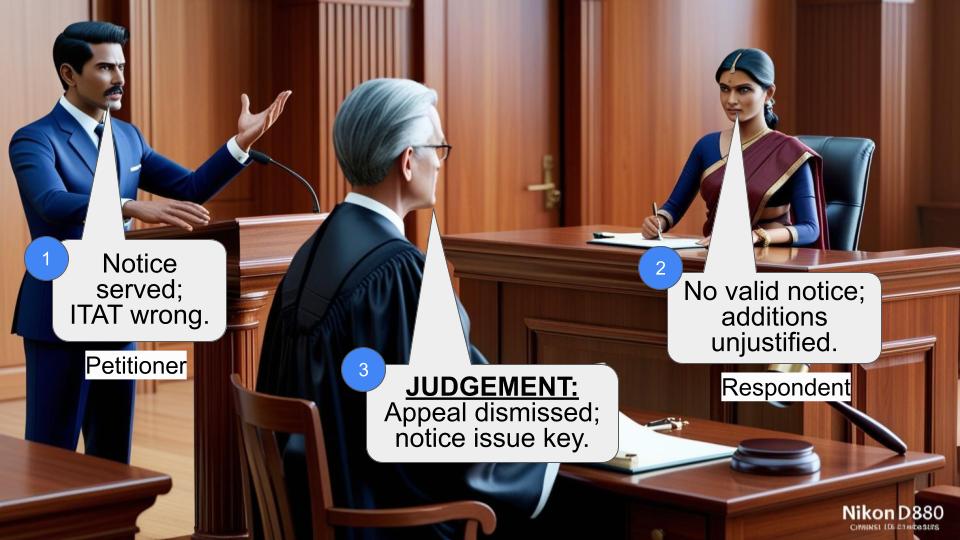
- Petitioners (Ferrous Infrastructure Pvt. Ltd.): Argued that the notice was invalid as the reasons were recorded after its issuance, violating Section 148(2) (of Income Tax Act, 1961). They also contended that their objections to the notice were not addressed in a separate speaking order, contrary to the Supreme Court’s directive in G.K.N. Driveshafts (India) Ltd. v. ITO.
- Respondent (Deputy Commissioner of Income Tax): Claimed that the date on the reasons was an inadvertent mistake and that the reasons were indeed recorded before the notice was issued.
Key Legal Precedents
- Haryana Acrylic Manufacturing Co. v. Commissioner of Income-tax: Emphasized the necessity of recording reasons before issuing a notice under Section 148 (of Income Tax Act, 1961).
- G.K.N. Driveshafts (India) Ltd. v. ITO: Established that reasons must be communicated to the assessee, who can then file objections, which must be addressed by a speaking order.
- Baldwin Boys High School: Reinforced the requirement that reasons must be recorded prior to issuing a notice under Section 148 (of Income Tax Act, 1961).
Judgement
The court ruled that the notice under Section 148 (of Income Tax Act, 1961) was invalid because the reasons were recorded after the notice was issued, violating Section 148(2) (of Income Tax Act, 1961). Consequently, all proceedings based on this notice were also invalidated. The court quashed the notice dated 30.08.2012 and all subsequent actions, including the reassessment order dated 30.03.2014.
FAQs
Q1: Why is it important to record reasons before issuing a notice under Section 148 (of Income Tax Act, 1961)?
A1: Recording reasons beforehand ensures that the notice is based on a legitimate basis and prevents arbitrary or whimsical actions by tax authorities.
Q2: What happens if the reasons are recorded after the notice is issued?
A2: If reasons are recorded after the notice, the notice and any subsequent proceedings are considered invalid.
Q3: What is a ‘speaking order’?
A3: A speaking order is a detailed order that addresses the objections raised by the assessee, providing reasons for the decision, ensuring transparency and fairness.

1. This writ petition is directed against the notice dated 30.08.2012
issued by the DCIT, Circle 11(1), New Delhi, under Section 148 (of Income Tax Act, 1961) of the
Income Tax Act, 1961. The writ petition is also directed against the order
dated 30.03.2014 passed by the Assessing Officer re-assessing the
income of the assessee in respect of the Assessment Year 2008-2009.
2. When this matter came up for hearing on the first occasion, i.e.,
19.08.2014, we had recorded that the learned counsel for the petitioners
had raised two points in this petition. The first point was that the
petitioners came to know, after the re-assessment order, that the purported
reasons for initiating reassessment proceedings had been recorded after
the issuance of notice under Section 148 (of Income Tax Act, 1961). It was submitted that the clear
position in law is that the reasons have to be recorded prior to the
issuance of notice under Section 148 (of Income Tax Act, 1961). The second point urged by the
learned counsel for the petitioners was that the objections furnished by
the petitioners to the Section 148 (of Income Tax Act, 1961) notice had not been disposed of by a
separate speaking order prior to the re-assessment order dated
30.03.2014. He submitted that this was in clear contradiction to the
Supreme Court decision in the case of G.KN Driveshafts (India) Ltd. v.
ITO : 259 ITR 19(SC).
3. The counter-affidavit has been filed on behalf of the Revenue and a
very surprising stand has been taken. In reply to paragraph No.1 of the
petition on merits, the counter-affidavit reads as under:-
“1. With respect to the content of Paragraph no. 1 it is
respectfully submitted that the factual position in the
matter is that the notice u/s.148 (of Income Tax Act, 1961) dated
30.08.2012 was issued and duly served upon the assessee
company. The notice u/s.148 (of Income Tax Act, 1961) was issued after recording
the reasons for issuance of notice u/s.l48 however, in the
lower portion of the reasons recorded; the date was
inadvertently mentioned as 18/09/2012. Thus the
contentions and grounds of challenge made by the
Petitioner are denied as being frivolous and baseless.”.
(underlining added)
In the above statement an impression is sought to be created that
the date mentioned as 18.09.2013 was incorrectly recorded. No reasons
have been given or explanation offered as to how such a circumstance
could, at all, have arisen. We asked the learned counsel for the Revenue
to produce the relevant file and on examining the same, we find that the
reasons for issuance of the notice under Section 148 of the Income Tax Act, 1961 which
have been recorded bears the date 19.09.2012. The said date is printed.
It is, first of all, inconceivable that when a document is being typed on or
before 30.08.2012 (the date on which the notice under Section 148 (of Income Tax Act, 1961) was
issued) that a future date of 19.09.2012 would be typed. Secondly, what
is even more shocking is the fact that the printed date 19.09.2012 has
been corrected in hand to read 18.09.2012. In other words, if there was a
mistake in the printing of the date, the same has been corrected to read
18.09.2012. Therefore, it cannot be said that the date mentioned in the
reasons, i.e., 18.09.2012 was an inadvertent mistake. The date had been
consciously corrected. That being the position, the factual situation is
that the reasons were recorded on 18.09.2012, they were also furnished to
the petitioners on 18.09.2012, but the notice under Section 148 (of Income Tax Act, 1961) had
already been issued on 30.08.2012. It is evident that the notice was
issued prior to the recording of the reasons.
Section 148(2) (of Income Tax Act, 1961) of the Income-Tax reads as under:-
“148. (2) The Assessing Officer shall, before issuing
any notice under this section, record his reasons for
doing so.”
It is absolutely clear from the said provision that the Assessing
Officer is required to record his reasons before he issues the notice under
Section 148 (of Income Tax Act, 1961).
4. This aspect has been dealt with by a Division Bench of this Court
in Haryana Acrylic Manufacturing Co. v. Commissioner of Income-tax:
308 ITR 38(Delhi).
“32. Secondly, let us assume for the sake of argument
that the actual reasons were those as noted in the said
form. Then why did the Assessing Officer
communicate a different set of reasons to the
petitioner? Did he think that the supplying of reasons
and the inviting of objections were mere charades?
Did he think that it was a mere pretence or a formality
which had to be gotten over with? At this point, it
would be well to remember that the Supreme Court in
GKN Driveshafts (supra) had specifically directed
that when a notice under Section 148 of the Income Tax Act, 1961
is issued and the noticee files a return and seeks
reasons for the issuance of the notice, the Assessing
Officer is bound to furnish reasons within a
reasonable time. On receipt of the reasons, the noticee
is entitled to file objections to the issuance of notice
and the Assessing Officer is bound to dispose of the
same by passing a speaking order. These are specific
directions given by the Supreme Court in all cases
where notices under Section 148 of the Income Tax Act, 1961 are
issued. Surely, the Assessing Officer could not have
construed these specific directions to be a mere empty
formalities or dead letters? There is a strong logic and
purpose behind the directions issued by the Supreme
Court and that is to prevent high-handedness on the
part of Assessing Officers and to temper any action
contemplated under Section 147 of the Income Tax Act, 1961 by
reason and substance. In fact, even Section 148(2) (of Income Tax Act, 1961)
stipulates that the Assessing Officer shall, before
issuing any notice under the said Section, record his
reasons for doing so. The Supreme Court has only
carried forward this mandatory requirement by
directing that the reasons which are recorded be
communicated to the assessee within a reasonable
period of time so that at that stage itself the assessee
may point out any objections that he may have with
regard to the initiation of action under Section 147 (of Income Tax Act, 1961) of
the said Act. The requirement of recording the
reasons, communicating the same to the assessee,
enabling the assessee to file objections and the
requirement of passing a speaking order are all
designed to ensure that the Assessing Officer does not
reopen assessments which have been finalized on his
mere whim or fancy and that he does so only on the
basis of lawful reasons. These steps are also designed
to ensure complete transparency and adherence to the
principles of natural justice. Thus, a deviation from
these directions would entail the nullifying of the
proceedings.....”
(underlining added)
5. Furthermore in the decision of the High Court of Karnanataka –
Commissioner of Income Tax, (Exemptions) v. Baldwin Boys High
School: 364 ITR 637(Karnataka) - this very question of whether a
notice under Section 148 of the Income Tax Act, 1961 could be issued without
recording reasons came up for consideration. The Karnataka High Court
observed as under:-
“6. Section 148 (of Income Tax Act, 1961) provides for issue of notice
where the income has escaped assessment. Sub-
section (2) of section 148 (of Income Tax Act, 1961) provides that the
Assessing Officer shall, before issuing any notice
under this section, record his reasons for doing so. In
view of this provision, no dispute was raised before
us about the procedure contemplated under this
provision. From a bare perusal of section 148 (of Income Tax Act, 1961) of the
Act, it is clear as crystal that the Assessing Officer is
obliged to record reasons before issuing notice under
section 148 (of Income Tax Act, 1961)....”
(underlining added)
6. The decision sought to be relied upon by Mr Madan on behalf of
the Revenue in the case of Adobe Systems Software Ireland Ltd. v.
Assistant Dirctor of Income Tax, 2014(7) AD 244, is not at all relevant
for the present discussion. That was a case which dealt with the
furnishing of the reasons to the assessee. The issue which had arisen was
whether the assessee was entitled to the reasons without even filing a
return. That is not the question before us. The only question here is
whether reasons could at all be recorded after issuance of the notice under
Section 148 (of Income Tax Act, 1961). And, secondly, that as the reasons were recorded
after the issuance of Section 148 (of Income Tax Act, 1961) notice, whether the proceedings were
not vitiated.
7. We have seen from the provisions of Section 148(2) (of Income Tax Act, 1961) as also the
decisions of this Court in Haryana Acrylic(supra), and that of the
Karnataka High Court in Baldwin Boys High School (supra), that the
reasons have to be recorded prior to the issuance of notice under Section
148. If they are not so recorded, then the notice under Section 148 (of Income Tax Act, 1961) and
proceedings pursuant thereto are without authority of law. In the present
case, it is evident that the reasons were recorded only on 18.09.2012, i.e.,
after the notice under Section 148 (of Income Tax Act, 1961) had been issued on 30.08.2012.
Clearly, the statutory provisions, as explained by judicial decisions,
indicate that the notice under Section 148 (of Income Tax Act, 1961) would be invalid and
consequently all proceedings pursuant thereto would also be vitiated.
8. We may also point out that the second issue raised by the learned
counsel for the petitioners also deserves some consideration. In GKN
Driveshafts (supra), the Supreme Court had directed as under:-
“However, we clarify that when a notice under
Section 148 (of Income Tax Act, 1961) is issued, the
proper course of action for the noticee is to file return
and if he so desires, to seek reasons for issuing
notices. The assessing officer is bound to furnish
reasons within a reasonable time. On receipt of
reasons, the noticee is entitled to file objections to
issuance of notice and the assessing officer is bound
to dispose of the same by passing a speaking order. In
the instant case, as the reasons have been disclosed in
these proceedings, the assessing officer has to dispose
of the objections, if filed, by passing a speaking order,
before proceeding with the assessment in respect of
the abovesaid five assessment years.”
(underlining added)
8. On going through the same, it is evident that the Assessing Officer
has to pass a speaking order disposing of the objections “before
proceeding with the assessment”. In the present case, a separate
speaking order has not been passed and the objections have been dealt
with, if at all, in the re-assessment order itself. On this ground also, the
petitioner is liable to succeed.
9. For all the reasons indicated above, the petition is allowed. The
notice under Section 148 (of Income Tax Act, 1961) dated 30.08.2012 is quashed so also all
proceedings pursuant to the said notice under Section 148 (of Income Tax Act, 1961) including the
order dated 30.03.2014.
10. The writ petition is allowed on the above terms.
BADAR DURREZ AHMED, J
SANJEEV SACHDEVA, J
MAY 21, 2015
×
Similar Ripples
Questions
Invalid Notice: Reasons Recorded After Issuance Renders Section 148 (of Income Tax Act, 1961) Notice Void
Write your CommentSimilar Posts


Generic
- Reportdata/3732.pdf
