


Tax Tribunal Upholds Lower Valuation for Property Sale, Rejecting Higher Stamp …


Full News

Tax Tribunal Upholds Lower Valuation for Property Sale, Rejecting Higher Stamp Duty Assessment
Tax Tribunal Upholds Lower Valuation for Property Sale, Rejecting Higher Stamp Duty Assessment
This case involves a tax appeal by the Principal Commissioner of Income Tax against an order of the Income Tax Appellate Tribunal (ITAT). The dispute centers around the valuation of an immovable property sold by an assessee for capital gains tax purposes. The ITAT had accepted a lower valuation provided by a departmental valuer, which was challenged by the tax department. The High Court dismissed the appeal, upholding the ITAT’s decision.
Get the full picture - access the original judgement of the court order here
Case Name:
Principal Commissioner of Income Tax Vs Rajabhai Lumbha Bhai Hadiya (High Court of Gujarat)
Tax Appeal No. 897 of 2015
Date: 1st December 2015
Key Takeaways:
- The court affirmed that when determining property value for capital gains tax, the lower of the stamp duty valuation or the departmental valuation should be used.
- Section 50C (of Income Tax Act, 1961) allows assessees to challenge stamp duty valuations and seek a departmental valuation.
- The judgment clarifies the interpretation of Section 50C (of Income Tax Act, 1961), providing guidance for similar cases in the future.
Issue:
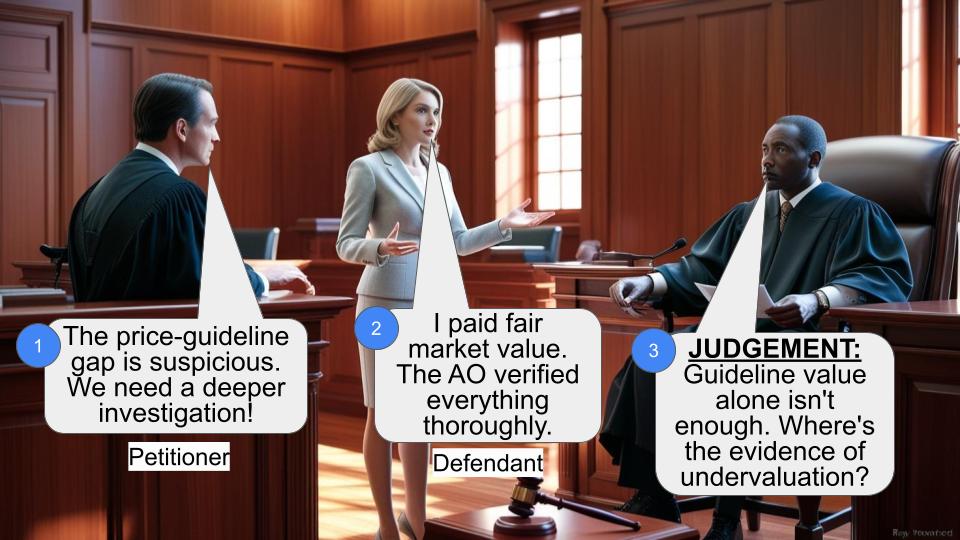
Whether the Income Tax Appellate Tribunal (ITAT) was correct in accepting the lower valuation provided by the departmental valuer instead of the higher valuation determined by the stamp duty authority for calculating capital gains tax?
Facts:
- The assessee sold an immovable property during the assessment year 2007-2008 for Rs. 47 lakhs.
- The Sub-Registrar of Stamp Duty valued the property at Rs. 3.4 crore.
- The assessee appealed to the Deputy Collector, Stamp Duties, who revised the valuation to Rs. 1.33 crore.
- The Assessing Officer initially adopted the Rs. 1.33 crore valuation for capital gains computation.
- On appeal, the CIT(A) called for a valuation report from the department valuer, who valued the property at Rs. 71.98 lakh.
- The CIT(A) accepted this lower valuation for capital gains purposes.
- The tax department appealed to the ITAT, which upheld the CIT(A)'s decision.
Arguments:
- Tax Department: Argued that the higher value determined by the stamp valuation authority (Rs. 1.33 crore) should be adopted for calculating capital gains.
- Assessee: Contended that the lower valuation provided by the departmental valuer (Rs. 71.98 lakh) should be used, as allowed under Section 50C (of Income Tax Act, 1961).
Key Legal Precedents:
The ITAT relied on its previous decision in the case of ITO v. Shri Bhartbhai Kalyanbhai Malvia (ITA No.2227/Ahd/2011, order dated 10.4.2015). In that case, the Tribunal held that when the departmental valuation is lower than the stamp duty valuation, the lower value should be adopted for computing capital gains.
Judgement:
- The High Court dismissed the tax department’s appeal, finding no error in the ITAT’s decision.
- The court interpreted Section 50C (of Income Tax Act, 1961), particularly subsections (1), (2), and (3).
- It concluded that when an assessee challenges the stamp duty valuation and the Assessing Officer obtains a valuation from the Valuation Officer, the lower of the two valuations should be used for computing capital gains.
- In this case, since the departmental valuation (Rs. 71.98 lakh) was lower than the stamp duty valuation (Rs. 1.33 crore), the court upheld the use of the lower value.
FAQs:
Q: What is Section 50C (of Income Tax Act, 1961)?
A: Section 50C (of Income Tax Act, 1961) is a special provision for determining the full value of consideration in cases involving the transfer of land or buildings. It allows for the use of stamp duty valuation when it’s higher than the stated sale consideration, but also provides a mechanism for challenging this valuation.
Q: Can an assessee challenge the stamp duty valuation?
A: Yes, under Section 50C(2) (of Income Tax Act, 1961), an assessee can claim before the Assessing Officer that the stamp duty valuation exceeds the fair market value of the property.
Q: What happens if the departmental valuation is lower than the stamp duty valuation?
A: As per this judgment, if the departmental valuation is lower, it should be used for computing capital gains.
Q: Does this judgment set a precedent for future cases?
A: Yes, this High Court decision provides guidance on how to interpret and apply Section 50C (of Income Tax Act, 1961) in similar situations, potentially influencing future cases and assessments.
Q: What’s the significance of this judgment for taxpayers?
A: It’s favorable for taxpayers as it confirms their right to challenge high stamp duty valuations and potentially use lower departmental valuations for capital gains tax purposes.

1. This tax appeal is preferred against the order of the Income Tax Appellate Tribunal dated 30.04.2015 raising the following question, for our consideration:
(A) Whether, on the facts and in the circumstances of the cased and in law, the ITAT was right in ignoring the fact that as per provisions of section 50-C(2)(b) (of Income Tax Act, 1961), the matter should not have been referred by CIT(A) for valuation as the assessee had already challenged the Juntry Value assessable by the Stamp Valuation authority, before the Nayab Collector and in that case, further reference to valuation is prohibited as per the Act and value determined by Nayab Collector has to be adopted as full value of consideration ?”
2. The issue pertains to valuation of immovable property sold by the assessee during the previous year, relevant assessment year 2007-2008, for sale consideration of Rs.47 lakhs. Sub-Registrar of Stamp Duty, however, valued the asset in question at Rs.3.4 crore (rounded off). Assessee carried this valuation in appeal before the Deputy Collector, Stamp Duties. Deputy Collector valued the property at Rs.1.33 crore (rounded off). Assessing Officer adopted such value of Rs.1.33 crore as sale consideration for computation of capital gain.
3. Assessee carried the matter in appeal. At the instance of the assessee, CIT (A) called for valuation report of the property from the department valuer who opined that value of the property on the date of sale was Rs.71.98 lakh (rounded off). CIT(A)accepted such valuation for the purpose of capital gain in the hands of the assessee and granted relief accordingly. The Department, however, carried the issue in appeal before the Tribunal contending that the valuation of the Deputy Collector, Stamp Duties should be adopted. The Tribunal rejected the appeal of the Revenue in the following terms:
“6. The contention of the DR is that where the value of the property made by the stamp valuation authority is higher than the value of the property determined by the departmental valuer, then the higher value should be adopted for the purpose of working out the capital gain of the assessee, and therefore, the CIT was not justified in directing the AO to adopt the valuation made by the departmental valuer at Rs.71,98,300/- which was lower than the value of the property determined by the stamp duty authority at Rs.3,34,63,125/-.
7. We find that the order of the CIT(A) is supported by the order of this Bench of the Tribunal in the case of ITO v. Shri Bhartbhai Kalyanbhai Malvia in ITA No.2227/Ahd/2011 order dated 10.4.2015 wherein the Tribunal at para-19 held as under:
“10. We find that section 50C(2) (of Income Tax Act, 1961) provides that where the assessee claimed before the AO that the value adopted or assessed by the stamp valuation authority under sub-section (1) exceeds the fair market value of the property, on the date of transfer, the AO may refer the valuation of the capital asset to the valuation officer, in such a situation, the lower of value determined by the departmental valuation officer and stamp duty valuation officer shall be considered as consideration accruing to the assessee. Since it has not been disputed by the DR that the value of the property determined by the DVO was lower than the value determined by the stamp duty valuation officer, therefore, we find that there is no infirmity in the order of the CIT(A) in directing the AO to adodpt the value determined by the departmental valuation officer, as sale consideration of the property for computing the capital gains in the hands of the assessee. Therefore, we dismiss this ground of appeal of the Revenue.”
4. Having heard learned counsel Mr.Sudhir Mehta for the Revenue and having perused the documents on record, we see no error in the decision of the Tribunal. Section 50-C (of Income Tax Act, 1961) pertains to special provisions for full value of consideration in certain cases, relevant portion of which reads as under:
“50-C. (1) Where the consideration received or accruing as a result of the transfer by an assessee of a capital asset, being land or building or both, is less than the value adopted or assessed by any authority of a State Government (hereafter in this section referred to as the “stamp valuation authority”) for the purpose of payment of stamp duty in respect of such transfer, the value so adopted or assessed shall, for the purposes of section 48 (of Income Tax Act, 1961), be deemed to be the full value of the consideration received or accruing as a result of such transfer.
(2) Without prejudice to the provisions of sub-section (1), where (a) the assessee claims before any Assessing Officer that the value adopted or assessed by the stamp valuation authority under subsection exceeds the fair market value of the property as on the date of transfer
(b) the value so adopted or assessed by the stamp valuation authority under sub-section (1) has not been disputed in any appeal or revision or no reference has been made before any other authority, court or the High Court, the Assessing Officer may refer the valuation of the capital asset to a Valuation Officer and where any such reference is made, the provisions of sub-sections (2), (3), (4), (5) and (6) of section 16A (of Income Tax Act, 1961), clause (i) of sub-section (1) and sub- sections (6) and (7) of section 23A (of Income Tax Act, 1961), sub-section (5) of section 24 (of Income Tax Act, 1961), section 34AA (of Income Tax Act, 1961), section 35 (of Income Tax Act, 1961) and section 37 of the Wealth-tax Act, 1957 (27 of 1957), shall, with necessary modifications, apply in relation to such reference as they apply in relation to a reference made by the Assessing Officer under sub-section (1) of section 16A of the Income Tax Act, 1961. (3) Subject to the provisions contained in sub-section (2), where the value ascertained under sub-section (2) exceeds the value adopted or assessed by the stamp valuation authority referred to in sub-section (1), the value so adopted or assessed by such authority shall be taken as the full value of the consideration received or accruing as a result of the transfer.
5. It can thus be seen that in view of sub-section (1) of section 50-C (of Income Tax Act, 1961), in case of capital asset being land or building for which consideration is received as a result of transfer by the assessee and such consideration is less than the value adopted or assessed or assessable by the stamp valuation authority of the State Government for the purpose of payment of stamp duty, valuation so adopted, assessed or assessable would be deemed to be the full value of the consideration received or accrued for the purpose of computing capital gains. Under clauses (a) and (b) of sub-section (2) of section 50-C (of Income Tax Act, 1961), however, assessee has a right to ascertain before the Assessing Officer that the value adopted or assessed by the stamp valuation authority exceeds the fair market value as on the date of transfer upon which the Assessing Officer would refer the valuation of the capital asset to the Valuation Officer. Under sub-section (3) of section 50-C (of Income Tax Act, 1961), where the value ascertained by the Valuation Officer exceeds the value adopted, assessed or assessable by the stamp valuation authority, the latter, i.e. the valuation of the stamp valuation authority, would be taken as the full value of the consideration for the purpose of computing capital gain. In other words, the valuation of the property adopted by the Stamp Duty authority of the State would be deemed to be the full value of the consideration for the purpose of computing capital gain. However, in case the assessee challenges such valuation before the Assessing Officer and the Assessing Officer calls for the valuation report from the Valuation Officer and the valuation adopted by the Valuation Officer exceeds the value adopted by the State Stamp Duty Authority, it would be the valuation of such stamp duty authority which would prevail for the purpose of computing capital gain. The Revenue intends to contend to the contrary which is simply not born out from the statutory provisions noticed.
6. In the result, there is no error in the view taken by the Tribunal. The Tax Appeal is, therefore, dismissed.
(AKIL KURESHI, J.)
(MOHINDER PAL, J.)
×
Questions
Tax Tribunal Upholds Lower Valuation for Property Sale, Rejecting Higher Stamp Duty Assessment
Write your CommentSimilar Posts
Generic
- Reportdata/3278.pdf
