


Supreme Court Upholds Dual Deductions Under Sections 80 (of Income Tax Act, 196…


Full News

Supreme Court Upholds Dual Deductions Under Sections 80 (of Income Tax Act, 1961)-HH and 80-I of Income Tax Act
Supreme Court Upholds Dual Deductions Under Sections 80 (of Income Tax Act, 1961)-HH and 80-I of Income Tax A…
The Delhi High Court dismissed an appeal by the Commissioner of Income Tax against Unipatch Rubber Ltd., upholding that deductions under Sections 80 (of Income Tax Act, 1961)-HH and 80-I of the Income Tax Act can be claimed independently on gross total income. This decision aligns with previous rulings by various High Courts and the Supreme Court.
Get the full picture - access the original judgement of the court order here.
Case Name:
Commissioner of Income Tax vs Unipatch Rubber Ltd. (High Court of Delhi)
ITA 38/2000
Date: 5th January 2015
Key Takeaways:
1. Deductions under Sections 80 (of Income Tax Act, 1961)-HH and 80-I can be claimed independently on gross total income.
2. The Supreme Court has previously affirmed this interpretation in Joint Commissioner of Income Tax vs. Mandideep Engineering and Packaging Ind. Pvt. Ltd.
3. The Revenue Department's acceptance of previous similar judgments prevents it from taking a contrary view in subsequent cases.
Issue:
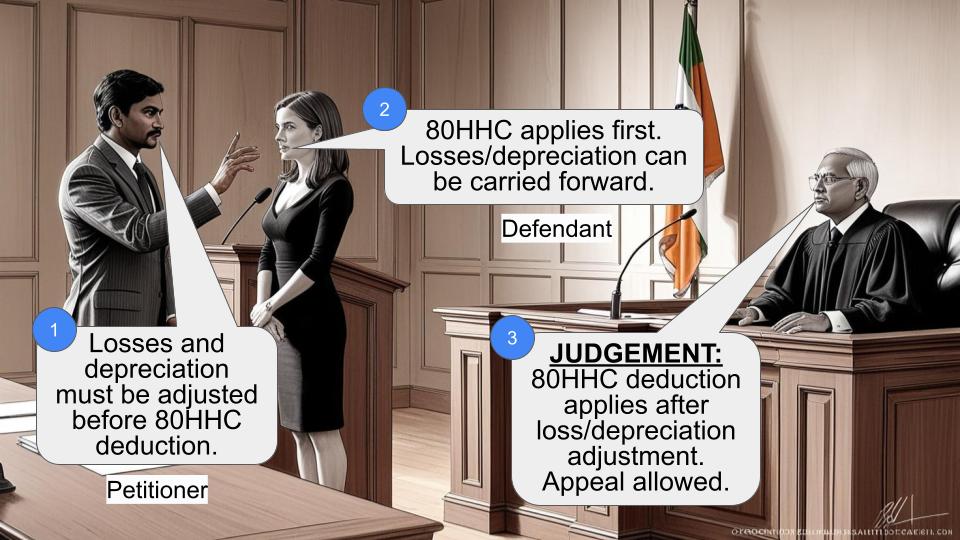
Whether an assessee is entitled to deduction/benefit under Section 80-I (of Income Tax Act, 1961) on the gross income without excluding/reducing deduction allowed under Section 80-HH (of Income Tax Act, 1961)?
Facts:
- For the assessment year 1989-90, Unipatch Rubber Ltd. filed a return declaring income of Rs.53,93,390/-.
- The company manufactured and sold rubber patches for tyre, tubes, uniseals etc.
- The Assessing Officer initially held that deduction under Section 80-I (of Income Tax Act, 1961) could be allowed only on the balance amount after deduction under Section 80-HH (of Income Tax Act, 1961).
- The Commissioner of Income Tax (Appeals) and the Income Tax Appellate Tribunal (ITAT) ruled in favor of the assessee, allowing deductions under both sections independently.
Arguments:
1. Revenue's Argument:
Section 80-HH(9) (of Income Tax Act, 1961) stipulates that deduction under Section 80-HH (of Income Tax Act, 1961) should be applied first, and only then should deduction under Section 80-I (of Income Tax Act, 1961) be allowed on the remaining amount.
2. Assessee's Argument (as upheld by CIT(A) and ITAT):
Deductions under Sections 80 (of Income Tax Act, 1961)-I and 80-HH should be applied independently to the gross total income.
Key Legal Precedents:
1. J.P. Tobacco Products Pvt. Ltd vs Commissioner of Income Tax (1998) 229 ITR 123
- Madhya Pradesh High Court held that benefits under Section 80-HH (of Income Tax Act, 1961) and Section 80-I (of Income Tax Act, 1961) were independent.
2. CIT vs S.A. Engineering Pvt. Ltd. (2006) 285 ITR 423 (Del)
- Delhi High Court followed the J.P. Tobacco Products judgment.
3. Joint Commissioner of Income Tax vs. Mandideep Engineering and Packaging Ind. Pvt. Ltd. (2007) 292 ITR (1) SC
- Supreme Court affirmed the view that deductions under both sections could be claimed on gross total income.
Judgement:
The Delhi High Court dismissed the appeal by the Revenue, upholding that:
1. Deductions under Sections 80 (of Income Tax Act, 1961)-HH and 80-I can be claimed independently on gross total income.
2. The court followed the law declared by the Supreme Court in the Mandideep Engineering case.
3. The question of law was answered against the Revenue.
FAQs:
Q1: What was the main issue in this case?
A1: The main issue was whether deductions under Sections 80 (of Income Tax Act, 1961)-HH and 80-I of the Income Tax Act could be claimed independently on gross total income.
Q2: Why did the court rule in favor of the assessee?
A2: The court followed the precedent set by the Supreme Court in the Mandideep Engineering case, which had already affirmed that both deductions could be claimed independently.
Q3: What is the significance of this judgment?
A3: This judgment reinforces the principle that deductions under Sections 80 (of Income Tax Act, 1961)-HH and 80-I can be claimed independently, providing clarity for taxpayers and tax professionals.
Q4: Can the Revenue Department challenge this interpretation in future cases?
A4: It would be difficult for the Revenue Department to challenge this interpretation, as the court noted that the Department had accepted similar judgments in the past and cannot now take a contrary view.
Q5: Does this judgment apply to all taxpayers?
A5: While this judgment specifically relates to the sections mentioned, it sets a precedent that could be applied in similar cases involving these deductions.

1. The question of law framed in this case by order dated 22.09.2000 is
as follows:-
“Whether assessee is entitled to deduction/benefit under Section 80-I (of Income Tax Act, 1961) on the gross income without excluding/reducing deduction allowed under Section 80-HH (of Income Tax Act, 1961)?”
2. The facts necessary for deciding this appeal under Section 260-A (of Income Tax Act, 1961) of
the Income Tax Act, 1961 are that for the period 01-01-1988 to 31-03-1989,relevant for the assessment year 1989-90, the return of income was filed by the respondent-assessee declaring Rs.53,93,390/- as income. The assessee manufactured and sold rubber patches for tyre, tubes, uniseals etc. By order dated 13-03-1992 the Assessing Officer inter alia held that deduction under Section 80-I (of Income Tax Act, 1961) could be allowed on the balance amount of income after it suffers a deduction under Section 80-HH (of Income Tax Act, 1961). This view was affirmed by the Commissioner of Income Tax (Appeals) who was of the opinion that both Sections i.e., Sections 80-HH and 80-I were independent provisions and consequently, the assessee was entitled to deduction under Section 80-I (of Income Tax Act, 1961) on the total amount without it having suffered any deduction under Section 80-HH (of Income Tax Act, 1961). The Revenue unsuccessfully appealed to the ITAT and consequently has approached this Court.
3. It is argued on behalf of the Revenue that the ITAT as well as the
Commissioner (Appeals) completely overlooked Section 80-HH(9) (of Income Tax Act, 1961) which is
in imperative terms and stipulates expressly that before the benefit of
Section 80-I (of Income Tax Act, 1961) could be claimed, or some other benefit – under Section 80-J (of Income Tax Act, 1961),could be claimed – the total profits had to be deducted in the manner
provided in the Section i.e. in terms of Section 80-HH(I) (of Income Tax Act, 1961). The submission of the Revenue in this regard may be noticed by its contention in the grounds of appeal to the following effect:-
“The language of Section 80-HH(9) (of Income Tax Act, 1961) is clear and specifically stipulates that where the assessee is entitled to deduction u/s 80-HH (of Income Tax Act, 1961) and 80 (of Income Tax Act, 1961)-I (of Income Tax Act, 1961), the assessee is first entitled to deduction u/s 80-HH (of Income Tax Act, 1961) and thereafter deduction will be allowed u/s 80-I (of Income Tax Act, 1961).”
4. The CIT(A) reasoned that the deduction under Section 80-I (of Income Tax Act, 1961) and 80 (of Income Tax Act, 1961)-
HH had to be with reference to gross total income independent to one
another, relying on the language with reference to Section 80-I (of Income Tax Act, 1961). The ITAT apparently endorsed this opinion in the following terms:-
“The next grievance is against the direction of the Ld.CIT(A) to
allow deduction u/s 80I (of Income Tax Act, 1961) on the same income on which deduction
u/s 80HH (of Income Tax Act, 1961) has been allowed i.e. on the gross income. The
assessee claimed deductions u/s 80HH (of Income Tax Act, 1961) & 80I (of Income Tax Act, 1961) on the gross
income. The issue is covered by the order dated 5.11.96 of Delhi
Bench ‘B’ in ITA No.5730/Del/91 in assessee’s own case.
Reliance on the orders of the Karnataka High Court and
Allahabad High Court reported in 203 ITR 811 and 140 ITR 745
have been placed. The ITAT had held in asstt. Year 1988-89 in
this very case that the deduction u/s 80I (of Income Tax Act, 1961) must be allowed without
taking into account other deductions permissible under Chapter
6 of the Act. Thus the relief under sec. 80HH (of Income Tax Act, 1961) and 80I (of Income Tax Act, 1961) were
admissible on gross income. Following the order of the ITAT we
dismiss the revenue’s ground.”
5. The relevant provisions are as follows:-
“Section 80-HH(1) (of Income Tax Act, 1961) – Where the gross total income of an
assessee includes any profits and gains derived from an
industrial undertaking, or the business of a hotel, to which this
section applies, there shall, in accordance with and subject to the
provisions of this section, be allowed, in computing the total
income of the assessee, a deduction from such profits and gains
of an amount equal to twenty per cent thereof.
Section 80HH(9) (of Income Tax Act, 1961) – In a case where the assessee is entitled also
to the deduction under [section 80-I (of Income Tax Act, 1961) or] section 80J (of Income Tax Act, 1961) in relation to
the profits and gains of an industrial undertaking or the business
of a hotel to which this section applies, effect shall first be given
to the provisions of this section.
[Deduction in respect of profits and gains from industrial
undertakings after a certain date, etc.
80-I. (1) Where the gross total income of an assessee includes
any profits and gains derived from an industrial undertaking or
a ship or the business of a hotel [or the business of repairs to
ocean-going vessels or other powered craft], to which this
section applies, there shall, in accordance with and subject to
the provisions of this section, be allowed, in computing the total
income of the assessee, a deduction from such profits and gains
of an amount equal to twenty per cent thereof :
Provided that in the case of an assessee, being a company, the
provisions of this sub-section shall have effect [in relation to
profits and gains derived from an industrial undertaking or a
ship or the business of a hotel] as if for the words “twenty per
cent”, the words “twenty-five per cent” had been substituted.
[(1A) Notwithstanding anything contained in sub-section (1), in
relation to any profits and gains derived by an assessee from—
(i) an industrial undertaking which begins to manufacture or
produce articles or things or to operate its cold storage plant or
plants; or
(ii) a ship which is first brought into use; or
(iii) the business of a hotel which starts functioning,
on or after the 1st day of April, 1990, [but before the 1st day of
April, 1991], there shall, in accordance with and subject to the
provisions of this section, be allowed in computing the total
income of the assessee, a deduction from such profits and gains
of an amount equal to twenty-five per cent thereof :
Provided that in the case of an assessee, being a company, the
provisions of this sub-section shall have effect in relation to
profits and gains derived from an industrial undertaking or a
ship or the business of a hotel as if for the words “twenty-five
per cent”, the words “thirty per cent” had been substituted.]
(2) This section applies to any industrial undertaking which
fulfils all the following conditions, namely :—
(i) it is not formed by the splitting up, or the reconstruction, of a
business already in existence;
(ii) it is not formed by the transfer to a new business of
machinery or plant previously used for any purpose;
(iii) it manufactures or produces any article or thing, not being
any article or thing specified in the list in the Eleventh
Schedule, or operates one or more cold storage plant or plants,
in any part of India, and begins to manufacture or produce
articles or things or to operate such plant or plants, at any time
within the period of [ten] years next following the 31st day of
March, 1981, or such further period as the Central Government
may, by notification in the Official Gazette, specify with
reference to any particular industrial undertaking;
(iv) in a case where the industrial undertaking manufactures or
produces articles or things, the undertaking employs ten or
more workers in a manufacturing process carried on with the
aid of power, or employs twenty or more workers in a
manufacturing process carried on without the aid of power :
Provided that the condition in clause (i) shall not apply in
respect of any industrial undertaking which is formed as a
result of the re-establishment, reconstruction or revival by the
assessee of the business of any such industrial undertaking as is
referred to in section 33B (of Income Tax Act, 1961), in the circumstances and within the
period specified in that section :
Provided further that the condition in clause (iii) shall, in
relation to a small-scale industrial undertaking, apply as if the
words “not being any article or thing specified in the list in the
Eleventh Schedule” had been omitted.
Explanation 1.—For the purposes of clause (ii) of this sub-
section, any machinery or plant which was used outside India
by any person other than the assessee shall not be regarded as
machinery or plant previously used for any purpose, if the
following conditions are fulfilled, namely :—
(a) such machinery or plant was not, at any time previous to the
date of the installation by the assessee, used in India;
(b) such machinery or plant is imported into India from any
country outside India; and
(c) no deduction on account of depreciation in respect of such
machi-nery or plant has been allowed or is allowable under the
provisions of this Act in computing the total income of any
person for any period prior to the date of the installation of the
machinery or plant by the assessee.
Explanation 2.—Where in the case of an industrial undertaking,
any machinery or plant or any part thereof previously used for
any purpose is transferred to a new business and the total value
of the machinery or plant or part so transferred does not exceed
twenty per cent of the total value of the machinery or plant used
in the business, then, for the purposes of clause (ii) of this sub-
section, the condition specified therein shall be deemed to have
been complied with.
Explanation 3.—For the purposes of this sub-section, “small-
scale industrial undertaking” shall have the same meaning as
in clause (b) of the Explanation below sub-section (8) of section
80HHA.
(3) This section applies to any ship, where all the following
conditions are fulfilled, namely :—
(i) it is owned by an Indian company and is wholly used for the
purposes of the business carried on by it;
(ii) it was not, previous to the date of its acquisition by the
Indian company, owned or used in Indian territorial waters by
a person resident in India; and
(iii) it is brought into use by the Indian company at any time
within the period of [ten] years next following the 1st day of
April, 1981.
(4) This section applies to the business of any hotel, where all
the following conditions are fulfilled, namely :—
(i) the business of the hotel is not formed by the splitting up, or
the reconstruction, of a business already in existence or by the
transfer to a new business of a building previously used as a
hotel or of any machinery or plant previously used for any
purpose;
(ii) the business of the hotel is owned and carried on by a
company registered in India with a paid-up capital of not less
than five hundred thousand rupees;
(iii) the hotel is for the time being approved for the purposes of
this sub-section by the Central Government;
(iv) the business of the hotel starts functioning after the 31st day
of March, 1981, but before the 1st day of April [1991].
[(4A) This section applies to the business of repairs to ocean-
going vessels or other powered craft which fulfils all the
following conditions, namely :—
(i) the business is not formed by the splitting up, or the
reconstruction, of a business already in existence;
(ii) it is not formed by the transfer to a new business of
machinery or plant previously used for any purpose;
(iii) it is carried on by an Indian company and the work by way
of repairs to ocean-going vessels or other powered craft has
been commenced by such company after the 31st day of March,
1983, but before the 1st day of April, 1988; and
(iv) it is for the time being approved for the purposes of this sub-
section by the Central Government.]
(5) The deduction specified in sub-section (1) shall be allowed
in computing the total income in respect of the assessment year
relevant to the previous year in which the industrial
undertaking begins to manufacture or produce articles or
things, or to operate its cold storage plant or plants or the ship
is first brought into use or the business of the hotel starts
functioning [or the company commences work by way of repairs
to ocean-going vessels or other powered craft] (such
assessment year being hereafter in this section referred to as
the initial assessment year) and each of the seven assessment
years immediately succeeding the initial assessment year :
Provided that in the case of an assessee, being a co-operative
society, the provisions of this sub-section shall have effect as if
for the words “seven assessment years”, the words “nine
assessment years” had been substituted :
[Provided further that in the case of an assessee carrying on
the business of repairs to ocean-going vessels or other powered
craft, the provisions of this sub-section shall have effect as if for
the words “seven assessment years”, the words “four
assessment years” had been substituted:]
[Provided also that in the case of—
(i) an industrial undertaking which begins to manufacture or
produce articles or things or to operate its cold storage plant or
plants; or
(ii) a ship which is first brought into use; or
(iii) the business of a hotel which starts functioning,
on or after the 1st day of April, 1990 [but before the 1st day of
April, 1991], provisions of this sub-section shall have effect as
if for the words “seven assessment years”, the words “nine
assessment years” had been substituted :
Provided also that in the case of an assessee, being a co-
operative society, deriving profits and gains from an industrial
undertaking or a ship or a hotel referred to in the third proviso,
the provisions of that proviso shall have effect as if for the
words “nine assessment years”, the words “eleven assessment
years” had been substituted.]
(6) Notwithstanding anything contained in any other provision
of this Act, the profits and gains of an industrial undertaking or
a ship or the business of a hotel [or the business of repairs to
ocean-going vessels or other powered craft] to which the
provisions of sub-section (1) apply shall, for the purposes of
determining the quantum of deduction under sub-section (1) for
the assessment year immediately succeeding the initial
assessment year or any subsequent assessment year, be
computed as if such industrial undertaking or ship or the
business of the hotel [or the business of repairs to ocean-going
vessels or other powered craft] were the only source of income
of the assessee during the previous years relevant to the initial
assessment year and to every subsequent assessment year up to
and including the assessment year for which the determination
is to be made.
(7) Where the assessee is a person other than a company or a
co-operative society, the deduction under sub-section (1) from
profits and gains derived from an industrial undertaking shall
not be admissible unless the accounts of the industrial
undertaking for the previous year relevant to the assessment
year for which the deduction is claimed have been audited by
an accountant, as defined in the Explanation below sub-section
(2) of section 288 (of Income Tax Act, 1961), and the assessee furnishes, along with his
return of income, the report of such audit in the prescribed form
duly signed and verified by such accountant.
(8) Where any goods held for the purposes of the business of the
industrial undertaking or the hotel or the operation of the ship
[or the business of repairs to ocean-going vessels or other
powered craft] are transferred to any other business carried on
by the assessee, or where any goods held for the purposes of
any other business carried on by the assessee are transferred to
the business of the industrial undertaking or the hotel or the
operation of the ship [or the business of repairs to ocean-going
vessels or other powered craft] and, in either case, the
consideration, if any, for such transfer as recorded in the
accounts of the business of the industrial undertaking or the
hotel or the operation of the ship [or the business of repairs to
ocean-going vessels or other powered craft] does not
correspond to the market value of such goods as on the date of
the transfer, then, for the purposes of the deduction under this
section, the profits and gains of the industrial undertaking or
the business of the hotel or the operation of the ship [or the
business of repairs to ocean-going vessels or other powered
craft] shall be computed as if the transfer, in either case, had
been made at the market value of such goods as on that date :
Provided that where, in the opinion of the [Assessing] Officer,
the computation of the profits and gains of the industrial
undertaking or the business of the hotel or the operation of the
ship [or the business of repairs to ocean-going vessels or other
powered craft] in the manner hereinbefore specified presents
exceptional difficulties, the [Assessing] Officer may compute
such profits and gains on such reasonable basis as he may
deem fit.
Explanation.—In this sub-section, “market value”, in relation
to any goods, means the price that such goods would ordinarily
fetch on sale in the open market.
(9) Where it appears to the [Assessing] Officer that, owing to
the close connection between the assessee carrying on the
business of the industrial undertaking or the hotel or the
operation of the ship [or the business of repairs to ocean-going
vessels or other powered craft] to which this section applies
and any other person, or for any other reason, the course of
business between them is so arranged that the business
transacted between them produces to the assessee more than
the ordinary profits which might be expected to arise in the
business of the industrial undertaking or the hotel or the
operation of the ship [or the business of repairs to ocean-going
vessels or other powered craft], the [Assessing] Officer shall, in
computing the profits and gains of the industrial undertaking or
the hotel or the ship [or the business of repairs to ocean-going
vessels or other powered craft] for the purposes of the
deduction under this section, take the amount of profits as may
be reasonably deemed to have been derived therefrom.
(10) The Central Government may, after making such inquiry as
it may think fit, direct, by notification in the Official Gazette,
that the exemption conferred by this section shall not apply to
any class of industrial undertakings with effect from such date
as it may specify in the notification.]
6. This Court notices that the question of law framed has now been
answered in a series of decisions. In the first case i.e. J.P.Tobacco Products Pvt. Ltd vs Commissioner of Income Tax; (1998)229 ITR 123, the Madhya Pradesh High Court, after noticing that sub-Section 9 (of Income Tax Act, 1961) of Section 80-HH (of Income Tax Act, 1961) was amended by Act No.30 of 1981, nevertheless, in relation to assessment year 1985-86, proceeded to hold that the benefits under Section 80-HH (of Income Tax Act, 1961) and Section 80-I (of Income Tax Act, 1961) were independent and consequently, there was no question of giving effect to Section 80-HH(9) (of Income Tax Act, 1961) and thereafter proceeding to bring the balance amount for the purposes of tax or benefit under Section 80-I (of Income Tax Act, 1961).
7. The view in J.P. Tobacco (supra) was followed by several other High
Courts i.e., Gujarat High Court, Allahabad High Court, Rajasthan High
Court, the Punjab and Haryana High Court and even by a Division Bench of
this Court [in CIT vs S.A. Engineering Pvt. Ltd. (2006) 285 ITR 423 (Del)].
Ultimately this view was affirmed by the Supreme Court in Joint
Commissioner of Income Tax vs. Mandideep Engineering and Packaging
Ind. Pvt. Ltd. (2007) 292 ITR (1) SC. The relevant part of the discussion by the Supreme Court is as follows:-
“2. The Madhya Pradesh High Court in J.P.Tobacco
Products P. Ltd. v. CIT reported in [1998] 229 ITR 123 took the
view that both the sections are independent and, therefore, the
deductions could be claimed both under sections 80HH (of Income Tax Act, 1961) and 80I (of Income Tax Act, 1961)
on the gross total income. Against this judgment a special leave
petition was filed in this court which was dismissed on the
ground of delay on July 21, 2000 (see[2000] 245 ITR (St.) 71).
The decision in J.P.Tobacco Products P. Ltd. [1998] 229 ITR
123 (MP) was followed by the same High Court in the case of
CIT v. Alpine Solvex P. Ltd. in I.T.A. No. 92 of 1999 decided on
May 2, 2000. Special leave petition against this decision was
dismissed by this court on January 12, 2001, (see [2001] 247 ITR
(St.) 36). This view has been followed repeatedly by different
High Courts in a number of cases against which no special leave
petitions were filed meaning thereby that the Department has
accepted the view taken in these judgments. See CIT v. Nima
Specific Family Trust reported in [2001] 248 ITR 29 (Bom); CIT
v. Chokshi Contacts P. Ltd. [2001] 251 ITR 587 (Raj); CIT v.
Amod Stamping [2005] 274 ITR 176 (Guj.); CIT v. Mittal
Appliances P. Ltd. [2004] 270 ITR 65 (MP); CIT v. Rochiram
and Sons [2004] 271 ITR 444 (Raj.); CIT v. Prakash Chandra
Basant Kumar [2005] 276 ITR 664 (MP); CIT v. S. B. Oil
Industries P. Ltd. [2005] 274 ITR 495 (P&H); CIT v. SKG
Engineering P. Ltd. [2005] 119 DLT 673 and CIT v. Lucky
Laboratories Ltd. [2006] 200 CTR 305 (All).
Since the special leave petitions filed against the judgment of
the Madhya Pradesh High Court have been dismissed and the
Department has not filed the special leave petitions against the
judgments of different High Courts following the view taken by
the Madhya Pradesh High Court, we do not find any merit in this
appeal. The Department having accepted the view taken in those
judgments cannot be permitted to take a contrary view in the
present case involving the same point. Accordingly, the civil
appeal is dismissed. No costs.”
8. In view of the above position in law, the question of law framed in
this appeal is answered in terms of the law declared by the Supreme Court in Mandideep Engineering and Packaging Ind. Pvt. Ltd. (supra) and against the Revenue. The appeal is accordingly dismissed.
S. RAVINDRA BHAT
(JUDGE)
R.K.GAUBA
(JUDGE)
JANUARY 05, 2015
×
Similar Ripples
Questions
Supreme Court Upholds Dual Deductions Under Sections 80 (of Income Tax Act, 1961)-HH and 80-I of Income Tax Act
Write your CommentSimilar Posts


Generic
- Reportdata/4173.pdf
