


Tribunal Upholds Deduction of Interest on Loan for Cinema Hall Renovation



Full News

Tribunal Upholds Deduction of Interest on Loan for Cinema Hall Renovation
Tribunal Upholds Deduction of Interest on Loan for Cinema Hall Renovation
This case involves a dispute between the Commissioner of Income Tax (CIT) and the assessee, L.N. Talkies, a registered firm running a cinema. The CIT had initiated proceedings under Section 263 (of Income Tax Act, 1961), challenging the Assessing Officer's decision to allow a deduction of Rs. 1,26,916 towards interest paid on loans used for renovating the cinema hall. The Tribunal, however, ruled in favor of the assessee, finding that the interest deduction was justified as the loans were used for a legitimate business purpose.
Get the full picture - access the original judgement of the court order here
Case Name:
Commissioner of Income Tax vs. L.N. Talkies (High Court of Gujarat)
Income Tax Reference No.28 of 1995
Date: 29th January 2008
Key Takeaways:
1. Once a loan or borrowing is found to be for the purpose of business, the interest paid on it is an allowable deduction.
2. The Tribunal's earlier finding that the assessee's loan was used for renovating the cinema hall, which is part of the business of exhibiting films, was accepted by the court.
3. The Tribunal was justified in setting aside the CIT's order under Section 263 (of Income Tax Act, 1961), as the interest deduction did not render the assessment order erroneous or prejudicial to the interests of the Revenue.
Issue:
Whether the Tribunal was correct in law and on the facts in setting aside the CIT's order under Section 263 (of Income Tax Act, 1961) regarding the deduction of interest amounting to Rs.1,26,916.
Facts:
- The assessee, L.N. Talkies, is a registered firm engaged in running a cinema.
- After the assessment was completed, the CIT initiated proceedings under Section 263 (of Income Tax Act, 1961), challenging the Assessing Officer's decision to allow a deduction of Rs.1,26,916 towards interest paid on loans.
- The CIT argued that the deduction was allowed without proper inquiry and investigation, rendering the assessment order erroneous and prejudicial to the interests of the Revenue.
- The assessee appealed the CIT's order to the Tribunal.
Arguments:
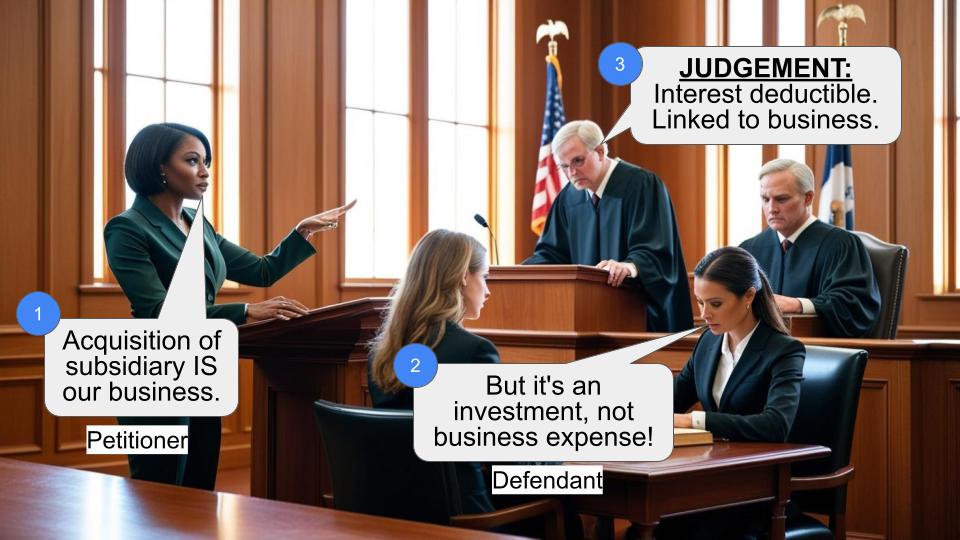
- The CIT argued that the deduction of interest was allowed without proper inquiry and investigation, making the assessment order erroneous and prejudicial to the interests of the Revenue.
- The assessee argued that the Tribunal had previously found in an earlier order that the loans were used for the renovation of the cinema hall, which is part of the assessee's business of exhibiting films. Therefore, the interest deduction was justified.
Key Legal Precedents:
- The Tribunal's earlier finding in the assessee's own case for the Assessment Year 1986-87, where it had recorded that the loans were used for the renovation of the cinema hall.
Judgment:
The Tribunal set aside the CIT's order under Section 263 (of Income Tax Act, 1961), finding that the deduction of interest did not render the assessment order erroneous or prejudicial to the interests of the Revenue. The Tribunal's decision was based on the following reasoning:
1. Once a loan or borrowing is found to be for the purpose of business, the interest paid on it is an allowable deduction.
2. In the present case, the Tribunal had previously found that the loans were used for the renovation of the cinema hall, which is part of the assessee's business of exhibiting films.
3. Therefore, the deduction of interest was justified, and the Tribunal was correct in setting aside the CIT's order under Section 263 (of Income Tax Act, 1961).
FAQs:
Q1. Why was the interest deduction allowed?
A1. The interest deduction was allowed because the Tribunal had previously found that the loans were used for the renovation of the cinema hall, which is part of the assessee's business of exhibiting films. Once a loan or borrowing is found to be for the purpose of business, the interest paid on it is an allowable deduction.
Q2. What was the CIT's argument against the interest deduction?
A2. The CIT argued that the deduction of interest was allowed by the Assessing Officer without proper inquiry and investigation, rendering the assessment order erroneous and prejudicial to the interests of the Revenue.
Q3. Why did the Tribunal set aside the CIT's order under Section 263 (of Income Tax Act, 1961)?
A3. The Tribunal set aside the CIT's order under Section 263 (of Income Tax Act, 1961) because the deduction of interest did not render the assessment order erroneous or prejudicial to the interests of the Revenue. The Tribunal's earlier finding that the loans were used for a legitimate business purpose (the renovation of the cinema hall) was accepted and applied in this case.
Q4. What is the significance of this case?
A4. This case establishes the principle that once a loan or borrowing is found to be for the purpose of business, the interest paid on it is an allowable deduction. The Tribunal's decision upholds this principle and reinforces the importance of considering the purpose of the loan when determining the deductibility of interest expenses.

1. The Income-tax Appellate Tribunal, Ahmedabad Bench “A” has referred the following question under section 256(2) (of Income Tax Act, 1961) (“the Act”).
“Whether, the Tribunal is right in law and on facts in setting aside the order made by the CIT u/s.263 (of Income Tax Act, 1961) on the issue of interest payment amounting to Rs.1,26,916?-?”
2. The Assessment Year is 1981-82. The relevant accounting period is S.Y. 2036. The assessee, a registered firm, is engaged in running a Cinema.
After assessment was complete the Commissioner of Income-tax (CIT) initiated proceedings under section 263 (of Income Tax Act, 1961) by issuance of notice dated 10.2.1986. Though the Notice pertains to two issues the only issue which is relevant for the present is the debit of a sum of Rs.1,26,916/- towards interest in the Profit and Loss Account. According to the CIT the deduction of the said amount had been allowed by the Assessing Officer without making any inquiry and investigation and hence the Assessment Order was erroneous and prejudicial to the interests of revenue. He, therefore, set aside the Assessment Order for the limited purpose of examination by the Assessing Officer.
3. The assessee carried the matter in Appeal before the Tribunal. After hearing both the sides, vide order dated 5.7.1988, the Tribunal allowed the assessee's Appeal on this ground on the basis of findings recorded by the Tribunal for the Assessment Year 1986-87.
4. Heard Mrs.M.M. Bhatt, learned Standing Counsel for the applicant – Revenue. Though served, there is no appearance on behalf of the respondent – assessee.
5. Learned Counsel for the applicant – Revenue submitted that the earlier order in assessee's own case, wherein the Tribunal had recorded a finding that the assessee had borrowed loans from the two parties for renovation of Cinema Hall and allowed the deduction of interest, had been accepted by the Revenue as the records do not reveal any pending reference or otherwise.
6. In the aforesaid fact situation it is not possible to take a different view of the matter considering the findings of fact recorded by the Tribunal. The position in law is well settled. Once a loan or borrowing is found to be for the purpose of business interest paid thereon is an allowable deduction. In the present case admittedly it has been found that the amounts borrowed from the two parties were utilized for renovation of Cinema Hall which is admittedly a part and parcel of the assessee's business of exhibiting films. Hence, in absence of any infirmity in the impugned order of the Tribunal no interference is warranted. The Tribunal was justified in setting aside the order made by the CIT under Section 263 (of Income Tax Act, 1961) on the issue of interest payment amounting to Rs.1,26,916/-.
7. The question referred is answered in the affirmative i.e. in favour of the assessee and against the Revenue. Reference stands disposed of accordingly. There shall be no order as to costs.
(D.A.MEHTA, J.)
(Z.K.SAIYED,J.)
×
Similar Ripples
Questions
Tribunal Upholds Deduction of Interest on Loan for Cinema Hall Renovation
Write your CommentSimilar Posts


Generic
- Reportdata/4934.pdf
