


Court Orders Manual Verification for Excess TDS Refund, Directs Timely Processi…


Full News

Court Orders Manual Verification for Excess TDS Refund, Directs Timely Processing
Court Orders Manual Verification for Excess TDS Refund, Directs Timely Processing
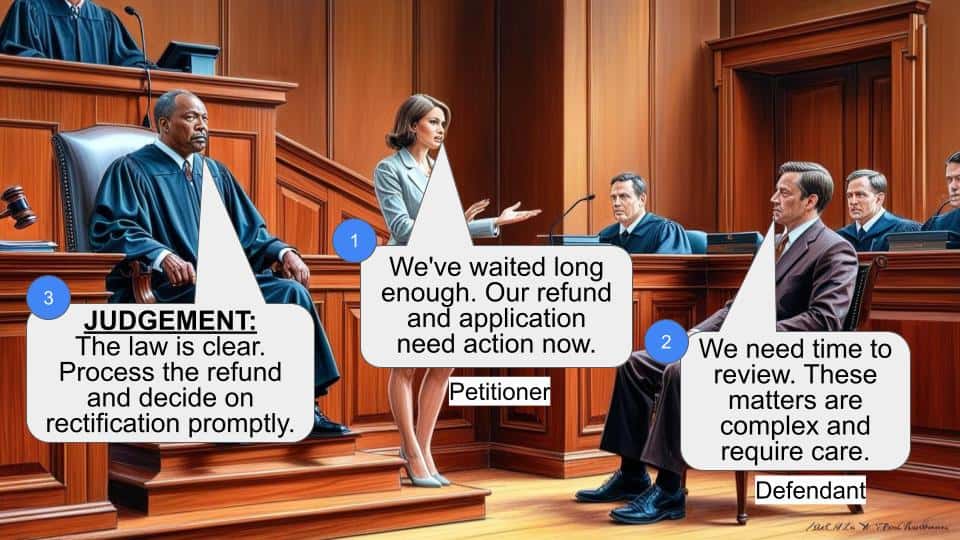
This case involves Clean Wind Power Kurnool Private Limited (the petitioner) seeking a court order to resolve technical issues on the TRACES portal, preventing them from filing a refund application for excess Tax Deduction at Source (TDS). The Delhi High Court directed the petitioner to follow a manual verification procedure and ordered the revenue department to process the request within a specified timeframe.
Get the full picture - access the original judgement of the court order here
Case Name:
Clean Wind Power Kurnool Private Limited vs Deputy Commissioner of Income Tax & TDS (High Court of Delhi)
W.P.(C) 3902/2020 & CM APPL. 13961/2020
Date: 8th July 2020
Key Takeaways:
1. Technical glitches in online portals can be addressed through manual procedures.
2. The court established a time-bound process for resolving TDS refund issues.
3. The judgment highlights the importance of having alternative procedures when digital systems fail.
Issue:
Can the court direct the revenue department to remove technical glitches in the TRACES portal or provide an alternative method for the petitioner to file its refund application for excess TDS?
Facts:
1. The petitioner deposited Rs.69,59,265/- towards TDS via Challan No.34758.
2. Only Rs.19,87,733/- was appropriated/adjusted, leaving an unclaimed excess of Rs.49,71,532/- .
3. The TRACES portal showed 'Maximum Refund Allowed' as 'Nil' against the Challan No.34758 .
4. The excess TDS of Rs.49,71,532/- was shown under 'Remaining Available Balance' instead of 'Maximum Refund Allowed' .
5. The petitioner's ticket raising this issue was closed on July 22, 2019, without resolving the problem .
Arguments:
Petitioner's Arguments:
1. The inability to claim a refund violates Section 200A (of Income Tax Act, 1961), Rule 31A(3A) (of Income Tax Rules, 1962), and CBDT Circular No. 2/2011 dated April 27, 2011 .
2. The technical glitch in the TRACES portal prevents the rightful claim of excess TDS refund.
Respondent's Arguments:
1. In such cases, scrutiny and verification of the TDS amount utilized must be done manually according to an established procedure .
Key Legal Precedents:
The judgment doesn't explicitly mention any legal precedents. However, it refers to:
1. Section 200A (of Income Tax Act, 1961)
2. Rule 31A(3A) (of Income Tax Rules, 1962)
3. CBDT Circular No. 2/2011 dated April 27, 2011
Judgment:
1. The court directed the petitioner to follow the manual procedure outlined by the revenue department .
2. The petitioner was given two days to follow the procedure .
3. The revenue department was ordered to decide on the petitioner's request within four weeks of the petitioner following the procedure .
4. The writ petition and application were disposed of with these directions and observations .
FAQs:
Q1: What was the main issue in this case?
A1: The main issue was the petitioner's inability to file a refund application for excess TDS due to technical glitches in the TRACES portal.
Q2: How did the court resolve the issue?
A2: The court directed the petitioner to follow a manual procedure outlined by the revenue department and ordered the department to process the request within a specific timeframe.
Q3: What is the significance of this judgment?
A3: This judgment highlights the importance of having alternative procedures when digital systems fail and establishes a time-bound process for resolving TDS refund issues.
Q4: What is the TRACES portal?
A4: TRACES (TDS Reconciliation Analysis and Correction Enabling System) is an online portal for managing TDS-related activities, including filing refund applications.
Q5: How long does the revenue department have to process the refund request?
A5: According to the judgment, the revenue department must decide on the petitioner's request within four weeks of the petitioner following the manual procedure.

1. The petition has been heard by way of video conferencing.
2. Present writ petition has been filed seeking a direction to the respondents to remove technical glitches and enable the TRACES portal so that petitioner can file its refund application for the excess Tax Deduction at Source (TDS) deposited by it. In the alternative, petitioner prays that the letter dated 04th June, 2020 addressed by the petitioner to the respondent No.1 be treated as a manual refund application and the respondents be directed to process the same in a time bound manner.
3. Learned counsel for petitioner states that petitioner vide Challan No.34758 deposited Rs.69,59,265/- towards TDS. Against the said deposit, the petitioner was able to appropriate/adjust only Rs.19,87,733/- leaving the outstanding excess unclaimed deposited amount of Rs.49,71,532/-. He states that the petitioner was unable to claim refund of the unclaimed excess TDS amount as the online TRACES portal showed ‘Maximum Refund Allowed’ as ‘Nil’ against the Challan No.34758. He further states that instead excess TDS of Rs.49,71,532/- is shown in the column of ‘Remaining Available Balance’ in respect of Challan No.34758 whereas it should have appeared under the head ‘Maximum Refund Allowed’.
4. He also states that the ticket raised by the petitioner was closed vide reply dated 22nd July, 2019 without resolving the issue faced by the petitioner. He submits that non-refund of the excess TDS amount deposited is violative of Section 200A (of Income Tax Act, 1961) read with Rule 31A(3A) (of Income Tax Rules, 1962) as well as CBDT Circular No. 2/2011 dated 27th April, 2011.
5. On the last date of hearing, learned counsel for respondents had stated that in cases like the present, scrutiny and verification of the TDS amount utilised has to be manually done according to the established procedure. Along with the status report, learned counsel for respondents has now placed on record the established procedure. The relevant procedure as mentioned in the status report is reproduced hereinblelow:-
“That for this CPC-TDS has to be introduce systemic changes in the online functionality of refund. Development of this functionality is in progress and will be implemented in due course. However, CPC-TDS has provided temporary arrangements which include the following steps:
i. Deductor has to approach jurisdictional TDS Assessing Officer with the grievance.
ii. Jurisdictional TDS Assessing Officer will forward this grievance to CPC-TDS via e-mail on aohelpesk@tdscpc.gov.in or through post.
iii. CPC-TDS will accordingly guide the Assessing officer to inform the deductor to tick the option “Refund due to Appeal effect” to place the refund request. By doing so deductor will be able to place the refund request with zero amount as well and the refund request will not get rejected by the system. A request number will be generated.
iv. Deductor will inform this request number to the Jurisdictional Assessing Officer and Jurisdictional TDS Assessing Officer will confirm the same to CPC-TDS by sharing the refund request number. This refund request number is required by CPC-TDS for record purpose for future referencing.
v. This online refund request generated as per the abovementioned point no. iii is further forwarded to TDS Assessing Officer. Assessing Officer will have the right to enhance the refund amount from Zero (0) to the amount available in the challan and also upload the relevant documents supporting the genuineness of the facts and reasons for refund.
vi. After approval from the competent Authority refund request will be processed in online manner.”
6. Consequently, petitioner is directed to follow the aforesaid procedure forthwith. At this stage, learned counsel for the petitioner states that the petitioner would follow the aforesaid procedure within two days. In the event, the petitioner follows the aforesaid procedure within two days, the respondents are directed to decide the petitioner’s request within four weeks thereafter. With the aforesaid directions and observations, present writ petition and application stand disposed of.
7. The order be uploaded on the website forthwith. Copy of the order be also forwarded to the learned counsel through e-mail.
MANMOHAN, J
SANJEEV NARULA, J
JULY 08, 2020
×
Questions
Court Orders Manual Verification for Excess TDS Refund, Directs Timely Processing
Write your CommentSimilar Posts


Generic
- Reportdata/6230.pdf
