


Court Rejects Tax Addition in Block Assessment Due to Lack of Related Evidence


Full News

Court Rejects Tax Addition in Block Assessment Due to Lack of Related Evidence
Court Rejects Tax Addition in Block Assessment Due to Lack of Related Evidence
This case involves the Commissioner of Income Tax (CIT) appealing against DPA Finvest Services Ltd. (DFSL) regarding a block assessment for undisclosed income. The Income Tax Appellate Tribunal (ITAT) had ruled in favor of DFSL, rejecting most of the tax additions made by the Assessing Officer (AO). The High Court dismissed the CIT's appeal, upholding the ITAT's decision.
Get the full picture - access the original judgement of the court order here
Case Name:
Commissioner of Income Tax Vs DPA Finvest Services Ltd. (High Court of Delhi)
ITA 228/2014
Date: 20th July 2015
Key Takeaways:
1. Block assessments under Chapter XIV-B of the Income Tax Act are limited to undisclosed income directly related to evidence found during a search.
2. The AO must establish a clear connection between additional information gathered during an inquiry and the evidence unearthed during the search.
3. Unexplained entries in disclosed accounts should be dealt with in regular assessment proceedings, not block assessments.
Issue:
Can the Assessing Officer add unexplained credit entries to the assessee's income in a block assessment when these entries are not directly related to evidence found during the search?
Facts:
1. A search operation was conducted on August 3, 2000, on Manoj Agarwal and M/s Friends Portfolio Pvt. Ltd. (FPPL).
2. FPPL was found to be providing bogus accommodation book entries.
3. DFSL (the assessee) was identified as a beneficiary of one such entry worth Rs.61,933.
4. The AO issued a notice to DFSL to explain credit entries in its bank account.
5. The AO added Rs.33,75,949 to DFSL's income as unexplained credits under Section 68 (of Income Tax Act, 1961).
6. The CIT (Appeals) overturned the AO's order, stating the additions were not related to evidence from the search.
7. The ITAT upheld the CIT (Appeals) decision, allowing only the addition of Rs.61,933.
Arguments:
- Revenue's Argument:
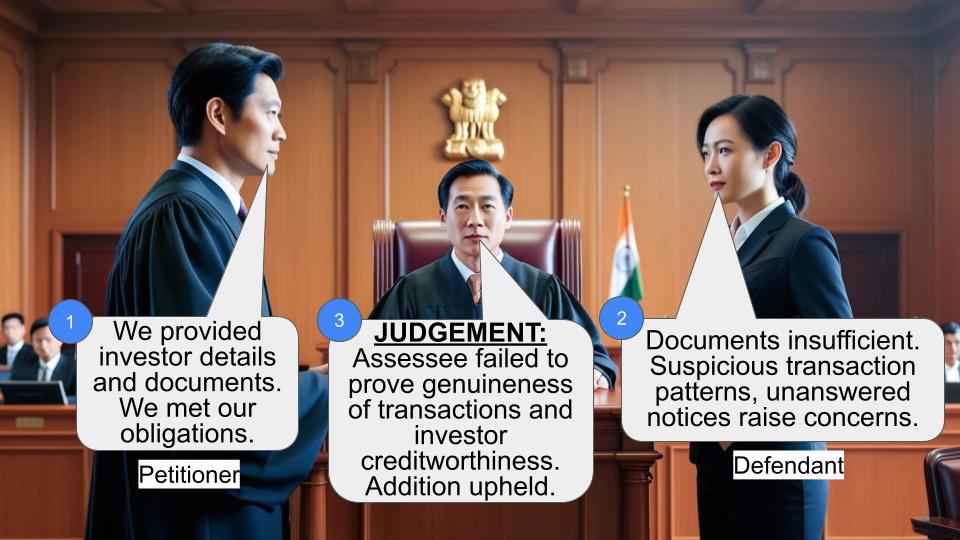
The interpretation of Section 158BB(1) (of Income Tax Act, 1961) by the ITAT was too narrow, overlooking the phrase "and relatable to such evidence."
- Assessee's Argument:
The accounts were fully disclosed in regular returns, and most entries had no connection to the search findings. Unexplained entries should be dealt with in regular assessment proceedings, not block assessments.
Key Legal Precedents:
1. ACIT v. Hotel Blue Moon (2010) 321 ITR 362 - Discussed the scope of Chapter XIV-B and block assessments.
2. CIT v. Blue Chip Construction Co. (P) Ltd. 213 CTR (Del) 530 - Unexplained entries in disclosed accounts should be dealt with in regular assessment proceedings.
3. CIT v. Harkaran Das Ved Pal 336 ITR 8 - Clarified the scope of block assessments under Chapter XIV-B.
4. CIT v. Ravi Kant Jain 250 ITR 141 - Established principles for determining undisclosed income in block assessments.
Judgement:
The High Court dismissed the appeal, finding no substantial question of law. It upheld the ITAT's decision, agreeing that:
1. The AO failed to establish a connection between the additional credit entries and the evidence found during the search.
2. Only the Rs. 61,933 entry directly related to the search evidence could be added to the assessee's income.
3. The AO's action of simply adding unexplained credit entries without establishing their relation to search evidence was unjustified.
FAQs:
1. Q: What is a block assessment?
A: A block assessment is a special procedure under Chapter XIV-B of the Income Tax Act to assess undisclosed income discovered during a search operation.
2. Q: Can all unexplained entries be added in a block assessment?
A: No, only entries directly related to or relatable to evidence found during the search can be added in a block assessment.
3. Q: What happens to unexplained entries not related to search evidence?
A: These should be dealt with in regular assessment proceedings under Section 143 (of Income Tax Act, 1961).
4. Q: What is the significance of this judgment for taxpayers?
A: It protects taxpayers from arbitrary additions in block assessments and ensures that the scope of such assessments remains limited to undisclosed income directly related to search evidence.
5. Q: How does this judgment impact the tax department's approach to block assessments?
A: It requires the tax department to establish a clear connection between additional information gathered during inquiries and the evidence unearthed during the search before making any additions to income in block assessments.

1. This appeal under Section 260A (of Income Tax Act, 1961) („Act) is directed against the order dated 20th September 2013 passed by the Income Tax Appellate Tribunal („ITAT‟) in IT(SS)22.No./Del/2010 for the block period from 1st April 1990 to 20th August 2000.
2. The brief facts of the case are that a search and seizure operation under Section 132 (of Income Tax Act, 1961) was conducted on 3rd August 2000 by the Investigation Wing of the Department in the case of Manoj Agarwal, M/s Friends Portfolio Pvt. Ltd. („FPPL‟) which admittedly had given bogus accommodation book entries to various persons. FPPL had given away its right to trade on the Stock Exchange to another company and, therefore, no genuine trading for any client was done by FPPL. In the course of the assessment proceedings of FPPL and Manoj Agarwal, it transpired that they were using the name and accounts of FPPL for the purposes of providing accommodation book entries. One of such persons who benefitted from such accommodation entry was found to be the Respondent Assessee i.e. M/s DPA Finvest Services Ltd. („DFSL‟). It was shown to have received a sum of Rs. 61,933 from FPPL as an accommodation entry. On the basis of the above material, a notice was issued to the Respondent DFSL who was asked to explain each of the credit entries in its bank account with Syndicate Bank,Green Park Extn. New Delhi.
3. In the order dated 30th March 2005, the Assessing Officer („AO‟) concluded that entries in the aforementioned account totaling Rs.33,75,949 “could not be explained by the assessee company”. Accordingly, they were treated as unexplained credit under Section 68 (of Income Tax Act, 1961). Penalty proceedings under Section 158BFA(2) (of Income Tax Act, 1961) were also initiated.
4. The aforementioned order was overturned by CIT (Appeals) by the order dated 22nd February 2010 by holding that the additions made were based on transactions “which are not related to any evidence collected during the course of search proceedings of the main person”. In other words, it was held that all the additions made were “basically the credit entry found in the appellant‟s declared bank account”.
5. By the impugned order dated 20th September 2013, the ITAT dismissed the Revenue‟s appeal on the ground that “addition can be made only for an amount of Rs.61,933/- which can be said to be income from undisclosed sources”. It was further recorded that as regards the additions made by the AO “nothing was brought on record to show that some evidence relating to these transactions was seized during search on Shri Manoj Agarwal”.
6. It is contended by learned counsel for the Appellant that the interpretation placed by the ITAT on Section 158BB(1) (of Income Tax Act, 1961) is too narrow and it overlooks the words “and relatable to such evidence” which follows the words “evidence found as a result of search or requisition of books of accounts or other documents....” In other words, his contention is that if there is anything that emerges during the enquiry which can be said to be „relatable‟ to the material unearthed during the search, then clearly the opinion to be formed by the AO cannot be restricted to merely what is found during the search. However, on facts, learned counsel for the Appellant was unable to dispute that in the present case the AO simply added the credit entries for which the Assessee was unable to give explanations.
7. It is pointed out by learned counsel for the Respondent that in this case the accounts were fully disclosed by the Assessee at the time of filing regular returns. According to him the entries for which explanation was sought had no connection either with Mr.Manoj Agarwal or FPPL and, therefore, could not be said to be relatable to a single accommodation entry that was unearthed during the search. Relying on the decision in CIT v. Blue Chip Construction Co. (P) Ltd. 213 CTR (Del) 530, it is submitted that the unexplained entries in the books of accounts of the Assessee could be dealt with only in the regular assessment proceedings under Section 143 (of Income Tax Act, 1961) and not in the block assessment proceedings. He sought to draw a distinction between „unexplained‟ income and „undisclosed‟ income which was a sine qua non for Section 158BB (of Income Tax Act, 1961) to apply. Reliance is also placed on the decisions in CIT v. JMD International 179 Taxman 253(Del), CIT v. Ansal Buildwell Ltd. 304 ITR 378 (Del), CIT v. Harkaran Das Ved Pal 336 ITR 8.
8. At the outset, it must be noticed that the ITAT has referred to the decision of the Supreme Court in ACIT v. Hotel Blue Moon (2010) 321 ITR 362. The two questions that the Supreme Court considered in the said case were:
(i) whether issuance of notice under Section 143(2) (of Income Tax Act, 1961) within the prescribed time limit was mandatory for the purposes of the assessment under Section 143(3) (of Income Tax Act, 1961)?; and (ii) whether certain additions made in that case under Section 68 (of Income Tax Act, 1961) ought to have been deleted?. An incidental issue that was examined was whether block assessment could have been made under Section 158BC (of Income Tax Act, 1961) without issuing notice under Section 143(3) (of Income Tax Act, 1961)? In that context, the Supreme Court discussed Chapter XIV-B under which Sections158BB and 158BC fall. In para 12, the Supreme Court observed as under:
“Chapter XIV-B provides for an assessment of the undisclosed income unearthed as a result of search without affecting the regular assessment made or to be made. Search is the sine qua non for the block assessment. The special provisions are devised to operate in the distinct field of undisclosed income and are clearly in addition to the regular assessments covering the previous years falling in the block period. The special procedure of Chapter XIV-B is intended to provide a mode of assessment of undisclosed income, which has been detected as a result of search. It is not intended to be substitute for regular assessment.
Its scope and ambit is limited in that sense to materials unearthed during search. It is in addition to the regular assessment already done or to be done. The assessment for the block period can only be done on the basis of evidence found as a result of search or requisition of books of accounts or documents and such other materials or information as are available with the AO. Therefore, the income assessable in block assessment under Chapter XIV-B is the income not disclosed but found and determined as a result of search under S. 132 or requisition under S. 132A of the Act”.
9. Although in the above background the Supreme Court observed that the scope and ambit of Chapter XIV-B was limited to “materials unearthed during search,” clearly the Court was not saying that the assessment for the block period could not be on the basis of materials and information available with AO and “relatable to such evidence” unearthed during the search. That question, in the facts of that case, did not arise before the Supreme Court.
10. In order to undertake a proper exercise in terms of Section 158BB(1) (of Income Tax Act, 1961), the AO will have to come to a definite conclusion that what emerges during the enquiry following the search in the form of information or material is „relatable to such evidence‟ as has been unearthed during the search. That exercise will of course vary from case to case. There has to be an application of mind by the AO to the information gathered, and an effort has to be made to relate such information or material to the evidence unearthed during the search. This Court in Harkaran Das Ved Pal (supra) explained as under:
“The procedure under Chapter XIV-B is not intended as a substitute to regular assessment and its scope and ambit is limited in that sense to materials unearthed during the search. As pointed out in Ravi Kant Jain (supra), the assessment for the block period can only be done on the basis of evidence found as a result of search or requisition of books of accounts or other documents and such other materials or information as are available with the AO and relatable to such evidence. It is, therefore, clear that the undisclosed income, which is to be determined under Chapter XIV-B, has to be determined on the basis of evidence discovered during the search. It is obvious that where the computation of undisclosed income is based on material other than what was found in the course of the search, the same could not be treated as undisclosed income determined under cl. (c) of Section 158BC (of Income Tax Act, 1961)”.
11. In coming to the above conclusion, this Court followed its earlier decision in CIT v. Ravi Kant Jain 250 ITR 141.
12. In the instant case, nothing has been brought on record by AO to show that any information or material that he came across during the enquiry was in fact „relatable‟ to the solitary accommodation entry which was unearthed during the search. In the circumstances the conclusion of the CIT (A) that there was no justification in the AO simply adding the credit entries which according to him were not explained by the Assessee cannot be faulted.
13. In the facts of the present case, the Court does not find any substantial question of law that arises which required examination by this Court.
14. The appeal is dismissed.
S. MURALIDHAR, J
VIBHU BAKHRU, J
JULY 20, 2015
×
Similar Ripples
Questions
Court Rejects Tax Addition in Block Assessment Due to Lack of Related Evidence
Write your CommentSimilar Posts

Generic
- Reportdata/3598.pdf
