


Court Rejects Revenue's Appeal on Block Assessment Commission Dispute


Full News
Court Rejects Revenue's Appeal on Block Assessment Commission Dispute
Court Rejects Revenue's Appeal on Block Assessment Commission Dispute
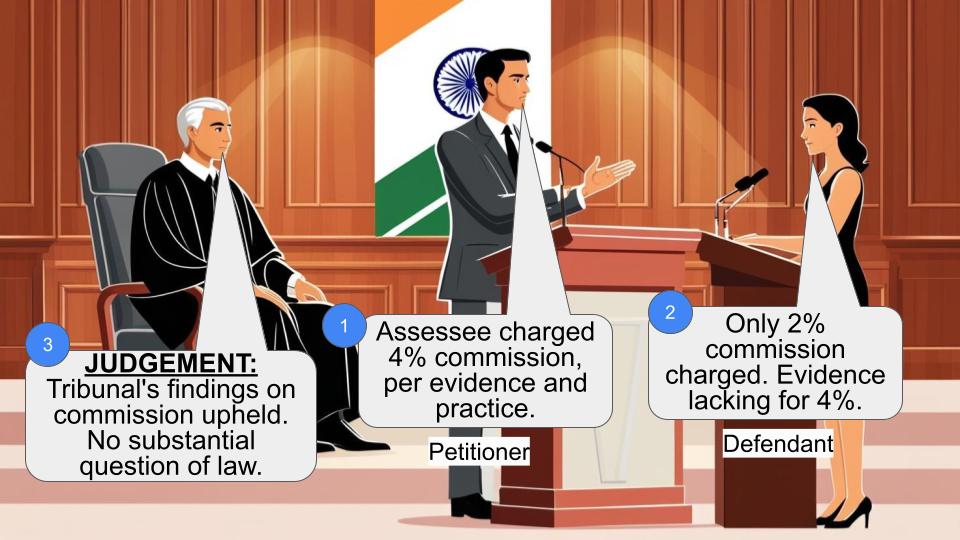
This case involves an appeal by the Revenue against an order passed by the Tribunal regarding a block assessment period. The main dispute was about the percentage of commission charged by the assessee (Deep Aggarwal Estates (P) Ltd.) on property sales. The High Court dismissed the appeal, finding no substantial question of law.
Get the full picture - access the original judgement of the court order here
Case Name:
Commissioner of Income Tax Vs Deep Aggarwal Estates (P) Ltd. (High Court of Delhi)
ITA 977/2007
Date: 9th October 2007
Key Takeaways
1. The court emphasized the importance of concrete evidence in tax assessments.
2. Personal knowledge or assumptions about trade practices are not considered legal evidence.
3. Tribunal's appreciation of evidence, if reasonable, is unlikely to be interfered with by higher courts.
Issue
Did the Tribunal err in its conclusion that there was insufficient evidence to support the Assessing Officer's finding that the assessee charged a 4% commission on property sales?
Facts
1. The case pertains to a block assessment period from 1988-89 to 1998-99.
2. The Assessing Officer (AO) had determined that the assessee was charging a 4% commission on property sales (2% from the buyer and 2% from the seller).
3. The assessee claimed they only charged a 2% commission.
4. The AO's decision was partly based on a statement from Raju Prasad, an employee who had worked as a peon for the assessee for six months.
5. The Tribunal had concluded that there was insufficient evidence to support the AO's finding of a 4% commission charge.
Arguments
Revenue's Argument:
- The AO's determination of a 4% commission charge was correct based on the statement of Raju Prasad and the AO's personal knowledge of trade practices.
Assessee's Argument:
- They only charged a 2% commission on property sales.
- There was insufficient evidence to support the AO's finding of a 4% commission charge.
Key Legal Precedents
No specific legal precedents were cited in the provided judgment. The case primarily revolved around the appreciation of evidence and the sufficiency of proof in tax assessments.
Judgement
1. The High Court dismissed the Revenue's appeal.
2. The court found that the Tribunal's conclusion was based on an appreciation of evidence, which doesn't raise a substantial question of law.
3. The court agreed with the Tribunal that reliance on Raju Prasad's statement was inadequate.
4. The court noted that the AO's personal knowledge about trade practices cannot be considered legal evidence.
FAQs
Q1: What was the main point of contention in this case?
A: The main dispute was whether the assessee charged a 4% commission (as claimed by the Revenue) or a 2% commission (as claimed by the assessee) on property sales.
Q2: Why did the High Court dismiss the Revenue's appeal?
A: The High Court dismissed the appeal because it found that the Tribunal's decision was based on an appreciation of evidence, which doesn't raise a substantial question of law.
Q3: What was the significance of Raju Prasad's statement in this case?
A: Raju Prasad's statement, who was a peon working for the assessee for six months, was considered by the AO but deemed inadequate by the Tribunal and the High Court as evidence for the 4% commission claim.
Q4: Can an Assessing Officer's personal knowledge be considered as evidence?
A: No, the court clearly stated that an AO's personal knowledge about trade practices cannot be considered legal evidence.
Q5: What does this judgment imply for future tax assessment cases?
A: This judgment emphasizes the need for concrete evidence in tax assessments and suggests that higher courts are unlikely to interfere with a Tribunal's reasonable appreciation of evidence.

1. The Revenue is aggrieved by an order dt. 22nd Sept., 2006 passed by the Tribunal, Delhi Bench ‘C’, in IT(SS)A No. 74/Del/2000 relevant for the block assessment period 1988-89 to 1998-99 and in ITA No. 4004/Del/2002 relevant for the asst. yr. 1998-99.
2. The present appeal is, however, preferred only against the block assessment,
3. The only question that has arisen in this case is whether the assessee received commission of 4 per cent on sale of properties (2 per cent from the buyer and 2 per cent from the seller) as held by the AO and by the CIT(A) or whether it used to receive commission at 2 per cent for such transactions ?
4. On consideration of the material, it appears that the statement of one Raju Prasad, who was an employee of the assessee and was working as a peon for the last six months may, have had some influence in the decision taken by the AO. Be that as it may the AO proceeded on the basis of his personal knowledge about the practice in the trade. This can hardly be said to be legal evidence.
5. The Tribunal came to the conclusion that reliance upon the statement of Raju Prasad was inadequate and there was no evidence at all to suggest that the assessee was charging 4 per cent commission as held by the AO. We find this to be merely a case of appreciation of the evidence on record. This does not, in our opinion, raise any substantial question of law.
6. Dismissed.
MADAN B. LOKUR, J
OCTOBER 09, 2007 S. MURALIDHAR, J kapil
×
Similar Ripples
Questions
Court Rejects Revenue's Appeal on Block Assessment Commission Dispute
Write your CommentSimilar Posts

Generic
- Reportdata/5286.pdf
