


Rule 8D (of Income Tax Rules, 1962) not retrospective, but direct and indirect …


Full News

Rule 8D (of Income Tax Rules, 1962) not retrospective, but direct and indirect expenses on exempt income must be disallowed
Rule 8D (of Income Tax Rules, 1962) not retrospective, but direct and indirect expenses on exempt income must…
This case involves an appeal by the Income Tax Department against a company (the assessee) regarding the treatment of expenses related to exempt income under Section 14A (of Income Tax Act, 1961). The court ruled that while Rule 8D (of Income Tax Rules, 1962) is not retrospective, both direct and indirect expenses related to exempt income must be disallowed under Section 14A (of Income Tax Act, 1961). The case was remitted back to the tribunal for further examination.
Get the full picture - access the original judgement of the court order here
Case Name:
CIT VS Sahara India Housing Corporation Ltd (High Court of Delhi)
ITA Nos. 740/2009, 762/2009 & 847/2010
Date: 27th April 2012
Key Takeaways:
1. Rule 8D (of Income Tax Rules, 1962) is not retrospective in nature.
2. Both direct and indirect expenses related to exempt income must be disallowed under Section 14A (of Income Tax Act, 1961).
3. The tribunal must examine the nexus between expenditure and tax-free income, even if the Assessing Officer's initial calculation was incorrect.
4. The case highlights the importance of proper examination of expenses related to exempt income.
Issue:
Was the Income Tax Appellate Tribunal correct in affirming the order of the Commissioner of Income Tax (Appeals) to delete the disallowance of Rs. 1,19,385/- made by the Assessing Officer under Section 14A (of Income Tax Act, 1961)?
Facts:
1. The case pertains to the assessment years 1999-2000, 2000-01, and 2001-02.
2. The Assessing Officer had disallowed Rs. 1,19,385/- under Section 14A (of Income Tax Act, 1961).
3. The Commissioner of Income Tax (Appeals) deleted this disallowance.
4. The Income Tax Appellate Tribunal affirmed the decision of the CIT(Appeals).
5. The Revenue (Income Tax Department) appealed against this decision in the High Court.
Arguments:
Revenue's Argument:
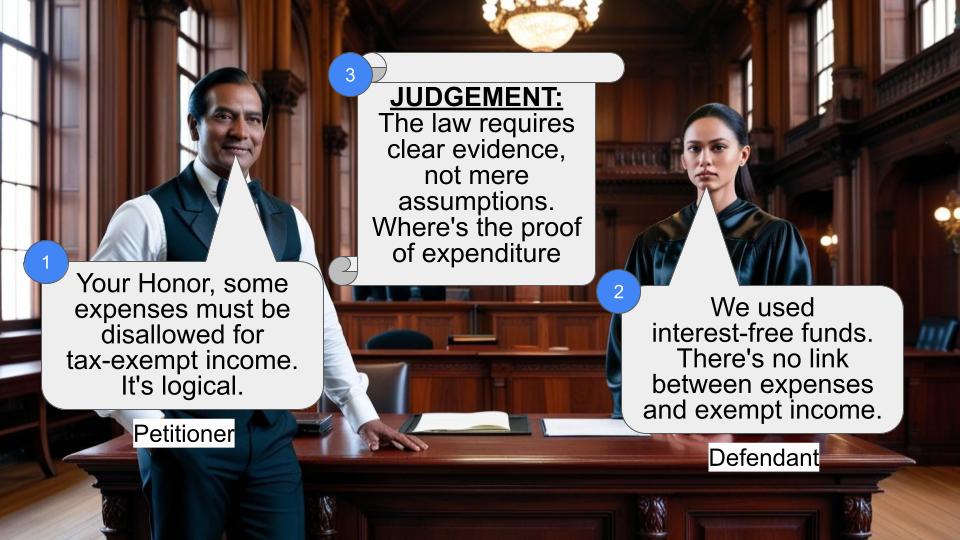
- The disallowance under Section 14A (of Income Tax Act, 1961) was justified as there were expenses related to exempt income.
Assessee's Argument:
- No direct or indirect expenditure was incurred in relation to tax-free income.
Key Legal Precedents:
1. ITA 687/2009, Maxxopp Investments Ltd. Vs. CIT dated 18th November, 2011: This case held that Rule 8D (of Income Tax Rules, 1962) is not retrospective, but both direct and indirect expenses related to exempt income must be disallowed under Section 14A (of Income Tax Act, 1961).
Judgement:
1. The court answered the question of law in favor of the Revenue and against the assessee.
2. It was held that the tribunal's decision to affirm the deletion of the entire disallowance was not correct.
3. The court ordered a remit to the tribunal to examine:
a) Whether any expenditure was incurred in relation to tax-free income.
b) The quantum of such expenditure, if any, to be disallowed.
4. The court emphasized that both direct and indirect expenses related to exempt income must be examined and disallowed if applicable.
FAQs:
1. Q: What is Section 14A (of Income Tax Act, 1961)?
A: Section 14A (of Income Tax Act, 1961) deals with the disallowance of expenditure incurred in relation to income not includible in total income (i.e., exempt income).
2. Q: Is Rule 8D (of Income Tax Rules, 1962) applicable retrospectively?
A: No, the court clarified that Rule 8D (of Income Tax Rules, 1962) is not retrospective in nature.
3. Q: Why did the court remit the case back to the tribunal?
A: The court felt that a proper examination of both direct and indirect expenses related to exempt income was necessary, which the tribunal had not done earlier.
4. Q: Does the deletion of the Assessing Officer's disallowance mean no expenses were related to exempt income?
A: Not necessarily. The court held that even if the Assessing Officer's calculation was incorrect, it doesn't automatically mean no expenses were related to exempt income.
5. Q: What should the tribunal examine in its fresh assessment?
A: The tribunal should examine the nexus between expenditure and tax-free income, and determine if any amount should be disallowed under Section 14A (of Income Tax Act, 1961).

1. Having heard learned counsel for the parties in these appeal, which pertain to the assessment years 1999-2000, 2000-01 and 2001- 02, we frame the following substantial question of law:-
“Whether the Income Tax Appellate Tribunal was right in holding that the gains/income from sale and purchase of securities was assessable under the head “capital gains” and not under the head “income from business”?
2. The aforesaid question is common for all the three assessment years.
3. For the assessment year 1999-2000, the Revenue has raised another issue pertaining to deduction under Section 14A (of Income Tax Act, 1961) (Act, for short). Accordingly, for the appeal, which pertains the assessment year 1999-2000 being ITA 762/2009, we frame the following additional question of law:-
“Whether the Income Tax Appellate Tribunal was right in affirming the order of the Commissioner of Income Tax (Appeals) deleting disallowance of Rs.1,90,385/- made by the Assessing Officer under Section 14A (of Income Tax Act, 1961)?”
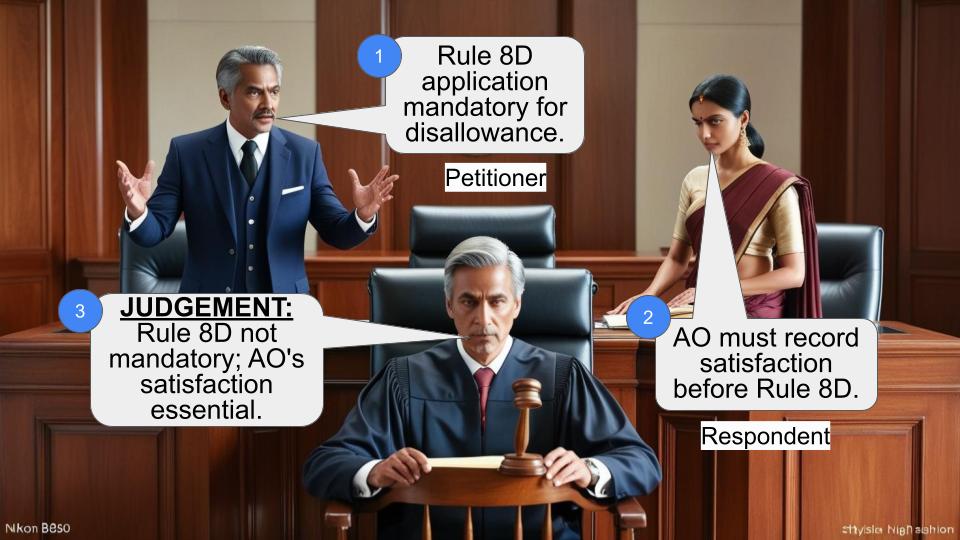
4. As far as the second question is concerned, an order of remit is required to be passed in view of the decision of this Court in ITA 687/2009,Maxxopp Investments Ltd. Vs. CIT dated 18th November, 2011. In the said decision, it has been held that Rule 8D (of Income Tax Rules, 1962) is not retrospective, but both the direct and indirect expenses in relation to exempt income have to be disallowed under Section 14A (of Income Tax Act, 1961). In the present case, we have noticed that the respondent-assessee is a company and the entire disallowance of Rs.1,19,385/- was deleted by the first appellate authority and the said order is affirmed by the tribunal. In other words, it has been held that no direct or indirect expenditure whatsoever were incurred in relation to tax free income, but there is no finding to the said effect. Merely, because the Assessing Officer was wrong in making disallowance of Rs. 1,19,385/- on ad hoc basis, cannot be a ground to hold that no amount whatsoever was relatable directly or indirectly to the earning of the tax free income. The nexus of the expenditure both direct and indirect has to be also seen and examined by the tribunal. Accordingly, we answer the question of law mentioned above in negative i.e. in favour of the Revenue and against the assessee and an order of remit is passed. The question whether any expenditure incurred, in the facts of the case, and the quantum, if any, thereof to be disallowed will be examined by the tribunal.
5. The first and the main question, which is common in all the appeals, arises as the assessee in the income-tax returns had claimed and treated the loss/gains from sale and purchase of securities as taxable under the head “capital gains” and not under the head “income from business”. The Assessing Officer in the assessment order rejected the claim and explanation given by the assessee as untenable on the ground that in the earlier years the assessee had treated income/loss from sale of securities as business income and had been assessed as such. He observed that the assessee cannot be allowed to change the head under which the transactions were taxable at his own sweet will.
6. The aforesaid findings recorded by the Assessing Officer were reversed by the first appellate authority in the assessment year 1999- 2000 observing that the respondent-assessee had shown the securities under the head “investment” in the balance sheet for many years. He has referred to the notes to accounts to the said balance sheets.The CIT(A) for the Assessment Year 2000-01, followed the same reasoning and reversed the addition made by the Assessing officer. For the Assessment Year 2001-02, CIT (A) relied upon the decision of the tribunal for the Assessment Year 1999-00 and 2000-01, wherein the same was directed to be taxable under the head “capital gain”.
7. The tribunal by the impugned order dated 4th April, 2008 for the assessment years 1999-2000 and 2000-01 dismissed the appeals filed by the Revenue, inter alia, recording as under:-
“15. We have carefully considered the rival submissions in the light of material placed before us. The fact that the assessee has shown the securities as investment in its books of account right from inception has not been controverted by Ld. DR. The same is supported by audited balance sheet of the assessee. The reason for not treating the same as short term capital gain in the year years has been explained by the assessee that the same was due to the reason that there was no difference in the rate of tax. However, earlier treatment given by the assessee to the said transaction cannot be criteria to determine the nature of income in the hands of the assessee, particularly when the securities have been shown as investment in the balance sheet. Considering the entirety of facts, we are of the opinion that Ld. CIT (A) is right in holding that the income/loss arisen to assessee from sale and purchase of security was income/loss from long term capital gain/loss. Thus, we uphold his findings and ground No.1 is dismissed.”
8. For the assessment year 2001-02, vide order dated 5 thJune, 2009, the tribunal followed its order dated 4th April, 2008.
9. A perusal of the reasoning given by the tribunal in the order dated 4th April, 2008, reveals that there was dispute between the respondent-assessee and the Revenue with regard to the earlier treatment given by the assessee. We have already noticed that the Assessing Officer had observed that in the earlier years the assessee had treated the transactions relating to securities as “business income”. The CIT (Appeals) had given a contradictory finding with regard to the treatment of the transactions relating to securities in the books of accounts. The tribunal in its order has not given any finding either in favour or against the respondent-assessee but referred to the balance sheets where the securities were shown under the head “investment". It has recorded and accepted that in some years (or as argued before us by the assessee in the return filed for the assessment year 1998-99) the gains were shown as “income from business” and not as “short term capital gains”. Tribunal has held that the earlier treatment given by the assessee cannot be determinative; and the explanation of the assesee that there was no difference in tax rate has been accepted.
10. Gujarat High Court in CIT vs. Rewashanker A. Kothari, (2006) 283 ITR 338 (Guj.), after examining earlier judgments on the question has laid down several parameters/tests which have to be applied to find out when income from transactions in shares/securities should be treated as “income from business” or the gain which has to be taxed under the head “capital gains”. The parameters/tests are as under:-
“(a) The first test is whether the initial acquisition of the subject-matter of transaction was with the intention of dealing in the item, or with a view to finding an investment. If the transaction, since the inception, appears to be impressed with the character of a commercial transaction entered into with a view to earn profit, it would furnish a valuable guideline.
(b) The second test that is often applied is as to why and how and for what purpose the sale was effected subsequently.
(c) The third test, which is frequently applied, is as to how the assessee dealt with the subject-matter of transaction during the time the asset was with the assessee. Has it been treated as stock-in-trade, or has it been shown in the books of account and balance sheet as an investment. This inquiry, though relevant, is not conclusive.
(d) The fourth test is as to how the assessee himself has returned the income from such activities and how the Department has dealt with the same in the course of preceding and succeeding assessments. This factor, though not conclusive, can afford good and cogent evidence to judge the nature of the transaction and would be a relevant circumstance to be considered in the absence of any satisfactory explanation.
(e) The fifth test, normally applied in cases of partnership firms and companies, is whether the deed of partnership or the memorandum of association, as the case may be, authorises such an activity.
(f) The last but not the least, rather the most important test, is as to the volume, frequency, continuity and regularity of transactions of purchase and sale of the goods concerned. In a case where there is repetition and continuity, coupled with the magnitude of the transaction, bearing reasonable proportion to the strength of holding, then an inference can readily be drawn that the activity is in the nature of business.”
11. CBDT in the Circular No.4/2007 dated 15th June, 2007 has elucidated and explained the tests which are to be applied. It is apparent that the tribunal did not examine the said relevant aspects. Accordingly, we deem it appropriate to pass an order of remit to the tribunal to examine the issue holistically keeping in mind the parameters/tests, which have been mentioned above. The tribunal will record specific finding as to the treatment given by the assessee in the return of income in the proceedings relating to the earlier assessment years including balance sheet etc. The observation/findings recorded by the tribunal in the impugned order in this regard will not be binding. Accordingly, the first question is answered in negative i.e. in favour of the Revenue and against the assessee to the extent indicated above.
12. The appeals are disposed of. No costs.
SANJIV KHANNA, J.
R.V.EASWAR, J.
APRIL 27, 2012
×
Questions
Rule 8D (of Income Tax Rules, 1962) not retrospective, but direct and indirect expenses on exempt income must be disallowed
Write your CommentSimilar Posts

Generic
- Reportdata/5876.pdf
