Full News

"Rough Diamonds Exempted from Customs Duty: Section 14 of Customs Act Inapplicable"
"Rough Diamonds Exempted from Customs Duty: Section 14 of Customs Act Inapplicable"
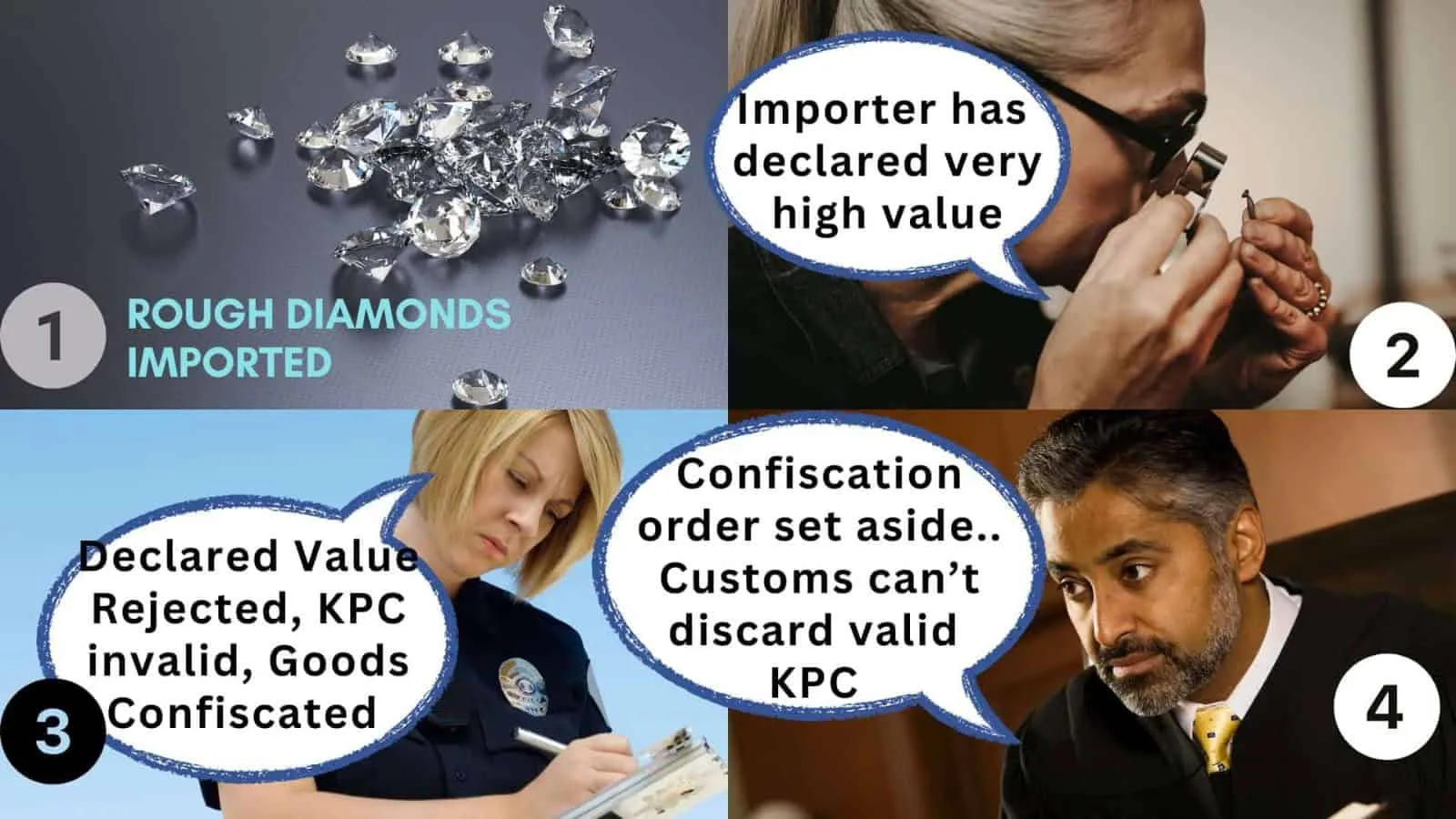
The case under review involves M/s Kiran Gems P Ltd and several individuals who are dissatisfied with the outcome of proceedings before the Commissioner of Customs (Appeals). The dispute revolves around the importation of two consignments of rough diamonds. The examination revealed discrepancies in the parcels, including markings of rejections and inconsistencies in quantities declared. The diamonds were seized under the Customs Act, and their assessable value was revised for confiscation. The first appellate authority upheld the confiscation but allowed redemption upon payment of fines. Penalties were also imposed on the involved parties. The appeal of the Commissioner of Customs was rejected due to a delay in filing and the inability to introduce additional grounds. The issue of review and administrative power within the customs law framework is discussed. The summary concludes with an examination of the valuation process for rough diamonds and the challenges in determining their value. The presence of an employee during the examination and the rejection of the first report are highlighted, indicating the need for credibility in the assessment process.
Court Name : CESTAT Mumbai
Parties : Commissioner of Customs Vs Kiran Gems Pvt Ltd
Decision Date : 22 June 2023
Judgement ref : Customs Appeal No. 87726 of 2022
USTOMS, EXCISE AND SERVICE TAX APPELLATE TRIBUNAL MUMBAI
WEST ZONAL BENCH
CUSTOMS APPEAL NO: 87726 OF 2022
[Arising out of Order-in-Appeal No: MUM-CUSTM-APSC-APP-1374 to
1379/2022-23 dated 15th September 2022 passed by the Commissioner of
Customs (Appeals), Mumbai - III.]
Commissioner of Customs
Air Special Cargo
Awas Corporate Point, Makwana Lane,
Behind SM Centre, Andheri-Kurla Road, Andheri (E)
Mumbai - 400059 … Appellant
versus
Kiran Gems Pvt Ltd
FE-5011, Bharat Diamond Bourse, G Block,
Bandra Kurla Complex, Bandra (E), Mumbai 400 051. …Respondent
APPEARANCE:
Shri Sydney D’Silva, Additional Commissioner (AR) for the appellant
Shri Sujay Kantawala, Advocate for the respondent
WITH
CUSTOMS APPEAL NO: 87811 OF 2022
[Arising out of Order-in-Appeal No: MUM-CUSTM-APSC-APP-1374 to
1379/2022-23 dated 15th September 2022 passed by the Commissioner of
Customs (Appeals), Mumbai - III.]
Kiran Gems Pvt Ltd
FE-5011, Bharat Diamond Bourse, G Block,
Bandra Kurla Complex, Bandra (E), Mumbai 400 051. … Appellant
versus
Commissioner of Customs
Air Special Cargo
Awas Corporate Point, Makwana Lane,
Behind SM Centre, Andheri-Kurla Road, Andheri (E)
Mumbai - 400059 …Respondent
WITH
CUSTOMS APPEAL NO: 87812 OF 2022
[Arising out of Order-in-Appeal No: MUM-CUSTM-APSC-APP-1374 to
1379/2022-23 dated 15th September 2022 passed by the Commissioner of
Customs (Appeals), Mumbai - III.]
Vallabhbhai S Patel
Kiran Gems Pvt Ltd
FE-5011, Bharat Diamond Bourse, G Block,
Bandra Kurla Complex, Bandra (E), Mumbai 400 051. … Appellant
versus
Commissioner of Customs
Air Special Cargo
Awas Corporate Point, Makwana Lane,
Behind SM Centre, Andheri-Kurla Road, Andheri (E)
Mumbai - 400059 …Respondent
WITH
CUSTOMS APPEAL NO: 87813 OF 2022
[Arising out of Order-in-Appeal No: MUM-CUSTM-APSC-APP-1374 to
1379/2022-23 dated 15th September 2022 passed by the Commissioner of
Customs (Appeals), Mumbai - III.]
Mavbjibhai S Patel
Kiran Gems Pvt Ltd
FE-5011, Bharat Diamond Bourse, G Block,
Bandra Kurla Complex, Bandra (E), Mumbai 400 051. … Appellant
versus
Commissioner of Customs
Air Special Cargo
Awas Corporate Point, Makwana Lane,
Behind SM Centre, Andheri-Kurla Road, Andheri (E)
Mumbai - 400059 …Respondent
APPEARANCE:
Shri Sujay Kantawala, Advocate for the appellants
Shri Sydney D’Silva, Additional Commissioner (AR) for the respondent
WITH
CUSTOMS APPEAL NO: 87823 OF 2022
[Arising out of Order-in-Appeal No: MUM-CUSTM-APSC-APP-1374 to
1379/2022-23 dated 15th September 2022 passed by the Commissioner of
Customs (Appeals), Mumbai - III.]
Raviraj Anil Kumar
Uniface Diam DMCC, Dubai Unit No. 3596
DMCC, Business Centre, Level No. 1 Jewellery
& Gemplex 3 PO Box, Dubai, UAE 112930 … Appellant
versus
Commissioner of Customs
Air Special Cargo
Awas Corporate Point, Makwana Lane,
Behind SM Centre, Andheri-Kurla Road, Andheri (E)
Mumbai - 400059 …Respondent
AND
CUSTOMS APPEAL NO: 87824 OF 2022
[Arising out of Order-in-Appeal No: MUM-CUSTM-APSC-APP-1374 to
1379/2022-23 dated 15th September 2022 passed by the Commissioner of
Customs (Appeals), Mumbai - III.]
Kushal Kamles Patel
Uniface Diam DMCC, Dubai Unit No. 3596
DMCC, Business Centre, Level No. 1 Jewellery
& Gemplex 3 PO Box, Dubai, UAE 112930 … Appellant
versus
Commissioner of Customs
Air Special Cargo
Awas Corporate Point, Makwana Lane,
Behind SM Centre, Andheri-Kurla Road, Andheri (E)
Mumbai - 400059 …Respondent
APPEARANCE:
Ms Lakshmi Menon, Advocate with Shri Akshay Deokule, Advocate for the
appellants Shri Sydney D’Silva, Additional Commissioner (AR) for the respondent
CORAM:
HON’BLE MR C J MATHEW, MEMBER (TECHNICAL)
APPEARANCE:
Ms Lakshmi Menon, Advocate with Shri Akshay Deokule, Advocate for the
appellants Shri Sydney D’Silva, Additional Commissioner (AR) for the respondent
CORAM:
HON’BLE MR AJAY SHARMA, MEMBER (JUDICIAL)
FINAL ORDER NO: A / 85978-85983 /2023
DATE OF HEARING: 27/04/2023
DATE OF DECISION: 22/06/2023
PER: C J MATHEW
The order impugned before us is significantly humungous. But
then so is the order-in-original that is the fount of the grievance of M/s
Kiran Gems P Ltd, S/Shri Vallabhai Patel, Mavjibhai S Patel, Raviraj
Anil Kumar Vakani and Kushal Kamlesh Patel, as well as that of
Commissioner of Customs (Airport Special Cargo), Chhatrapati
Shivaji Maharaj International Airport (CSMIA), Mumbai, all of whom
are disappointed by the outcome of proceedings before Commissioner
of Customs (Appeals), Mumbai -III and are in appeal before us. For
comparison, in the Bible, an 800,000 word composition by several
contributors, is the New Testament, comprising 200,000 words and,
just about half of which is the word count in the order of Joint
Commissioner, (Airport Special Cargo), Chhatrapati Shivaji Maharaj
International Airport (CSMIA), Mumbai to sustain confiscating
‘rough diamonds’ imported against bills of entry no.
2673556/02.04.2019 and 2812593/12.04.2019. The factual matrix,
therefore, cannot but be as vast and as complex enough for holding
interest.
2. The two consignments of 62,837 carats and 76,195.45 carats,
valued at ₹ 49,21,80,126.88 and ₹ 119,24,42,649.19 respectively,
imported by M/s Kiran Gems P Ltd from M/s Unifacet Diam, DMCC,
Dubai were declared to be in conformity with description
corresponding to tariff item 7102 3100 in First Schedule to Customs
Tariff Act, 1975 upon presentation at Precious Cargo Customs
Clearance Centre (PCCCC), Bharat Diamond Bourse (BDB) but, on
examination, were observed to consist of parcels, some of which were
marked as ‘rejections’ from ‘Al Rosa’ mine, besides not matching the
quantities declared in the bills of entry which were, of themselves,
inconsistent with the details in the accompanying invoices, packing
lists and Kimberley Process Certificates (KPC) and, therefore, seized
under section 110 of Customs Act, 1962 on 4th April 2019 and 22nd
April 2019. The adjudicating authority found the Kimberley Process
Certificates (KPC) to be in order. However, the ‘rough diamonds’
were ordered to be confiscated under section 111(m) of Customs Act,
1962 on account of assessable value having been revised to ₹
26,16,99,645.22 and ₹ 94,24,99,507.50 by recourse to rule 9 of
Customs Valuation (Determination of Value of Imported Goods)
Rules, 2007 but allowed to be redeemed, under section 125 of
Customs Act, 1962, on payment of fine of ₹ 2,00,00,000 and ₹
8,00,00,000 respectively and to be re-exported subject to conforming
of declarations therein in accord with the examination report in
addition to acceding to drawal of representative samples from each
consignment over which no claim would ever be preferred. The first
appellate authority upheld all of these except the conditions prescribed
for re-export for want of such authority in section 125 of Customs
Act, 1962. In addition, penalty of ₹ 4,00,00,000 on M/s Kiran Gems P
Ltd, of ₹ 1,00,00,000 each on S/Shri Mavjibhai S Patel and
Vallabbhai S Patel, Managing Director and Chairman & Director of
M/s Kiran Gems P Ltd, and ₹ 50,00,000 and ₹ 25,00,000 respectively
on S/Shri Kushal Kamlesh Patel and Raviraj Anilkumar Vakani,
owner of M/s Unifacet Diam Dubai and General Manager of M/s
Unifacet Diam Dubai, under section 112(a) of Customs Act, 1962
were left untouched by the first appellate authority as were penalties
of ₹ 50,00,000 each on S/Shri Mavjibhai S Patel and Vallabbhai S
Patel, Managing Director and Chairman & Director of M/s Kiran
Gems P Ltd, and ₹ 25,00,000 and ₹ 15,00,000 respectively on S/Shri
Kushal Kamlesh Patel and Raviraj Anilkumar Vakani, owner of M/s
Unifacet Diam Dubai and General Manager of M/s Unifacet Diam
Dubai, under section 114AA of Customs Act, 1962.
3. Appeal of Commissioner of Customs (Airport Special Cargo),
Chhatrapati Shivaji Maharaj International Airport (CSMIA), Mumbai
against discarding of proposal for confiscation under section 111(d) of
Customs Act, 1962, and consequent grant of redemption on payment
of fine, was rejected by the first appellate authority for not having
been subject to review, the essential pre-requisite for filing of appeal
against its own order, within the time stipulated in section 129DD of
Customs Act, 1962. Concomitantly, the additional grounds sought to
be incorporated in that appeal were, for not having been included in
the determination by the competent authority in the review preceding
the appeal itself, also not entertained. The appeal of Revenue, though
seeking also to agitate grievance against the order-in-original, is about
the rejection of their appeal by the first appellate authority. It has been
brought to our attention that the sole relief granted in the impugned
proceedings, viz., the setting aside of conditions for re-export, is not a
cause of grievance at this stage.
4. It would appear that the voluminous findings of the original
authority are, therefore, only about the composition of lots/parcels and
the reasoning for recourse to the ‘residual method’ of valuation after
rejecting the declared value under rule 12 of Customs Valuation
(Determination of Value of Imported Goods) Rules, 2007. It does not
require restating that there is no duty liability involved in the dispute
as no duty is leviable on import of ‘rough diamonds’ and it would also
appear that the concern of customs authorities is ‘hawala/money
laundering’, otherwise known as ‘round tripping’, and vulnerability of
the trade in ‘rough diamonds’, particularly channeling of ‘conflict
diamonds’ and as ‘medium’ in illicit remittance, which inevitably pass
through customs jurisdictions enabling the spotlight to be turned on
the perpetrators in that brief window of processing for clearance. We
have no doubt that more power to the pursuit of ‘larger good’ does
have a touch of noble ideals but it just happens that the ‘larger good’
is not the domain of any of the compartments in a national
administration in which each performs such tasks as are assigned by
the national administration in the interests of the ‘larger good’ which
is best served by effective discharge of that assigned task. Customs
law is about import-export and jurisdictionally operated within the
procedure prescribed in section 47 and section 50 of Customs Act,
1962; to venture beyond is to step into the unknown and the
unauthorized that may only trip up those tasked with authority to do
so.
5. On scrutiny of the grounds of appeal filed by Revenue, and
ignoring the cavil about the findings of the original authority which,
admittedly, were not considered on merit by the first appellate
authority, it would appear to be limited to coverage of ‘nullfication of
time between 15th March 2020 and 28th February 2022’ by the
Hon’ble Supreme Court in Re: Cognizance for Extension of
in order dated 10th January 2022 that, according to
jurisdictional Committee of Commissioners, encompassed anything to
do with appeals, and adjudication, before judicial and quasi-judicial
authorities. There is no justification offered therein for the Tribunal to
entertain pleas for relief that goes beyond the bounds of the order of
the first appellate authority who had no jurisdiction, after rejection of
appeal of Commissioner of Customs (Airport Special Cargo),
Chhatrapati Shivaji Maharaj International Airport (CSMIA), to
consider imposition of detriment on the importer and appellantindividuals that the adjudicating authority had not. We are, therefore,
constrained to limit our consideration to subjecting the finding of the
first appellate authority, that review is an administrative exercise,
separate of appeal, prescribed in section 129D of Customs Act, 1962
which did not enjoy the latitude afforded by the order of the Hon’ble
Supreme Court supra, to the test of legal and proper. Should it be
found not to be so, we shall have no option but to restore that appeal
back to the first appellate authority which would also require that the
other appeals be deferred till the outcome of such remand be known.
It is, therefore, of essence that the appeal of Revenue be decided first
and within the limited scope of our remit.
6. Incidentally, the discarding of the additional ground is referred
to, peripherally, in the same appeal and sought to be justified, even if
as supplementary review, by reliance on the decisions of the Hon’ble
High Court of Madras in Commissioner of Customs, Tuticorin v.
Madura Coats Pvt Ltd [2013-TIOL-1208-HC-MAD-CUS], of the
Tribunal in Commissioner of Customs (Export), Goa v. Vinka
Industries and ors [2016-TIOL-60-CESTAT-MUM] and of the
Hon’ble High Court of Delhi in Commissioner of Service Tax v. Japan
Airlines International Co Ltd [2015-TIOL-1645-HC-DEL-ST-LB] all
dealing with nature of review power and amenability to correctives.
7. The first appellate authority has examined the special law
enacted for review of departmental adjudication and departmental
appellate orders for mounting challenge, and not over grievance, for
lack of being legal and proper. Accordingly, section 129D of Customs
Act, 1962 is not just about appeal which initiates jurisdiction over a
dispute for Commissioner (Appeals) or the Tribunal, as the case may
be, as available to the assessee or other affected person but also
precursor to appeal for ensuring that application of mind, and not
knee-jerk reaction to unfavourable outcome, informs the decision to
pursue appellate remedies. The statutory ‘time-limit’ enabled for
completion of the process is three months which may, for sufficient
reason, be extended by another thirty days by Central Board of Excise
& Customs (CBEC) and, thereafter, another one month is available for
filing of the appeal itself. Not only are these time-lines separate and
distinct from that available to assessee or other affected person but, as
pointed by the first appellate authority, the segregation is ample
manifest of legislative intent to treat these as two distinct
contingencies; hence the claim of the jurisdictional Committee that all
of that is the time facilitated for appeal and, thereby, within the ambit
of the order of the Hon’ble Supreme Court does not resonate with us.
The first appellate authority has concluded that the ‘nullification’
would apply to the time taken between conclusion of review and
action thereafter for implementing the outcome of review but not to
modify the time allowed for review.
8. It has been noted by the first appellate authority that the
Hon’ble High Court of Bombay, in re Vinka Industries, had held
review to be an administrative mechanism. We find no reason to
disagree with that conclusion and, more so, as the decision of a Larger
Bench of Hon’ble High Court of Delhi in re Japan Airline
International Co Ltd, cited by Revenue in support of correctives made
to decisions in review, has arrived at much the same conclusion.
Therefore, the administrative character of the review procedure laid
down in law is not a stand that Revenue can now seek to dispute. The
order of the Hon’ble Supreme Court, as the apex judicial authority, is
limited to its remit of supervision over appellate and adjudicatory
forums, of all hues and shades in such a suo moto cognizance of
disruption in this most unusual period in human history that, in some
way or other and for an extended time, impeded external interface
with public institutions. The same cannot be said to have intruded
upon internal administrative arrangements; on the contrary, while the
public at large were, more or less, sequestered at their homes,
officialdom were accorded exclusive access to public transport
systems, even skeletal as they may have been, for keeping the
administrative machinery operational. Therefore, even
circumstantially, there is no claim for Revenue to propose that the
special context which prompted the Hon’ble Supreme Court was no
less relevant to them. In any case, the Hon’ble Supreme Court cannot,
except when called upon to in the course of litigation, have intended
to intervene in administrative domain of the executive. No other
justification has made appearance in the grounds furnished by the
jurisdictional Committee of Commissioners and, hence, we have no
reason to conclude that the disposal of appeal filed by Commissioner
of Customs before the first appellate authority was not legal and
proper.
9. On that conclusion, it must also be stated that the doctrine of
merger has, effectively, erased the order of the original authority and
only the order of the first appellate authority is available for pursuing
before the Tribunal. The proposals discarded by the original authority
do not survive and, as held by the Hon’ble Supreme Court in AV
Papayya Sastry v. Government of Andhra Pradesh [(2007) 4 SCC
‘38…… All orders passed by the courts/authorities below,
therefore, merge in the judgement of this Court and after such
judgment, it is not open to any party to the judgement to
approach any court or authority to review, recall or
reconsider the order.’
as the essence of the doctrine that, at every stage of appellate
hierarchy, applies insofar as orders of lower forums are concerned.
Hence, the discarding of the proposals for confiscation under section
111(d) of Customs Act, 1962 and for denial of the option of
redemption are, after the refusal of the first appellate authority to
admit the appeal of Commissioner of Customs, no longer available for
agitating before the Tribunal. The sole possible cavil was the dilution
of the condition by sole relief obtained by appellants from the first
appellate authority but even that has passed by for not having been
disputed in the appeal before us.
10. The cavil against rejection of the plea for bringing in additional
grounds before first appellate authority is, with reiteration of
correctness of the order of dismissal of appeal of Commissioner of
Customs, now academic. In any case, the decisions relied upon by the
jurisdictional Committee of Commissioners have approved of the
proposition that review process does not ever attain finality but not
forever by allowing the limitation in section 129D to be stretched by
or for accommodating such correctives before the first appellate
authority vested with very limited power to condone delays in filing
appeals or applications. This proceeding is, thus, restricted to the pleas
of the importer and the appellant-individuals.
11. All that remains for resolution in the dispute is that of valuation
of impugned goods. Value, at the best of times, is difficult to ascertain
for, ultimately, it remains a buyer-seller transaction and their mutual
agreement on the price to be paid. More so, in a commodity such as
‘rough diamonds’ which is surrendered to Man by Mother Earth and,
in the nature of all primary produce that is, generally, not used as
such, ‘price discovery’ is a complex tangle of factors. Insofar as these
goods, as presented for clearance, are concerned, its appearance is
highly deceptive and contingent upon skill in cutting to reveal
capability of capturing light for reflecting it back. Value of the
impugned consignment was ascertained on three different occasions.
The first, by a ‘panel member’ that took place on 2nd April 2019,
certified the declared value to be ‘fair’ but the one undertaken by
Committee of Panel Members, as certified in reports of 3rd April 2019
and 15th April 2019, elicited values, of ₹ 41.55 crores and ₹ 113.68
crores respectively, that are marginally lower than that declared at the
time of import. The reliability of report, consequent upon a further
examination by Mr Surajratan Agrawal, an Income Tax Departmentapproved valuer, undertaken on 18th September 2019 at the request of
the investigators and accepted by the adjudicating authority, is at the
core of the controversy. Needless to say, it is the persistence in
seeking out certifications until an acceptable one had been elicited that
is a cavil of the appellants and the whole of it resting on deviation
from procedure devised by customs authorities in view of the
peculiarities of the trade, such as limited stylized expertise, preference
for secrecy and the locii of players in the diamond industry. Thus,
value, in addition to compliance with Rules notified under the
prescription in section 14 of Customs Act, 1962, must also adhere to
the process of ascertainment, save by ‘transaction value’ of ‘identical’
or ‘similar’ – effectively inapplicable to ‘rough diamonds’ – goods,
spelt out in instructions intended for Bharat Diamond Bourse (BDB).
The foundation of this administrative instrument is ‘identity’ of
consignment and ‘anonymity’ of the importer.
12. We find that the submission of doubts cast on the presence of
Mr Prakash Vaghani, an employee of the importer, at the last
examination, sought to be buttressed by requests for crossexamination of several of the persons in attendance then and demands
for video footage from surveillance cameras, emanates from the first
of the underlying pillars. Yet another critical aspect was the rationale
adopted by the original authority for rejection of the first report, i.e.,
disclosure of identity of importer, which the first appellate authority
found to be bemusing as the mandated presence of representative of
importer in such proceedings itself assures revelation. The first
appellate authority, referring to paragraph 14 of the said instructions,
also pointed out that it is only in certain specified contingencies that
customs authorities could discard report of GJEPC-approved ‘panel of
experts’ for undertaking further ascertainment. It would also appear to
us that this micro-management of assessment was caused by
‘unfortunate events’ of July 2018 – whatever those be – to accord
credibility to this ‘sub rosa’, as it were, process.
13. The first appellate authority appears to be proficient in
‘dialectics’ which, as seen from the disposal of two issues raised by
appellants - limited cross-examination permitted and serial resort to
valuers in breach of instructions on examination procedure – before
her, is not to be faulted but suitability for deployment in determination
of legal and proper is in question. It was concluded that a
representative of each of the institutions concerned with examination
had been subjected to requirement of section 138B of Customs Act,
1962 which sufficed to overcome any threshold objection to
repudiation of that which had been permitted by the predecessor
‘incumbent in office’ empowered to adjudicate and that,
notwithstanding the impropriety of seeking third examination, the
difference in value elicited by the ‘proper’ second examination
justifies confiscation under section 111(m) of Customs Act, 1962 for,
thereby, not disturbing the order itself. In our view, invoking of
Customs Valuation (Determination of Value of Imported Goods)
Rules, 2007 thus in appellate jurisdiction, by confining the testing of
adjudicatory determination of value not by aptness of substituted
value of the impugned goods to rule 3(4) of Customs Valuation
(Determination of Value of Imported Goods) Rules, 2007 but only for
validating rejection of declared value goes against the grain of
Explanation.- (1) For the removal of doubts, it is hereby
declared that:-
(i) This rule by itself does not provide a method for
determination of value, it provides a mechanism and
procedure for rejection of declared value in cases where
there is reasonable doubt that the declared value does not
represent the transaction value; where the declared value is
rejected, the value shall be determined by proceeding
sequentially in accordance with rules 4 to 9…..’
in rule 12 of Customs Valuation (Determination of Value of Imported
Goods) Rules, 2007. The impugned order has failed to approve,
modify or reject the value adopted by the adjudicating authority by
recourse to the said Rules. An appellate authority steps into the shoes
of the adjudicating authority in merit review and not as an external
examiner evaluating the term paper of a graduate student. Hence the
finding in the impugned order that
‘In view of above discussions, though I note there are
procedural violations by the AA, yet those are not having
major bearings negatively on the appellant. As no duty is
applicable on impugned goods, the RF under section 125 will
depend upon the value re-determined of the goods. As
department never relied upon the report of the 2nd Panel
Members and said report will not affect impugned order
except having some bearing on the quantum of the RF. I
proceed further with the 3rd report as the base of the order
only considering that it actually helped the appellant in
getting lesser RF and they will not be aggrieved with the
lesser RF imposed on them on the basis of the 3rd report
relied upon by the department. Thus by saying so, I find
myself in agreement with the AA as far as Order part is
concerned. …’ (emphasis supplied) is not only in breach of mandate devolving on appellate authority but also fatal to the consequent detriments.
14. Repelling the allegation that the some prior arrangement,
arising out of personal relationship between the owners of the
importer and supplier entities, Mr Sujay Kantawala, Learned Counsel
for importer, denied any connections and, submitting that such
relationship even if evidenced would not have sufficed for discarding
value unless in accordance with rule 3(2) and rule 3(3) of Customs
Valuation (Determination of Value of Imported Goods) Rules, 2007,
he also drew attention to the findings in the impugned order which,
with reference to economics of the purported transaction, cast doubts
on ‘round tripping’ as the motive for the alleged overvaluation.
Furthermore, he contended that, with the stringent procedures of
public notice no. 30/2018 dated 19th December 2018, any attempt at
‘misdeclaration’ would be 14. Repelling the allegation that the some prior arrangement, arising out of personal relationship between the owners of the
importer and supplier entities, Mr Sujay Kantawala, Learned Counsel
for importer, denied any connections and, submitting that such
relationship even if evidenced would not have sufficed for discarding
value unless in accordance with rule 3(2) and rule 3(3) of Customs
Valuation (Determination of Value of Imported Goods) Rules, 2007,
he also drew attention to the findings in the impugned order which,
with reference to economics of the purported transaction, cast doubts
on ‘round tripping’ as the motive for the alleged overvaluation.
Furthermore, he contended that, with the stringent procedures of
public notice no. 30/2018 dated 19th December 2018, any attempt at
‘misdeclaration’ would farthest from the minds of any entity
importing through Precious Cargo Customs Clearance Centre
(PCCCC) of Bharat Diamond Bourse (BDB). Both Learned
Authorized Representative and he elaborated upon Kimberly Process
International Certification scheme, the internationally acknowledged
system for auditing of ‘rough diamonds’ established for cleaning up
the transborder trade in that prized commodity.
15. From their elucidation, we gather that the regime was
established in 2003, following the Fowler Report and resolution
adopted at the World Diamond Congress at Antwerp in July 2000,
with contracting States agreeing to implement safeguards on shipment
of ‘rough diamond’ from mines to the buyers engaged in cutting and
polishing of the stones by taking responsibility for verifying
provenance from country of export and certifying provenance upon
export from the country for satisfaction of authorities of the next
country in the chain. The threshold implementation by the contracting
States envisages integrity of ‘chain of possession’ through audit of
warranty declaration on sales invoice and acceptance of consignments
only in sealed condition accompanied by prescribed certificate. Thus,
it would appear that the efficacy of the scheme rests upon the selfinterest of the authorities in the country of export to remain within the
‘trade route’ of this lucrative article. It is not in dispute that the
impugned consignments were accompanied by Kimberly Process
Certificates (KPC) issued by the competent authority in Dubai and
there is no evidence on record to conclude that the authorities at that
end were less than diligent in administering the process; nor was any
attempt made to verify any suspicion thereto from the issuing
authority. It is, therefore, not surprising that the original authority
rendered the crucial finding that the certification was valid for the
consignments as received.
16. Though the declared classification has been referred to, and
discussed with reference to the representative samples drawn by the
expert valuers, and concluded thereto on conformity with
prescriptions, nothing turns on that for any detriment under section
111 of Customs Act, 1962 directly; indeed, that was not an aspect
agitated in appeal of importer before the first appellate authority. That,
however, caused alarm for consequence on the value declared in the
bills of entry and the impugned order has taken note of
‘(iii) The proper officer shall have the powers to raise doubts
on the truth or accuracy of the declared value based on
certain reasons which may include –
(a) the significantly higher value at which identical or similar
goods imported at or about the same time in comparable
quantities in a comparable commercial transaction were
assessed;
(b) the sale involves an abnormal discount or abnormal
reduction from the ordinary competitive price;
(c) the sale involves special discounts limited to exclusive
agents;
(d) the misdeclaration of goods in parameters such as
description, quality, quantity, country of origin, year of
manufacture or production;
(e) the non-declaration of parameters such as brand, grade,
specifications that have relevance to value;
(f) the fraudulent or manipulated document’ (emphasis supplied in impugned order) in Explanation (1) below rule 12 of Customs Valuation
(Determination of Value of Imported Goods) Rules, 2007 as enabling
recourse to rule 12, thereby, with notice, as intended therein, having
been communicated in the show cause notice leading to adjudication
and culminating thereafter by the impugned order. From this, it can be
clearly deduced that classification itself was not an issue with the
lower authorities except insofar as it enabled invoking of rule 12 and,
thereupon, rule 9, of Customs Valuation (Determination of Value of
Imported Goods) Rules, 2007. We have already made our
observations supra about the catalytical, even if pivotal as such
generally are, role of rule 12 of Customs Valuation (Determination of
Value of Imported Goods) Rules, 2007 in valuation – not as an end in,
or of, itself – of imported goods by recourse to enumerated methods.
We may also add to it, at this stage, with the observation that reliance
upon the text of that rule is valid only within the context of the rubric
in the Explanation.
17. These appeals, thus, are concerned only with the validity of
resort to rule 9, as the only available option, and resort, for want of
any other option, to rule 3(4) of Customs Valuation (Determination of
Value of Imported Goods) Rules, 2007. Our concern is more with a
legal conundrum that transcends procedural closure and deserves no
little attention. Before doing so, and indeed for ascertaining
conformity of adopted valuation, such as it is in the light of
reservations in the impugned order noted supra, with rule 9 of
Customs Valuation (Determination of Value of Imported Goods)
Rules, 2007, we turn to the rival submissions.
18. Learned Counsel for the appellants submitted that the
reasonable belief that impelled more than routine intrusion into the
import was the stated belief of overvaluation and not on account of
any doubts about compliance with Kimberley Process Certification
(KPC) which, he implied, was an afterthought pursuant to the scrutiny
by the expert valuers. He pointed out that the lower authorities had,
themselves, admitted to the instructions in the public notice having
been compromised by revelation of identity of the importer and
alluded to the possibility of prejudiced reporting of contents as valuers
were also in the trade. He placed particular emphasis on appreciation
of the statement of Mr Surajratan Agrawal of 6th September 2019
alongside the record of his cross-examination before the adjudicating
authority within the prescription of section 114 of Indian Evidence
Act, 1872, Learned Counsel also urged us to take note of the
discrepancies in the panchanama of 18th September 2019 that would
unravel the truth or lack in the contention of the investigators that
representative of the importer was present during the proceedings. We
were also taken through several portions of the order of the original
authority that, according to him, manifested motivated action against
the importer borne by unwarranted presumption of wrong-doing.
19. Reliance was placed on the decision of the Tribunal in ST
Enterprises and M/s Ayush Business Overseas v. Commissioner of
Customs (Chennai VII) [2021 (378) ELT 514 (Tri-Chennai)] to
sustain the contention that classification incorporated in documents of
foreign supplier are not binding on the importer, in Sirthai Superware
India Ltd v. Commissioner of Customs, Nhava Sheva-III [2020 (371)
ELT 324 (Tri-Mum)] to contend that claim for a particular
classification would not absolve the assessing officer of primary
responsibility to ascertain the appropriate classification and in
Advanced Spectra Tek Private Limited v. Commissioner of Customs
(ACC & I), Mumbai [2019 (369) ELT 871 (Tri. Mumbai)] on the
limitations of section 111 of Customs Act, 1962.
20. Ms Lakshmi Menon, Learned Counsel for the appellants from
outside India, pointed out to us that the charge of having abetted in
acts that rendered the goods liable for confiscation is extra
jurisdictional overreach as any offence committed in the country,
insofar as clearance of imported goods are concerned, would, by
default, be invoked against suppliers and expressed concern that such
was not the intent of law. She emphasized that the only document that
formed the basis of the adjudication, viz. the Kimberley Process
Certificates (KPC), had been found to be in order by the original
authority. She contended that the decision of the Tribunal in Sahil
Diamonds Pvt Ltd v. Commissioner of Customs, Ahmedabad [2010
(250) ELT 310 (Tri-Ahmd)] holding that
‘9. It stand contended before us that there is no evidence
produced by the department to show that invoices issued by
the foreign supplier was either fabricated or fake or that any
relationship existed between foreign supplier and the
appellant. The Commissioner has only relied upon the report
of the third panel and the retracted statements of the Director
of the appellant-company. Relying upon the decision in the
case of M/s. Mahalaxmi Gems v. CC, Mumbai, 2002 (144)
ELT 548 (Tri-Mum) as confirmed by the Hon’ble Supreme
Court in 2008 (231) ELT 198 (S.C.), he submits that the
transaction value cannot be rejected merely on the basis of
report given by the trade panel constituted by the department
in the absence of any evidence to show the violations of Rule
4(2) of the Customs Valuation Rules, 1988. The Hon’ble
Supreme Court while upholding the Tribunal’s judgment has
observed that where the department failed to show any
contemporaneous evidence and has failed to show that the
invoices are fabricated/fake or any relationship existed
between the importer and exporter, the transaction value
cannot be rejected based upon the (sic) any expert panel
report.’ applies squarely in their matter too.
21. Narrating the factual backdrop, Learned Authorized
Representative submitted that the two bills of entry were filed for
consignments of ‘rough diamonds’ said to be leviable to ‘nil’ duty
corresponding to tariff item 7102 3100 of First Schedule to Customs
Tariff Act, 1975 and comprising 23 nos and 70 nos parcels that, on
examination, were found to be mixed with ‘industrial diamonds’
which would render tariff item 7102 1000 of First Schedule to
Customs Tariff Act, 1975, corresponding to ‘unsorted’ diamonds to be
more appropriate that, even admittedly without duty liability, would,
nevertheless, be reason enough to discard the declared value.
According to him, immediately after India contracted with other
participating States for ‘policing’ of ‘rough diamonds’, circular no.
53/2003-Cus dated 23rd June 2003, issued by Central Board of Excise
and Customs (CBEC), imposed stipulations to align customs
procedures for clearance of ‘rough diamonds’ with paragraph 2.2 of
the Export Import Policy (EXIM) prevailing then and he drew
attention to paragraph no. 3, 6 and 7 therein to emphasize that
absolute confiscation must follow in such circumstances. Learned
Authorized Representative highlighted the inconsistency in documents
in support of his proposition that goods should have been absolutely
confiscated. He also pointed out that it was insistence on the part of
the importer that the diamonds were of ‘gem’ quality which
necessitated the ‘panchanama’ that is now sought to be discredited. It
was argued by him that due weightage should be accorded to the
format of certificate issued by the Gem and Jewelery Export
Promotion Council (GJEPC) before adjudging the acceptability of
certificate produced by the importer.
22. We have no doubt about the intention of circular no. 53/2003-
Cus dated 23rd June 2003 of Central Board of Excise and Customs
(CBEC) in aligning customs procedure to conform to the global
crusade against ‘conflict diamonds’ but such a peremptory direction
which deprives an adjudicating authority of inherent latitude in
exercising powers conferred statutorily is certainly poor, even if wellintentioned, execution of such intent. After all, statutory exercise of
power, in adjudication process, is also an acknowledged check on
policy formulation that transcends legislative intent which should
have been reasonably overcome, in overriding circumstances for
conformity with the comity of nations, only by amendments in statute.
A circular of an attached office of the Central Government to its
subordinate formations is not to be presumed as articulation even of
policy intent let alone legislative intent when it circumscribes
statutory conferment. In the light of failure to contest the easing of
restrictions on re-export, the argument of Learned Authorized
Representative for absolute confiscation is unacceptable.
23. Considering the attention paid to resort to rule 9 of Customs
Valuation (Determination of Value of Imported Goods) Rules, 2007,
we must tarry awhile on that even if, to us, that is of peripheral
relevance. From a plain reading of‘……
(2) No value shall be determined under the provisions of
this rule on the basis of -
(i) the selling price in India of the goods produced in
India;
(ii) a system which provides for the acceptance for
customs purposes of the highest of the two alternative
values;
(iii) the price of the goods on the domestic market of the
country of exportation;
(iv) the cost of production other than computed values
which have been determined for identical or similar
goods in accordance with the provisions of rule 8;
(v) the price of the goods for the export to a country other
than India;
(vi) minimum customs values; or
(vii) arbitrary or fictitious values.’ in rule 9 of Customs Valuation (Determination of Value of Imported Goods) Rules, 2007, it cannot but escape our attention that it is not a free flowing empowerment but one designed to be consistent with rule 3 of Customs Valuation (Determination of Value of Imported Goods) Rules, 2007 and, in addition, to be irrefutably in conformity with stipulations supra. From the reports of the expert valuers, we are unable to ascertain that conformity; indeed, we note that in crossexamination at the adjudication stage, Mr Surajratan Agrawal was
disinclined to disclose the manner in which the suggested value could
be justified lest it compromise his professional and commercial
interest. The lack of credibility of such reports cannot be overstated
ever.
24. It is quite possible that purposeful misdeclaration of value by
importers of articles, such as ‘rough diamonds’, may warrant recourse
to rule 9 of Customs Valuation (Determination of Value of Imported
Goods) Rules, 2007 but the peculiarities of a trade upon which
customs officials may be entirely dependent for expertise and whose
activities may, even validly, be veiled under layers of secrecy may not
be found by assessing officers to be of concern but the law cannot be
ignored. That supervisory level of customs officialdom may have
found it necessary to bypass impediments to proper resort to rule 9 of
Customs Valuation (Determination of Value of Imported Goods)
Rules, 2007 does not make up for that want of credibility. It is the
remit of the administration to find a solution but the solution,
whatever that may be, should conform to the law – a law of valuation
that was devised by them to be congruent with multilateral
engagement. We cannot carve out exceptions to the law and, if at all,
such opinion is to be relied upon, the valuer must, unequivocally, be
prepared to narrate, and stand by, the justifications for such value.
Absent that, substituted value will fail the test of law, as it does in the
present dispute, and will have to be held as untenable even at the cost
of declaring such instructions, if any, as not implementable.
25. Even as we hold so, another aspect, alluded by us supra, is of
overwhelming concern. The orders of the lower authority appear to
show concern about compliance with section 46 of Customs Act,
1962, as rightly should be, for, in matters of clearance of goods by an
importer, that is the ‘starter’s pistol, so to speak, which brings the
importer in contact with customs law. In relation to such imported
goods, that initiates the implementation of Customs Act, 1962 and,
hence, of consequence, it is the conclusion of the process by
‘47. Clearance of goods for home consumption.
(1) Where the proper officer is satisfied that any goods
entered for home consumption are not prohibited goods and
the importer has paid the import duty, if any, assessed
thereon and any charges payable under this Act in respect of
the same, the proper officer may make an order permitting
clearance of the goods for home consumption:
that renders a finality to the filing of bill of entry and it is, thereby,
that the ‘proper officer’ therein is vested with authority to grant
clearance, upon which the goods cease to be ‘imported’ for purposes
of Customs Act, 1962; such ‘proper officer’ is permitted to interfere
with clearance only if the appropriate duty has not been paid and/or
the goods are subject to some prohibition.
26. It is not the case of the lower authorities that any prohibition,
‘under Customs Act, 1962 or any other law for the time being in
force’, stood in the way of clearance for home consumption upon
assessment of bill of entry; a subsequent proceeding under Customs
Act, 1962 cannot rest upon a prohibition that, at the time of clearance,
was not in existence for resort to section 124 of Customs Act, 1962
proposing confiscation of goods under section 111 of Customs Act,
1962. Nor is it the case of the lower authorities that duty was to be
collected or was short-collected on clearance for invoking section 28
of Customs Act, 1962. There is, thus, no scope for barring clearance
for home consumption. The sole bar, as we can garner, is the finding
that the goods were subjected to re-determination of value, arising
from rejection of declared value under rule 12 of Customs Valuation
(Determination of Value of Imported Goods) Rules, 2007, even if for
no purpose other than as a puzzle to be solved for it has been held that
no duty liability arises either. To postulate that empowerment to
confiscate, under section 111(m) of Customs Act, 1962, on the ground
that misdeclaration of value empowers resort to valuation provisions
of the statute, intended for specific purpose, is to put the cart before
the horse and effect before cause.
27. The process that commenced with filing of bill of entry, under
section 46 of Customs Act, 1962, acknowledges the importer in
relation to the imported goods for further action thereto and requires
section 17 of Customs Act, 1962, as the mechanism, to enable closure
under section 47 of Customs Act, 1962. The determination of duty
liability calls for application of the charging provision in
‘(1) Except as otherwise provided in this Act, or any other
law for the time being in force, duties of customs shall be
levied at such rates as may be specified under the Customs
Tariff Act, 1975 (51 of 1975), or any other law for the time
being in force, on goods imported into, or exported from,
India.’ of section 12 of Customs Act, 1962 that, necessarily and save for
exception therein which is not an issue here, has, in the first instance
to proceed to First Schedule to Customs Tariff Act, 1975 for
ascertainment of rate of duty liability - ad valorem or specific - as
Customs Tariff Act, 1975 authorizes. The next step of
‘14. Valuation of goods. (1) For the purposes of the Customs
Tariff Act, 1975 (51 of 1975), or any other law for the time
being in force, the value of the imported goods and export
goods shall be the transaction value of such goods’
arises only if, for the purposes of Customs Tariff Act, 1975, duty is to
be determined on basis of value, with the Customs Valuation
(Determination of Value of Imported Goods) Rules, 2007 to be
resorted to in accordance therewith, and not in any other
circumstances.
28. The orders of the lower authorities leave no room for doubt that
there is no difference in rate of ‘nil’ duty, corresponding to either of
the tariff items – declared or substituted – in dispute, with the
implication that the Customs Tariff Act, 1975 is not germane to the
impugned goods. It is also not the case of the lower authorities that
any other law, requiring declaration of ‘value’ in bill of entry for any
purpose other than assessment to duty, has been breached insofar as
the present dispute in concerned. In such circumstances, section 14 of
Customs Act, 1962, or any Rules framed thereunder, is not of
relevance to the impugned goods. Consequently, the Customs
Valuation (Determination of Value of Imported Goods) Rules, 2007
cannot be brought to bear on the impugned goods. The valuation is
purely academic and we, thus, reiterate our earlier observation that
agencies of the State must restrict their statutory intervention only
within the intent of the statute. Any excess of that will not only
imperil their action but also have consequences in law.
29. For the present, we stop with the consequence of action being
imperiled to set aside the impugned order and allow the appeals of
importer and the individual-appellants with consequential relief. The
importer may, if it chooses to, exercise right to re-export without any
restraint on the goods subject to compliance with section 50 of
Customs Act, 1962. Upon seeking of re-export, the goods shall be
released to them within a period of one month. The appeal of
Revenue, devoid of merit and substance, is dismissed.
(Order pronounced in the open court on 22/06/2023)
(AJAY SHARMA)
Member (Judicial)
(C J MATHEW)
Member (Technical)
×