


Full News
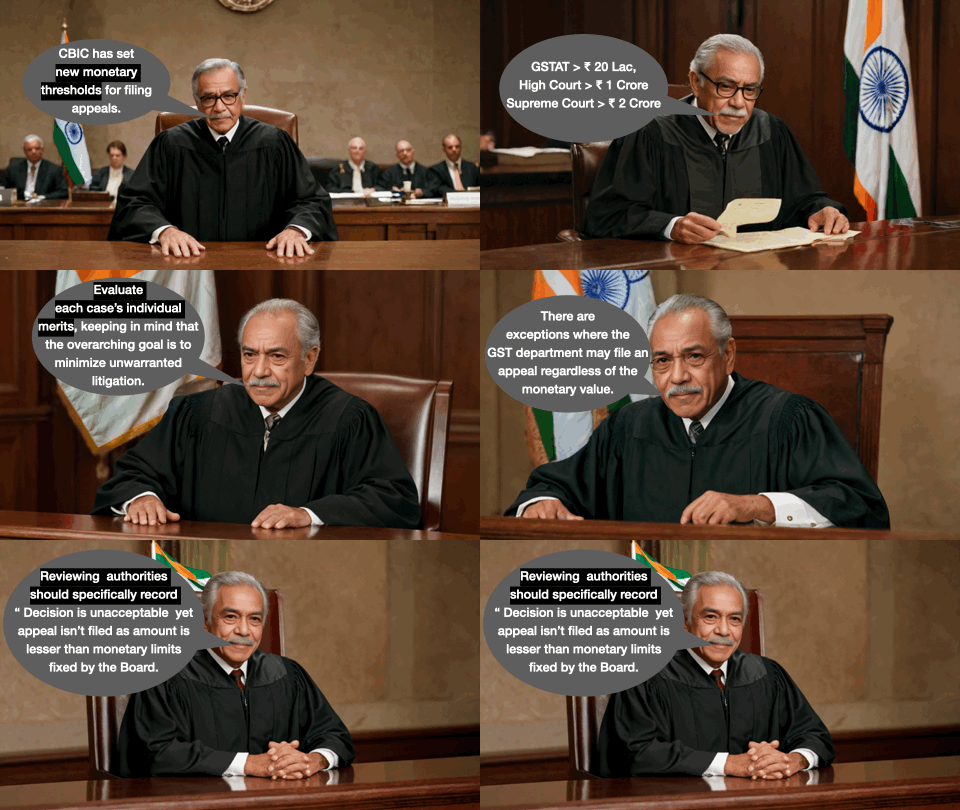
CBIC Circular Sets New Monetary Limits for GST Appeals to Curb Unnecessary Litigation and Provide Greater Certainty to Taxpayers - (Circular No. 207/1/2024-GST)
CBIC Circular Sets New Monetary Limits for GST Appeals to Curb Unnecessary Litigation and Provide Greater Cer…
The Central Board of Indirect Taxes and Customs has established new monetary limits for filing appeals in GST cases, aiming to reduce unnecessary litigation and provide taxpayers with greater certainty. These thresholds apply to appeals before the Goods and Services Tax Appellate Tribunal, High Courts, and the Supreme Court. The circular outlines specific guidelines for determining case eligibility and includes important exceptions where appeals may be filed regardless of the monetary value involved.
Circular No. 207/1/2024-GST
Key Takeaways:
This circular
1. Sets new monetary thresholds for filing GST appeals at different levels of the judiciary.
2. Aims to reduce government litigation and optimize judicial resource utilization.
3. Provides Specific guidelines for determining case eligibility based on disputed amounts.
4. Lists down important exceptions where GST can file appeal regardless of monetary value.
5. Emphasises merit-based decision making for filing appeals in cases above thresholds.
6. Right Click here and open Official Circular in new tab
Commentary:
The Central Board of Indirect Taxes and Customs (CBIC) has introduced new monetary thresholds for filing appeals in Goods and Services Tax (GST) cases. This decision, made on the recommendations of the GST Council, is in line with the National Litigation Policy's goal of reducing government litigation and expediting case resolutions.
The new monetary limits have been set as follows:
- For appeals before the Goods and Services Tax Appellate Tribunal (GSTAT): Rs. 20,00,000
- For appeals before High Courts: Rs. 1,00,00,000
- For appeals before the Supreme Court: Rs. 2,00,00,000
The CBIC has provided these specific guidelines for calculating the monetary limits:
- For disputes involving tax demands (with or without penalties and/or interest), the aggregate amount of tax in dispute, including CGST, SGST/UTGST, IGST, and Compensation Cess, will be considered.
- In cases solely involving interest or penalties, or late fees, the respective amounts will be taken into account.
- If there's no disputed tax but dispute pertains solely to demand of interest, penalty and/or late fee the aggregate of amount of interest, penalty and late fee shall be considered.
- For erroneous refunds, the disputed refund amount will be the determining factor.
- In a composite order that disposes of multiple appeals or demand notices, these monetary limits apply to the total amount in dispute rather than individual components.
The CBIC has outlined several exceptions where the GST department may file an appeal regardless of the monetary value.
These exceptions include:
1. Cases where provisions of the CGST Act, SGST/UTGST Act, IGST Act, or GST (Compensation to States) Act are held unconstitutional.
2. Instances where rules or regulations under these Acts are deemed ultra vires to the parent Act.
3. Cases involving government orders, notifications, instructions, or circulars held ultra vires.
4. Matters related to valuation, classification, refunds, place of supply, or other recurring issues involving statutory interpretation
5. Cases where adverse comments or costs have been imposed against the government or its officers
6. Any other cases deemed necessary to contest in the interest of justice or revenue
CBIC has instructed against automatic appeal filing where the disputed amount exceeds the monetary limits.
Instead, CBIC encouraged GST officers to evaluate the individual merits of each case, keeping in mind that the overarching goal is to minimize unwarranted litigation and provide a sense of certainty for taxpayers.
CBIC has required the reviewing authorities to specifically record -
Even though the decision is not acceptable, appeal is not being filed as the amount involved is less than the monetary limit fixed by the Board.
This way department will clearly alleviate the worries about setting precedents. And comply with the subsections (2), (3), and (4) of Section 120 of the CGST Act.
Furthermore, the circular emphasizes that non-filing of appeals based on monetary limits does not preclude tax officers from filing appeals in other cases involving similar issues where the disputed amount exceeds the threshold. It also does not imply that the department has acquiesced to the decision on disputed issues in similar cases.
The CBIC instructs departmental representatives and counsels to bring these points to the attention of the GSTAT, High Courts, or Supreme Court when relevant. This is to ensure that no inference is drawn suggesting that decisions in cases where appeals were not filed are acceptable to the department.
FAQs:
Q1: What is the purpose of setting these monetary limits for GST appeals
A1: The primary purpose is to reduce unnecessary litigation, optimize judicial resources, and provide greater certainty to taxpayers in their tax assessments.
Q2: Do these monetary limits apply to all GST-related appeals?
A2: While they apply to most cases, there are specific exceptions where appeals can be filed regardless of the monetary value involved.
Q3: How are the monetary limits determined in cases involving multiple types of disputes?
A3: The circular provides specific guidelines for different scenarios, such as combining tax, interest, and penalty amounts in certain cases.
Q4: Does the decision not to file an appeal based on these limits set a precedent for similar cases?
A4: No, the circular explicitly states that such decisions do not have precedent value and should not be interpreted as the department acquiescing to the decision.
Q5: Can tax officers still file appeals in cases below the monetary limits?
A5: Yes, if the case falls under one of the specified exceptions or if it's deemed necessary in the interest of justice or revenue.
Key Precedents:
1. Section 120 of the Central Goods and Services Tax Act, 2017: This section provides the power to the Central Board of Indirect Taxes & Customs to fix monetary limits for filing appeals or applications by tax authorities.
2. National Litigation Policy: This policy emphasizes the importance of prudent litigation practices and establishes thresholds for filing appeals in Revenue matters.
3. Section 168 of the CGST Act: This section is read in conjunction with Section 120 to empower the Board to issue the current circular.
4. Subsections (2), (3), and (4) of Section 120 of the CGST Act: These provisions clarify that cases where appeals are not filed due to monetary limits shall not have precedent value and do not indicate acquiescence by the department.

Circular No. 207/1/2024-GST
F. No. CBIC-20001/4/2024-GST
Government of India
Ministry of Finance
Department of Revenue
Central Board of Indirect Taxes and Customs
GST Policy Wing
North Block, New Delhi,
Dated the 26thJune 2024
To,
The Principal Chief Commissioners / Chief Commissioners / Principal Commissioners /Commissioners of Central Tax (All)
The Principal Directors General/ Directors General of Central Tax (All)
Madam/Sir,
Subject: Reduction of Government Litigation – fixing monetary limits for filing appeals or applications by the Department before GSTAT, High Courts and Supreme Court - reg.
Reference is invited to the National Litigation Policy which was conceived with the aim of optimizing the utilization of judicial resources and expediting the resolution of pending cases. It underscores the importance of prudent litigation practices by establishing thresholds for filing appeals in Revenue matters. Specifically, the Policy mandates that appeals should not be pursued when the amount involved is below a specified monetary limit set by Revenue authorities. Furthermore, it discourages filing appeals in cases where established precedents from Tribunals and High Courts have settled the matter and have not been contested in the Supreme Court.
1.1 Section 120 of the Central Goods and Services Tax Act, 2017 (hereinafter referred as “the CGST Act”) provides for power to the the Central Board of Indirect Taxes & Customs (hereinafter referred to as “the Board”) for fixing the monetary limits for filing of appeal or application by the tax authorities as below:
“120. Appeal not to be filed in certain cases.
(1) The Board may, on the recommendations of the Council, from time to time, issue orders or instructions or directions fixing such monetary limits, as it may deem fit, for the purposes of regulating the filing of appeal or application by the officer of the central tax under the provisions of this Chapter.
(2) Where, in pursuance of the orders or instructions or directions issued under sub-section (1), the officer of the central tax has not filed an appeal or application against any decision or order passed under the provisions of this Act, it shall not preclude such officer of the central tax from filing appeal or application in any other case involving the same or similar issues or questions of law.
(3) Notwithstanding the fact that no appeal or application has been filed by the officer of the central tax pursuant to the orders or instructions or directions issued under sub-section (1), no person, being a party in appeal or application shall contend that the officer of the central tax has acquiesced in the decision on the disputed issue by not filing an appeal or application.
(4) The Appellate Tribunal or court hearing such appeal or application shall have regard to the circumstances under which appeal or application was not filed by the officer of the central tax in pursuance of the orders or instructions or directions issued under sub-section (1).”
2. Accordingly, in exercise of the powers conferred by Section 120 of the CGST Act read with section 168 of the CGST Act, the Board, on the recommendations of the GST Council, fixes the following monetary limits below which appeal or application or Special Leave Petition, as the case may be, shall not be filed by the Central Tax officers before Goods and Service Tax Appellate Tribunal (GSTAT), High Court and Supreme Court under the provisions of CGST Act, subject to the exclusions mentioned in para 4 below:

3. While determining whether a case falls within the above monetary limits or not, the following principles are to be considered:
i. Where the dispute pertains to demand of tax (with or without penalty and/or interest), the aggregate of the amount of tax in dispute (including CGST, SGST/UTGST, IGST and Compensation Cess) only shall be considered while applying the monetary limit for filing appeal.
ii. Where the dispute pertains to demand of interest only, the amount of interest shall be considered for applying the monetary limit for filing appeal.
iii. Where the dispute pertains to imposition of penalty only, the amount of penalty shall be considered for applying the monetary limit for filing appeal.
iv. Where the dispute pertains to imposition of late fee only, the amount of late fee shall be considered for applying the monetary limit for filing appeal.
v. Where the dispute pertains to demand of interest, penalty and/or late fee (without involving any disputed tax amount), the aggregate of amount of interest, penalty and late fee shall be considered for applying the monetary limit for filing appeal.
vi. Where the dispute pertains to erroneous refund, the amount of refund in dispute (including CGST, SGST/UTGST, IGST and Compensation Cess) shall be considered for deciding whether appeal needs to be filed or not.
vii. Monetary limit shall be applied on the disputed amount of tax/ interest/penalty/late fee, as the case may be, in respect of which appeal or application is contemplated to be filedin a case.
viii. In a composite order which disposes more than one appeal/demand notice, the monetary limits shall be applicable on the total amount of tax/interest/penalty/late fee, as the case may be, and not on the amount involved in individual appeal or demand notice.
4. EXCLUSIONS
Monetary limits specified above for filing appeal or application by the department before GSTAT or High Court and for filing Special Leave Petition or appeal before the Supreme Court shall be applicable in all cases, except in the following circumstances where the decision to file appeal shall be taken on merits irrespective of the said monetary limits:
i. Where any provision of the CGST Act or SGST/UTGST Act or IGST Act or GST (Compensation to States) Act has been held to be ultra vires to the Constitution of India; or
ii. Where any Rules or regulations made under CGST Act or SGST/UTGST Act or IGST Act or GST (Compensation to States) Act have been held to be ultra vires the parent Act; or
iii. Where any order, notification, instruction, or circular issued by the Government or the Board has been held to be ultra vires of the CGST Act or SGST/UTGST Act orIGST Act or GST (Compensation to States) Actor the Rules made thereunder;or
iv. Where the matter is related to -
a. Valuation of goods or services; or
b. Classification of goods or services; or
c. Refunds; or
d. Place of Supply; or
e. Any other issue, which is recurring in nature and/or involves interpretation of the provisions of the Act /the Rules/ notification/circular/order/instruction etc; or
v. Where strictures/adverse comments have been passed and/or cost has been imposed against the Government/Department or their officers; or
vi. Any other case or class of cases, where in the opinion of the Board, it is necessary to contest in the interest of justice or revenue.
5. It is pertinent to mention that an appeal should not be filed merely because the disputed tax amount involved in a case exceeds the monetary limits fixed above. Filing of appeal in such cases is to be decided on merits of the case. The officers concerned shall keep in mind the overall objective of reducing unnecessary litigation and providing certainty to taxpayers on their tax assessment while taking a decision regarding filing an appeal.
6. Attention is drawn to sub-sections (2), (3) & (4) of section 120 of the CGST Act, which provide that in cases where it is decided not to file appeal in pursuance of these instructions, such cases shall not have any precedent value. In such cases, the Reviewing Authorities shall specifically record that “even though the decision is not acceptable, appeal is not being filed as the amount involved is less than the monetary limit fixed by the Board.”
6.1 Non-filing of appeal based on the above monetary limits, shall not preclude the tax officer from filing appeal or application in any other case involving the same or similar issues in which the tax in dispute exceeds the monetary limit or case involving the questions of law.
6.2 Further, it is re-iterated that in such cases where appeal is not filed solely on the basis of the above monetary limits, there will be no presumption that the Department has acquiesced in the decision on the disputed issues in the case of same taxpayers or in case of any other taxpayers. Accordingly, in case any prior order is being cited or relied upon by the taxpayer, claiming that the same has been accepted by the Department, it must be checked as to whether such order was accepted only on account of the monetary limit before following them in the name of judicial discipline.
6.3 Also, in respect of such cases where no appeal is filed based on the monetary limit, the Departmental representatives/counsels must make every effort to bring to the notice of the GSTAT or the Court, as the case may be, that the appeal in such cases was not filed only for the reason of the amount of the tax in dispute being less than the specified monetary limit and, therefore, no inference shall be drawn that the decisions rendered therein were acceptable to the Department. Accordingly, they should draw the attention of the GSTAT or the Court towards the provisions of sub-section (4) of section 120 of the CGST Act, 2017 as reproduced in para 1.1 above.
7. The above may be brought to the notice of all concerned.
8. Difficulties, if any, in implementation of thiscircular may be informed to the Board (gst-cbec@gov.in).
9. Hindi version will follow.
(Sanjay Mangal)
Principal Commissioner (GST)
×


