


Ad hoc provision for service charges denied as tax deduction, court upholds


Full News
Ad hoc provision for service charges denied as tax deduction, court upholds
Ad hoc provision for service charges denied as tax deduction, court upholds
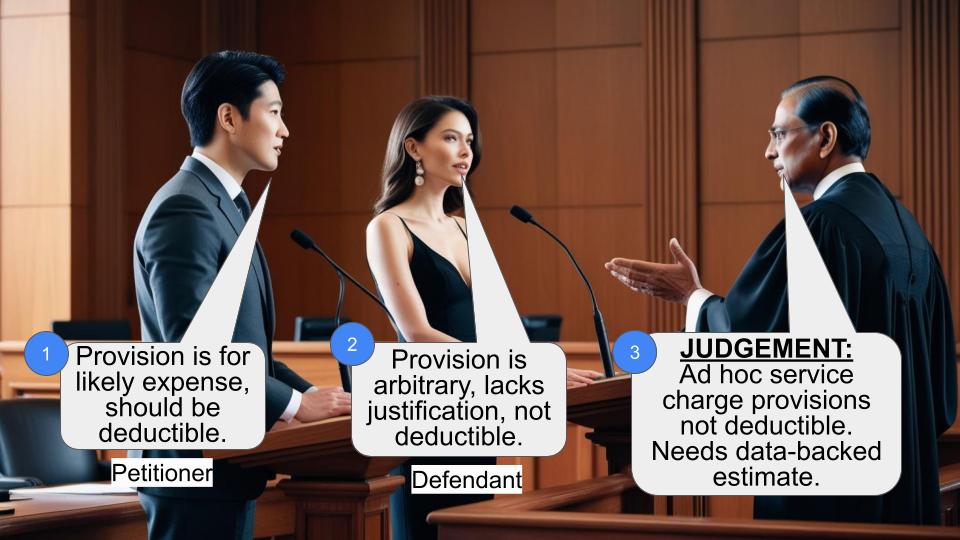
This case is about a company that sells office equipment like typewriters. They were trying to claim tax deductions for service charges they set aside (called provisions) for potential future repairs. The tax authorities said "no way," and the case went all the way up to the High Court. In the end, the court agreed with the tax authorities and said the company couldn't claim these deductions.
Get the full picture - access the original judgement of the court order here
Case Name:
Commissioner of Income Tax vs Forbes Campbell Finance Ltd (High Court of Madras)
Tax Case (Appeal) Nos.148 to 155 of 2005
Date: 9th July 2012
Key Takeaways:
1. Provisions for future expenses need to be based on solid historical data, not just guesswork.
2. To claim a provision as a deduction, you need to show it's for a real, likely expense, not just a maybe.
3. The court emphasized the importance of consistent, scientific methods in making provisions.
4. Just because you've been doing something for years doesn't mean it's right - the tax authorities can still challenge it.
Issue:
The main question here was: Can a company claim tax deductions for provisions made on an ad hoc basis for potential future service charges?
Facts:
1. The company sells office equipment like typewriters and offers a one-year warranty.
2. They have service dealers who install and repair the machines.
3. For each sale, they set aside money (make a provision) for potential future service charges.
4. They did this every year, setting aside Rs. 82 per machine sold.
5. But here's the kicker - more than 60% of this money was still unused after two years!
6. The tax authorities said, "Hold up, you can't claim this as a deduction."
7. This dispute covered multiple tax years from 1990-91 to 1997-98.
Arguments:
The company said:
- "Hey, we've been doing this for years, and you've never complained before!"
- "We have to set this money aside because we might need to pay for repairs later."
- "It's not a maybe expense, it's definitely going to happen... we just don't know when or how much."
The tax authorities said:
- "You're just guessing. This isn't based on any real data."
- "Most of this money isn't even being used. It's just sitting there."
- "You can't claim a deduction for something that might happen in the future."
Key Legal Precedents:
1. Rotork Controls India P. Ltd. Vs. CIT [2009] 314 ITR 62 (SC): This Supreme Court case said you can claim provisions if:
a) There's a present obligation from a past event
b) You'll probably need to pay out money
c) You can make a reliable estimate of how much
The court said all three conditions need to be met.
2. CIT Vs. Ericsson Communications (P) Ltd. [2009] 318 ITR 340: This Delhi High Court case allowed provisions because they were made on a scientific basis, not ad hoc.
Judgement:
The court sided with the tax authorities. They said:
1. The company's provisions were ad hoc, not based on any scientific data.
2. Just because they'd been doing it for years doesn't make it right.
3. The fact that 60% of the money was still unused after two years shows it wasn't a reliable estimate.
4. The company couldn't prove they met the three conditions from the Rotork case.
So, the court said nope, you can't claim these provisions as deductions.
FAQs:
1. Q: Does this mean companies can never claim provisions for future expenses?
A: No, they can, but they need to be based on solid historical data and meet specific conditions.
2. Q: What should companies do differently after this judgment?
A: They should review their provisioning policies and ensure they're based on scientific, data-driven methods.
3. Q: Could the company have won if they had better record-keeping?
A: Possibly. If they could show a clear historical trend and more accurate estimates, they might have had a better case.
4. Q: Does this apply to all types of provisions?
A: While this case was about service charges, the principles could apply to other types of provisions too.
5. Q: What's the main lesson for businesses?
A: Don't assume that just because you've always done something a certain way, it's automatically acceptable for tax purposes. Always be prepared to justify your accounting practices with solid data.

1. These Tax Cases arise out of the common order of the Income Tax Appellate Tribunal, relating to the assessment years 1990-91 to 1997-98. The following are the substantial questions of law arising in these Tax Case Appeals filed by the Revenue:
(i) Whether in the facts and circumstances of the case, the Tribunal was right in treating the provision for installation and service charges as a provision for an ascertained liability and hence an allowable deduction?
(ii) Whether in the facts and circumstances of the case, whether provisions made year after year far in excess of claims likely to be made be treated as accrued expenditure?
The assessment for the assessment years 1990-91 and 1991-92 are reassessment and the assessment for the other years are under Section 143(3) (of Income Tax Act, 1961).
2. The assessee herein is engaged in the business of trading in various office equipment and appliances like typewriters, duplicator papers, shredding machines, etc. It is stated that the assessee offered one year warranty and free service during this period. The installation and service are done by various dealers appointed by the company. It is stated that on the sale of the electronic typewriters, the service dealers were eligible for receiving installation charges as well as service charges. While on the installation of every typewriter, the dealer was entitled to the installation charges, he however was entitled to service charges only, on such a claim made by the service dealer. Thus a sum of Rs.96/- was given to the service dealer, out of which, Rs.14/- was given immediately on installation as representing installation charges. On the sum of Rs.82/- representing service charges for four quarters in the warranty period, on the sales effected, the assessee created provision in its accounts in respect of the service charges payable to the service dealers. It is stated that out of the price of Rs.13,13,376/-, a sum of Rs.2,97,992/- was paid as service charges to the dealer during the accounting year 1992-93 and a sum of Rs.1,53,662/- was paid during the accounting year 1993-94. Since there was no claim from the service dealer, the balance of Rs.8,61,721/- representing the excessive provision was offered as income for 1994-95. The assessee took the stand that even though there might not have been a necessity to provide free service, yet, given the obligation to provide a free service during the warranty period, it created necessary provision in the accounts each year on the amount representing the service charges payable to the service dealers as and when any claim was made by them. Thus the obligation could not be treated as a contingent liability.
3. The Assessing Authority pointed out that the service dealers became eligible for the service charges only when a claim was preferred by them. In the absence of any claim made or even a belated claim made, the provision made could only be treated as a contingent liability and not deductable. It is also seen from the orders placed that apart from selling the machines through their various service dealers, the assessee also sold directly through their Branches. However, as far as the servicing of the machines were concerned, they were done through the service dealers only.
4. The assessee, in the course of the assessment proceedings, pointed out that the service dealers appointed all over India claimed service charges as and when they offered the service and many a times, these claims were made after prolonged deliberations with the customers. The assessee also pointed out in the course of the assessment proceedings that on the number of machines sold, the service charges were calculated at the rate of Rs.82/- per machine and the provision was thus made.
5. Aggrieved by that, the assessee went on appeal before the Commissioner of Income Tax (Appeals), who confirmed the assessments for the assessment years. A reading of the orders passed by the Commissioner of Income Tax (Appeals), particularly the one for the assessment year 1992-93, based on which appeals in respect of other assessment years were decided, shows that wherever the assessee had a licence to install the machines, it also offered service through the network of service dealers and the free service of machines was guaranteed for one year during the year of sale and the service was to be done for four quarters. The Commissioner of Income Tax (Appeals) also pointed out that even though the assessee assured free four quarterly services during the period of one year warranty, some purchasers had not availed of the services provided by the assessee or had availed only a portion of the services.
6. On a perusal of the accounts, the Commissioner of Income Tax (Appeals) pointed out that more than 60% of the provision made towards the service charges remained unpaid even after more than two years from the date of sale. Thus the Commissioner of Income Tax (Appeals) came to a factual finding that the assessee had not made the provision after taking stock of the situation properly. The assessee had made provision even for those cases of sale where it did not have to depend on the service dealers who had to be paid. Thus the Commissioner of Income Tax (Appeals) held that the assessee had had the bulk of the provision unpaid even at the end of two years, and on a totality of the facts, the Commissioner of Income Tax (Appeals) held that the provision was made to represent some contingent liability and it was not in respect of any ascertained liability with service done by the service dealer in the relevant year of accounting. He further pointed out that the provision was predominantly towards the services which might be done by the service dealer in some future period, and the facts projected showed that even such probability was less than 50%.
7. Aggrieved by this order, the assessee went on appeal before the Income Tax Appellate Tribunal. A perusal of the order of the Tribunal shows, particularly in paragraph 4, that the provision had been made on ad hoc basis and the liability to make payment for the service charges arose only at the time of doing the actual service by the dealers and the claim preferred by the service dealers after incurring the expenditure, and it was not certain in all the cases.
8. The Tribunal further pointed out that many a times, the claims were made subsequently after prolonged deliberations with the customers, but the liabilities got crystallised as soon as the machine was sold.
9. Thus pointing out that the assessee, hence, had made a provision towards the unascertained liability, the Tribunal referred to the decision reported in [1959] 37 ITR 1 (Calcutta Co. Ltd. Vs. CIT) as well as (2003) 130 Taxman 400 (Mad) (CIT Vs. Beema Manufacturers (P) Ltd.) and ultimately came to the conclusion that the orders of the lower authorities merited to be set aside. Aggrieved by this, the present appeals have been filed by the Revenue.
10. Learned Standing Counsel appearing for the Revenue pointed out that the assessee had admittedly not made any provision in its accounts for the service charges based on any scientific basis. Admittedly, the provision for service charges was made only on the sale effected for that particular year and this method went on without any change.
11. Learned Standing Counsel pointed out that it is not denied by the assessee too that the payment of service charges was conditioned by the actual services rendered by the service provider and the claim made by the service provider. In the background of the fact that more than 60% of the provision remained unpaid even after more than two years, it was clear that the provision made was only on an ad hoc basis and not on historical basis. Considering the factual finding of the Commissioner of Income Tax (Appeals) as well as by the Tribunal based on the submissions made by the assessee, the claim of the assessee ought not to have been allowed by the Tribunal and that the provision made, pure and simple, is of a contingent liability.
12. Per contra, learned counsel appearing for the assessee placed reliance on the decision of the Apex Court reported in [2009] 314 ITR 62 (SC) (Rotork Controls India P. Ltd. Vs. CIT) and pointed out that considering the fact that the assessee had been making a consistent practice of providing for service charges in all earlier years and the Department had accepted the said method even in the subsequent years, consistently for the method of accounting could not be faulted with for the year under consideration. Thus, in the absence of any material to reject the accounts maintained by the assessee, their claim could not be negatived.
13. Learned counsel also placed reliance on the decision of the Delhi High Court reported in [2009] 318 ITR 340 (CIT Vs. Ericsson Communications (P) Ltd.), wherein, the Delhi High Court had followed the Supreme Court decision reported in [2009] 314 ITR 62 (SC) (Rotork Controls India P. Ltd. Vs. CIT) that the provision made was based on historical analysis; consequently, the claim has to be allowed. She further made a submission that in the event of this Court not agreeing with the assessee's submission, the matter be remanded back to the Assessing Authority for a fresh consideration, based on the decision of the Apex Court, so as to enable the assessee to provide further material in support of its claim that the provision for service charges was made only on the basis of historical analysis.
14. We reject the claim of the assessee on both counts. As far as the reliance placed on the decision reported in [2009] 314 ITR 62 (SC) (Rotork Controls India P. Ltd. Vs. CIT) is concerned, in considering the claim on a provision made for warranty claim, the Apex Court held that "a provision is recognised when: (a) an enterprise has a present obligation as a result of a past event; (b) it is probable that an outflow of resources will be required to settle the obligation; and (c) a reliable estimate can be made of the amount of the obligation. If these conditions are not met, no provision can be recognized. "
15. The Apex Court pointed out that a liability is defined as a present obligation arising from past events, the settlement of which is expected to result in an outflow from the enterprise of resources embodying economic benefits. The case before the Apex Court related to a provision made for covering the warranty in respect of sales of valve actuators. Valve Actuators are sophisticated equipments and that every item of sale was covered by the warranty scheme and no purchaser was ready and willing to buy Valve Actuators without warranty. The provision was made by the assessee on account of warranty claims likely to arise on the sale effected by the assessee. Consistently, the claim of the assessee on the provisions thus made was allowed. The Apex Court pointed out that the assessee had been in the manufacture of the valves right from 1983-84 onwards and the statistical data indicated that every year, some of these manufactured Actuators were found to be defective. Thus warranty became an integral part of the sale price of the Valve Actuators. The Apex Court pointed out that the obligation arising from past events, hence, were recognised as an obligating event and the warranty provision in the said case was recognized because of the past events resulting in an outflow of resources. Thus a reliable estimate had to be made on the amount of obligation. Thus the Apex Court pointed out that all the three conditions which were necessary for the recognition of the provision, namely, the past obligation resulting in the outflow of resources, the insistence of the purchasers for a warranty considering the past events indicating defective actuators likely to enter into the market and thirdly, the warranty clause, becoming part of the sale price of the valve actuators leading to a reliable estimate to be made of the amount of the obligation therein, stood satisfied in that case. The Apex Court further pointed out that the assessee in the said case provided for warranty on historical trend. Thus the Apex Court pointed out that the appropriate method in respect of considering the provision made towards warranty is a historical trend, since it specified the actual concept and the matching concept to determine the historical trend. Thus, the Apex Court pointed out:
" For determining an appropriate historical trend, it is important that the company has a proper accounting system for capturing relationship between the nature of the sales, the warranty provisions made and the actual expenses incurred against it subsequently. Thus, the decision on the warranty provision should be based on past experience of the company. A detailed assessment of the warranty provisioning policy is required particularly if the experience suggests that warranty provisions are generally reversed if they remained unutilized at the end of the period prescribed in the warranty. Therefore, the company should scrutinize the historical trend of warranty provisions made and the actual expenses incurred against it. On this basis a sensible estimate should be made. The warranty provision for the products should be based on the estimate at year end of future warranty expenses. Such estimates need reassessment every year. As one reaches close to the end of the warranty period, the probability that the warranty expenses will be incurred is considerably reduced and that should be reflected in the estimation amount. Whether this should be done through a pro rata reversal or otherwise would require assessment of historical trend. If warranty provisions are based on experience and historical trend(s) and if the working is robust then the question of reversal in the subsequent two years, in the above example, may not arise in a significant way. "
16. Thus the Apex Court pointed out that the provision has to be made based on reliable estimation of the obligations. Unless the three conditions recognising the liability are satisfied, the claim could not be automatically allowed as a provision made on a historical trend. Satisfied of the assessee's claim therein answering the requirements, the Apex Court granted the relief to the assessee therein.
17. As far as the decision of the Delhi High Court reported in [2009] 318 ITR 340 (CIT Vs. Ericsson Communications (P) Ltd.), relied on by the assessee is concerned, the Delhi High Court pointed out, on an analysis of facts, that the policy and principles as regards the provision for warranty were made by the assessee on scientific basis and not on an ad hoc method. The scientific method was consistently applied by the assessee company for its business throughout the world and that the consistent application of the provision thus entitled the assessee for a deduction.
18. Applying the law declared by the Apex Court to the facts of the case herein, one can draw an inference that the provision for the service charges payable by the assessee by way of warranty provision is not made on any scientific data. Admittedly, the provision made was only on ad hoc basis, a fact which is recorded by the Tribunal. The said fact is further strengthened by the fact that even though the warranty period is for one year and the assessee has to make payment to the service provider as and when a demand is made, normally such payment claim has to come during the period of warranty or within a reasonable time. Even though the agreement that the assessee had with the service provider is not placed before this Court, nor was it placed before the authorities below, nevertheless, a reading of the Commissioner's order relating to the assessment year 1992-93 makes the facts clear by reason of the fact that more than 60% of the provision remained unpaid even after more than two years since the date of sale. This aspect persuaded the Commissioner of Income Tax (Appeals) to come to the conclusion that the assessee had not made the provision after taking stock of the situation properly. The assessee pleaded before the Officer that the service charges were made immediately on the sale of the typewriter and the installation done by the service provider. The assessee does not deny the fact that the service charges payable to the dealer arises only as and when a claim is made by the service provider. In none of these assessment years, the assessee had pleaded that the provision made in the accounts towards the service charges were reversed within a reasonable time, or for that matter, any analysis was made by the assessee at the end of any of these years, to contend that the provision was made only on a scientific basis on a historical analysis of the facts as regards the sales as well as the service charges claim made by the service provider or an obligation arising out of the past events.
19. Learned counsel for the assessee submitted that the assessee may be given a chance to produce the agreement and the materials to show that the provision was made for the service charges based on past obligation. We do not find any justification to grant the plea, since the facts pleaded by the assessee are very clear in this case. Further, the claim that the provision was made on historical trend is a new line of argument taken before this Court apparently inspired by the law laid down by the Apex Court reported in [2009] 314 ITR 62 (SC) (Rotork Controls India P. Ltd. Vs. CIT). The facts pleaded before the authorities clearly point out that the provision for service charges was made as and when a sale was effected during that particular year. It cannot be denied as a matter of fact that in the course of none of these assessments before the authorities, a claim was made by the assessee that the provision was made based on historical analysis of the facts relating to sales and service charges payable during the warranty period and the past events resulting in an outflow of resources.
20. As already pointed out in the preceding paragraphs, the decision of the Supreme Court relied on by the assessee, in fact, goes against the fact pleaded by the assessee.
21. Thus, given the factual finding that the provision made by the assessee was on ad hoc basis only when the consistent contention admitted by the assessee throughout had been that on every sale made, the provision was made in the accounts based on the number of sales effected every year as regards the service charges, we do not find, any useful purpose would be served by remanding the matter back to the Tribunal, or for that matter, to the Assessing Authority.
22. If really the provision made was otherwise based on past experience, certainly, the figures would not have stayed as having a correlation to the sales, or for that matter, as the Commissioner of Income Tax (Appeals) observed, more than 60% of the provision would not have remained unpaid even after more than two years from the date of sale.
23. In the background of the above, we have no hesitation in setting aside the order of the Tribunal, thereby restoring the order of the Assessing Officer. The Tribunal, while observing that the provision was only made on ad hoc basis, committed a serious error in law in holding that such ad hoc provision would nevertheless qualify for deduction.
In view of the above, the Tax Case Appeals stand allowed. No costs.
Index: Yes / No (C.V.,J.) (K.R.C.B.,J.)
Internet: Yes / No 09.07.2012
To
1. The Income Tax Appellate Tribunal, Chennai Bench 'A'.
2. The Commissioner of Income Tax (Appeals) V, Chennai-34.
3. The Joint Commissioner of Income Tax, Special Range-I, Chennai-34.
CHITRA VENKATARAMAN,J.
and
K.RAVICHANDRABAABU,J.
Dated: 09.07.2012
×
Questions
Ad hoc provision for service charges denied as tax deduction, court upholds
Write your CommentSimilar Posts
Generic
- Reportdata/5708.pdf
