AO Must Record Dissatisfaction Before Invoking Rule 8D (of Income Tax Rules, 19…


Full News
AO Must Record Dissatisfaction Before Invoking Rule 8D (of Income Tax Rules, 1962) for Exempt Income Expenditure
AO Must Record Dissatisfaction Before Invoking Rule 8D (of Income Tax Rules, 1962) for Exempt Income Expendit…
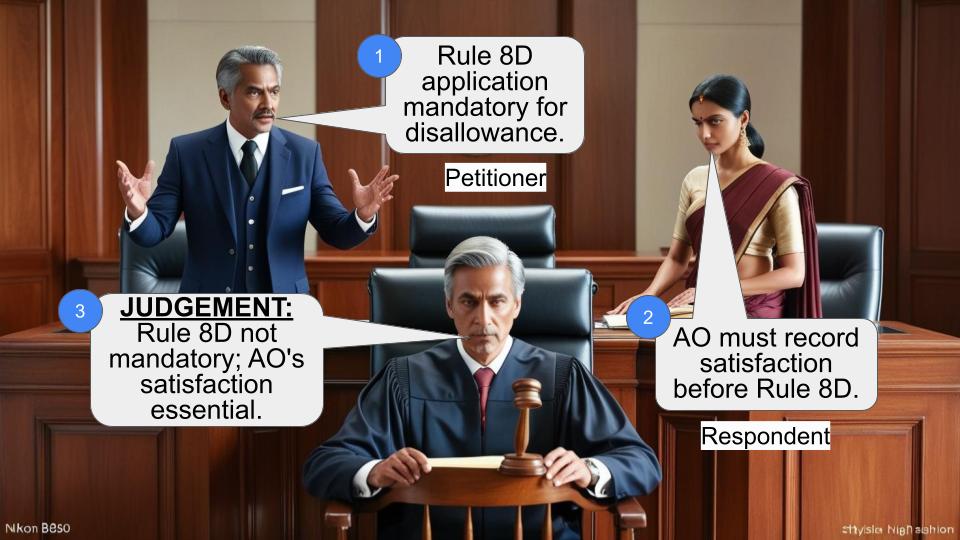
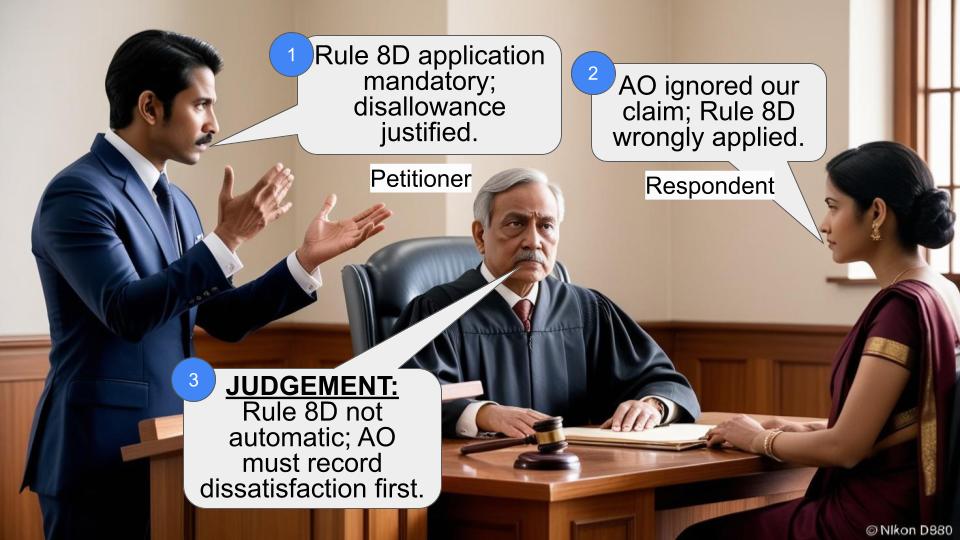
This case involves the Principal Commissioner of Income Tax vs Vedanta Limited, concerning the application of Rule 8D (of Income Tax Rules, 1962), in relation to Section 14A (of Income Tax Act, 1961). The court ruled that the Assessing Officer (AO) cannot automatically apply Rule 8D (of Income Tax Rules, 1962) without first recording dissatisfaction with the assessee's claim regarding expenditure incurred to earn exempt income.
Get the full picture - access the original judgement of the court order here
Case Name:
Principal Commissioner of Income Tax Vs Vedanta Limited (High Court of Delhi)
ITA 1467/2018
Date: 18th December 2018
Key Takeaways:
1. Rule 8D (of Income Tax Rules, 1962) is not a mandatory or universally applicable rule for cases involving exempt income.
2. The AO must record dissatisfaction with the assessee's claim before invoking Rule 8D (of Income Tax Rules, 1962).
3. Rule 8D (of Income Tax Rules, 1962) is a best judgment determination, applicable only after rejecting the assessee's explanation.
4. The judgment reinforces the importance of proper procedure in tax assessments.
Issue:
Can the Assessing Officer invoke and apply Rule 8D (of Income Tax Rules, 1962), without first recording dissatisfaction regarding the correctness of the assessee's claim in relation to expenditure incurred to earn exempt income?
Facts:
- The case relates to the assessment year 2010-2011 for Vedanta Ltd (formerly Madras Aluminium Co. Ltd.).
- Vedanta earned dividend income of Rs.8.97 crores, exempt under Section 10(34) (of Income Tax Act, 1961).
- The assessee made a self-disallowance of Rs.9,07,453/-.
- The AO applied Rule 8D (of Income Tax Rules, 1962) without examining or commenting on the assessee's disallowance.
- The AO made an addition of Rs.2,06,19,999/- to the assessee's income.
Arguments:
Revenue's Argument:
- The AO applied Rule 8D (of Income Tax Rules, 1962) as it was considered mandatory in cases where the assessee earned exempt income.
Assessee's Argument:
- The AO failed to record objective satisfaction regarding the appropriateness of the disallowance made by the assessee.
- The disallowance was worked out mechanically without considering the assessee's submissions or accounts.
- The assessee had sufficient own funds/interest-free funds to make investments yielding tax-free income.
Key Legal Precedents:
1. Godrej & Boyce Manufacturing Co. Ltd. Vs. Deputy Commissioner of Income-Tax and another [2017] 394 ITR 449 (SC): The Supreme Court held that the AO must record satisfaction that the assessee's accounts do not enable a correct claim determination before applying Section 14A(2) (of Income Tax Act, 1961) and (3) read with Rule 8D (of Income Tax Rules, 1962).
Judgement:
The High Court dismissed the appeal by the Revenue, affirming the orders of the Income Tax Appellate Tribunal (ITAT) and the Commissioner of Income Tax (Appeals). The court held that:
1. The AO cannot invoke and apply Rule 8D (of Income Tax Rules, 1962) unless they record dissatisfaction regarding the correctness of the assessee's claim.
2. Rule 8D (of Income Tax Rules, 1962) is not applicable by default but only when the AO records satisfaction and rejects the assessee's explanation.
3. The assessment order proceeded on a wrong assumption that Rule 8D (of Income Tax Rules, 1962) applies to all cases and is mandatory.
FAQs:
1. Q: What is Rule 8D (of Income Tax Rules, 1962)?
A: Rule 8D (of Income Tax Rules, 1962) provides a formula for determining expenditure incurred in relation to income not forming part of the total income under the Income Tax Act.
2. Q: Is Rule 8D (of Income Tax Rules, 1962) mandatory in all cases involving exempt income?
A: No, Rule 8D (of Income Tax Rules, 1962) is not mandatory or universally applicable. It can only be invoked after the AO records dissatisfaction with the assessee's claim.
3. Q: What should the Assessing Officer do before applying Rule 8D (of Income Tax Rules, 1962)?
A: The AO should examine the assessee's claim, record dissatisfaction with its correctness, and reject the assessee's explanation regarding the disallowance of expenditure.
4. Q: What is the significance of this judgment?
A: This judgment reinforces the importance of proper procedure in tax assessments and prevents the automatic application of Rule 8D (of Income Tax Rules, 1962) without due consideration of the assessee's claims.
5. Q: How does this judgment impact taxpayers?
A: It provides protection to taxpayers against arbitrary application of Rule 8D (of Income Tax Rules, 1962) and ensures that their explanations are duly considered before any disallowance is made.

CM APPL. 53243/2018(for condonation of delay) in ITA 1467/2018
This is an application for condonation of delay of 59 days in filing of the appeal. The application is not opposed by counsel for the respondent. Accordingly the application is allowed and delay is condoned.
ITA 1467/2018
This appeal by the Revenue under Section 260A (of Income Tax Act, 1961) (for short ‘Act’) in the case of Vedanta Ltd (Formerly known as Madras Aluminium Co. Ltd.) relates to the assessment year 2010-2011 and arises from the order dated 10th April, 2018 passed by the Income-Tax Appellate Tribunal ('Tribunal', for short).
2. The issue raised by the Revenue relates to the disallowance under Section 14A (of Income Tax Act, 1961). It is an accepted and admitted position that the respondent assessee had earned dividend income of Rs.8.97 crores which was exempted under Section 10(34) (of Income Tax Act, 1961). The said dividend was paid by group companies. The assessee had made self disallowance of Rs. 9,07,453/-.
3. The assessing officer, without examining and referring to the disallowance or recording his dissatisfaction on disallowance made, had invoked and applied Rule 8D (of Income Tax Rules, 1962)(‘Rules’, for short) as if it was mandatory. This is clear from the relevant portion of the assessment order under the heading expenditure incurred in relation to income not includible in total income under section 14A (of Income Tax Act, 1961) read with Rule 8D (of Income Tax Rules, 1962), which for the sake of completeness and clarity is reproduced below:-
“The assessee company filed its return electronically on 28.09.2010 admitting an income of Rs. 81,99,030/- under normal computation and Rs. 168,14,36,980/- u/s 115B (of Income Tax Act, 1961), The return was e-processed U/s 143(1) (of Income Tax Act, 1961). The case was selected for scrutiny and notice u/s 143(2) (of Income Tax Act, 1961) was issued on 29.08.2011 which was duly served on the assessee company on 06.09.2011.
In response to the above notice and subsequent hearing notice, Sh. Rajkumar Bashak, authorized representative of the assessee company attended from time to time and produced books of account and other details called for. The books of account and details produced were examined.
The assessee company has income from business and income from Short Term Capital Gains during the financial year. The assessee had also claimed deduction u/s 80IA (of Income Tax Act, 1961) on the income generated from eligible unit limited to business income. It is further observed during the examination of books of account that the assessee had not worked out deduction as per Section 14A (of Income Tax Act, 1961) read with Rule 8D (of Income Tax Rules, 1962) with regard to the expenditure in relation to dividend income on which exemption u/s 10(34) (of Income Tax Act, 1961) has been claimed. Therefore, the total income as per regular computation has been assessed as follows:-
Expenditure Incurred In Relation To Income Not Includible In Total Income Under Section 14A (of Income Tax Act, 1961) Read With Rule 8D (of Income Tax Rules, 1962):-
(i) Direct Expenditure Rs. 9,07,453/-
(ii) Interest Expenditure to the extent not directly attributable to any particular Income(A) Rs.12,26,00,000
Average Value of Investment (B)
Average value of investment in exempted income as Per the balance sheet as on 01.04.2009 and 31.03.2010
Investment in exempted income as on 01.04.2009 Rs. 72,91.40.000/-
Investment in exempted income as on 31.03.2010 Rs. 107,03,70,000/-
Total Rs. 179,95,10,000/-
Average Value of Investment (B)
Average Value of Total Assests(C)
Value of total assets as Rs. 693,77,70,000/-
On 01.04.2009
Value of total assets as Rs. 756,35,60,000/-
On 31.03.2010
Average Value of total assets (C) Rs.1450,13,30,000
Rs.725,06,650,000
Therefore interest expenditure to be disallowed AxB/C=12,26,00,000x89,97,55,000 =Rs.1,52,13,771 725,06,65,000
(iii) Half percentage of average value of Investment(B) =Rs. 44,98,775 Aggregate of (i), (ii) and (iii)= 907453+15213771+4498775 =Rs.2,06,19,999
Therefore, audition to the tune of Rs.2,06,19,999/- is made to the income of assessee company.”
4. The Commissioner of Income-Tax (Appeals) deleted the said addition on two accounts; firstly, he held that the Assessing Officer had failed to record his objective satisfaction whether the disallowance made by the assessee was appropriate and in accordance with law. He observed that the Assessing Officer had mechanically applied Rule 8D (of Income Tax Rules, 1962) without recording any satisfaction for invoking the said rule. The Rule 8D (of Income Tax Rules, 1962) can be applied only if the assessing officer is not satisfied with the correctness of the claim made by the assessee in respect of the expenditure which the assessee claims to have been incurred in relation to income which does not form part of his total income.
5. The second reason given by the Commissioner of Income-Tax (Appeals) was facts specific. He had recorded the following findings:-
“Further I found disallowance has been worked out mechanically without considering the submissions or referring to the accounts of the assessee. I have examined the annual report of the appellant and it is seen that As on 31st March, 2010 the appellant had the total investment in assets giving rise to tax free income at Rs. 107.03 crores and against that the appellant had own funds of Rs. 22.50 crores as share capital and Rs. 493.41 crores as reserves and surplus. Thus own funds/interest free funds amounting to Rs. 515.91 crores are much more as compared to investments of Rs. 107.03 crores yielding tax free income.
Further during the current year the investments have increased from Rs. 72.91 crores as on 31.03.2009 to Rs. 107.03 crores as 31.03.2010 however there is no corresponding increase in loans. In fact loans have declined from Rs. 4.46 crores as on 31.03.2009 to Rs. 1.04 crores as on 31.03.2010. Thus it cannot be said that borrowed funds had been used to make fresh investments.
The interest expenses of Rs. 12.26 crores debited to the profit and loss account. Out of this a sum of Rs. 12.02crores is interest paid to Tamilnadu Electricity Board and interest paid on cash credits is Rs. 8.9 lakhs. Thus, it is clear that, interest paid is used for business purposes as the bifurcation of the interest cost in the following table shows:
Particulars Rs. Million
Interest provides as per supreme Court order on Belated Payments made to Tamilnadu Electricity Board 120.21
Interest on cash credit accounts of Bank grid other misc interest
0.89
Bank Charges 1.50 Total interest considered by AO
122.60
6. Commissioner of Income Tax (Appeals) on examining facts had held that the assessee had not used interest bearing funds for making investment that had yielded tax free income. He referred to decisions of different High Courts. Reference was also made to clause (iii) to Rule 8D(2) (of Income Tax Rules, 1962) to observe that the assessing officer had not examined the question whether the disallowance of Rs. 9,07,453/- was sufficient and in accordance with law.
The final finding recorded by the Commissioner of the Income-Tax (Appeals) was:
“Thus respectfully relying of the above referred decision of Hon’ble ITAT, it is held that the rejection of appellant’s claim by A.O. u/s 14A (of Income Tax Act, 1961) is not as per law as no satisfaction is recorded for invoking Rule 8D (of Income Tax Rules, 1962) and the rejection of appellant’s claim is not supported by material evidence that expenses debited to the accounts of the appellant have proximate connection with the earning of the exempt income. Therefore, the disallowance of expenses under Rule 8D(2) (of Income Tax Rules, 1962) is not in accordance with law and is liable to be deleted.”
7. The Tribunal adopts and accepts the reasoning given by first appellate authority, holding that the findings did not call for any interference.
8. It is apparent that the Assessing Officer without examining, commenting and rejecting the disallowance made by the respondent- assessee had applied Rule 8D (of Income Tax Rules, 1962) as compulsory and universally applicable rule where the assessee has earned exempt income. However, Rule 8D (of Income Tax Rules, 1962) cannot be invoked and applied unless the Assessing Officer records his dissatisfaction regarding correctness of the claim made by the assessee in relation to expenditure incurred to earn exempt income. This is the mandate and pre- condition imposed by sub-section (2) to Section 14A (of Income Tax Act, 1961). Rule 8D (of Income Tax Rules, 1962) is in the nature of best judgment determination i.e. determination in default and on rejection of the explanation of the assessee in relation to expenditure incurred to earn exempt income. Rule 8D (of Income Tax Rules, 1962) is not applicable by default but only if and when the Assessing Officer records his satisfaction and rejects the explanation of the assessee regarding the disallowance of expenditure. In the present case the assessment order proceeds on a wrong assumption that Rule 8D (of Income Tax Rules, 1962) would applies to all cases and is mandatory. Finding of the Tribunal affirming the order of the Commissioner of Income Tax (Appeals) is in accordance with the law.
9. Legal principle and ratio is no longer res integra and is settled by the judgment of the Supreme Court in Godrej & Boyce Manufacturing Co. Ltd. Vs. Deputy Commissioner of Income-Tax and another [2017] 394 ITR 449 (SC) in which it has been held as under:-
“37. We do not see how in the aforesaid fact situation a different view could have been taken for Assessment Year 2002-2003. Sub-sections (2) and (3) of Section 14-A (of Income Tax Act, 1961) read with Rule 8-D (of Income Tax Rules, 1962) merely prescribe a formula for determination of expenditure incurred in relation to income which does not form part of the total income under the Act in a situation where the assessing officer is not satisfied with the claim of the assessee. Whether such determination is to be made on application of the formula prescribed under Rule 8-D (of Income Tax Rules, 1962) or in the best judgment of the assessing officer, what the law postulates is the requirement of a satisfaction in the assessing officer that having regard to the accounts of the assessee, as placed before him, it is not possible to generate the requisite satisfaction with regard to the correctness of the claim of the assessee. It is only thereafter that the provisions of Sections 14-A(2) and (3) read with Rule 8-D (of Income Tax Rules, 1962) or a best judgment determination, as earlier prevailing, would become applicable.”
10. As the legal issue is settled, no substantial question of law arises for consideration in the present appeal, which is dismissed.
SANJIV KHANNA, J
ANUP JAIRAM BHAMBHANI, J
DECEMBER 18, 2018
×