


Full News

AO's Failure to Record Satisfaction Invalidates Penalty Under Section 271(1)(c) (of Income Tax Act, 1961)
AO's Failure to Record Satisfaction Invalidates Penalty Under Section 271(1)(c) (of Income Tax Act, 1961)
This case involves an appeal by the Revenue against an order passed by the Income Tax Appellate Tribunal (ITAT) regarding penalty proceedings under section 271(1)(c) (of Income Tax Act, 1961). The ITAT had allowed the assessee's appeal, invalidating the penalty imposed by the Assessing Officer (AO). The High Court dismissed the Revenue's appeal, affirming the ITAT's decision.
Get the full picture - access the original judgement of the court order here
Case Name:
Commissioner of Income Tax vs. Delhi Crockery House (High Court of Delhi)
ITA No. 966 of 2007
Date: 9th October 2007
Key Takeaways:
1. The AO must record satisfaction in the assessment order that penalty proceedings under section 271(1)(c) (of Income Tax Act, 1961) should be initiated.
2. Mere inability to provide confirmation from parties doesn't necessarily indicate furnishing of incorrect particulars.
3. The court's interpretation of "discernible satisfaction" in assessment orders is crucial for penalty proceedings.
Issue:
Can penalty proceedings under section 271(1)(c) (of Income Tax Act, 1961) be sustained if the Assessing Officer fails to record satisfaction in the assessment order that there was concealment of facts or furnishing of inaccurate particulars by the assessee?
Facts:
1. The case pertains to the assessment year 1995-96.
2. The AO finalized the assessment on March 20, 1998, stating that penalty proceedings under section 271(1)(c) (of Income Tax Act, 1961) had been initiated separately.
3. On May 27, 2004, the AO imposed a penalty of Rs. 1,95,800 on the assessee under section 271(1)(c) (of Income Tax Act, 1961).
4. The Commissioner of Income Tax (Appeals) confirmed this penalty on December 29, 2004.
5. The assessee appealed to the ITAT, which allowed the appeal and invalidated the penalty.
Arguments:
The Revenue argued that:
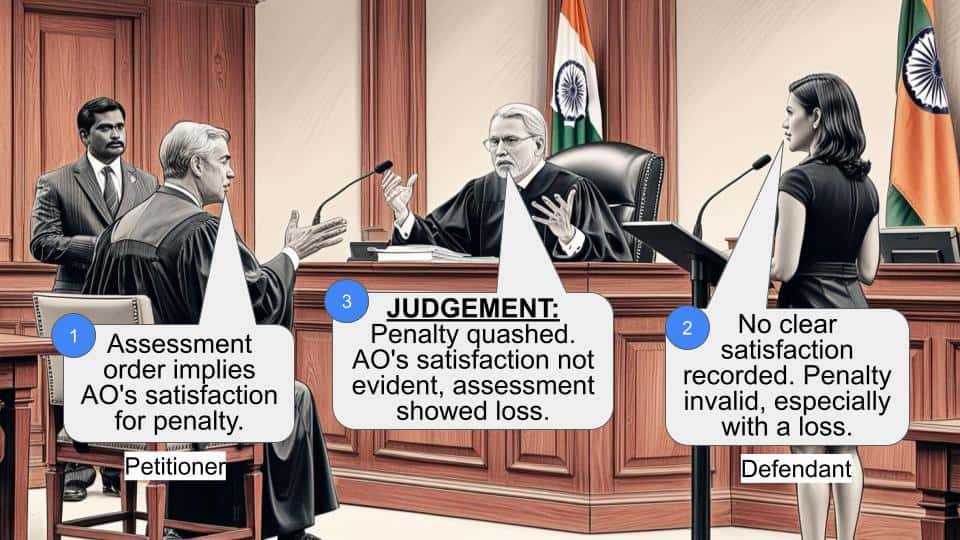
1. The satisfaction of the AO for initiating penalty proceedings could be discernible from the assessment order itself.
2. A larger bench of the High Court was considering a related question, and this case should await that decision.
The assessee contended that:
1. The AO had not recorded his satisfaction in the assessment order regarding concealment of facts or furnishing of inaccurate particulars.
2. The penalty proceedings were invalid based on the decision in CIT vs. Ram Commercial Enterprises Ltd.
Key Legal Precedents:
1. CIT vs. Ram Commercial Enterprises Ltd. (2001) 167 CTR (Del) 321 : (2000) 246 ITR 568 (Del)
2. Dilip N. Shroff vs. Joint CIT (2007) 210 CTR (SC) 228 : (2007) 291 ITR 519 (SC)
3. T. Ashok Pai vs. CIT (2007) 210 CTR (SC) 259 : (2007) 292 ITR 11 (SC)
These cases established the principle that the AO must record satisfaction in the assessment order for initiating penalty proceedings.
Judgement:
The High Court dismissed the Revenue's appeal, holding that:
1. No satisfaction by the AO that penalty proceedings should be initiated was discernible from the assessment order.
2. The assessee's inability to file confirmations from parties doesn't necessarily indicate furnishing of incorrect particulars.
3. The assessment order was more about interpreting information rather than concealment of particulars.
4. No substantial question of law arose in the appeal.
FAQs:
1. Q: What is section 271(1)(c) (of Income Tax Act, 1961)?
A: It's a provision that allows the AO to impose penalties for concealment of income or furnishing inaccurate particulars of income.
2. Q: Why is the AO's "satisfaction" important in penalty proceedings?
A: It ensures that penalties are not imposed arbitrarily and that there's a reasonable basis for initiating such proceedings.
3. Q: What's the significance of the "Ram Commercial Enterprises Ltd." case?
A: It established that the AO must record satisfaction in the assessment order for initiating penalty proceedings, which was approved by the Supreme Court in subsequent cases.
4. Q: Does this judgment mean penalties can never be imposed if not mentioned in the assessment order?
A: Not necessarily. The court suggests that if the satisfaction is "discernible" from the order, it might be sufficient, but this wasn't the case here.
5. Q: How might this judgment affect future tax assessments?
A: It emphasizes the need for AOs to clearly record their reasons for initiating penalty proceedings in their assessment orders, potentially leading to more detailed and careful drafting of such orders.

1. In this appeal under s. 260A of the IT Act,1961 (‘Act’), the Revenue is aggrieved by an order dt. 13th Nov., 2006 passed by the Income-tax Appellate Tribunal (‘Tribunal’) Delhi Bench ‘E’, New Delhi in ITA No. 1036/Del/2005 for the asst. yr. 1995-96 concerning penalty proceedings under s. 271(1)(c) of the Act.
2. The Assessing Officer (‘AO’) while finalising the assessment for the asst. yr. 1995-96 stated towards the end of the order dt. 20th March, 1998 as follows :
"Assessed at Rs. 20,80,216. Issue necessary forms. Give credit of prepaid taxes. Charge interest as per rules-penalty proceedings under s. 271(1)(c) of the IT Act have been initiated separately."
3. Thereafter the AO passed an order on 27th May, 2004 under s. 271(1)(c) of the Act imposing a penalty of Rs. 1,95,800 on the assessee. This was confirmed by the Commissioner of Income-tax (A) [‘CIT(A)’] by his order dt. 29th Dec., 2004.
4. The appeal preferred by the assessee was allowed by the Tribunal on the ground that the AO had not recorded his satisfaction in the assessment order that there was either concealment of facts or furnishing of inaccurate particulars by the assessee and that in view of the decision of this Court in CIT vs. Ram Commercial Enterprises Ltd. (2001) 167 CTR (Del) 321 : (2000) 246 ITR 568 (Del) the penalty proceedings cannot be sustained.
5. We may note at the outset that the decision of this Court in Ram Commercial Enterprises Limited has been approved by the Supreme Court in Dilip N. Shroff vs. Joint CIT (2007) 210 CTR (SC) 228 :
(2007) 291 ITR 519 (SC) and T. Ashok Pai vs. CIT (2007) 210 CTR (SC) 259 : (2007) 292 ITR 11 (SC)
6. While not contesting the proposition laid down by this Court in Ram Commercial Enterprises Limited, Ms. Sonia Mathur, learned standing counsel for the Revenue nevertheless urges that another Bench of this Court has in CIT vs. Rampur Engg. Co. Ltd.(2006) 204 CTR (Del) 149 : (2006) 155 Taxman 223 (Del) referred the following substantial question of law to a larger Bench which according to the referring Bench was not considered in Ram Commercial Enterprises Ltd. :
"Whether satisfaction of the officer initiating the proceedings under s. 271 of the IT Act can be said to have been recorded even in cases where satisfaction is not recorded in specific terms but is otherwise discernible from order passed by the authority" She accordingly submits that this Court should await the decision of the larger Bench.
7. Assuming the Revenue were to succeed before the larger Bench, and the question referred to it is answered in the affirmative, it would mean that it is sufficient that the satisfaction of the AO for initiating penalty proceedings against an assessee under s. 271(1)(c) of the Act is discernible from the assessment order itself and that such satisfaction need not be separately or expressly indicated in the assessment order. In that event the assessment order in the present case would have to be examined to find out if the satisfaction of the AO is discernible. Therefore, without expressing any view on the issue pending consideration by the larger Bench, and presuming that the question referred to it is answered in the affirmative, we proceed to examine the assessment order in the instant case in order to find out whether the satisfaction of the AO that penalty proceedings should be initiated against the assessee under s. 271(1)(c) of the Act is discernible therefrom.
8. Having examined the assessment order ourselves, we are unable to discern therein any satisfaction recorded by the AO that penalty proceedings should be initiated. While it is true that the assessee could not file confirmation from the parties from whom the amounts were received, that by itself does not indicate that there was furnishing of incorrect particulars. In fact we do not find that the assessment order was so much about concealment of particulars as about the interpretation of the information furnished by the assessee.
9. In the circumstance we find no substantial question of law arises in the present appeal. Dismissed.
MADAN B. LOKUR, J
S. MURALIDHAR, J
OCTOBER 09, 2007
×
Similar Ripples
Questions
AO's Failure to Record Satisfaction Invalidates Penalty Under Section 271(1)(c) (of Income Tax Act, 1961)
Write your CommentSimilar Posts


Generic
- Reportdata/5284.pdf
