


Appellate Authorities' Power Extends to New Grounds, Even Those Available at Re…


Full News

Appellate Authorities' Power Extends to New Grounds, Even Those Available at Return Filing
Appellate Authorities' Power Extends to New Grounds, Even Those Available at Return Filing
This case involves an appeal by an assessee (taxpayer) against the Income Tax Appellate Tribunal (ITAT)'s decision. The main issue was whether the Commissioner of Income Tax (Appeals) [CIT(A)] had the jurisdiction to entertain additional grounds raised by the assessee that were not originally presented to the Assessing Officer. The High Court ruled in favor of the assessee, stating that the CIT(A) does have such jurisdiction.
Get the full picture - access the original judgement of the court order here
Case Name:
M/s. Siva Equipment Pvt. Ltd. Vs Assistant Commissioner of Income Tax & Union of India, Through The Secretary (Revenue), Ministry of Finance (High Court of Bombay)
Tax Appeal No.67 of 2014
Date: 5th February 2020
Key Takeaways:
1. Appellate authorities have jurisdiction to entertain new grounds, even if they were available when the original return was filed.
2. The power of appellate authorities is co-terminus with the power of assessing authorities.
3. Appellate authorities have discretion to allow or disallow new claims, but they cannot be said to lack jurisdiction to consider them.
4. The case emphasizes the importance of ascertaining the correct tax liability of the assessee in accordance with the law.
Issue:
Does the Commissioner of Income Tax (Appeals) have the jurisdiction to entertain additional grounds raised by the assessee that were not originally presented to the Assessing Officer during the assessment proceedings?
Facts:
1. The assessee filed a return for the assessment year 2009-2010 declaring a total income of "Nil".
2. The Assessing Officer assessed the total income at Rs.70,80,040/- and imposed a tax liability of Rs.27,62,035/-.
3. The assessee filed an application for rectification, pointing out that:
a) An amount of Rs.52,14,543/- of short-term capital gain was inadvertently considered as business income.
b) An amount of Rs.5,90,093/- was incorrectly added to the business income as a balancing charge on the sale of a factory building.
4. The rectification application was rejected by the Assessing Officer.
5. The assessee appealed to the CIT(A) against both the assessment order and the rejection of the rectification application.
6. The CIT(A) allowed the appeal against the assessment order, accepting the additional grounds raised by the assessee.
7. The Revenue appealed to the ITAT, which set aside the CIT(A)'s order, leading to this appeal in the High Court.
Arguments:
Assessee:
- The CIT(A) has the jurisdiction to entertain additional grounds, even if they were available at the time of filing the return.
- The ITAT misinterpreted previous Supreme Court judgments.
Revenue:
- Appellate authorities can only entertain new grounds if they were not available when the returns were filed or when the assessment order was made.
- The CIT(A) exceeded its jurisdiction by allowing additional grounds.
Key Legal Precedents:
1. Commissioner of Income Tax vs. Pruthvi Brokers & Shareholders P. Ltd. [2012] 349 ITR 336 (Bom)
2. Additional Commissioner of Income-Tax, Gujarat vs. Gurjargravures P. Ltd, 1978 111 ITR 1 (SC)
3. Goetze (India) Ltd. vs. Commissioner of Income Tax [2006] 284 ITR 323 (SC)
4. Jute Corporation of India Ltd. vs. Commissioner of Income Tax and Anr., 187 ITR 688 (SC)
5. Commissioner of Income Tax, U.P vs. Kanpur Coal Syndicate, 53 ITR 225 (SC)
6. Ahmedabad Electricity Co. Ltd Vs. CIT (193) 199 ITR 351 (Bom)
Judgment:
The High Court ruled in favor of the assessee, holding that:
1. The CIT(A) has jurisdiction to entertain additional grounds raised by the assessee, even if they were available at the time of filing the original return.
2. The power of appellate authorities is co-terminus with the power of assessing authorities.
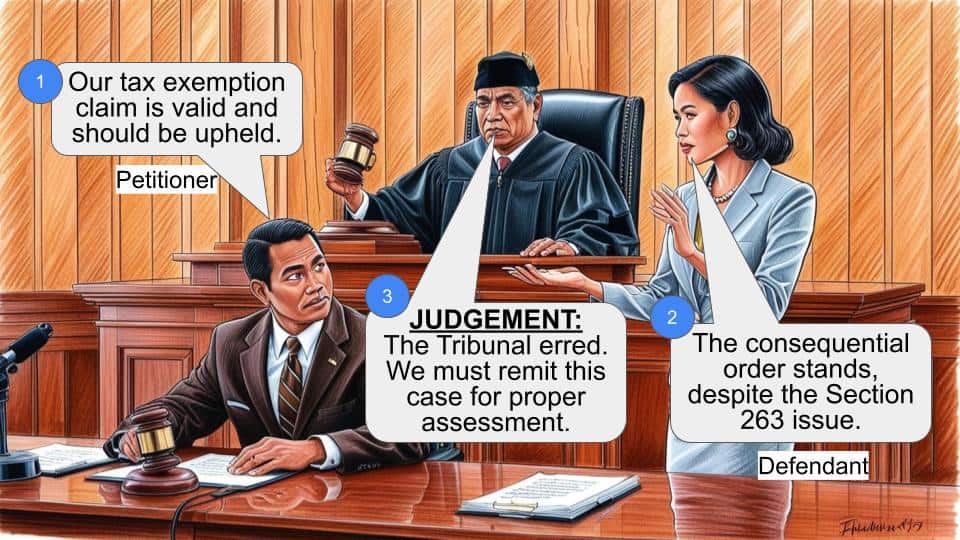
3. The case was remanded back to the CIT(A) to decide on the merits of the additional grounds raised by the assessee.
FAQs:
1. Q: What was the main issue in this case?
A: The main issue was whether the CIT(A) had the jurisdiction to entertain additional grounds that were not originally presented to the Assessing Officer.
2. Q: How did the High Court's decision differ from the ITAT's ruling?
A: The High Court overturned the ITAT's decision, ruling that the CIT(A) does have jurisdiction to entertain additional grounds, even if they were available at the time of filing the original return.
3. Q: What is the significance of this judgment for taxpayers?
A: This judgment allows taxpayers to raise new grounds or claims before appellate authorities, even if these grounds were available at the time of filing the original return.
4. Q: Does this mean appellate authorities must always accept new grounds?
A: No, the judgment clarifies that appellate authorities have the discretion to allow or disallow new claims, but they cannot be said to lack jurisdiction to consider them.
5. Q: What happens next in this case?
A: The case has been remanded back to the CIT(A) to decide on the merits of the additional grounds raised by the assessee.

1.Heard Mr. Rohan Deshpande, who appears along with Ms. Vinita Palyekar for the appellant and Ms. Susan Linhares, the learned Standing Counsel for the Respondents. 2. This appeal was admitted on 25/11/2014 on the following substantial questions of law: (1) Whether on the facts and in the circumstances of the case and in law, the ITAT is correct in holding that the CIT(A) was not empowered to adjudicate o the grounds raised before him by the assessee (despite the fact that the said grounds were arising out of the assessment and that a decision on the grounds was neither fruitless nor academic) and that the appeal before the CIT (A) was not maintainable? (2) Without prejudice to the above, whether on the facts and in the circumstances of the case and in law, the ITAT is correct in holding that the CIT (A) was not empowered to adjudicate on the grounds raised before the him by the assessee, despite the settle position in law that the CIT (A) has powers to admit and adjudicate even fresh claims, and there is no requirement in law that the claims should be made either in a revised return or during he course of assessment proceedings? 3. The aforesaid substantial questions of law arise for determination in the context of the return filed by the appellant for the assessment year 2009-2010 declaring a total income of “Nil”. The Assessing Officer, (AO) vide its order dated 12/12/2011 made under section 143(3) (of Income Tax Act, 1961) (the said Act) assessed he total income of the appellant at Rs.70,80,040/- and imposed tax liability of Rs.27,62,035/-. 4. The appellant on 21/1/2012 filed an application for rectification under section 154 (of Income Tax Act, 1961) in respect of the aforesaid order dated 12/12/2011 by pointing out that an amount of Rs.52,14,543/- of short term capital gain on the sale of debts funds was inadvertently considered as business income in the appellant's return instead of short term capital gain. The appellant also pointed out that an amount of Rs.5,90,093/- was earlier incorrectly added to the business income in the return as balancing charge on sale of factory building.
5. The appellant's application under section 154 of the Income Tax Act, 1961 was, however, rejected by the assessing officer on 29/3/2012 inter alia by observing that the appellant having failed to file the revised return within the prescribed period of limitation or having failed to make relevant claims during the course of assessment proceedings was not entitled to seek for any rectification under section 154 of the Income Tax Act, 1961. As against the order dated 29/3/2012, the appellant on 26/4/2012 preferred an appeal to the Commissioner of Income Tax (Appeals) – CIT (Appeals).
6. The appellant, also instituted an appeal against the order dated 12/12/2011 made under section 143(3) of the Income Tax Act, 1961 by the Assessing Officer. 7. Both the aforesaid appeals were taken up for consideration by the CIT (Appeals) and disposed of by a common order dated 26/9/2013. The CIT (Appeals) dismissed the appellant's appeal against order dated 29/3/2012 in relation to the provisions of section 154 of the Income Tax Act, 1961. However, the CIT (Appeals) allowed the appellant's appeal against order dated 12/12/2011 made under section 143(3) of the Income Tax Act, 1961.
8. Aggrieved by the aforesaid, the respondent/Revenue filed an appeal to the Income Tax Appellate Tribunal (ITAT), which has, by the impugned judgment and order dated 11/4/2014 set aside the common order dated 26/9/2013 made by the CIT (Appeals). Hence the present appeal on the aforesaid substantial questions of law.
9. Mr. Rohan Deshpande, the learned counsel for the appellant submits that the impugned judgment and order made by the ITAT is contrary to the law laid down by the division Bench of this Court in Commissioner of Income Tax Vs. Pruthvi Brokers & Shareholders P. Ltd. [2012] 349 ITR 336 (Bom). He submits that the ITAT has misread and misconstrued the decision. The Apex Court in Goetze (India) Ltd. Vs. Commissioner of Income Tax [2006] 284 ITR 323 (SC), in as much as it clearly did not deal with the powers of the appellate authority under the said Act. He submits that the ITAT erred in placing reliance on the decision of the Apex Court in Additional Commissioner of Income-Tax, Gujarat Vs. Gurjargravures P. Ltd, 1978 111 ITR 1 (SC) since in Jute Corporation of India Ltd. Vs. Commissioner of Income Tax and anr, 187 ITR 688 (SC), the Apex Court has held that the view taken in Gurjargravures (supra) is in conflict with the view taken by the Three Judge Bench of the Apex Court in Commissioner of Income Tax, U. P Vs. Kanpur Coal Syndicate, 53 ITR 225 (SC). Mr. Desphande pointed out that in any case, Gurjargravures (supra) has been considered, read and interpreted by the Division Bench of this Court in Pruthvi Brokers (supra) in a particular manner and such reading and interpretation was clearly binding upon the ITAT, which could not have read the decision in Gurjargravures (supra) in a different manner.
10. For all these reasons Mr. Deshpande submits that the ITAT clearly erred in holding that the powers of the CIT (Appeals) were restricted to entertain the grounds, which were, originally unavailable to the appellant at the stage of assessment of the proceedings before the Assessing Officer.
11. Mr. Deshpande submits that in the present case, the respondent/revenue had not even questioned the common order of the CIT (Appeals) dated 26/9/2013 on merits and accordingly the ITAT, lacked jurisdiction or in any case was not justified in upsetting the findings recorded by the CIT (Appeals) on merits. In support of his contention, Mr. Deshpande referred us to the Memo of Appeal filed by the respondent/revenue before the ITAT.
12. Based upon the aforesaid contentions, Mr. Deshpande submits that the two substantial questions of law may be answered in favour of the appellant and against the respondent/revenue.
13. Ms. Susan Linhares, the learned Standing Counsel for the respondent defends the impugned judgment and order on the basis of the reasoning reflected therein . She relies on Gurjargravures (supra), to submit that the appellate authorities can entertain new grounds only if the ground so raised could not have been raised at a stage when the returns were filed or when the assessment order was made or when such a ground became available on account of change of circumstances or law. She submits tat the Memo of Appeal to which reference is made by Mr. Deshpande has to be construed liberally and so construed, it is apparent that the respondent/revenue had attacked the order of the CIT (Appeals) on merits as well. In any case, she submits that the rulings in Gurjargravures (supra) and Godze (supra) were clearly attracted to the facts and circumstances of the present case and the CIT (Appeals), erred in ignoring the same. For all these reasons Ms. Linhares submitted that the substantial questions of law framed in this appeal may be answered against the appellant/assessee and in favour of the the respondent/revenue.
14. Rival contentions now fall for our determination.
15. As regards the factual aspects, the same, have been set out to the extent necessary for the determination of the substantial questions of law on which this appeal was admitted, at the very outset. There is no doubt that when the appellants filed their returns before the Assessing Officer there was no claim that the amount of Rs.52,14,543/-, which was indicated as business income was to be treated as short term capital gain or for that matter, the amount of Rs.5,90,093/- was incorrectly added to the business income. These contentions/grounds were raised to in the application for rectification under section 154 of the Income Tax Act, 1961, and consequent upon rejection of the application under section 154 of the Income Tax Act, 1961 before the CIT (Appeals), in the two separate appeals questioning not only the rejection of the application under section 154 of the Income Tax Act, 1961 but also questioning the order dated 12/12/2011 by which the Assessing Officer accepted the return of the appellant under section 143(3) of the Income Tax Act, 1961.
16. The question which therefore arises in this matter is whether the CIT (Appeals) had the jurisdiction to entertain this additional grounds in the appeal instituted by the appellant questioning the Assessing Officer's order dated 12/12/2011 made under section 143(3) of the Income Tax Act, 1961, even though such grounds neither flow from any change of circumstances or the law nor is it that such grounds were unavailable to the appellant/assessee at the stage of filing the return or during the progress of the assessment proceedings before the Assessing Officer.
17. The CIT (Appeals) has held that it had such jurisdiction. In exercise of such jurisdiction, the CIT (Appeals) not only permitted the appellants to raise these additional grounds but also allowed the appeal by accepting such additional grounds.
18. The ITAT by the impugned judgment and order dated 11/4/2014, by relying mainly on Gurjargravures (supra) and Goetze (supra) has held that the CIT (Appeals) exceeded its jurisdiction in entertaining the two additional grounds, which had never been raised by the appellant before the Assessing Officer in the course of the assessment proceedings.
19. According to us, the view taken by the ITAT is not consistent with the view taken by the Division Bench of this Court in the case of Pruthvi Brokers (supra), which has considered the decisions in Gurjargravures (supra) as well as Goetze (supra) and further read and interpreted the same in a particular manner.
20. Gurjargravures (supra), is a decision of a two Judge bench of the Hon'ble Apex Court. This was considered by a three Judge Bench of the Hon'ble Apex Court in the case of Jute Corporation of India Ltd. (supra), wherein the three Judge Bench, observed that apparently the view taken by the two Judge bench in Gurujargravures (supra) appears to be in conflict with the view taken by the three Judge Bench in Kanpur Coal Syndicate (supra) which is again a decision of the three Judge Bench of the Hon'ble Apex Court. Accordingly, it was held that the view of the Larger bench in Kanpur Coal Syndicate (supra) prevails, in which, it has been categorically held that the power of the appellate authorities is co- terminus with the power of the assessing authorities. 21. Apart from the aforesaid, the Division Bench of this Court in Pruthvi Brokers (supra) by reference to the portion in Gurujargravures (supra) upon which specific reliance was placed by Ms. Linhares, has held that such portion which was also relied upon by ITAT, does not curtail the ambit of the jurisdiction of the appellate authorities. Such portion does not restrict the new/additional grounds that may be taken by the assessee before the appellate authorities, to those that were not available when the return was filed or even when the assessment order was made. The appellate authorities, have jurisdiction to deal with the additional grounds including those which were available when the original return was filed. In taking this view, the Division Bench also adverted to and relied upon the decision of Ahmedabad Electricity Co. Ltd Vs. CIT (193) 199 ITR 351 (Bom), in which the Full Bench of this Court has held that the appellate authorities have very wide powers while considering an appeal which may be filed by the assessee. The appellate authorities may confirm, reduce, enhance or annul the assessment or remand the case to the Assessing Officer. This is because, unlike an ordinary appeal, the basic purpose of a tax appeal is to ascertain the correct tax liability of the assessee in accordance with law. 22. In Pruthvi Brokers (supra), the division Bench, after considering several decisions has held that it is clear that an assessee is entitled to raise not merely additional legal submissions before the appellate authorities, but is also entitled to raise additional claims before them. The appellate authorities have the discretion whether or not to permit such additional claims to be raised. It cannot, however, be said that they have no jurisdiction to consider the same. They have the jurisdiction to entertain the new claim. That they may choose not to exercise their jurisdiction in a given case is another matter. The exercise of discretion is entirely different from the existence of jurisdiction.
23. The decision in Goetze (supra) upon which reliance is placed by the ITAT also makes it clear that the issue involved in the said case was limited to the power of the assessing authority and does not impeach on the powers of the ITAT under section 254 of the Income Tax Act, 1961. This means that in Goetze, the Hon'ble Apex Court was not dealing with the extent of the powers of the appellate authorities but the observations were in relation to the powers of the assessing authority. This is the distinction drawn by the division Bench in Pruthvi Brokers (supra) as well and this is the distinction which the ITAT failed to note in the impugned order. 24. Taking into consideration the aforesaid rulings, we are satisfied that the substantial questions of law as framed are required to be answered in favour of the appellant/assessee and against the respondent/revenue to the extent of holding that the CIT (Appeals), in the facts and circumstances of the present case, did have the jurisdiction to entertain the two additional grounds raised by the appellants in the context of payment of the amount of Rs.52,14,543/- as short terms capital gain and the addition of amount of Rs.5,90,093/- to the business income in the return filed by the appellant. However, in the present case the ITAT after holding that the CIT (Appeals) lacked the jurisdiction to entertain the two additional grounds has proceeded to observe that even on merits, the CIT (Appeals) was wrong in exercising discretion in favour of the appellants or accepting the case of the appellants on merits.
25. Mr. Deshpande submits that there was no challenge to the merits on behalf of the respondent/revenue which according to him is evident from the memo of appeal which is placed on record at pages 128 to 130 of the paper Book in the present appeal. Ms. Linahres, however, contests this contention.
26. Upon perusal of the Memo of Appeal, we agree with Ms. Linhares that the same is not required to be construed in some restricted sense, but rather, the same is required to to be construed liberally. So construed, it cannot be said that there was no challenge to the finding of CIT (Appeals) on merits. That apart, Ms. Linhares, is entitled to draw some sustenance from the decision of the Full Bench of this Court in Ahmedabad Electricity Co. (supra) in which the Full Bench has held that an appeal under the provisions of the said Act is unlike an ordinary appeal since, the basic purpose of a tax appeal is to ascertain the correct tax liability of assessee in accordance with law.
27. In the present case, we have also perused the common order dated 26/9/2013 made by the CIT (Appeals) and we find that notwithstanding the length of the order, on the merits of the additional grounds urged by the appellant/assessee, the CIT (Appeals) has only made the following observations :
“ I have gone through the submission of the appellant and documents submitted. On the basis of the above, I find the claim of the appellant to be correct. ”
28. According to us, the aforesaid is hardly a satisfactory manner for dealing with the additional grounds raised by the appellant /assessee and contested by the respondent/revenue on merits. The ITAT (Appeals) in the impugned order has correctly observed that the issue could not have been decided in such a perfunctory manner. The issue is highly debatable and requiring assessment of the material on record. Accordingly, we are of the opinion that after declaring that the CIT (Appeals) had the jurisdiction to entertain the additional grounds raised by the appellant, the matter will have to be remanded to the CIT(Appeals) for determining whether in the facts and circumstances of the present case, discretion was required to be exercised in favour of the appellant/assessee and further, whether on merits the appellant/assessee was entitled to the benefits as claimed by raising the aforesaid additional grounds.
29. The two substantial questions of law as framed are answered accordingly by holding that the CIT (Appeals) has the jurisdiction to entertain the two additional grounds/claims raised by the appellant before it. However, we have also held that in the exercise of such jurisdiction, the CIT (Appeals) has not properly dealt with the said additional grounds/claims on their merits. Hence the necessity of remand to CIT (Appeals) to deal with the said two additional grounds/claims on merits.
30. Accordingly, we set aside not only the impugned order dated 11/4/2014 made by the ITAT but we also set aside the order dated 26/9/2013 made by the CIT (Appeals), restricted only to Tax Appeal no.18/MRG/2012-13 and restore only the said appeal to file of the CIT (Appeals) for deciding whether the additional grounds/claims raised by the appellant deserve to be allowed on 'merits'. The CIT (Appeals) in pursuance of this remand, shall, however, not revisit the issue of jurisdiction but only examine the additional grounds/claims on merits. Further, it is clarified that we have not interfered with the order dated 26/9/2013 made by the CIT (Appeals) in Tax Appeal no.20/MRG/2012-13 against order dated 29/3/2012 rejecting the appellant's application under section 154 of the Income Tax Act, 1961, which, in any case, had not even been challenged by the appellant before the ITAT.
31. The parties to now appear before the CIT (Appeals) on 9/3/2020 at 11 a.m. on which date, the CIT (Appeals), may indicate to the parties the date on which the Tax Appeal No.18/MRG/2012-13 which is now restored to its file, will be heard and disposed off. We clarify that in so far as the issue of exercise of discretion and the merits of the two additional grounds/claims is concerned, all contentions of the parties are left open for determination by the CIT (Appeals) in pursuance of the present limited remand.
32. The appeal is disposed off in the aforesaid terms, without making any order as to costs. 33. All concerned to act on the basis of authenticated copy of this order.
×
Similar Ripples
Questions
Appellate Authorities' Power Extends to New Grounds, Even Those Available at Return Filing
Write your CommentSimilar Posts

Generic
- Reportdata/6294.pdf
