Assessee wins as High Court quashes reassessment order for not disposing object…




Full News
Assessee wins as High Court quashes reassessment order for not disposing objections against reopening notice.
Assessee wins as High Court quashes reassessment order for not disposing objections against reopening notice.
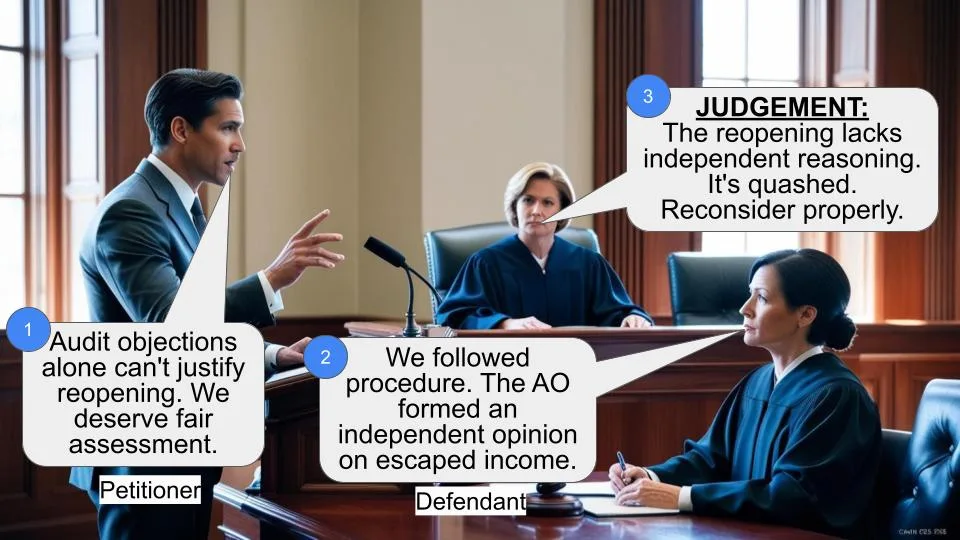
This case involves a dispute between an assessee, Simaben Vinodrai Ravani, and the Income Tax Officer (ITO) over a reassessment order passed by the ITO for the assessment year 2010-11. The High Court of Gujarat quashed the reassessment order and remanded the matter back to the ITO to properly dispose of the assessee’s objections against reopening the assessment before proceeding further.
Get the full picture - access the original judgement of the court order here
Case Name:
Simaben Vinodrai Ravani v. Income Tax Officer (High Court of Gujarat)
Special Civil Application No. 212 of 2017
Date: 7th February 2017
Key Takeaways:
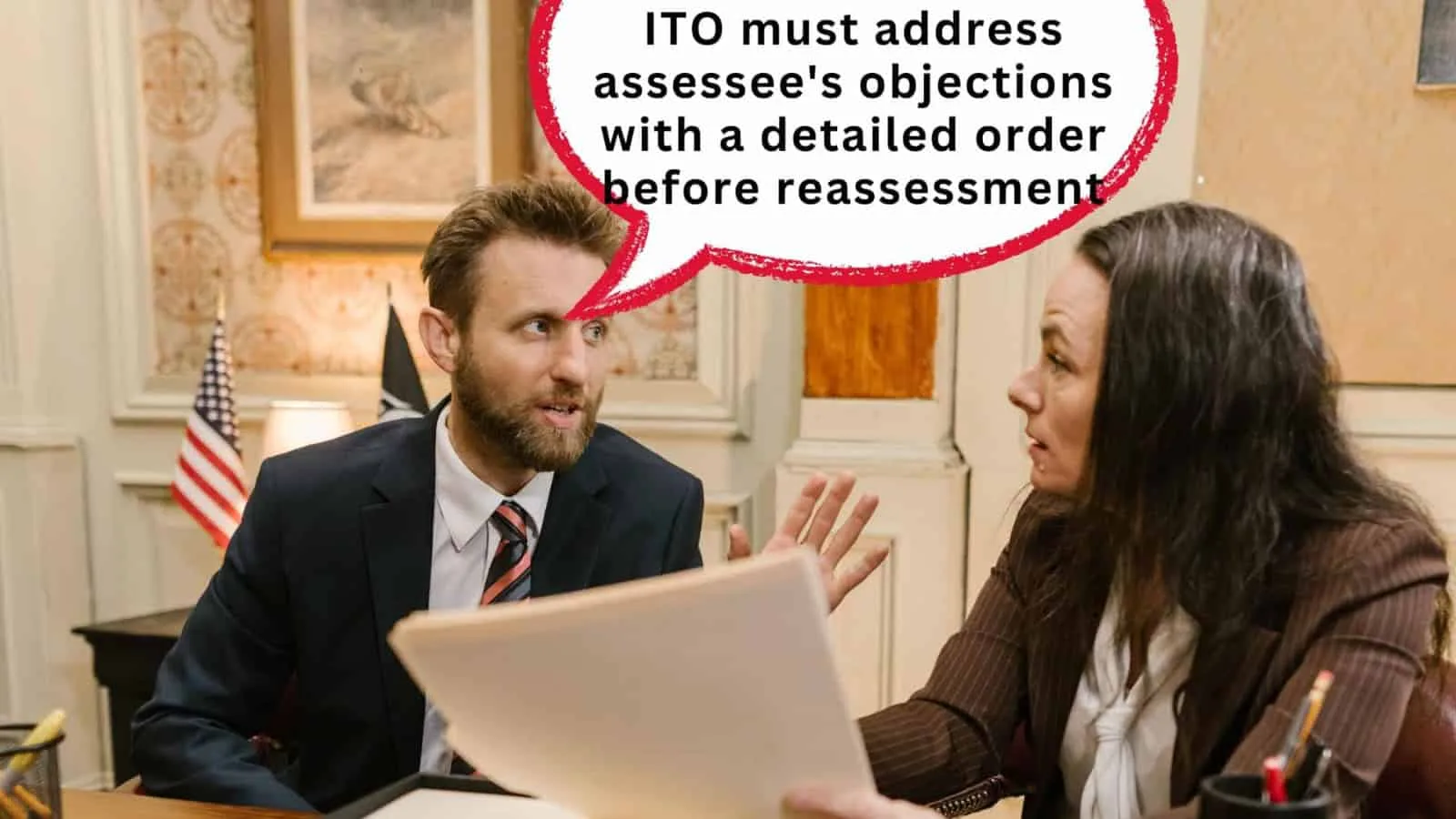
- The ITO is obligated to dispose of the assessee’s objections against reopening the assessment by passing a speaking order before proceeding with the reassessment.
- Failing to follow this mandatory procedure renders the reassessment order illegal and liable to be quashed.
- The court relied on the Supreme Court’s decision in G.K.N. Driveshafts (India) Ltd. v. ITO and its own decisions in emphasizing this procedural requirement.
Issue:
Whether the ITO can pass a reassessment order without first disposing of the assessee’s objections against reopening the assessment by way of a speaking order?
Facts:
The ITO issued a notice under Section 148 (of Income Tax Act, 1961) to reopen the assessment for AY 2010-11 on 29.03.2016.
The assessee filed objections against reopening on 14.12.2016.
However, without dealing with and disposing of these objections, the ITO passed the reassessment order on 26.12.2016 and issued a demand notice on 30.12.2016.
The assessee challenged this before the High Court.
Arguments:
Assessee:
The ITO violated the binding precedents by not disposing of the objections through a speaking order before passing the reassessment order, rendering it illegal.
Revenue:
Requested to remand the matter back to the ITO at the stage of notice under Section 148 (of Income Tax Act, 1961).
Key Legal Precedents:
- G.K.N. Driveshafts (India) Ltd. v. ITO (2003) 259 ITR 19 (SC)
- Garden Finance Ltd. v. Asstt. CIT (2004) 268 ITR 48 (Guj.) (FB)
- Arvind Mills Ltd. v. Assistant Commissioner of Wealth Tax (2014) 141 Taxmann 210 (Guj.)
Judgement:
The High Court quashed the reassessment order and demand notice, and remanded the matter back to the ITO to deal with and dispose of the assessee’s objections of 14.12.2016 through a speaking order before proceeding further with reassessment.
The ITO was directed to give the assessee reasonable time (minimum 2 months) to challenge the order on objections, if overruled. Costs of Rs. 5000 were imposed on the ITO.
FAQs:
Q1: What is the key legal principle established in this case?
A1: The key principle is that the ITO is obligated to dispose of the assessee’s objections against reopening the assessment by passing a speaking order before proceeding with the reassessment. Failing to do so renders the reassessment order illegal and liable to be quashed.
Q2: What was the reasoning behind the court’s decision?
A2: The court relied on binding precedents from the Supreme Court and its own decisions which have clearly laid down this procedural requirement as mandatory. The ITO violated this by passing the reassessment order without first properly disposing of the objections.
Q3: What are the implications of this case?
A3: This case reinforces the importance of following the due process laid down by the courts in reassessment proceedings. ITOs must ensure they properly dispose of objections against reopening through a speaking order before passing the reassessment order to avoid it being quashed.

[1.0] RULE. Ms. Mauna Bhatt, learned Advocate waives service of notice of Rule on behalf of the respondent. In the facts and circumstances of the case and with the consent of learned Counsel appearing for respective parties, present petition is taken up for final hearing today.
[2.0] By way of this petition under Article 226 of the Constitution of India, the petitioner – assessee has prayed for an appropriate writ, direction and order quashing and setting aside the impugned notice under Section 148 (of Income Tax Act, 1961) (hereinafter referred to as “Act”) at Annexure C and the reassessment order under Section 143(3) (of Income Tax Act, 1961), which is at Annexure Q.
[3.0] Facts leading to the present Special Civil Application in nut-shell are as under:
[3.1] That the petitioner assessee filed her return of income for AY 2010-11 on 15.10.2010. That the scrutiny assessment under Section 143(3) (of Income Tax Act, 1961) was framed by the Assessing Officer.
[3.2] That thereafter after a period of more than 4 years, the assessee received the impugned notice under Section 148 (of Income Tax Act, 1961) on 29.03.2016 by which the Assessing Officer sought to reopen the assessment for AY 2010-11 alleging inter alia the income chargeable to tax has escaped assessment within the meaning of Section 147 (of Income Tax Act, 1961). That the petitioner vide letter dated 11.04.2016 requested the respondent to supply copy of the reasons recorded for issuance of notice under Section 148 (of Income Tax Act, 1961). It is the case on behalf of the petitioner assessee that the respondent by its letter dated 12.04.2016 asked the petitioner to file the return of income in response to notice under Section 148 (of Income Tax Act, 1961) and stated further that only thereafter, he will provide copy of the reasons recorded. That the petitioner assessee by letter dated 18.04.2016 requested the respondent to take the return filed earlier, as the return filed in response to his notice and once again requested the respondent to supply copy of the reasons recorded. That thereafter the assessee received a notice under Section 143(2) (of Income Tax Act, 1961) dated 14.07.2016 along with the questionnaire. Copy of the reasons was recorded to the said notice. That on receipt of the reasons recorded to reopen the assessment and after some further communications, the assessee filed her objections to the reasons recorded, on 14.12.2016. That without disposing of the objections filed by the petitioner, the Assessing Officer has straightway passed the reassessment order dated 26.12.2016 wherein the loss of Rs.8,74,57,155/ came to be disallowed and resultantly the total income of the petitioner came to be assessed at Rs.9,23,25,290/. Simultaneously, the respondent sent to the petitioner a demand notice dated 30.12.2016 for Rs.5,14,82,780/.
[3.3] Feeling aggrieved and dissatisfied with the impugned notice under Section 148 (of Income Tax Act, 1961) as well as reassessment order for AY 2010-11, the assessee has preferred the present Special Civil Application under Article 226 of the Constitution of India.
[4.0] Having heard learned Counsel appearing on behalf of the respective parties it is not in dispute that before passing the reassessment order under Section 143(3) (of Income Tax Act, 1961) read with Section 147 (of Income Tax Act, 1961), the Assessing Officer has not dealt with and disposed of the objections raised by the assessee, raised against the reasons recorded to reopen the assessment for AY 2009-10
[4.1] It is submitted by Shri Shah, learned Counsel appearing on behalf of the petitioner that as per the decision of the Hon’ble Supreme Court in the case of G.K.N. Driveshafts (India) Ltd. v. ITO reported in (2003) 259 ITR 19 and the decision of the Division Bench of this Court in the case of Arvind Mills Ltd. v. Assistant Commissioner of Wealth Tax reported in (2014) 141 Taxmann 210 (Guj.), the Assessing Officer is bound / obliged to dispose of the preliminary objections against reopening, by passing a speaking order, before proceeding with the assessment in respect of the assessment year for which such notice has been issued. It is submitted that the aforesaid is held to be mandatory.
[4.2] It is further submitted that even while considering / deciding and/or disposing of the objections against the reopening of the assessment, the Assessing Officer is bound to pass a speaking order and that too before proceeding further with the assessment. It is submitted that in the present case the Assessing Officer has passed a nonspeaking order while dealing with and disposing off the objections raised by the petitioner and that too while passing the order of Assessment under Section 143(3) (of Income Tax Act, 1961) r/W. Section 147 (of Income Tax Act, 1961). It is submitted that therefore the impugned order of assessment is absolutely illegal, arbitrary and the same deserves to be quashed and set aside.
[5.0] Mrs. Bhatt, learned Counsel appearing on behalf of the Revenue is not in a position to dispute that the objections raised by the petitioner on 14.12.2016, which are raised against reopening of the assessment, were not dealt with and disposed of by the Assessing Officer before passing the reassessment order. Therefore, she has requested to pass appropriate order to remand the matter to the Assessing Officer at the stage of the notice under Section 148 (of Income Tax Act, 1961).
[6.0] Heard learned Counsel appearing for respective parties at length.
At the outset it is required to be noted that the impugned notice under section 148 (of Income Tax Act, 1961) to reopen the assessment for AY 2010-11 was issued by the Assessing Officer on 29.03.2016. That the assessee asked for the reasons recorded to reopen the assessment which came to be supplied / furnished by the Assessing Officer on 14.07.2016 along with the notice under Section 143(2) (of Income Tax Act, 1961) and the questionnaire. That the assessee raised the objections against the reasons recorded to reopen the assessment on 14.12.2016. Without dealing with and/or disposing of the said objections the Assessing Officer has framed the reassessment on 26.12.2016 and has issued the demand notice dated 30.12.2016. It is required to be noted that between the objections raised on 14.12.2016 and the order of assessment dated 26.12.2016, there was sufficient time available with the Assessing Officer to deal with and dispose of the objections. In the case of G.K.N. Driveshafts (India) Ltd. (Supra), the Hon’ble Supreme Court has laid down an elaborate procedure as to the manner of dealing with objections raised against the notice under Section 148 (of Income Tax Act, 1961) in the following words:
“However, we clarify that when a notice under section 148 (of Income Tax Act, 1961) of the Income tax Act is issued, the proper course of action for the notice is to file a return and if he so desires, to seek reasons for issuing notices. The Assessing Officer is bound to furnish reasons within a reasonable time. On receipt of reasons, the notice is entitled to file objections to issuance of notice and the Assessing Officer is bound to dispose of the same by passing a speaking order. In the instance case, as the reasons have been disclosed in these proceedings, the Assessing Officer has to dispose of the objections, if filed, by passing a speaking order, before proceeding with the assessment in respect of the above said five assessment years.”
[6.1] In a subsequent decision in the case of Garden Finance Ltd. v. Asstt. CIT reported in (2004) 268 ITR 48 (Guj.) (FB), the effect of Supreme Court decision in the case of G.K.N. Driveshaft (India) Ltd. (Supra) came up for consideration and by a majority opinion it has been thus laid down by this Court as under:
“What the Supreme Court has now done in the G.K.N. Case (2003)259 ITR 19 is not to whittle down the principle laid down by the Constitution Bench of the Apex Court in Calcutta Discount Co. Ltd. case (1961) 41 ITR 191 but to require the assessee first to lodge preliminary objection before the Assessing Officer who is bound to decide the preliminary objections to issuance of the re-assessment notice by passing a speaking order and, therefore, if such order on the preliminary objections is still against the assessee, the assessee will get an opportunity to challenge the same by filing a writ petition so that he does not have to wait till completion of the re-assessment proceedings which would have entailed the liability to pay tax and interest on re-assessment and also to go through the gamut of appeal, the second appeal before Income tax Appellate Tribunal and then reference / tax appeal to the High Court. Viewed in this light, it appears to me that the rigour of availing of the alternative remedy before the Assessing Officer for objecting to the re-assessment notice under section 148 (of Income Tax Act, 1961) has been considerably softened by the Apex Court in G.K.N. case (2003) 259 ITR 19 in the year 2003. In my view, therefore, the G.K.N. case (2003) 259 ITR 19 (SC) does not run counter to the Calcutta Discount Co. Ltd. case (1961) 41 ITR 191 (SC) but it merely provides for challenge to the re-assessment notice in two stages, that is,
i) raising preliminary objections before the Assessing Officer and in case of failure before the Assessing Officer,
ii) challenging the speaking order of the Assessing Officer under section 148 (of Income Tax Act, 1961) (p.87).”
[6.2] In the case of Arvind Mills Ltd. (Supra), in para 9, the Division Bench after considering the decision of the Hon’ble Supreme Court in the case of G.K.N. Driveshafts (India) Ltd. (Supra) and the Garden Finance Ltd. (Supra) has observed and held as under:
“9. The position in law is thus well settled. After a notice for re- assessment has been issued an assessee is required to file the return and seek reasons for issuance of such notice. The Assessing Officer is then bound to supply the reasons within a reasonable time. On receipt of reasons, the assessee is entitled to file preliminary objections to issuance of notice and the Assessing Officer is under a mandate to dispose of such preliminary objections by passing a speaking order, before proceeding with the assessment in respect of the assessment year for which such notice has been issued.”
[6.3] Identical question came to be considered by the Division Bench of this Court in the case of Banaskantha District Oil seeds Growers Coop Union Ltd. vs. ACIT rendered in Special Civil Application No.7813/2015 and considering the decisions of the Hon’ble Supreme Court and this Court, the Division Bench of this Court quashed and set aside the reassessment order which was passed without disposing of the objections raised by the assesse.
[7.0] In view of the above and for the reasons stated above, present Special Civil Application succeeds in part. Impugned assessment order dated 26.12.2016 passed by the Assessing Officer is hereby quashed and set aside. Consequently, the demand notice dated 30.12.2016 is also quashed and set aside. The matter is remitted to the file of the Assessing Officer at the stage of submitting the objections by the petitioner against the reopening of the assessment for AY 2010-11. The Assessing Officer now to deal with and dispose of the objections raised by the petitioner on 14.12.2016 and pass a speaking order, before proceeding with the reassessment in respect of the assessment year for which such notice has been issued and communicate the outcome of the same and thereafter after giving some reasonable time to the petitioner to challenge the decision dispose of the objections (in case the Assessing Officer over rules the objections raised by the petitioner by a speaking order). He may proceed further with the reassessment proceedings in respect of AY for which such notice has been issued. The Assessing Officer to give reasonable time to the petitioner which shall not be less than two months from the date of disposing of the objections (in case the Assessing Officer over rules the objections raised by the petitioner by a speaking order). However, it is made clear that we have not expressed anything on merits and the impugned assessment order has been set aside solely on the aforesaid ground and for the reasons stated above. Rule made absolute to the aforesaid extent. In the facts and circumstances of the case, more particularly when the Assessing Officer has not followed the binding decisions of the Hon’ble Supreme Court as well as Full Bench and Division Bench of this Court referred to here in above and has passed the reassessment order without dealing with and/or disposing of the objections raised by the petitioner, the petition is allowed with cost which is quantified at Rs.5000/, which shall be deposited by the concerned Officer with the Registry of this Court, within a period of 3 weeks from today. On such deposit the Registry is directed to transmit the same to Gujarat State Legal Services Authority.
Sd/
(M.R. SHAH, J.)
Sd/
(B.N. KARIA, J.)
×