


Assessee’s Right to Choose Initial Year for Tax Deduction Upheld


Full News
Assessee’s Right to Choose Initial Year for Tax Deduction Upheld
Assessee’s Right to Choose Initial Year for Tax Deduction Upheld
In the case of “Commissioner of Income Tax vs. Best Corporation Ltd.,” the High Court addressed the issue of whether an assessee can choose the initial year for claiming tax deductions under Section 80IA (of Income Tax Act, 1961). The court upheld the assessee’s right to select the initial year within a specified period, allowing for deductions over ten consecutive years. This decision aligns with previous rulings and clarifications from the Central Board of Direct Taxes (CBDT).
Get the full picture - access the original judgement of the court order here
Case Name:
Commissioner of Income Tax vs. Best Corporation Ltd. (High Court of Madras)
TCA.No.167 of 2016 and CMP.No.2523 of 2016
Date: 23rd March 2016
Key Takeaways:
- The court confirmed that an assessee eligible for deductions under Section 80IA (of Income Tax Act, 1961) can choose the initial year for claiming deductions.
- The deduction can be claimed for ten consecutive years within a fifteen or twenty-year period, as applicable.
- The decision reinforces the interpretation that the “initial assessment year” is the year chosen by the assessee, not necessarily the year the business commenced.
- The ruling aligns with the CBDT’s Circular No. 1/2016, which clarifies the interpretation of the “initial assessment year.”
Issue:
Can an assessee choose the initial year for claiming deductions under Section 80IA (of Income Tax Act, 1961), or must it be the year the eligible business commenced?
Facts:
Best Corporation Ltd. sought to claim tax deductions under Section 80IA (of Income Tax Act, 1961). The dispute arose over whether the company could choose the initial year for these deductions or if it had to be the year the business started. The Income Tax Department challenged the company’s choice, leading to the court case.
Arguments:
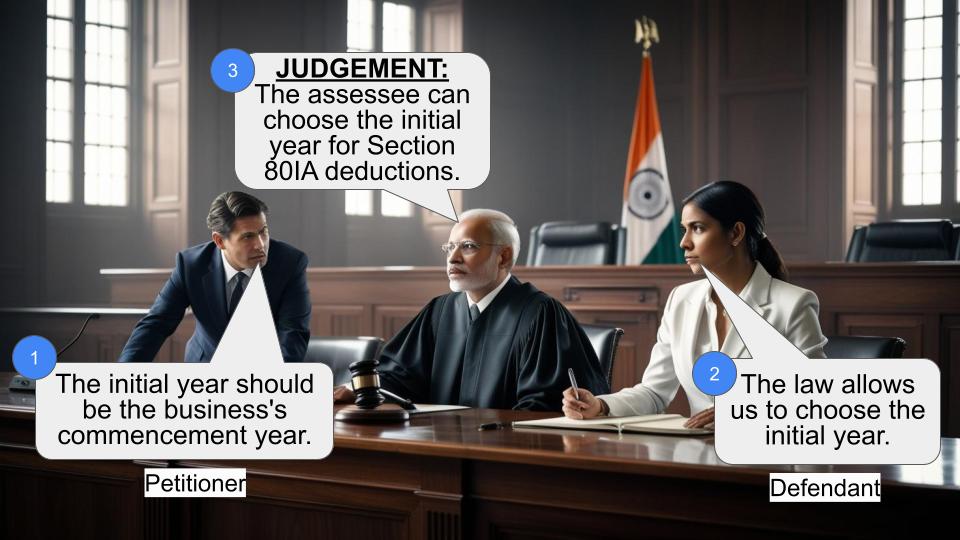
- Assessee’s Argument: Best Corporation Ltd. argued that Section 80IA (of Income Tax Act, 1961) allows them to choose the initial year for claiming deductions within a specified period, as supported by the CBDT’s circular.
- Department’s Argument: The Income Tax Department contended that the initial year should be the year the business commenced, not a year chosen by the assessee.
Key Legal Precedents:
- The court referenced the decision in “M/s. Velayudhaswamy Spinning Mills (340 ITR 477),” which supported the assessee’s right to choose the initial year for deductions.
- The CBDT’s Circular No. 1/2016 was also pivotal, as it clarified the interpretation of the “initial assessment year” under Section 80IA (of Income Tax Act, 1961).
Judgement:
The High Court ruled in favor of Best Corporation Ltd., affirming that the assessee could choose the initial year for claiming deductions under Section 80IA (of Income Tax Act, 1961). The court dismissed the appeal by the Income Tax Department, emphasizing the alignment with the CBDT’s circular and previous court decisions.
FAQs:
- What does Section 80IA (of Income Tax Act, 1961) entail?
- Section 80IA (of Income Tax Act, 1961) provides tax deductions for profits and gains from certain eligible businesses, allowing deductions for ten consecutive years within a specified period.
2. Why was the choice of the initial year significant in this case?
- Choosing the initial year affects the timing and duration of tax benefits, impacting the financial planning of the business.
3. What was the role of the CBDT’s Circular No. 1/2016 in this case?
- The circular clarified that the assessee has the option to choose the initial year for deductions, supporting the court’s decision.
4. What does this decision mean for other businesses?
- It reinforces the right of businesses to strategically choose the initial year for tax deductions under Section 80IA (of Income Tax Act, 1961), providing flexibility in financial planning.

The Revenue has come up with the above appeal raising the following substantial questions of law :
"(1) Whether under the facts and circumstances of the case, the Income Tax Appellate Tribunal was right in law in holding that the assessee is entitled to deduction under Section 80IA (of Income Tax Act, 1961) without setting off the losses/unabsorbed depreciation pertaining to the windmill, which were set off in the earlier year against other business income of the assessee following the decision of the jurisdictional High Court in the case of M/s. Velayudhaswamy Spinning Mills (340 ITR 477), when the same is pending appeal before the Supreme Court in SLP. Civil No.1136 of 2011 ?
(2) Whether under the facts and circumstances of the case, the Income Tax Appellate Tribunal was correct in holding that the initial assessment year in Section 80IA(5) (of Income Tax Act, 1961) would only mean the year of claim of deduction under Section 80IA (of Income Tax Act, 1961) and not the year of commencement of eligible business ? and
(3) Whether on the facts and in the circumstances of the case, the Tribunal was right in holding that the assessee has the option to choose the first/initial assessment year of claim for deduction under Section 80IA (of Income Tax Act, 1961) ?"
2. Heard Mr.T.R.Senthilkumar, learned Standing Counsel for the Department.
3. Even according to the learned Standing Counsel for the Department, this Court has consistently followed the decision in M/s.Velayudhaswamy Spinning Mills (340 ITR 477), despite the Honourable Supreme Court ordering notice.
4. Interestingly, on the basis of the decision in Velayudhaswamy Spinning Mills, the Central Board of Direct Taxes has issued Circular No.1/2016 dated 15.2.2016. It will be useful to extract the circular in entirety, which is as follows :
"Circular No. 1 /2016 Government of India Ministry of Finance Department of Revenue Central Board of Direct Taxes North Block, New Delhi, the 15th February, 2016 Subject: Clarification of the term ‘initial assessment year' in Section 80IA(5) (of Income Tax Act, 1961)
Section 801A (of Income Tax Act, 1961) (‘Act’), as substituted by Finance Act, 1999 with effect from 1.4.2000, provides for deduction of an amount equal to 100% of the profits and gains derived by an undertaking or enterprise from an eligible business (as referred to in Sub-Section (4) of that Section) in accordance with the prescribed provisions. Sub-Section (2) of Section 801A (of Income Tax Act, 1961) further provides that the aforesaid deduction can be claimed by the assessee, at his option, for any ten consecutive assessment years out of fifteen years (twenty years in certain cases) beginning from the year in which the undertaking commences operation, begins development or starts providing services etc. as stipulated therein. Sub-Section (5) of Section 801A (of Income Tax Act, 1961) further provides as under :
“Notwithstanding anything contained in any other provision of this Act, the profits and gains of an eligible business to which the provisions of Sub- Section (1) apply shall, for the purposes of determining the quantum of deduction under that Sub-Section for the assessment year immediately succeeding the initial assessment year or any subsequent assessment year, be computed as if such eligible business were the only source of income of the assessee during the previous year relevant to the initial assessment year and to every subsequent assessment year up to and including the assessment year for which the determination is to be made”.
In the above Sub-Section, which prescribes the manner of determining the quantum of deduction, a reference has been made to the term ‘initial assessment year’. It has been represented that some Assessing Officers are interpreting the term ‘initial assessment year’ as the year in which the eligible business/manufacturing activity had commenced and are considering such first year of commencement/operation etc. itself as the first year for granting deduction, ignoring the clear mandate provided under Sub-Section (2) which allows a choice to the assessee for deciding the year from which it desires to claim deduction out of the applicable slab of fifteen (or twenty) years. The matter has been examined by the Board. It is abundantly clear from Sub-Section (2) that an assessee who is eligible to claim deduction u/s 80IA (of Income Tax Act, 1961) has the option to choose the initial/first year from which it may desire the claim of deduction for ten consecutive years, out of a slab of fifteen (or twenty) years, as prescribed under that Sub-Section. It is hereby clarified that once such initial assessment year has been opted for by the assessee, he shall be entitled to claim deduction u/s 801A (of Income Tax Act, 1961) for ten consecutive years beginning from the year in respect of which he has exercised such option subject to the fulfillment of conditions prescribed in the section. Hence, the term ‘initial assessment year’ would mean the first year opted for by the assessee for claiming deduction u/s 801A (of Income Tax Act, 1961). However, the total number of years for claiming deduction should not transgress the prescribed slab of fifteen or twenty years, as the case may be and the period of claim should be availed in continuity.
The Assessing Officers are, therefore, directed to allow deduction u/s 801A (of Income Tax Act, 1961) in accordance with this clarification and after being satisfied that all the prescribed conditions applicable in a particular case are duly satisfied. Pending litigation on allowability of deduction u/s 80 (of Income Tax Act, 1961) IA shall also not be pursued to the extent it relates to interpreting ‘initial assessment year’ as mentioned in Sub- Section (5) of that section for which the Standing
V.RAMASUBRAMANIAN,J
AND
M.DURAISWAMY,J
Counsel/DRs be suitably instructed.
The above be brought to the notice of all Assessing Officers concerned."
5. Therefore, admittedly, questions of law 2 and 3 are also covered by the above circular. Hence, the appeal deserves to be dismissed.
6. Accordingly, the above tax case appeal is dismissed. Consequently, the above CMP is also dismissed.
7. But, we cannot resist our temptation to record one more fact. If an issue is covered by the judgment of the High Court, it is always open to the Department to take it on appeal to the Supreme Court and get the law settled once and for all. But, once a decision is taken at the level of the Board, we do not know why repeated appeals should be filed, only to meet with the same fate as that of a decision, on which, a circular has been issued.
The Department shall take note of this for future guidance.
23.3.2016
Internet : Yes
To
The Income Tax Appellate Tribunal, 'C' Bench, Chennai.
TCA.No.167 of 2016 &
CMP.No.2523 of 2016
×
Questions
Assessee’s Right to Choose Initial Year for Tax Deduction Upheld
Write your CommentSimilar Posts


Generic
- Reportdata/2972.pdf
