Full News

Cash Loan Repayment: Penalty Quashed as Reasonable Cause Proven, Says Chhattisgarh High Court
Cash Loan Repayment: Penalty Quashed as Reasonable Cause Proven, Says Chhattisgarh High Court
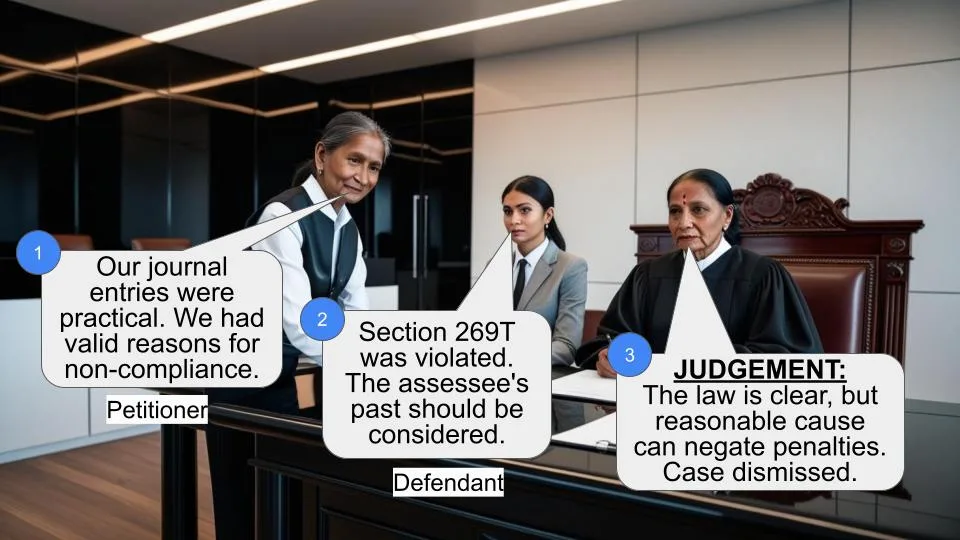
This case involves Kamaljeet Kaur Gill, who was penalized for repaying a loan in cash, allegedly violating Section 269T (of Income Tax Act, 1961). The authorities imposed a penalty under Section 271E (of Income Tax Act, 1961), but the High Court set aside the penalty, holding that the taxpayer had a reasonable cause for the cash repayment, as required by Section 273B (of Income Tax Act, 1961). The court emphasized that penalties are not automatic and must consider genuine reasons for non-compliance.
Get the full picture - access the original judgement of the court order here
Case Name
Kamaljeet Kaur Gill vs. The Joint Commissioner of Income Tax, Range-3, Raipur (High Court of Chhattisgarh, Bilaspur)
TAXC No. 48 of 2024
Date: 24th April 2025
Key Takeaways
- Penalty under Section 271E (of Income Tax Act, 1961) is not automatic: If a taxpayer can show a “reasonable cause” for violating Section 269T (of Income Tax Act, 1961) (repayment of loans in cash), no penalty should be imposed, as per Section 273B (of Income Tax Act, 1961).
- Genuine and bona fide transactions matter: The court found the taxpayer’s transaction was genuine and not intended to evade tax.
- Discretion must be exercised judiciously: Authorities must consider the taxpayer’s explanation and not impose penalties mechanically.
- Precedents reinforce the need for fairness: The court relied on Supreme Court decisions emphasizing that penalties are quasi-criminal and should not be imposed for technical or minor breaches if there’s a bona fide reason.
Issue
Was the penalty imposed under Section 271E (of Income Tax Act, 1961), for repaying a loan in cash (in violation of Section 269T (of Income Tax Act, 1961)), justified when the taxpayer claimed a reasonable cause under Section 273B (of Income Tax Act, 1961)?
Facts
- Who: Kamaljeet Kaur Gill, a resident of Raipur, Chhattisgarh.
- What happened: For the assessment year 2012-13, she repaid a loan of ₹14,59,688 in cash to M/s. Tata Finance Corporation.
- Why is this a problem: Section 269T (of Income Tax Act, 1961) prohibits repayment of loans above ₹20,000 in cash; it must be through an account payee cheque, bank draft, or electronic means.
- What did the authorities do: The Assessing Officer imposed a penalty under Section 271E (of Income Tax Act, 1961) for this cash repayment. The taxpayer explained that the finance company insisted on cash payment (supported by a letter from the company), but the authorities (including CIT (Appeals) and ITAT) rejected her explanation and upheld the penalty.
- What did the High Court do: The High Court reviewed whether the taxpayer had a “reasonable cause” for the cash repayment and whether the penalty was justified.
Arguments
Appellant (Kamaljeet Kaur Gill)
- The cash repayment was genuine, reflected in her books, and accepted during assessment.
- The finance company insisted on cash payment (supported by a letter).
- The authorities failed to consider her reasonable cause under Section 273B (of Income Tax Act, 1961).
- Penalty should not be automatic; discretion must be exercised.
Respondent (Income Tax Department)
- There was a clear violation of Section 269T (of Income Tax Act, 1961).
- The authorities’ findings were based on evidence and not perverse.
- The penalty was lawfully imposed as per the statute.
Key Legal Precedents
- Hindustan Steel Ltd. v. State of Orissa (1969) 2 SCC 627
- Penalties are quasi-criminal; not to be imposed for technical or minor breaches if there’s a bona fide belief or reasonable cause.
2. Assistant Director of Inspection v. Kum. A.B. Shanthi [2002] 122 Taxman 574 (SC)
- Section 273B (of Income Tax Act, 1961) provides that no penalty shall be imposed if there is a reasonable cause for the failure; the authority has discretionary power.
3. Azadi Bachao Andolan v. Union of India, 2001 SCC OnLine Del 293
- Defined “reasonable cause” as what would constrain a person of average intelligence and ordinary prudence, acting without negligence or inaction.
Statutory Provisions Referenced:
- Section 269T (of Income Tax Act, 1961): Prohibits cash repayment of loans/deposits above ₹20,000.
- Section 271E (of Income Tax Act, 1961): Provides for penalty equal to the amount repaid in violation of Section 269T (of Income Tax Act, 1961).
- Section 273B (of Income Tax Act, 1961): No penalty if reasonable cause is proven for the failure.
Judgement
- Decision: The High Court set aside the penalty imposed under Section 271E (of Income Tax Act, 1961).
- Reasoning: The court found that the taxpayer had a reasonable cause for repaying the loan in cash, as the finance company insisted on it (supported by documentary evidence). The transaction was genuine, reflected in the books, and not intended to evade tax. The authorities failed to consider Section 273B (of Income Tax Act, 1961), which provides an exception to penalty if reasonable cause is shown.
- Order: The penalty order and subsequent appellate orders were quashed. The appeal was allowed in favor of the taxpayer.
FAQs
Q1: What is Section 269T (of Income Tax Act, 1961)?
A: It prohibits repayment of loans or deposits above ₹20,000 in cash; such payments must be made through specified banking channels.
Q2: What is Section 271E (of Income Tax Act, 1961)?
A: It imposes a penalty equal to the amount repaid in violation of Section 269T (of Income Tax Act, 1961).
Q3: What is Section 273B (of Income Tax Act, 1961)?
A: It provides that no penalty shall be imposed if the taxpayer proves there was a reasonable cause for the failure.
Q4: Why did the court set aside the penalty?
A: Because the taxpayer had a reasonable cause (the finance company insisted on cash payment), and the transaction was genuine and not intended to evade tax.
Q5: Does this mean penalties for cash repayments are always quashed?
A: No. Penalties can be quashed only if the taxpayer proves a reasonable cause for the violation. Each case depends on its facts.
Q6: What does “reasonable cause” mean?
A: It means a cause that would prevent a reasonable person from complying, without negligence or bad faith.
Q7: What is the significance of this judgment?
A: It reinforces that penalties under the Income Tax Act are not automatic and authorities must consider genuine explanations before imposing them.
×