


Co-op Societies' Tax Deduction Claim: Court Upholds Tribunal's Decision, Clarif…


Full News

Co-op Societies' Tax Deduction Claim: Court Upholds Tribunal's Decision, Clarifies Circular's Role
Co-op Societies' Tax Deduction Claim: Court Upholds Tribunal's Decision, Clarifies Circular's Role
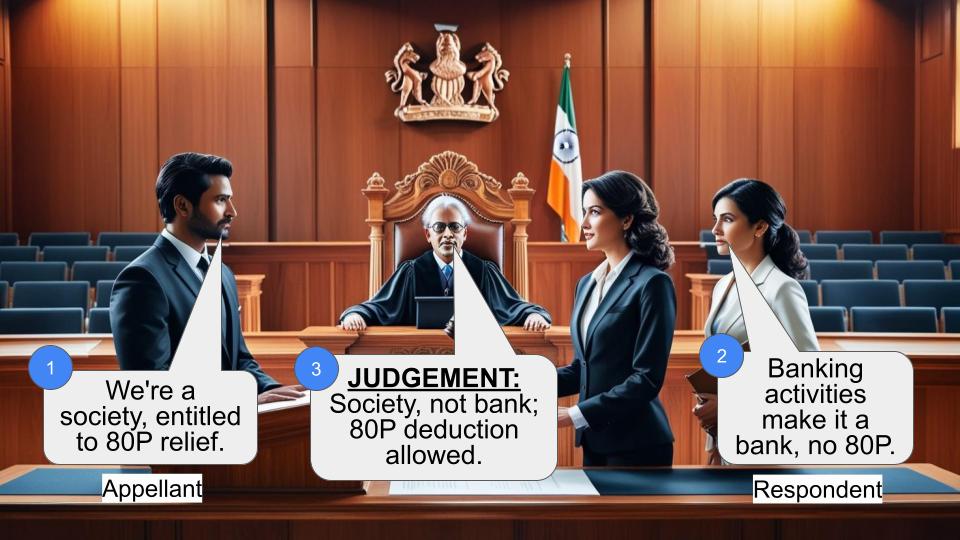
A case here about some Co-operative Societies who were trying to claim a tax deduction under Section 80P(2) (of Income Tax Act, 1961). The Income Tax Department initially denied their claim, but the Societies won their appeal at the Tribunal level. Now, they're in the High Court, not to challenge the decision (which was in their favor), but to argue about a circular that wasn't considered. Spoiler alert: the High Court dismissed their appeal.
Get the full picture - access the original judgement of the court order here
Case Name:
Kuthannur Service Co-operative Bank Limited and Ors. vs Income Tax Officer and Ors. (High Court of Kerala)
ITA.No.197 of 2019
Date: 8th January 2020
Key Takeaways:
1. The High Court affirmed that circulars issued by government departments don't override court decisions.
2. The court emphasized the importance of following the most recent legal precedents, even if they overturn previous judgments.
3. The case highlights the evolving interpretation of Section 80P (of Income Tax Act, 1961) regarding co-operative societies.
Issue:
The main question here is: Should the Income Tax Appellate Tribunal have considered a circular issued by the Central Board of Direct Taxes when deciding on the Co-operative Societies' claim for tax deduction under Section 80P(2) (of Income Tax Act, 1961)?
Facts:
1. We've got some Co-operative Societies registered under the Kerala Co-operative Societies Act, 1969.
2. These societies claimed a tax deduction under Section 80P(2) (of Income Tax Act, 1961).
3. The Assessing Officer initially denied this claim, treating them as Co-operative Banks instead of Primary Agricultural Credit Societies.
4. The societies appealed, and the Commissioner of Income Tax (Appeals) ruled in their favor, based on a previous High Court judgment (Chirakkal Service Co-operative Bank Limited v. Commissioner of Income Tax).
5. The Income Tax Department appealed to the Tribunal but lost.
6. Now, the societies themselves are in the High Court, not to challenge the decision (which was in their favor), but to argue that a circular (Circular No.133/6 of 2007 dated 09.05.2007) should have been considered.
Arguments:
The Co-operative Societies' main argument is that the Tribunal should have considered Circular No.133/6 of 2007. This circular apparently clarified that for Section 80P(4) (of Income Tax Act, 1961), a co-operative bank should be defined as per Part V of the Banking Regulation Act, 1949. They're saying this circular should determine whether they're conducting banking business or not.
The Income Tax Department, on the other hand, is sticking to the Tribunal's decision, which was based on the Chirakkal case.
Key Legal Precedents:
1. Chirakkal Service Co-operative Bank Limited v. Commissioner of Income Tax (2016 (2) KHC 726: 2016 (2) KLT 535):
This case initially supported the societies' claim for deduction.
2. Mavilayi Service Co-operative Bank Limited v. Commissioner of Income Tax (2019 (2) KHC 287: 2019 (2) KLT 597):
This Full Bench decision overruled Chirakkal, stating that the Assessing Officer needs to investigate the actual activities of the society, not just rely on its registration certificate.
3. Citizen Co-operative Society v. Assistant Commissioner of Income Tax (AIR 2017 SC 5147):
This Supreme Court case influenced the Mavilayi decision.
4. Commissioner of Central Excise v. M/s Gurukripa Resins Private Limited (2011) 13 SCC 180 and Commissioner of Central Excise v. M/s Ratan Melting Wire Industries (2008) 13 SCC 1:
These cases establish that circulars are binding on tax authorities but not on courts.
Judgement:
The High Court dismissed the societies' appeal.
1. They agreed that the Tribunal's decision, based on the now-overruled Chirakkal case, was incorrect in light of the Mavilayi decision.
2. However, since the Revenue Department didn't appeal against the Tribunal's decision, the court couldn't interfere with it.
3. The court emphasized that circulars issued by government departments don't override court decisions. So, the circular the societies were relying on couldn't trump the Mavilayi judgment.
4. The court also pointed out that circulars aren't binding on the Tribunal or the courts, only on tax authorities.
FAQs:
Q1: Why did the Co-operative Societies appeal if they won at the Tribunal?
A1: They wanted the court to consider a specific circular that they believed strengthened their case, even though they had already won.
Q2: What's the significance of the Mavilayi case?
A2: It changed how tax authorities should assess co-operative societies for tax deductions, requiring a deeper look into their activities rather than just their registration status.
Q3: Are government circulars not important in legal decisions?
A3: While they're important for guiding tax authorities, they don't override court decisions and aren't binding on courts or tribunals.
Q4: What's the main takeaway for co-operative societies from this case?
A4: Co-operative societies should be prepared for tax authorities to examine their actual activities, not just their registration status, when claiming tax deductions.
Q5: Could this decision affect other co-operative societies?
A5: Yes, it reinforces the principle that tax authorities need to look at the actual activities of co-operative societies when assessing their eligibility for tax deductions under Section 80P (of Income Tax Act, 1961).

The appellants/assessees are Co-operative Societies registered under the Kerala Co-operative Societies Act, 1969. The issue raised in these appeals relates to their claim for deduction under Section 80P(2) (of Income Tax Act, 1961) (hereinafter referred to as 'the Act').
2. The claim for deduction under Section 80P(2) (of Income Tax Act, 1961) made by the appellants was denied by the Assessing Officer by treating them as Co-operative Banks and not as Primary Agricultural Credit Societies. Aggrieved by the assessment orders thus passed by the Assessing Officer, the appellants filed appeals before the Commissioner of Income Tax (Appeals). The appellate authority, by following the judgment of this Court in Chirakkal Service Co-operative Bank Limited v. Commissioner of Income Tax : 2016 (2) KHC 726: 2016 (2) KLT 535, allowed the appeals and directed the Assessing Officer to grant deduction under Section 80P(2) (of Income Tax Act, 1961), on the ground that the assessees are classified as Primary Agricultural Credit Societies by the Registrar of Co-operative Societies.
3. The revenue challenged the orders passed by the first appellate authority in second appeals filed before the Income Tax Appellate Tribunal, Cochin Bench. The assessees filed cross objections supporting the orders passed by the first appellate authority, by making reference to a circular issued by the department. The Tribunal also relied upon the decision of this Court in Chirakkal Service Co-operative Bank Limited (supra) and dismissed the appeals filed by the revenue. The cross objections filed by the assessees were also dismissed on the ground that they only supported the view taken by the first appellate authority. Though the decision of the Tribunal was in their favour, the assessees have filed these appeals against the orders passed by the Tribunal, raising only the grievance that the Tribunal has not considered the effect of the circular issued by the department in the matter.
4. We have heard learned counsel for the appellants and also the learned Standing Counsel for the Income Tax Department.
5. Section 80P (of Income Tax Act, 1961) deals with deduction in respect of income of co-operative societies. Sub-section (1) of that section provides that where, in the case of an assessee being a co- operative society, the gross total income includes any income referred to in sub-section (2) of that section, there shall be deducted, in accordance with and subject to the provisions of Section 80P (of Income Tax Act, 1961), the sums specified in sub-section (2) thereof, in computing the total income of the assessee. Sub-section (4) of Section 80P (of Income Tax Act, 1961) provides that the provisions of Section 80P (of Income Tax Act, 1961) shall not apply in relation to any co-operative bank other than a primary agricultural credit society or a primary co-operative agricultural and rural development bank.
6. In Chirakkal Service Co-operative Bank (supra), a Division Bench of this Court held that, societies having been classified as Primary Agricultural Credit Societies by the competent authority under the Kerala Co-operative Societies Act, it has necessarily to be held that the principal object of such societies is to undertake agricultural credit activities and to provide loans and advances for agricultural purposes, the rate of interest on such loans and advances to be at the rate to be fixed by the Registrar of Co-operative Societies and having its area of operation confined to a village, panchayat or a municipality and as such, they are entitled for the benefit of sub-section (4) of Section 80P (of Income Tax Act, 1961) to ease themselves out from the coverage of Section 80P (of Income Tax Act, 1961) and that the authorities under the Act cannot probe into any issues or such matters relating to such societies and that the Primary Agricultural Credit Societies registered as such under the Kerala Co-operative Socities Act and classified so under that statute, are entitled to such exemption.
7. Chirakkal (supra) now stands overruled by the decision of a Full Bench of this Court in Mavilayi Service Co-operative Bank Limited v. Commissioner of Income Tax : 2019 (2) KHC 287: 2019 (2) KLT 597, in which it has been held as follows:
“In view of the law laid down by the Apex Court in Citizen Co-operative Society v. Assistant Commissioner of Income Tax: AIR 2017 SC 5147, it cannot be contended that, while considering the claim made by an assessee society for deduction under Section 80P (of Income Tax Act, 1961), after the introduction of sub-section (4) thereof, the Assessing Officer has to extend the benefits available, merely looking at the class of the society as per the certificate of registration issued under the Central or State Co-operative Societies Act and the Rules made thereunder. On such a claim for deduction under Section 80P of the ITAct, the Assessing Officer has to conduct an enquiry into the factual situation as to the activities of the assessee society and arrive at a conclusion whether benefits can be extended or not in the light of the provisions under sub-section(4) of Section 80P (of Income Tax Act, 1961)”. The Full Bench has further held as follows:
“Moreover, the law laid down by the Division Bench in Chirakkal is not good law, since, in view of the law laid down by the Apex Court in Citizen Co- operative Society, on a claim for deduction under Section 80P (of Income Tax Act, 1961), by reason of sub-section (4) thereof, the Assessing Officer has to conduct an enquiry into the factual situation as to the activities of the assessee society and arrive at a conclusion whether benefits can be extended or not in the light of the provisions under sub-section (4) of Section 80P (of Income Tax Act, 1961)”.
8. The orders passed by the Tribunal, confirming the decision of the first appellate authority merely on the basis of Chirakkal (supra), are erroneous, in the light of the law laid down by the Full Bench of this Court in Mavilayi Service Co- operative Bank (supra). However, the revenue has not filed any appeal or cross objection challenging the orders passed by the Tribunal and we cannot interfere with the decision of the Tribunal in these appeals filed at the instance of the assessees.
9. The grievance of the appellants is that, though the orders passed by the Tribunal are in their favour, the Tribunal has not considered the effect of Circular No.133/6 of 2007 dated 09.05.2007 issued by the Central Board of Direct Taxes. In this circular, it was clarified by the department that, for the purpose of Section 80P(4) (of Income Tax Act, 1961), a co-operative bank shall have the meaning assigned to it in Part V of the Banking Regulation Act, 1949. In other words, the contention of the appellants is that, in view of the aforesaid circular, in order to ascertain whether a co- operative society is conducting the business of banking, what shall be considered is whether it is a co-operative bank within the meaning of Part V of the Banking Regulation Act, 1949 and that the criteria shall not be as stated by the Full Bench of this Court in Mavilayi (supra).
10. The aforesaid contention is misconceived. Clarificatory circulars are issued by Government departments for the guidance of the officers. Such circulars or instructions do bind the department and its officers. But they do not bind the Court in interpretation of statutory provisions. Circulars issued by a Government department cannot have any primacy over the decision of the jurisdictional High Court. Circulars and instructions thus issued will not survive, if they are contrary to the decision of a Constitutional Court. If a circular provides an interpretation of law that runs contrary to the interpretation given by the jurisdictional High Court, it no longer survives. Circulars or instructions given by the department are no doubt binding on the authorities under the Act, but when the Supreme Court or the High Court has declared the law on the question arising for consideration, it will not be open to a party to contend that the circular should be given effect to and not the view expressed in the decision of the Supreme Court or the High Court. Any direction issued by the Government in a circular would be mere expression of its opinion. But, once a provision has been interpreted by the superior court, then it will not be open to the assessee to project an interpretation on the concerned provision in tune with the circular, but against the law laid down by the Court.
11. In Commissioner of Central Excise v. M/s Gurukripa Resins Private Limited : (2011) 13 SCC 180, the Supreme Court has held as follows:
“It is well settled proposition of law that Circulars and instructions issued by the Central Board of Excise and Customs are no doubt binding in law on the authorities under the respective Statutes but when this Court or the High Court declares the law on the question arising for consideration, it would not be appropriate for the Courts or the Tribunal, as the case may be, to direct that the Board's Circular should be given effect to and not the view expressed in a decision of this Court or a High Court”.
12. In Commissioner of Central Excise v. M/s Ratan Melting Wire Industries: (2008) 13 SCC 1, the Constitution Bench has held as follows:
“Circulars and instructions issued by the Board are no doubt binding in law on the authorities under the respective statutes, but when the Supreme Court or the High Court declares the law on the question arising for consideration, it would not be appropriate for the Court to direct that the circular should be given effect to and not the view expressed in a decision of this Court or the High Court. So far as the clarifications/circulars issued by the Central Government and of the State Government are concerned they represent merely their understanding of the statutory provisions. They are not binding upon the Court. It is for the Court to declare what the particular provision of statute says and it is not for the Executive. Looked at from another angle, a circular which is contrary to the statutory provisions has really no existence in law”.
13. It is true that, when the Tribunal passed the orders, the decision in Mavilayi (supra) was not in existence. But, the decision in Chirakkal (supra), was then in force. In view of the decision in Chirakkal (supra), it was not necessary for the Tribunal to consider the effect of the circular issued by the department. A circular issued by the department is not binding on the Income Tax Appellate Tribunal also. Authority for this proposition can be had from the decision of the Supreme Court in Commissioner of Income Tax v. Hero Cycles : AIR 1998 SC 1555, wherein it has been held as follows:
“We have passed similar orders in a large number of cases but in this case on behalf of the assessee it has been contended that there is a circular issued by Central Board of Direct Taxes, New Delhi which should conclude the matter. A copy of the so called circular dated 9th April, 1981/13th April, 1981 has been handed over in Court. It does not appear that the document handed over in Court is a copy of Circular at all. ...... Moreover, it is well settled that circulars can bind the Income Tax Officer but will not bind the appellate authority or the Tribunal or the Court or even the assessee”. (emphasis supplied).
14. The appellants have filed these appeals challenging the orders passed by the Tribunal in their favour. No substantial question of law arises for consideration in these appeals. The appeals are misconceived and they are liable to be dismissed. Consequently, the appeals are dismissed.
(sd/-)
C.K.ABDUL REHIM, JUDGE
(sd/-)
R.NARAYANA PISHARADI, JUDGE
×
Questions
Co-op Societies' Tax Deduction Claim: Court Upholds Tribunal's Decision, Clarifies Circular's Role
Write your CommentSimilar Posts


Generic
- Reportdata/6143.pdf
