Court Bars Appeal from Miscellaneous Application Dismissal, Upholds Statutory A…





Full News
Court Bars Appeal from Miscellaneous Application Dismissal, Upholds Statutory Appeal Rights
Court Bars Appeal from Miscellaneous Application Dismissal, Upholds Statutory Appeal Rights
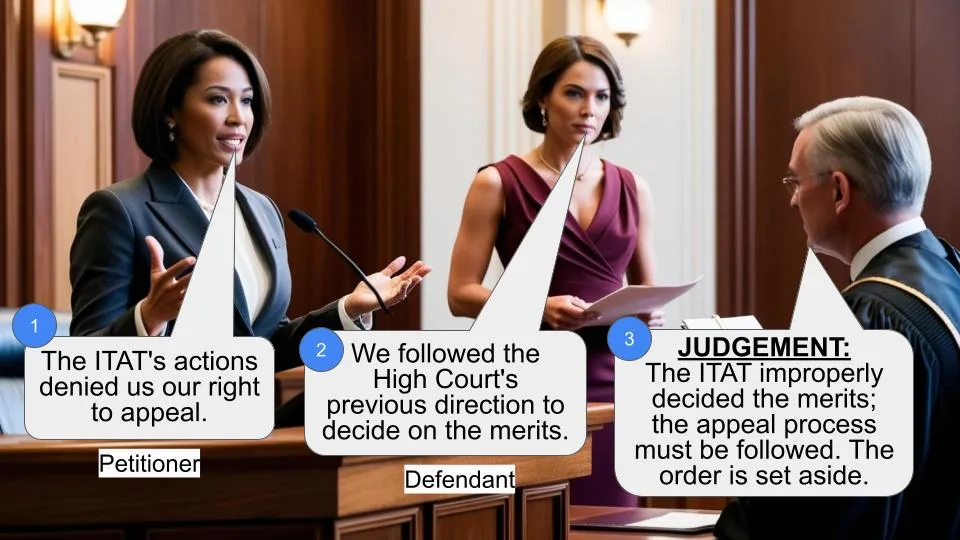
This case involves Safari Mercantile § Ltd. challenging an order by the Income Tax Appellate Tribunal (ITAT) that dismissed their Miscellaneous Application for rectification. The High Court set aside the ITAT’s order, emphasizing the importance of preserving statutory appeal rights and proper procedural handling of rectification applications.
Get the full picture - access the original judgement of the court order here
Case Name
Safari Mercantile § Ltd. vs Income Tax Appellate Tribunal & Anr. (High Court of Bombay)
Writ Petition No. 2102 of 2008
Date: 23rd June 2016
Key Takeaways
- No appeal can be filed against an order rejecting a Miscellaneous Application for rectification under Section 254(2) (of Income Tax Act, 1961).
- Tribunals should be cautious not to decide substantive issues on merits while disposing of rectification applications.
- The right to statutory appeal under Section 260A (of Income Tax Act, 1961) cannot be bypassed by dealing with merits in a Miscellaneous Application.
- Courts should ensure that in rectifying errors, they don’t cause further prejudice to the parties involved.
Issue
Can an appeal be entertained by the High Court from an order dismissing a Miscellaneous Application for rectification under Section 254(2) (of Income Tax Act, 1961), and how should such applications be handled to preserve statutory appeal rights?
Facts
- Safari Mercantile filed a tax return for the assessment year 2001-02, partially paying self-assessment tax.
- The Assessing Officer imposed a penalty under Section 221 (of Income Tax Act, 1961).
- The Commissioner of Income Tax (Appeals) set aside the penalty.
- The ITAT allowed the Revenue’s appeal, upholding the penalty.
- Safari Mercantile filed a Miscellaneous Application under Section 254(2) (of Income Tax Act, 1961) for rectification, which was initially dismissed.
- The High Court directed ITAT to reconsider the Miscellaneous Application.
- ITAT again dismissed the application, leading to the current petition.
Arguments
Petitioner (Safari Mercantile):
- ITAT shouldn’t have decided merits in a rectification application.
- The procedure adopted deprived them of their statutory right to appeal.
Revenue:
- ITAT acted as per the High Court’s earlier direction to dispose of the application on merits.
Key Legal Precedents
- Chem Amit v/s. Assistant Commissioner of Income Tax (272 ITR 397): Established that no appeal can be filed from an order rejecting a Miscellaneous Application for rectification under Section 254(2) (of Income Tax Act, 1961).
- Honda Siel Power Products Ltd. v/s. Commissioner of Income Tax (295 ITR 466): Emphasized the duty of tribunals to rectify mistakes and errors that cause prejudice.
Judgement
The High Court set aside the ITAT’s order dated 14th March, 2008. It directed the ITAT to:
- Recall its order dated 9th May, 2006 to the extent it upheld the penalty.
- Post the appeal for hearing on the specific issue of penalty imposition.
- Decide the petitioner’s appeal on this issue after hearing both parties.
- Not re-decide other issues concluded by the 9th May, 2006 order.
FAQs
Q: Why couldn’t Safari Mercantile appeal the ITAT’s decision on merits?
A: The court in Chem Amit v/s. Assistant Commissioner of Income Tax held that no appeal can be filed from an order rejecting a Miscellaneous Application for rectification under Section 254(2) (of Income Tax Act, 1961).
Q: What was the main procedural error made by the ITAT?
A: The ITAT decided on the merits of the case in a Miscellaneous Application for rectification, which should have been done in a regular appeal hearing.
Q: How did the High Court’s decision protect the petitioner’s rights?
A: By setting aside the ITAT’s order and directing a proper hearing on the specific issue, the court ensured that the petitioner’s statutory right to appeal under Section 260A (of Income Tax Act, 1961) was preserved.
Q: What lesson can be drawn for tribunals handling rectification applications?
A: Tribunals should be careful not to decide substantive issues on merits while disposing of rectification applications, as this can deprive parties of their statutory appeal rights.
Q: Does this judgment set any new legal precedent?
A: While it doesn’t set a new precedent, it reinforces the importance of proper procedural handling of rectification applications and the preservation of statutory appeal rights.

1. This Petition under Article 226 of the Constitution of India challenges the order dated 14th March, 2008 passed by the Income Tax Appellate Tribunal (the Tribunal). The impugned order rejected the petitioner's Miscellaneous application under Section 254(2) (of Income Tax Act, 1961) (the Act) seeking to rectify an order dated 9th May, 2006 passed under Section 254(1) (of Income Tax Act, 1961) by the Tribunal. The relevant Assessment Year is 200102.
2. This Petition was admitted on 18th September 2008.
3. Briefly the facts leadings to this Petition are as under:
(a) The petitioner filed its return of income on 31st October, 2001 declaring a total income of Rs.74.18 crores, paying self assessment tax of Rs.90 lakhs. This was in partial discharge of tax and interest liability aggregating of Rs.10.03 crores.
(b) On 13th December, 2001 the Assessing Officer passed an order under Section 140A (of Income Tax Act, 1961). The above order held that as the petitioner had failed to partially pay the self assessment tax along with interest it is deemed to be an assessee in default under Section 140A(3) (of Income Tax Act, 1961) to the extent the tax and interest are unpaid. Consequent to the above the Assessing Officer passed an order dated 7th May, 2002 imposing a penalty of Rs.91.13 lakhs under Section 221 (of Income Tax Act, 1961).
(c) Being aggrieved with the order dated 7th May, 2002 imposing penalty, the petitioner preferred an appeal before the Commissioner of Income Tax (Appeals) (CIT(A)). In appeal the CIT(A) by order dated 16th December, 2002 set aside the penalty. This, inter alia, on the ground that the Assessing Officer had not issued a proper demand notice under Section 156 (of Income Tax Act, 1961) before taking action to impose penalty under Section 221 (of Income Tax Act, 1961). Thus holding that the petitioner could not be deemed to be an assessee in default.
(d) Being aggrieved with the order dated 7th May, 2002 of the CIT(A), the Revenue filed an appeal to the Tribunal. By an order dated 9th May, 2006 the Tribunal allowed the Revenue's appeal. It held that the amount of tax which was not paid is undisputed and no reasonable cause for not paying the tax was made out. Thus, holding that the imposition of penalty by the Assessing Officer cannot be faulted.
(e) On 20th December, 2006, the petitioner filed a Miscellaneous Application under Section 254(2) (of Income Tax Act, 1961) before the Tribunal seeking to rectify its order dated 9th May, 2006. This on the ground that there was error apparent on record as the petitioner's contention regarding non-service of the demand notice under Section 156 (of Income Tax Act, 1961) before taking action under Section 221 (of Income Tax Act, 1961) though raised before the Tribunal has not been considered. However, by an order dated 7th March, 2007 the Tribunal dismissed the petitioner's Miscellaneous Application, inter alia, holding that there was no error apparent from the record. This for the reason that no submission with regard to nonservice of a demand notice before imposing a penalty under Section 221 (of Income Tax Act, 1961) upon the petitioner was made during the hearing of the appeal leading to order dated 9th May, 2006.
(f) The petitioner challenged the order dated 7th March, 2007 of the Tribunal by filing Writ Petition No.1517 of 2007 in this Court. On consideration of the submissions, this Court by an order dated 31st July,2007 allowed the Petition, inter alia, holding as under:
Therefore, the finding recorded by the Tribunal that the plea regarding nonservice of the demand notice was not raised before the Tribunal cannot be sustained.
12. Accordingly, the Writ Petition is allowed. The impugned order dated 7th March, 2007 passed by the Tribunal is set aside and the Tribunal is directed to dispose of the Miscellaneous Application on merits.”
(g) Consequent to the above order dated 31st July, 2007 of this Court, the Tribunal heard the petitioner's Miscellaneous Application and dismissed it by impugned order dated 14th March, 2008. This dismissal of the Miscellaneous Application was on consideration of the statutory provisions in the context of judgements.
4. The grievance of the petitioner as articulated by its counsel is that the Miscellaneous Application under Section 254(2) (of Income Tax Act, 1961) was for hearing before the Tribunal consequent to the order dated 31st July, 2007 of this Court. At this stage the Tribunal could not have decided the merits of the dispute namely the effect of nonservice of a demand notice on penalty proceedings and dismissed the Miscellaneous Application. The scope of an application under Section 254(2) (of Income Tax Act, 1961) was only whether or not there was an error apparent on record. In view of the order of this Court dated 31st July, 2007 (Writ Petition No.1517 of 2007) so far as the Tribunal is concerned, it was an concluded issue that the plea regarding nonservice of the demand notice had been raised by the petitioner before the Tribunal during the hearing of its appeal under Section 252(1) (of Income Tax Act, 1961). At the hearing of the Miscellaneous Application the Tribunal should have recalled the order of dismissal dated 9th May, 2006 and listed the appeal of the petitioner before it for hearing under Section 254(1) (of Income Tax Act, 1961) on the issue it had failed to to consider. Not following the above procedure has left the petitioner remedyless. This is so as even though the petitioner is aggrieved by the order of the Tribunal holding on merits (while disposing of rectification application) that nonservice of a demand notice would have no impact on penalty proceedings it cannot prefer an appeal under Section 260A (of Income Tax Act, 1961). This for the reason that this Court in Chem Amit v/s. Assistant Commissioner of Income Tax 272 ITR 397 has held that no appeal can be filed from an order rejecting a Miscellaneous Application for rectification under Section 252(2) (of Income Tax Act, 1961).
5. As against the above, Mr. Mohanty, the learned counsel for the Revenue submits that no interference with the order dated 14th March, 2008 of the Tribunal is called for. This for the reasons that this Court had directed the Tribunal to dispose of the Miscellaneous Application on merits. Thus in the context of the order of this Court dated 31st July, 2007 the Tribunal decided the issue on merits viz. the effect of nonservice of a demand notice under Section 156 (of Income Tax Act, 1961) for the purposes of penalty proceedings under the 221 of the Act.
6. The Apex Court in Honda Siel Power Products Ltd. v/s. Commissioner of Income Tax 295 ITR 466 has observed as under: “When prejudice results from an order attributable to the Tribunal's mistake, error or omission, then it is the duty of the Tribunal to set it right. Atonement to the wronged party by the Court or the Tribunal for the wrong committed by it has nothing to do with the concept of inherent power to review. In the present case, the Tribunal was justified in exercising its powers under Section 254(2) (of Income Tax Act, 1961) when it was pointed out to the Tribunal that the judgment of the coordinate Bench was placed before the Tribunal when the original order came to be passed but it had committed a mistake in not considering the material which was already on record. The Tribunal has acknowledged its mistake, it has accordingly rectified its order. In our view, the High Court was not justified in interfering with the said order.”
7. We note that this Court in its order dated 31st July, 2007 has while setting aside the order dated 7th March, 2007 of the Tribunal dismissing the petitioner's Miscellaneous Application had held that there was an error apparent from the record in the order dated 9th May, 2006. The direction of the Court in its order dated 31st July, 2007 to the Tribunal to dispose of the Miscellaneous Application on merits as there is an error apparent on record in the order dated 9th May, 2006. This disposing of Miscellaneous Application could only be after recalling the conclusion in its order dated 9th May, 2006 allowing the Revenue's appeal and hearing the petitioner on the issue of penalty being imposable even in the absence of a demand notice being served upon the assessee. This was for the reason that its conclusion was reached without having considered the petitioner's contention that no penalty can be imposed in the absence of receipt of a demand notice by the petitioner. However, the Tribunal in the impugned order has dealt with the issue of imposition of penalty being imposed under Section 221 (of Income Tax Act, 1961) even without service of demand notice under Section 156 (of Income Tax Act, 1961) upon an assessee. This the Tribunal could have only done while passing an order in appeal. The consequent order which would has been passed in appeal would enable the parties to challenge the same before this Court in an appeal under Section 260A (of Income Tax Act, 1961). The procedure adopted by the Revenue in this case has deprived the right of statutory appeal to the petitioner. No appeal is entertained by this Court from an order dismissing the Miscellaneous Application for rectification under Section 254(2) (of Income Tax Act, 1961) (see Chem Amit (supra)). Thus in the process of atoning for a mistake, one should take utmost care to ensure no further prejudice is caused. The rejection on merits of the contentions of the parties by the Tribunal on a substantial question of law is subject to the statutory right of appeal under Section 260A (of Income Tax Act, 1961). This right cannot be bypassed by dealing with the merits in an Miscellaneous Application for rectification.
8. In the above view, we set aside the impugned order dated 14th March, 2008 of the Tribunal. We direct the Tribunal to recall its order dated 9th May, 2006 to the extent it upheld the order of the Assessing Officer imposing penalty under Section 221 (of Income Tax Act, 1961) and post the appeal for hearing at a date convenient to it. Needless to state petitioner's appeal in respect of only the above issue would be decided after hearing the parties. The other issues would not be redecided as they stand concluded by the order dated 9th May, 2006.
9. Rule made absolute in above terms. No order as to costs.
(A. K. MENON, J.) (M. S. SANKLECHA, J.)
×