


Court Compels Tax Officer to Process Refund Claim, Criticizes Delay





Full News
Court Compels Tax Officer to Process Refund Claim, Criticizes Delay
Court Compels Tax Officer to Process Refund Claim, Criticizes Delay
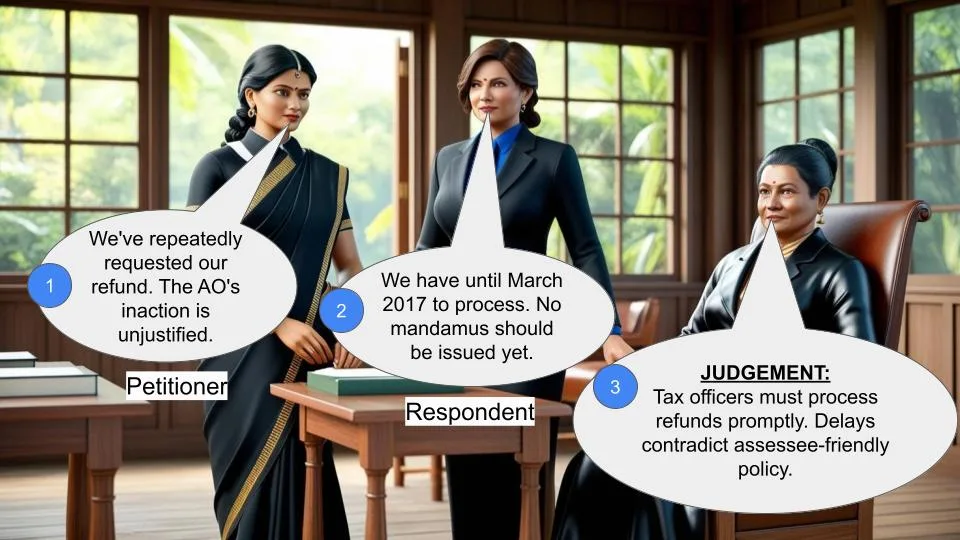
The High Court directed an Assessing Officer to process a company's tax refund claim within 8 weeks, criticizing the officer's delay and attitude. The court emphasized that tax authorities should be assessee-friendly and not create unnecessary obstacles for taxpayers seeking refunds.
For a comprehensive understanding, check out the original judgement of the court order here."
Case Name:
Group M. Media India Pvt. Ltd. Vs Union of India & Ors. (High Court of Bombay)
Writ Petition No. 2067 of 2016
Key Takeaways
1. The court's powers under Article 226 of the Constitution are broad and can be used to issue any direction for justice.
2. Tax officers should process refund claims expeditiously, as per CBDT instructions.
3. Officers cannot rely on instructions that have been quashed by a competent court.
4. The court criticized the tax officer's attitude, suggesting it went against the department's assessee-friendly approach.
Issue
Whether the court can direct the Assessing Officer to process the petitioner's tax return and consider the refund claim under Sections 143(1) (of Income Tax Act, 1961) and 143(1D) of the Income Tax Act, despite the officer's inaction?
Facts
1. The petitioner filed its tax return for AY 2015-16 on November 29, 2015, declaring an income of Rs. 144.48 crores and claiming a refund of Rs. 27.24 crores.
2. The Assessing Officer issued a notice under Section 143(2) (of Income Tax Act, 1961) on April 12, 2016.
3. The petitioner made multiple requests and representations for processing the return and granting the refund between April and August 2016.
4. The Assessing Officer did not respond to these requests, leading to the filing of this petition.
Arguments
Petitioner:
1. The CBDT Instruction No. 1 of 2015, which the officer relied on to not process the return, had been quashed by the Delhi High Court.
2. The Assessing Officer is obliged to ignore the quashed instruction and decide on processing the refund.
Revenue:
1. Initially relied on CBDT Instruction No. 1 of 2015 to justify not processing the return.
2. Later argued that the Assessing Officer had time until March 31, 2017, to process the return, so no mandamus should be issued before that date.
Key Legal Precedents
1. Tata Teleservices Ltd. Vs. Central Board of Direct Taxes & Anr. W.P. (C) No.12304/2015: Delhi High Court quashed CBDT Instruction No. 1 of 2015.
2. Commissioner of Income Tax Vs. Smt. Godavaridevi Saraf, 113 ITR 589: Held that when a provision is declared ultra vires by a competent court, it's binding on all authorities administering the Act across the country.
Judgement
1. The court directed the Assessing Officer to consider and process the petitioner's representation dated August 12, 2016, within 8 weeks.
2. The court criticized the Assessing Officer's attitude, stating it went against the tax administration's assessee-friendly approach.
3. The court emphasized its broad powers under Article 226 of the
Constitution to issue any direction for justice.
FAQs
Q1: Why did the court criticize the Assessing Officer's conduct?
A1: The court found the officer's delay in processing the refund and lack of communication unreasonable and against the department's assessee-friendly approach.
Q2: What is the significance of the Delhi High Court's decision in the Tata Teleservices case?
A2: It quashed CBDT Instruction No. 1 of 2015, which means tax officers can no longer rely on it to delay processing returns and refunds.
Q3: What does this judgment mean for taxpayers awaiting refunds?
A3: It reinforces that tax authorities should process refund claims expeditiously and cannot unnecessarily delay the process, even if a scrutiny notice has been issued.
Q4: How broad are the court's powers under Article 226 of the Constitution?
A4: The court clarified that its powers are very wide and not limited to prerogative writs, allowing it to issue any direction or order for doing justice.
Q5: What is the timeframe given by the court for processing the petitioner's refund claim?
A5: The court directed the Assessing Officer to process the claim within 8 weeks from the date of the judgment.

1. By consent of the parties, petition is taken up for final disposal at the stage of admission.
2. This petition under Article 226 of the Constitution of India challenges the inaction / failure on the part of the Assessing Officer in processing the return of income under Section 143(1) (of Income Tax Act, 1961) (the Act) and granting refund consequent thereto in accordance with Section 143(1D) (of Income Tax Act, 1961). This petition relates to Assessment Year 2015-16.
3. Briefly, the facts leading to this petition are as under :
(a) On 29th November, 2015, the petitioner filed its return of income for the Assessment Year 201516 under Section 139 (of Income Tax Act, 1961). In its return, the petitioner declared an income of Rs.144.48 crores and claimed a refund of Rs.27.24 crores.
(b) On 12th April, 2016, the Assessing Officer issued a notice under Section 143(2) (of Income Tax Act, 1961) to the petitioner relating to the subject assessment year.
(c) On 27th April, 2016, the petitioner requested the Assessing Officer to process its return of income for the subject Assessment Year in terms of Section 143(1) (of Income Tax Act, 1961) and grant the consequent refund due. The petitioner had annexed Form 30 claiming a refund of Rs.27.24 crores to the above communication.
(d) In the absence of any positive response, the petitioner filed further representations dated 1st June, 2016 inter alia requesting the Assessing Officer to process the return of income under Section 143(1) (of Income Tax Act, 1961) and grant a consequent refund. This also failed to elicit any response from the Assessing Officer.
(e) Thereafter, the petitioner met the Assessing Officer on 6th June, 2016 for expediting the process of the refund claim. At that time, the petitioner was informed of Central Board of Direct Taxes (CBDT) Instruction No.1 of 2015, which seemed to fetter the exercise of his discretion under Section 143(1D) (of Income Tax Act, 1961). The petitioner by its letter dated 6th and 24th June, 2016 inter alia pointed out to the Assessing Officer that the Delhi High Court, in an order dated 11th May, 2016, had quashed Instruction No.1 of 2015 in the case of Tata Teleservices Ltd.Vs. Central Board of Direct Taxes & Anr. W.P. (C) No.12304/2015 and CM 32604/2015.
(f) Thereafter, on 12th August, 2016, the petitioner made a further representation to the Assessing Officer as well as to the Principal Commissioner of Income Tax, City12, inter alia seeking the processing of its return in terms of Section 143(1) (of Income Tax Act, 1961) and consequent refund in respect of its return filed for A.Y. 201516.
4. The Assessing Officer yet did not respond to the petitioner's demand for refunds. Thus, the present petition seeking a mandamus to the Assessing Officer to process the return of income under Section 143(1) (of Income Tax Act, 1961) and consequent refund, if due, is filed.
5. The respondent Revenue has responded to the petition by filing an affidavitinreply dated 7th September, 2016 of Mr. Rishi Kumar, Assistant Commissioner of Income Tax. In the affidavitinreply, it is pointed out that the reason for not processing the petitioner's return of income under Section 143(1) (of Income Tax Act, 1961) and considering the refund due consequent thereto under Section 143(1D) (of Income Tax Act, 1961) was CBDT Instruction No.1 of 2015 dated 13th January, 2015. In this case, notice under Section 143(2) (of Income Tax Act, 1961) has been issued on 12th April, 2016. Therefore, in terms of the above Instruction, the return of income cannot be processed. In support, reliance is placed by the Revenue on the following paragraphs in Instruction No.1 of 2015 dated 13th January, 2015:
“4. Considering the unambiguous language of the relevant provision and the intention of law as discussed above, the Central Board of Direct Taxes, in exercise of the powers conferred on it under Section 119 (of Income Tax Act, 1961) hereby clarifies that the processing of a return cannot be undertaken after notice has been issued under subsection (2) of section 143 (of Income Tax Act, 1961). It shall, however, be desirable that scrutiny assessments in such cases are completed expeditiously.
5. This may be brought to the notice of all concerned for strict compliances.”
6. Mr. Easwar, learned Senior Counsel appearing for the petitioner points out that Instruction No.1 of 2015 dated 13th January, 2015 issued by the CBDT has been quashed by the Hon'ble Delhi High Court in Tata Teleservices Ltd. (supra). Therefore, the Assessing Officer cannot now place reliance upon it to disregard the statutory duty cast upon him in terms of Section 143(1) (of Income Tax Act, 1961) and 143(1D) of the Act. Further attention was drawn to the decisions of this Court in Commissioner of Income Tax Vs. Smt. Godavaridevi Saraf, 113 ITR 589 and Commissioner of Income Tax Vs. Valson Dyeing Bleaching and Printing Works, 259 ELT 33 wherein it is held that where a provision of law was declared ultra virus by the competent Court then the same will be binding on all Authorities administering the Act all over the Country. This so long as there is no contrary decision on that point. The Assessing Officer is, therefore, obliged to ignore Instruction No.1 of 2015 dated 13th January, 2015 and decide the petitioner's application to process the refund under Section 143(1) (of Income Tax Act, 1961) and consider the applicability of subsection 1(D) (of Income Tax Act, 1961) of Section 143 (of Income Tax Act, 1961) to the facts of the present case for the purpose of grant of refund.
7. Mr. Mohanty, learned Counsel appearing for the respondent Revenue does not dispute that the decision of the Delhi High Court is the only decision on the issue of validity of instruction no.1 of 2015 dated 13th January, 2015 and based on this decision, the Assessing Officer would be required to act independent of the above instruction. However, he contends that the Assessing Officer has time to process the petitioner's return of income in terms of Section 143(1) (of Income Tax Act, 1961) till 31st March, 2017. Thus, it is submitted that no mandamus can be issued before 31st March, 2017 directing the Assessing Officer to process the return of income under Section 143(1) (of Income Tax Act, 1961).
8. Before us, Mr. Mohanty does not dispute the fact that in view of the Delhi High Court decision in Tata Teleservices Ltd. (supra), Instruction No.1 of 2015 dated 13th January, 2015 of the CBDT would not fetter the Assessing Officer in any manner from exercising his discretion to process the return of income under Section 143(1) (of Income Tax Act, 1961) and considering the grant of refund under Section 143(1D) (of Income Tax Act, 1961). The petitioner before the Delhi High Court was not granted refund, pending scrutiny assessment in view of Instruction No.1/2015 dated 13th January, 2015. The Delhi High Court held that the instruction issued is without jurisdiction. This for the reason that although Section 119 (of Income Tax Act, 1961) does empower the CBDT to issue instructions for the proper administration of the Act, this power is hedged in by limitations as provided in the proviso to Sections 119(1) and also 119(2) of the Act, i.e. the CBDT cannot direct an Assessing Officer to dispose of a case in a particular manner nor can the instructions be prejudicial to the assessee. Therefore, the circulars / orders / instructions issued by the CBDT under Section 119 (of Income Tax Act, 1961) would be binding upon the Revenue only to the extent they are beneficial to the assessee. Such Instructions, if not beneficial to the assessee, cannot prevail over the Act. In the above view, the Delhi High Court held that Instruction No.1 of 2015 dated 13th January, 2015 issued by the CBDT is unsustainable in law and, therefore, set it aside. It must also be pointed out that the Revenue is not disputing the decision of the Delhi High Court in Tata Teleservices Ltd. (supra) either on facts or in law. Therefore, in view of the decision of this Court in Godavaridevi Saraf (supra), the officers implementing the Act are bound by the decision of the Delhi High Court and Instruction No.1 of 2015 dated 13th January, 2015 has ceased to exist. Therefore, no reference to the above Instruction can be made by the Assessing Officer while disposing of the petitioner's application in processing its return under Section 143(1) (of Income Tax Act, 1961) and consequent refund, if any, under Section 143(1D) (of Income Tax Act, 1961). Needless to state that the Assessing Officer would independently apply his mind and take a decision in terms of Section 143(1D) (of Income Tax Act, 1961) whether or not to grant a refund in the facts and circumstances of the petitioner's case for A.Y. 201516.
9. The only contention on behalf of the Revenue to oppose the petition is that as the Assessing Officer has time available to process the refund till 31st March, 2017, no mandamus can be issued till 31st March, 2015. We repeatedly asked of Mr. Mohanty, the learned Counsel for the Revenue, if there was any reason why the return could not be processed before 31st March, 2017. No reasons are forthcoming from the Revenue as to why the Assessing Officer will not able to dispose of the application for refund or process the return under Section 143(1) (of Income Tax Act, 1961) before 31st March, 2017. This conduct / stand of the Assessing Officer, to say the least, is most disturbing in the context of the fact that the petitioners have been seeking refund since April, 2016. First, he does not deem it proper to inform the petitioner in writing why he cannot deal with the application and after the petitioner moves the Court, the stand taken is that no direction can be given to him till 31st March, 2017 which is the last date to process the return under Section 143(1) (of Income Tax Act, 1961). This attitude on the part of the Assessing Officer is preposterous.
10. The action of the officer on the ground urged seems to be in complete variance with the higher echelons of administration of the tax administration being an assessee friendly regime. In fact, the CBDT has itself issued Instruction No.7/2012, dated 1st August, 2002 wherein they have specifically directed the officers of the Revenue to process all returns in which refunds are payable expeditiously. Similarly, as late as in 2014 in the Citizen's Charter issued by the Income Tax Department in its vision statement states that the Department aspires to issue refunds along with interest under Section 143(1) (of Income Tax Act, 1961) within 6 months from date of electronically filing the returns. In this case, the return was filed on 29th November, 2015, yet there is no reason why the Assessing Officer has not processed the refund and taken a decision to grant or not grant a refund under Section 143(1D) (of Income Tax Act, 1961). This attitude on the part of the Assessing Officer leaves us with a feeling (not based on any evidence) that the Officers of the Revenue seem to believe that it is not enough for the assessee to please the deity (Income Tax Act) but the assessee must also please the priest (Income Tax Officer) before getting what is due to him under the Act. The officers of the State must ensure that their conduct does not give rise to the above feeling even remotely.
11. Lastly, we must for the benefit of the Revenue reiterate that our powers under Article 226 of the Constitution are very wide for the purpose of doing justice. The powers of a Court under Article 226 of the Constitution of India are not limited only to prerogative writs but also to issue any direction or order for doing justice. Therefore, Article 226(1) of the Constitution empowers the Court to issue directions, orders or writs, including writs in the nature of habeas corpus, mandamus, certiorari or any of them. Therefore, in view of the conduct of the Assessing Officer, we are compelled to direct the Assessing Officer to consider and process the petitioner's representation dated 12th August, 2016 and dispose of the same as expeditiously as possible within a period of 8 weeks from today.
12. The Petition is allowed in above terms. No order as to costs.
(S.C. GUPTE, J.) (M.S. SANKLECHA, J.)
×
Similar Ripples
Questions
Court Compels Tax Officer to Process Refund Claim, Criticizes Delay
Write your CommentSimilar Posts

Generic
- Reportdata/11475-bombay-hc.pdf
