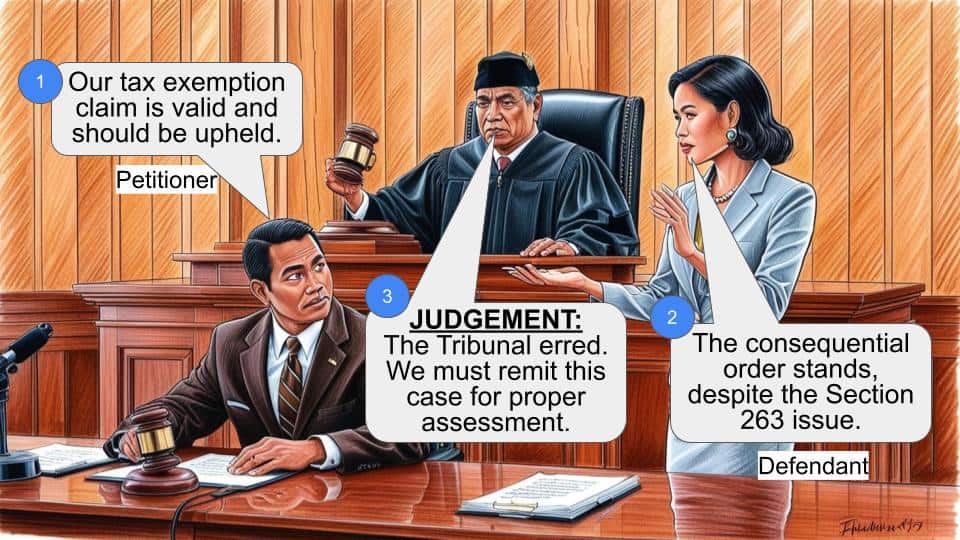
Court Denies Direct Challenge to Tax Order, Cites Alternative Appeal Route


Full News

Court Denies Direct Challenge to Tax Order, Cites Alternative Appeal Route
Court Denies Direct Challenge to Tax Order, Cites Alternative Appeal Route
In this case, ADC India Communications Ltd. challenged an assessment order by the Assistant Commissioner of Income Tax, which demanded a significant tax payment. The High Court refused to entertain the writ petition directly, emphasizing the availability of an alternative remedy through an appeal to the Commissioner of Income Tax (Appeals). The court highlighted the importance of following the prescribed appellate process before seeking intervention under Article 226 of the Constitution of India.
Get the full picture - access the original judgement of the court order here
Case Name:
ADC India Communications Ltd. vs. Assistant Commissioner of Income Tax (High Court of Karnataka)
Writ Petition No. 18581 of 2016 (T-IT)
Date: 15th November 2016
Key Takeaways
- The court emphasized the importance of exhausting alternative remedies before approaching the High Court under Article 226.
- The case underscores the burden on the assessee to prove the correct valuation of assets for depreciation claims.
- The decision reinforces the role of appellate authorities in resolving factual disputes in tax matters.
Issue
Can the impugned assessment order be directly challenged in the High Court under Article 226, despite the availability of an alternative appellate remedy?
Facts
ADC India Communications Ltd. was assessed a tax demand of Rs. 1,95,56,185/- for the assessment year 1994-95. The dispute centered around the valuation of two Biogas plants and a Flameless Furnace, which the company claimed were purchased for Rs. 50 lakhs and Rs. 44,20,800/- respectively. The company sought 100% depreciation on these assets. However, a Chartered Engineer's certificate valued them at only Rs. 2.53 lakhs, leading to a reduced depreciation claim by the tax authorities.
Arguments
- Petitioner (ADC India Communications Ltd.): Argued that the assessment order was flawed due to the loss of evidence over 20 years and sought relief from the High Court, bypassing the appellate process.
- Respondent (Assistant Commissioner of Income Tax): Maintained that the valuation was based on credible evidence and that the petitioner should follow the appellate process.
Key Legal Precedents
The court did not cite specific case laws but emphasized the procedural requirement under the Income Tax Act, 1961, for the assessee to appeal to the Commissioner of Income Tax (Appeals) before seeking judicial review.
Judgement
The High Court dismissed the writ petition, directing the petitioner to file an appeal with the Commissioner of Income Tax (Appeals) within one month. The court assured that no objections regarding the limitation period would be raised if the appeal was filed within this timeframe. The court also instructed the assessing authority not to take coercive steps to recover the disputed amount for four weeks.
FAQs
Q1: Why did the court refuse to hear the case directly?
A1: The court emphasized the need to exhaust alternative remedies, such as an appeal to the Commissioner of Income Tax (Appeals), before seeking intervention under Article 226.
Q2: What was the main issue in the case?
A2: The main issue was whether the valuation of the Biogas plants and Flameless Furnace was accurate and whether the company could claim 100% depreciation.
Q3: What does this decision mean for ADC India Communications Ltd.?
A3: The company must now pursue an appeal with the Commissioner of Income Tax (Appeals) to contest the assessment order.
Q4: What is the significance of this case for other taxpayers?
A4: It highlights the importance of following the prescribed appellate process in tax disputes and the burden on taxpayers to substantiate their claims with evidence.

1. This writ petition has been filed by the petitioner-assessee aggrieved by the impugned assessment order passed by the respondent-Assessing Authority, Assistant Commissioner of Income Tax, for the Assessment year 1994-95 raising a demand of Rs.1,95,56,185/-.
2. The learned senior counsel Mr. N. Venkataramana appearing for the petitioner urged before the Court that the said demand upon a rectification order, stands reduced, however, the rectification order passed by the same authority was not placed on record.
3. The issue raised in this second round of litigation is that the earlier remand to the Assessing Authority has been upheld by this Court while deciding the appeal of the Revenue vide ITA No.1294/2006 in the case of Commissioner of Income Tax & another vs. M/s.Krone Communications Ltd., (now taken over by the petitioner M/s.ADC India Communications Ltd.,) and the Division Bench of this Court while upholding the order of the ITAT remanding the matter back to the Assessing Authority has observed as under:-
“5. Heard, Learned counsel for both sides. It is clarified that the remand is an open remand. The Assessing Authority is free to assess sale value of the product with reference to the materials pertaining to the supplier and other relevant material if any. Accordingly, the appeal is disposed of”.
4. The matter in issue is, as to whether the plants and equipments, namely two Biogas Plants and one Flameless Furnace shown to have been purchased by the petitioner-assessee during the relevant Assessment Year at the stated the price of Rs.50 lakhs for two biogas plants and Rs.44,20,800/- for one flameless furnace, was a genuine price or not, because the petitioner-assessee as per the relevant Rules under the Income Tax Act, 1961, (for short ‘the Act’), was entitled to claim 100% depreciation of the purchase value of the said plants, which after they were purchased by the assessee-company, were given on lease to other two companies. The assessee has contended before the Assessing Authority that even the lessor was entitled to claim depreciation in its hands and on the lease rent earned by the assessee during the previous year, the tax has been paid by the assessee-company.
5. However, to check the exaggerated claim of depreciation on the so called inflated price of these plants, the Assessing Authority relied upon the certificate of a Chartered Engineer, M/s.Techno Economic Consultants, which opined in the said Certificate that the price of the said two Biogas plants and one Flameless Furnace in his estimation, was only to the extent of Rs.2.53 lakhs in the year 1996 as stated in paragraph-13(c) of the impugned Assessment order.
6. Though, the learned senior counsel for the petitioner pointed out that the said valuation certificate dealt with only one biogas plant and not with the cost of Flameless Furnace, after the remand of case by the learned ITAT as well as this Court, the respondent- Assessing Authority has now again passed the impugned assessment order relying upon the same valuation of these plants and equipments viz., Biogas plants and Flameless Furnace to the extent of Rs.2.53 lakhs and reducing the claim of depreciation accordingly, has computed the net tax payable by the assessee company along with the interest and penalty in the impugned order. Therefore, the petitioner-assessee has approached this Court by way of this writ petition, aggrieved by the said order.
7. The learned senior counsel appearing for the petitioner-assessee urged before the Court that after the lapse of more than 20 years, in this second round of litigation, the evidence of the erstwhile or contemporary period is almost lost and therefore, both the sides, the petitioner-assessee as well as the Revenue were rendered clueless about the proper purchase value and assessment of price of these equipments and therefore, the impugned order is not sustainable and the writ petition deserves to be entertained by this Court, notwithstanding the availability of remedy by way of appeal, again before the next higher appellate authority namely, the Commissioner of Income Tax (Appeals) as per Section 254 (of Income Tax Act, 1961). He also urged that the due tax as earlier assessed has been paid on the lease rentals earned by the petitioner-assessee and the same has been paid.
8. Having heard the learned senior counsel appearing for the petitioner-assessee, this Court is of the opinion that the impugned assessment order directly cannot be assailed before this Court in the extraordinary jurisdiction of this Court under Article 226 of the Constitution of India, in view of an effective alternative remedy by way of appeal available to the petitioner, notwithstanding the fact that the said order has been passed after remand twice over by the higher appellate forums, upheld even by this Court while disposing of the appeal filed by the Revenue as aforesaid.
9. The burden of proving the correct cost, market value/price of the plant and machineries purchased by the assessee, on which the claim of 100% depreciation was allowable under the relevant Rules was certainly on the assessee. The contra evidence adduced was by the Revenue in the present case in the form of the Certificate issued by M/s.Techno Economic Consultants, who valued these plants at only Rs.2.53 lakhs in the year 1996. The burden of rebuttal of that evidence adduced by the Revenue also was on the assessee. Irrespective of the rounds of litigation, the assessee perhaps cannot claim any immunity from this burden to be discharged by it for establishing the fair and correct market value or the cost of the plant and machineries in question. If the invoices produced by it in support of the said purchase of the equipments were not relied upon by the Assessing Authority finding them to be prima-facie highly inflated on the face of the valuation Ccertificate given by one of the Chartered Engineer, namely, M/s. Techno Economic Consultants, were to be treated by the gospel truth and the petitioner was to be allowed 100% depreciation on that basis, that would obviously cut into the income taxable at the hands of the petitioner-assessee to a largely inflated extent, which cannot be permitted. The right of the assessing authority to question the inflated claim of depreciation cannot be doubted.
10. This Court cannot readily accept the contention of the assessee that a Biogas plant, which as per one of the Chartered Engineers was having a Replacement cost only at Rs.2.53 lakhs, was purchased by the assessee-company at Rs.50 lakhs and claim of 100% depreciation could be made thereon. Therefore, this burden of the assessee does not seem to have been appropriately discharged by the assessee in the present case.
11.The very purpose of remand to the Assessing Authority and the exercise to be undertaken by the fact finding bodies, including appellate forums at the level of Commissioner of Income Tax (Appeals) and ITAT, the authorities prescribed under the provisions of the I.T.Act, 1961, would be frustrated, if this Court were to undertake this exercise in writ jurisdiction of this Court.
Therefore, without expressing any opinion on the valuation of the plant and machineries purchased by the assessee-company and its right to claim depreciation thereon, the petitioner-company is relegated back before the first appellate authority namely, the Commissioner of Income Tax (Appeals). It goes without saying that if the assessee-company leads appropriate evidence to support its claim even before the first appellate authority, who undoubtedly has the co-extensive powers as are available to the Assessing Authority under the Act, the said first appellate authority is expected not to shirk its responsibility, but decide the appeal on merits weighing such evidence and he is expected to record his own appropriate findings of fact, because multiple rounds of litigation and remands have already taken place in this case.
12. With these observations, the writ petition is disposed of and it is directed that, if the appeal against the impugned order dated 29.02.2016 is filed by the petitioner within a period of one month from today, the first appellate authority namely, CIT (Appeals) will not raise any objection as to the limitation for filing the said appeal against the petitioner-assessee and will decide the appeal on merits. No costs.
For a period of four weeks from today, till the assessee files the appeal before the Commissioner of Income Tax (Appeals), it is expected that the assessing authority will not take any coercive steps to recover the disputed demand under the impugned order. However, after the period of four weeks from today, the recovery of tax, interest and penalty under the impugned order will abide by the further orders to be passed by the Appellate Authority, if any.
Sd/-
JUDGE
×