


Court Dismisses Tax Appeal Due to Lack of Territorial Jurisdiction





Full News
Court Dismisses Tax Appeal Due to Lack of Territorial Jurisdiction
Court Dismisses Tax Appeal Due to Lack of Territorial Jurisdiction
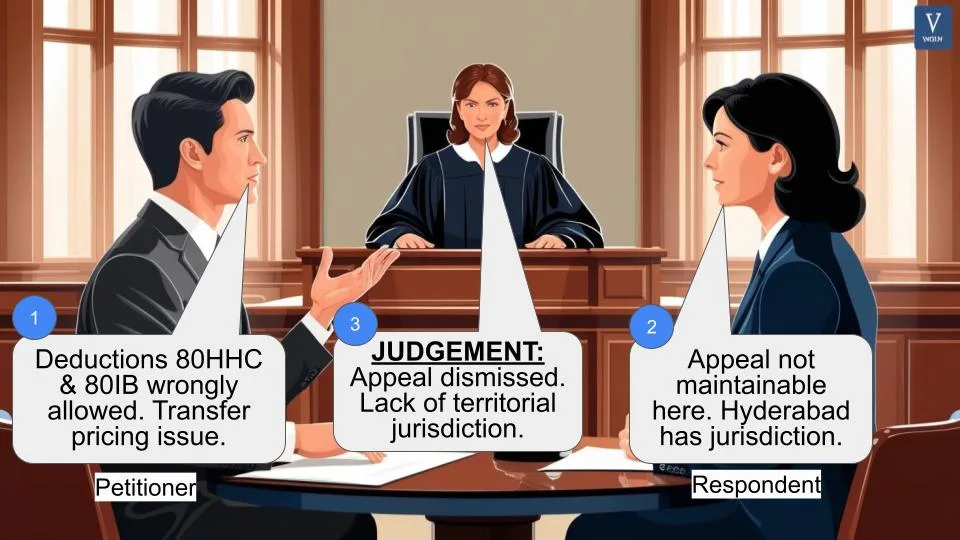
The Principal Commissioner of Income Tax (the appellant) filed an appeal against ITW India Ltd. (the respondent) regarding some tax deductions. The interesting twist? The court ended up dismissing the appeal, not because of the tax issues, but because they realized they didn't have the authority to hear the case in the first place.
Get the full picture - access the original judgement of the court order here
Case Name:
Principal Commissioner of Income Tax vs ITW India Ltd. (High Court of Punjab & Haryana)
ITA No.1 of 2016 (O&M)
Date: 23rd April 2016
Key Takeaways:
1. The court's territorial jurisdiction is crucial in tax appeal cases.
2. The location where the initial assessment was made determines which High Court has jurisdiction.
3. Transferring a case under Section 127 (of Income Tax Act, 1961) doesn't change the High Court's jurisdiction.
4. This decision reinforces the importance of filing appeals in the correct jurisdictional High Court.
Issue:
The main question here was: Does the High Court have territorial jurisdiction to hear this income tax appeal when the initial assessment and proceedings took place in a different jurisdiction (Hyderabad)?
Facts:
1. ITW India Ltd. filed their income tax return for 2004-05, claiming deductions under sections 80HHC (of Income Tax Act, 1961) and 80IB (of Income Tax Act, 1961).
2. The assessment was completed by the Deputy Commissioner of Income Tax in Hyderabad.
3. The company appealed to the Commissioner of Income Tax (Appeals) in Hyderabad.
4. Further appeals were made to the Income Tax Appellate Tribunal in Hyderabad.
5. The Principal Commissioner of Income Tax then filed this appeal under Section 260A (of Income Tax Act, 1961) to a different High Court (not specified, but presumably not Hyderabad).
Arguments:
The appeal raised questions about:
1. Whether separate deductions under sections 80HHC (of Income Tax Act, 1961) and 80IB (of Income Tax Act, 1961) are allowable on the same profits.
2. How to compute deductions under section 80HHC (of Income Tax Act, 1961) after allowing deductions under section 80IB (of Income Tax Act, 1961).
3. Issues related to transfer pricing adjustments.
However, the court didn't get into these arguments because of the jurisdiction issue.
Key Legal Precedents:
The court relied heavily on two previous cases:
1. The Commissioner of Income Tax, Faridabad Vs. M/s Motorola India Ltd. (2010) 326 ITR 156
2. Commissioner of Income Tax (Central) Gurgaon vs. M/s Parabolic Drugs Limited (ITA No. 49 of 2012)
These cases established that the High Court where the initial assessment was made has jurisdiction over the appeal, regardless of any subsequent transfers.
Judgement:
The court dismissed the appeal, saying they didn't have territorial jurisdiction to hear it. They ordered the appeal documents to be returned to the tax department so they could file it with the correct court (which would be the High Court that has jurisdiction over Hyderabad).
FAQs:
1. Q: Why did the court dismiss the case without addressing the tax issues?
A: The court found it didn't have the authority (jurisdiction) to hear the case because the initial tax assessment was done in a different area (Hyderabad).
2. Q: Does this mean the tax dispute is over?
A: Not at all! The tax department can still file the appeal with the correct High Court (the one with jurisdiction over Hyderabad).
3. Q: What's the significance of this decision?
A: It emphasizes the importance of filing tax appeals in the correct High Court based on where the initial assessment was made, not where the company might be currently located.
4. Q: Can't tax cases be transferred between jurisdictions?
A: While cases can be transferred between tax officers, this doesn't change which High Court has the authority to hear appeals related to that case.
5. Q: What should taxpayers learn from this?
A: Always be aware of which jurisdiction your tax assessment falls under, as this will determine where any future appeals need to be filed.

1. This appeal has been preferred by the appellant-revenue under Section 260A (of Income Tax Act, 1961) (in short, “the Act”) against the order dated 27.3.2015 Annexure A.4 passed by the In come Tax Appellate Tribunal, Hyderabad Bench 'B', Hyderabad (in short, “the Tribunal”) in ITA No.206/HYD/2009 for the assessment year 2004-05 claiming following substantial questions of law:-
“i) Whether on the facts and circumstances of the case, the ITAT was justified in law in holding that two separate deductions under section 80HHC (of Income Tax Act, 1961) and 80IB (of Income Tax Act, 1961) are allowable to the assessee on the same profits and gains in contravention of section 80IB(13) (of Income Tax Act, 1961) read with section 80IA(9) (of Income Tax Act, 1961)?
ii) Whether in view of the facts and circumstances of the case, the Tribunal erred in law in not allowing the amount of deduction allowed under section 80IB (of Income Tax Act, 1961) to be reduced from the business profits to compute deduction under section 8HHC (of Income Tax Act, 1961) on the resultant profits?
Iii) Whether on the facts and circumstances of the case, the Hon'ble ITAT erred in law in not adjudicating about inclusion of export benefits to be part of profit from exports to AE and not adjudicating about allowance of variation to the extent of (+/-) 5% while determining the ALP of international transaction?”
2. A few facts relevant for the decision of the controversy involved as narrated in the appeal may be noticed. The assessee company furnished its return of income for the assessment year 2004-05 on 30.10.2004 declaring income of ` 40,19,33,216/- after claiming deduction under sections 80HHC (of Income Tax Act, 1961) and 80IB (of Income Tax Act, 1961). Assessment under section 143(3) (of Income Tax Act, 1961) was completed on 29.12.2006, Annexure A.2 at a total income of ` 43,03,52,979/-. The assessee had claimed deduction under section 80IB (of Income Tax Act, 1961) on the profits and gains derived from the industrial unit situated at Silvassa to the tune of ` 1,90,96,190/- and also claimed deduction under Section 80HHC (of Income Tax Act, 1961) amounting to ` 85,40,817/- on the profits derived from exports made from all the divisions including industrial unit of Silvassa. The Assessing Officer, in view of the provisions contained in section 80IB(13) (of Income Tax Act, 1961) read with section 801A(9) (of Income Tax Act, 1961) reduced the deduction of ` 1,93,22,532/- allowable under section 80IB (of Income Tax Act, 1961) i.e. 30% of ` 6,44,08,441/- from the profits and gains of business to calculate profits of the business for computation of the deduction under Section 80HHC (of Income Tax Act, 1961). Accordingly, the Assessing Officer allowed the deduction under Section 80HHC (of Income Tax Act, 1961) at ` 77,75,288/- as against the assessee's claim of ` 85,40,817/- in its return of income. Further the Assessing Officer noticed that the assessee had entered into international transactions with its associated enterprises involving export of finished goods amounting to ` 9,22,35,092/- and other international transactions.
The Assessing Officer made a reference to the Transfer Pricing Officer (TPO) under Section 92CA(1) (of Income Tax Act, 1961) to determine the Arm's Length Price (ALP) of these international transactions. On the basis of TPO's order, total addition of ` 2,66,59,178/- was made by the Assessing Officer to the total income of the assessee on account of transfer pricing adjustments. Aggrieved by the order, the assessee filed appeal before the Commissioner of Income Tax (Appeals) [CIT(A)]. Vide order dated 3.12.2008, Annexure A.3, the CIT(A) partly allowed the appeal and confirmed the order passed by the Assessing Officer in allowing deduction under section 80HHC (of Income Tax Act, 1961) at ` 77,75,288/- with reference to the eligible profits of the business after reducing the amount of deduction allowed under section 80IB (of Income Tax Act, 1961). Further, the CIT(A) sustained the addition of 1,02,47,642/- out of total addition of ` 2,45,98,456/- involving export of manufactured goods and confirmed the addition on account of transfer pricing adjustments towards commission payment of 20,60,722/-. Not satisfied with the order, the assessee filed appeal before the Tribunal. The department also filed cross appeal. Vide order dated 27.3.2015, Annexure A.4, the Tribunal partly allowed the appeal filed by the assessee and dismissed the revenue's appeal as infructuous. Hence the instant appeal by the revenue.
3. We have heard learned counsel for the parties.
4. After perusing the averments made in the appeal and hearing learned counsel for the parties, we find that the initial order dated 21.12.2006, Annexure A.1 under Section 92CA(3) (of Income Tax Act, 1961) which was rectified under Section 154 (of Income Tax Act, 1961) on 28.12.2006 was passed by the Additional Commissioner of Income Tax (Transfer Pricing), Hyderabad. The final assessment order dated 29.12.2006, Annexure A.2 was passed by the Deputy Commissioner of Income Tax, Circle 2(1), Hyderabad. Even the appeal was filed by the assessee before the CIT(A) at Hyderabad. Further appeal by the assessee and cross appeal by the revenue were filed before the Tribunal at Hyderabad. Since the initial process of assessment was started at Hyderabad and the final assessment was framed by the Assessing Officer at Hyderabad, this court lacks territorial jurisdiction to adjudicate the matter.
In The Commissioner of Income Tax, Faridabad Vs. M/s Motorola India Ltd. (2010) 326 ITR 156, where the assessment was framed by the Assessing Officer at Bangalore, the Revenue in that case, had sought to justify the filing of the appeal in this Court on the ground that the assessee respondent had requested for transfer of the case from Bangalore to Gurgaon on 02.01.2002 and the case was transferred from Bangalore to Gurgaon on 20.05.2005 under Section 127 (of Income Tax Act, 1961). The Division Bench of this Court, while repelling the aforesaid contention had noticed as under:
“The decision of the High Courts are binding on the subordinate Courts and authorities or Tribunals under its superintendence throughout the territory in relation to which it exercises jurisdiction but it does not extend beyond its territorial jurisdiction. In other words, the decision of one High Court is not a binding precedent for another High Court or for Courts or Tribunals outside its territorial jurisdiction. The doctrine of precedents and rule of binding efficacy of law laid down by the High Court within its territorial jurisdiction, the questions of law arising out of decision in a reference, has to be determined by the High Court which exercises territorial jurisdiction over the situs of the Assessing Officer and if it was otherwise then it would result in serious anomalies as an assessee affected by an assessment order at Bombay may invoke the jurisdiction of Delhi High Court to take advantage of a suitable decision taken by it. Thus, such an assessee may avoid application of inconvenient law laid down by the jurisdictional High Court of Bombay. On the basis of the aforementioned reasoning, the Division Bench sustained the objection that the jurisdiction to entertain the application under sub-section (1) and (2) of Section 256 (of Income Tax Act, 1961) vested in the High Court of Bombay and not of Delhi. We are in respectful agreement with the aforementioned reasoning of the Delhi High Court. Accordingly, we hold that the preliminary objection raised by learned counsel for the assessee-respondent is sustainable.
A conjoint reading of the aforementioned provisions makes it evident that the Director General or Chief Commissioner or Commissioner is empowered to transfer any case from one or more Assessing Officers subordinate to him to any other Assessing Officer. It also deals with the procedure when the case is transferred from one Assessing Officer subordinate to a Director General or Chief Commissioner or Commissioner to an Assessing Officer who is not subordinate to the same Director General, Chief Commissioner or Commissioner. The aforementioned situation and the definition of expression 'case' in relation to jurisdiction of an Assessing Officer is quite understandable but it has got nothing to do with the territorial jurisdiction of the Tribunal or High Courts merely because Section 127 (of Income Tax Act, 1961) dealing with transfer has been incorporated in the same chapter. Therefore, the argument raised is completely devoid of substance and we have no hesitation to reject the same.
In view of the above, the appeal is dismissed by sustaining the preliminary objection that this Court has no territorial jurisdiction over an order passed by the Assessing Officer at Bangalore. Accordingly, these appeals are returned to the revenue appellant for their filing before the competent court of jurisdiction in accordance with law.”
Similar order was passed by this Court in ITA No.49 of 2012 [Commissioner of Income Tax (Central) Gurgaon vs. M/s Parabolic Drugs Limited], decided on 11.10.2012.
5. In view of the above, this court has no territorial jurisdiction to adjudicate upon the lis over an order passed by the Assessing Officer, i.e. Deputy Commissioner of Income Tax, Circle 2(1), Hyderabad, the complete paper book of appeal including application for condonation of delay is returned to the appellant-revenue for filing before the competent court of jurisdiction in accordance with law.
(Ajay Kumar Mittal)
Judge
April 23,2016 (Darshan Singh)
gs' Judge
×
Similar Ripples
Questions
Court Dismisses Tax Appeal Due to Lack of Territorial Jurisdiction
Write your CommentSimilar Posts

Generic
- Reportdata/2892.pdf
