


Court Dismisses Tax Appeal: Insufficient Evidence for Reassessment


Full News

Court Dismisses Tax Appeal: Insufficient Evidence for Reassessment
Court Dismisses Tax Appeal: Insufficient Evidence for Reassessment
A case where the Income Tax Department (the Revenue) appealed against an order by the Income Tax Appellate Tribunal (ITAT). The ITAT had earlier dismissed the Revenue's appeal against a decision by the Commissioner of Income Tax (Appeals) or CIT(A). The CIT(A) had deleted an addition made by the Assessing Officer (AO) to the income of the respondent, Sant Lal. The High Court ultimately dismissed the Revenue's appeal, agreeing with the lower authorities that there wasn't enough evidence to justify the reassessment.
Get the full picture - access the original judgement of the court order here
Case Name:
Commissioner of Income Tax vs. Sant Lal (High Court of Delhi)
ITA 1173/2017
Date: 11th March 2020
Key Takeaways:
1. The court emphasized the importance of thorough investigation and corroboration of evidence in tax reassessment cases.
2. Reliance on coded entries and third-party statements without direct link to the assessee was deemed insufficient for reassessment.
3. The judgment highlights the need for concrete evidence to justify additions to declared income.
Issue:
The main question here is: Was there sufficient evidence to justify the reassessment and addition of Rs.3,70,00,000 to the respondent's income for the Assessment Year 2002-03?
Facts:
1. Sant Lal (the respondent) filed an income tax return for AY 2002-03, declaring an income of Rs.2,91,670.
2. On December 15, 2004, there was a search and seizure operation at Brij Mohan Gupta's premises.
3. The search revealed that Gupta was allegedly involved in a "hundi" business (informal money transfer system).
4. Documents seized during the search supposedly contained coded entries related to various parties, including the respondent.
5. Based on this information, the AO initiated reassessment proceedings against Sant Lal under Section 148 (of Income Tax Act, 1961).
6. The AO added Rs.3,70,00,000 to Sant Lal's income as unexplained income.
7. The CIT(A) deleted this addition, and the ITAT confirmed the CIT(A)'s order.
8. The Revenue then appealed to the High Court.
Arguments:
The Revenue's side:
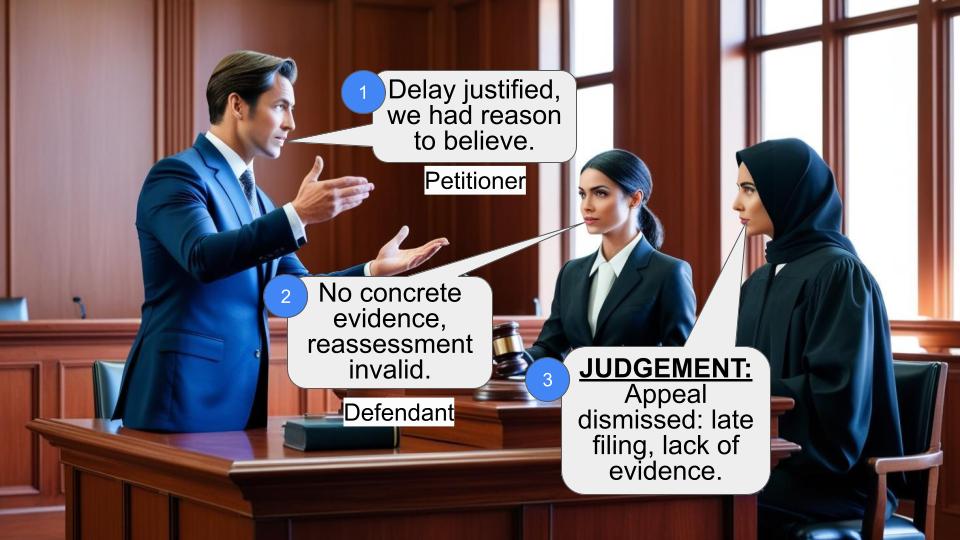
- They argued that Brij Mohan Gupta's involvement in the "hundi" business was proven and unchallenged.
- The seized documents showed cash advances from the respondent to Gupta.
- These documents were part of regular business books and should be considered strong evidence.
The Respondent's side:
- The evidence was insufficient to link the respondent to the alleged transactions.
- The documents were not found from the respondent's premises and weren't in his handwriting.
- The Revenue failed to corroborate the information or establish a direct link to the respondent.
Key Legal Precedents:
1. DCIT v. Mahabir Prasad Gupta (ITA No. 713 & 714/Del/2011)
2. Ashok Prasad Gupta v. Commissioner of Income Tax (ITA No. 4417 to 4420/Del/2009)
3. Commissioner of Income Tax-X v. Mahabir Prasad Gupta (ITA No. 814/2015)
These cases were cited as they dealt with similar issues arising from the same search operation and were found in favor of the assessees.
Judgement:
The High Court dismissed the Revenue's appeal. Here's why:
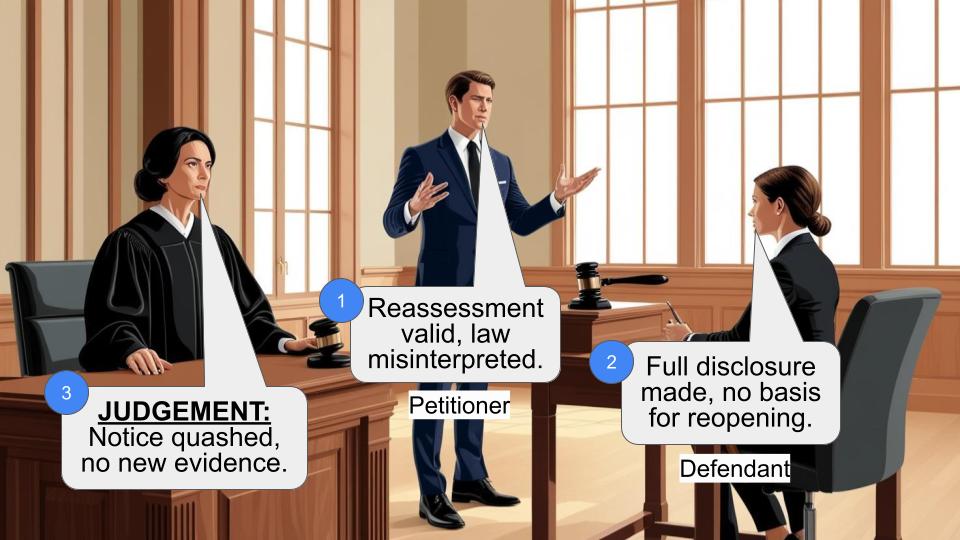
1. The court found no reason to interfere with the concurrent findings of fact by the CIT(A) and ITAT.
2. It noted that the AO didn't make any further inquiry or investigation based on the information from the DCIT.
3. The court emphasized that no attempt was made to gather or corroborate evidence linking the respondent to the alleged transactions.
4. The court relied on its previous decision in Commissioner of Income Tax v. Mahabir Prasad Gupta, where similar additions were deleted due to lack of evidence.
FAQs:
Q1: What was the main issue in this case?
A1: The main issue was whether there was enough evidence to justify adding Rs.3,70,00,000 to Sant Lal's income through reassessment.
Q2: Why did the court dismiss the Revenue's appeal?
A2: The court found that the Revenue didn't provide enough concrete evidence to link Sant Lal to the alleged transactions and didn't conduct further investigations to corroborate the information.
Q3: What's the significance of the "hundi" business mentioned in the case?
A3: The "hundi" business refers to an informal money transfer system. The Revenue claimed that Sant Lal was involved in this system with Brij Mohan Gupta, but couldn't prove it conclusively.
Q4: How does this judgment impact future tax reassessment cases?
A4: It emphasizes the need for tax authorities to conduct thorough investigations and gather concrete evidence before making additions to a taxpayer's income, especially when relying on third-party information.
Q5: What sections of the Income Tax Act were relevant in this case?
A5: The key sections mentioned were Section 148 (of Income Tax Act, 1961) (issue of notice where income has escaped assessment), Section 147 (of Income Tax Act, 1961) (income escaping assessment), and Section 153C (of Income Tax Act, 1961) (assessment of income of any other person).

1. The present appeal under Section 260 (of Income Tax Act, 1961) A of the Income Tax Act, 1961 (hereinafter referred as “the Act”) is directed against the order dated 15th June, 2017 passed by Income Tax Appellate Tax (ITAT) in ITA No. 4730/Del/2009 relating to the assessment year (AY) 2002-03 whereby the appeal preferred by the Revenue against the order of the CIT (A), has been dismissed.
2. Briefly stated, the case of the Revenue is that Respondent filed his income return (ITR) for AY 2002-03 declaring an income of Rs.2,91,670/- comprising of income from salary from M/s Jagat Agro Commodities (P) Ltd., income from House Property and Capital Gains. On 15th December, 2004, a search and seizure operation under Section 132 (of Income Tax Act, 1961) was conducted in the case of Sh. Brij Mohan Gupta. During the course of search, various incriminating documents/diaries/loose papers were found and seized. During post search proceedings, statements on oath were recorded of Sh. B.M.Gupta, his son Sh. Rajeev Gupta and accountant Sh. Ram Avtar Singhal. The search operation revealed that Sh. B. M. Gupta was allegedly engaged in “hundi” business at the relevant time, wherein previously undisclosed money/cash was arranged from various parties including the respondent, and the same was advanced to different parties for undisclosed interest income on the said advanced amounts. Sh. B. M. Gupta and his Group acted as mediator/broker in such clandestine financial transactions and charged commission/brokerage for arranging the same.
3. The various loose papers/diaries found and seized, contained details of the various parties on behalf of whom the said Group carried out the “hundi” business. The entries found in these documents were coded entries and had been recorded by one Sh. Ram Avtar Singhal, the accountant of the said group. Sh. Singhal decoded and confirmed the said entries by giving the correct details of the said transactions and the parties involved.
4. On 30th November, 2006, the cases of the said group were centralized with the DCIT, Central Circle-19, New Delhi and assessment of Sh. Brij Mohan Gupta Group cases were completed under Section 153A (of Income Tax Act, 1961). Sh. Brij Mohan Gupta, admitted his involvement in the unaccounted “hundi”/ undisclosed cash transactions on behalf of various parties which included the respondent and also disclosed the brokerage income earned by him in such transactions. Accordingly, the contents of documents found and seized and the statements recorded on oath were forwarded to the Assessing Officer (AO) holding jurisdiction to undertake action under Section 153C (of Income Tax Act, 1961)/148 of the Act against the respondent.
5. On 19th March, 2008, on being satisfied with the said information furnished by DCIT, Central Circle-19, the concerned AO initiated action under Section 148 (of Income Tax Act, 1961). Therefore, in response to said notice, the respondent stated that his previously filed ITR be accepted in compliance to the said notice. The AO observed that the ITR so relied upon by the respondent did not disclose any transaction of cash loans with Sh. Brij Mohan Gupta group and the same was contrary to the evidence unearthed during the search. On this basis, show cause notices were issued to the respondent under Section 142(1) (of Income Tax Act, 1961) granting him opportunities to appear before the AO and to prove his case. Such opportunities were not availed of and this ultimately led to framing of assessment order under Section 147 (of Income Tax Act, 1961)/143(3)/69A of the Act assessing respondent‟s total income at Rs.3,72,91,670/- which included undisclosed cash transactions amounting to Rs.3,70,00,000/- representing the respondent‟s unexplained income which had escaped assessment.
6. In the appeal filed by the respondent, CIT (A) deleted the addition made by the AO. Thereafter, when the Revenue carried the matter further in appeal, the ITAT confirmed the order of CIT(A) on the ground that the issues in appeal were directly covered in the previous appeals as decided by the ITAT „E‟ Bench in the case of DCIT v. Mahabir Prasad Gupta in ITA No.713 & 714/Del/2011 vide order dated 23rd November, 2012 and in the case of Ashok Prasad Gupta v. Commissioner of Income Tax in ITA No. 4417 to 4420/Del/2009 vide order dated 16.06.2011.
7. By way of the present appeal, Revenue has assailed the order of the Tribunal. Ms.Easha Kadian, appearing on behalf of Mr.Raghvendra Singh, Sr. Standing counsel for the Revenue argues that order passed by the Tribunal suffers from perversity, material errors and illegalities, inasmuch as the Tribunal has erroneously relied upon the orders passed by the coordinate Bench of the ITAT in the case of the DCIT v. Mahabir (supra) and in the case of Ashok Prasad Gupta (supra). It is argued that the ITAT has failed to appreciate that Sh. Brij Mohan Gupta and his group‟s engagement in “hundi” business stood proven and unchallenged by the respondent. It is further argued that the cash advances from the respondent by Sh.Brij Mohan Gupta in the subject year were expressly recorded in the seized documents which formed a part of regular books of the business and no better evidentiary and documentary proof could be expected from such transactions.
8. At the outset, it is noticed that on 20th December, 2017, this Court recorded the submissions of the learned counsel for the Revenue and directed the learned counsel to produce subsequent order made by the AO after fresh determination in lieu of remand made in the case of the Ashok Prasad Gupta (supra). The said order reads as under:
“CM No.46522/2017 (exemption)
Exemption is allowed subject to all just exceptions.
ITA 1173/2017
1. It is stated that the impugned order in the present case arises out of common search proceedings involving the B.M. Gupta Group as the concern. The reassessment proceedings were initiated in respect of the present assessee culminating in addition of Rs.3,72,91,670/-. The CIT(A) accepted the appeal and directed deletion of a major portion of the amount, i.e. Rs.3.70 crores. On further appeal, the Revenue's contentions were rejected on the ground that the ITAT's previous decision in Deputy Commissioner of Income Tax Vs. Mahabir Prasad Gupta (ITA 713 & 714/Del/2011 - by order dated 23.11.2012 governed the case.
2. In identical circumstances arising out of the same search proceedings, this Court in Commissioner of Income Tax vs. Lakhmi Chand (ITA 1124/2017), on 08.12.2017, passed the following order in the Revenue's appeal stating as follows:-
" Learned counsel for the Revenue relied upon the order of this Court in ITA No. 282/2012 in the case of Ashok Prasad Gupta Vs. Commissioner of Income Tax, decided on 13.09.2012.
It is submitted that the Court remitted the matter to the AO for fresh determination. The said order along with subsequent event i.e. order of the AO/CIT (A) shall be made available to the Court on the next date of hearing,since the IT AT has relied upon its previous order in that case.
List on 26.02.2018. "
3. Accordingly, the Revenue shall produce the subsequent order made by the AO after fresh determination, in view of the remand made in Ashok Prasad Gupta Vs. Commissioner of Income Tax, decided on 13.09.2012.
4. List on 26.02.2018.”
9. Since December, 2017, the Revenue has failed to place on record the said order. Today, once again time is being sought to produce the said order.
However, having regard to the fact that more than two years have lapsed and the Revenue has failed to place the order on record, we have proceeded to hear the matter on merits.
10. The learned counsel for the respondent, submits that at the time of issuance of the notice by this court, since the respondent was not represented, it could not bring to the notice of this Court that in Commissioner of Income Tax-X v. Mahabir Prasad Gupta, ITA No. 814/2015, vide order dated 20th October, 2015, the appeal of the Revenue has been dismissal on merits. He submits that in view of the said dismissal, nothing survives in the present matter, in as much as the material which forms the basis for re-assessment was not found to be sustainable for initiating action pertaining to Mahabir Prasad Gupta (supra), which is germane for the action initiated against the Respondent.
11. We have perused the impugned order and notice that the ITAT has given a finding of the fact that the case of the respondent is covered with the decision of the ITAT in the cases of Mahabir Prasad Gupta (supra) and Ashok Prasad (supra). The relevant portion of the impugned order read as under:
“4. In the circumstances and fact of the case, we are of the view that the case is fully covered with the decision of ITAT in the cases of Mahabir Prasad Gupta (Supra) and Ashok Prasad Gupta (supra) and further observed that Revenue could lay its hands on the diary of Sh. Brij Mohan Gupta where names of persons were recorded in quoted words and revenue could not establish the name of the assessee from such quoted words. Though the Revenue has placed on record statement of Sh. Brij Mohan Gupta, Ram Avtar Singal and Rajiv Gupta but still Revenue has failed to establish link between the information noted in abbreviated form and the assessee. The diary was neither found from the promises of the assessee nor in the hand writing of the assessee any third person may write the name of any person at his sweet will, in such circumstances assessee cannot be put to any liability on the action of the third person, the same has to be corroborated by the Revenue which has not been done in the present case. In the circumstances and facts of the case, we do not find any infirmity in the order of the Ld. CIT(A) who has rightly deleted the additions so made by the AO. Accordingly, all the grounds of the Revenue are dismissed.”
12. In case of the Commissioner of Income Tax v. Mahabir Prasad Gupta (supra), this Court has examined the facts and concluded that the concurrent finding of the facts cannot be disturbed as there was no material which could justify the assessment order. The relevant portion of the said order which reads as under:
“13. The above submissions fail to persuade this Court to interfere with the matter. Concurrent findings of fact have been rendered by the CIT (A) as well as by the ITAT. Nothing has been pleaded in the memorandum of appeal to persuade the Court to hold that those findings are perverse or contrary to the facts on record. Secondly, there is not a whisper in the order of the AO about any bag recovered from the premises of the Assessee during the search of the Assessee’s premises on 22nd March 2006. There is no such averment even in the memorandum of appeal filed before this Court. The material referred to in the order of the AO is that which was recovered from the premises of Mr. Brij Mohan Gupta and nothing else. That material has been discussed threadbare in the order of the CIT (A). Detailed reasons have been given as to why that material was insufficient to link the Assessee with “MP Gupta‟ whose name finds mention in the diary and the documents seized from the premises of Mr. Brij Mohan Gupta.
14. Consequently, the Court is not persuaded to permit the Revenue, for the first time, before this Court to set up an entirely different case of there having been a bag seized from the premises of the Assessee which according to the Revenue contained incriminating material against the Assessee.”
13. In view of the aforesaid facts and the concurrent findings given by the CIT (A) and ITAT, it is evident that the Revenue has not been able to produce any cogent material which could fasten the liability on the respondent. The CIT(A) has also examined the assessment record and has observed that the AO did not make any further inquiry/investigation on the information passed on by the DCIT, Central Circle-19, New Delhi. No attempt or effort was made to gather or corroborate evidence in this relation.
14. In these facts and circumstances, we are not inclined to entertain the present appeal as no substantial question of law arises for our consideration.
Accordingly, the present appeal is dismissed.
SANJEEV NARULA, J
MANMOHAN, J
×
Similar Ripples
Questions
Court Dismisses Tax Appeal: Insufficient Evidence for Reassessment
Write your CommentSimilar Posts

Generic
- Reportdata/5998.pdf
