


Court Dismisses Tax Appeal: No Disallowance Without Exempt Income


Full News
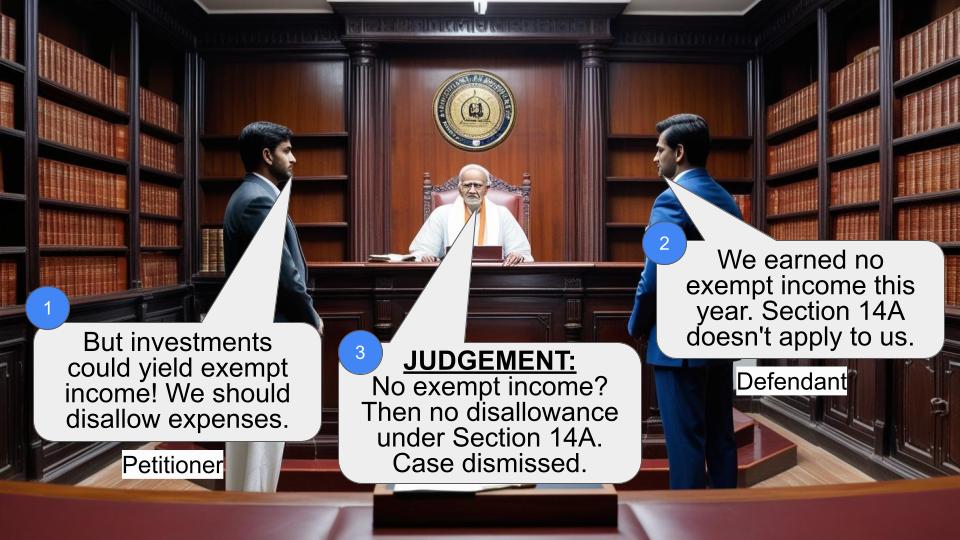
Court Dismisses Tax Appeal: No Disallowance Without Exempt Income
Court Dismisses Tax Appeal: No Disallowance Without Exempt Income
A case where the tax department (Principal Commissioner of Income Tax) went up against a company called M/s. Kohinoor Project Pvt. Ltd. The main issue was about disallowing certain expenses under a specific tax rule. Long story short, the court sided with the company and dismissed the tax department's appeal. Let's break it down further!
Get the full picture - access the original judgement of the court order here
Case Name:
Principal Commissioner of Income Tax vs M/s. Kohinoor Project Pvt. Ltd. (High Court of Bombay)
Income Tax Appeal No.1124 of 2017
Date: 27th January 2017
Key Takeaways:
1. The court reinforced the principle that you can't disallow expenses under Section 14A (of Income Tax Act, 1961) if there's no exempt income.
2. This decision aligns with previous rulings from other High Courts, showing a consistent interpretation across India.
3. It's a win for taxpayers, as it prevents the tax department from making disallowances when there's no actual exempt income.
Issue:
The main question here was: Can the tax department disallow expenses under Section 14A (of Income Tax Act, 1961) when the assessee (that's the taxpayer) hasn't earned any exempt income during the relevant year?
Facts:
1. M/s. Kohinoor Project Pvt. Ltd. filed a tax return showing a loss of about 10.16 crores for the 2008-09 assessment year.
2. The tax department noticed that the company had invested 7.90 crores in shares of Kohinoor CTNL Infrastructure Co. Ltd.
3. Even though the company didn't earn any exempt income that year, the tax officer disallowed expenses of about 6.96 crores under Section 14A (of Income Tax Act, 1961).
4. The company appealed, and the amount was reduced to about 1.16 crores.
5. The tax department wasn't happy with this reduction and appealed to the Income Tax Appellate Tribunal (ITAT), which then completely deleted the disallowance.
6. That's when the tax department took it to the High Court, leading to this case.
Arguments:
The tax department argued that:
1. The ITAT shouldn't have deleted the entire disallowance.
2. Even without exempt income, Rule 8D (of Income Tax Rules, 1962) should apply for calculating disallowance.
The company (assessee) countered that:
1. They didn't claim any exempt income, so no disallowance should be made under Section 14A (of Income Tax Act, 1961).
Key Legal Precedents:
The court relied on some important previous decisions:
1. Cheminvest Limited v/s. Commissioner of Income Tax, 378 ITR 33 (Delhi)
2. CIT v/s. Lakhani Marketing Incl., [2014], 49 taxman.com 257 (Punjab & Haryana)
3. CIT v/s. Shivam Motors Pvt. Ltd., [2015] 55 taxman.com 262 (Allahabad)
All these cases consistently held that if there's no exempt income, you can't make disallowances under Section 14A (of Income Tax Act, 1961).
Judgement:
The court agreed with the ITAT and dismissed the tax department's appeal. They said that Section 14A (of Income Tax Act, 1961) only applies when there's actual receipt of exempt income during the relevant year. No exempt income, no disallowance – simple as that!
FAQs:
Q1: What's Section 14A (of Income Tax Act, 1961) all about?
A1: It's a rule that says you can't claim deductions for expenses related to income that isn't taxable.
Q2: Why is this judgment important?
A2: It clarifies that tax authorities can't disallow expenses under Section 14A (of Income Tax Act, 1961) if you haven't actually earned any exempt income.
Q3: Does this apply to all taxpayers?
A3: While this specific case was about a company, the principle could potentially apply to other taxpayers too.
Q4: What if I have investments that could earn exempt income in the future?
A4: Based on this judgment, what matters is whether you actually received exempt income in the current tax year, not potential future income.
Q5: Is this the final word on the matter?
A5: While it's a High Court decision, the tax department could potentially appeal to the Supreme Court if they choose to.

1. Heard Mr.A.R.Malhotra, learned standing counsel revenue for the appellant and Mr. Mihir C. Naniwadekar, learned counsel for the respondent - assessee.
2. This appeal has been fled by the revenue under Section 260A (of Income Tax Act, 1961) (“the Act” for short) against the order dated 18.10.2016 passed by the Income Tax Appellate Tribunal “A” Bench, Mumbai ("Tribunal" for short) in Income Tax Appeal No. 5241/Mum/2013 for the Assessment Year 2008-09.
3. The appeal has been preferred projecting the following two questions as substantial questions of law :
(i) Whether on the facts and in circumstances of the case and in law, Hon’ble ITAT was justifed in deleting the addition of Rs.5,79,95,481/- on the ground that when there is no exempt income declared during the year, there cannot be any disallowance u/s. 14A (of Income Tax Act, 1961) read with Rule 8D (of Income Tax Rules, 1962) while confrming the order of the Ld. CIT(A) restricting the disallowance to Rs.1,16,03,269/- under Rule 8D(2)(ii) (of Income Tax Rules, 1962) ?
(ii) Whether on the facts and in the circumstances of the case and in law, Hon’ble ITAT was justifed in confrming the order of the Ld. CIT(A) to restrict the disallowance to Rs.1.16 crore without appreciating the fact that by doing this, Hon’ble ITAT has allowed the application of Rule 8D(2)(ii) (of Income Tax Rules, 1962) in the case of the assessee even when it has not earned any exempt income ?
4. Respondent in its return of income for the assessment year under consideration declared total loss of Rs.(-) 10,16,33,795/-. The case was selected for scrutiny and thereafter subjected to scrutiny assessment. Assessing Ofcer noted that assessee had made investment of Rs.7.90 Crores in shares of Kohinor CTNL Infrastructure Co. Ltd. which was held to be strategic investment for which assessee would receive future benefts. Notwithstanding the fact that the assessee had earned no exempt income for the relevant previous year, Assessing Ofcer made disallowance to the extent of Rs.6,95,98,750/- under Section 14A (of Income Tax Act, 1961).
5. Aggrieved by the aforesaid, assessee preferred appeal before the Commissioner of Income Tax (Appeals)-12, Mumbai. In the appeal proceedings the frst appellate authority held that the Assessing Ofcer was justifed in invoking Section 14A (of Income Tax Act, 1961) by taking the view that the assessee had made investments that would give rise to exempt income and, therefore, Section 14A (of Income Tax Act, 1961) was applicable. Accordingly, vide order dated 08.05.2013, frst appellate authority afrmed the action of the Assessing Ofcer in invoking Section 14A (of Income Tax Act, 1961) but reduced the quantum of disallowance to Rs.1,16,03,269/- for the grounds and reasons mentioned in the appellate order.
6. Aggrieved by the reduction in the quantum of disallowance revenue preferred appeal before the Tribunal. The Tribunal considered the contention of the assessee that no exempt income was claimed by the assessee under Section 14A (of Income Tax Act, 1961) and, therefore, no disallowance could have been made by the Assessing Ofcer by invoking Section 14A (of Income Tax Act, 1961) together with Rule 8D(2)(ii) (of Income Tax Rules, 1962). Tribunal relied upon the decision of the Delhi High Court in the case of Cheminvest Limited v/s. Commissioner of Income Tax, 378 ITR 33(Delhi); the decision of the Punjab and Haryana High Court in CIT v/s. Lakhani Marketing Incl., [2014], 49 taxman.com 257; and decision of the Allahabad High Court in the case of CIT v/s. Shivam Motors Pvt. Ltd., [2015] 55 taxman.com 262(Allahabad) and observed that there is uniformity in the view that in case there is no exempt income claimed by the assessee in the return of income, no disallowance can be made by the revenue. Consequently, vide order dated 18.10.2016 Tribunal dismissed the appeal of the revenue.
7. Submissions made by learned counsel for the parties have been considered.
8. Section 14A (of Income Tax Act, 1961) deals with expenditure incurred in relation to income not includible in total income. As per sub- Section (1) of Section 14A (of Income Tax Act, 1961), for the purpose of computing the total income, no deduction shall be allowed in respect of expenditure incurred by the assessee in relation to income which does not form part of the total income. In Cheminvest Ltd. (supra) Delhi High Court examined the expression "does not form part of the total income" as appearing in sub-Section (1) of Section 14A (of Income Tax Act, 1961). Delhi High Court held that the said expression envisages that there should be an actual receipt of income which is not includible in the total income during the relevant previous year for the purpose of disallowing any expenditure incurred in relation to the said income. It was clarifed that Section 14A (of Income Tax Act, 1961) will not apply if no exempt income is received or receivable during the relevant previous year.
9. This view has been followed in several decisions by this Court. In fact in Income Tax Appeal No. 259 of 2017, Principal Commissioner of Income Tax, Mumbai v/s. MAN Infraprojects Ltd., decided on 09.04.2019, this Court followed the decision of the Delhi High Court in Cheminvest Ltd. (supra). It was further noted in MAN Infraprojects Ltd. that the decision of the Delhi High Court was challenged by the revenue before the Supreme Court by fling SLP but the SLP was dismissed.
10. In the light of the above, we hold that no substantial question of law arises from the order of the Tribunal. The appeal is devoid of merit and is accordingly, dismissed.
(MILIND N. JADHAV, J.) (UJJAL BHUYAN,J.)
×
Questions
Court Dismisses Tax Appeal: No Disallowance Without Exempt Income
Write your CommentSimilar Posts

Generic
- Reportdata/6093.pdf
