


Court Favors Justice-Oriented Approach in One-Day Tax Return Delay Case


Full News
Court Favors Justice-Oriented Approach in One-Day Tax Return Delay Case
Court Favors Justice-Oriented Approach in One-Day Tax Return Delay Case
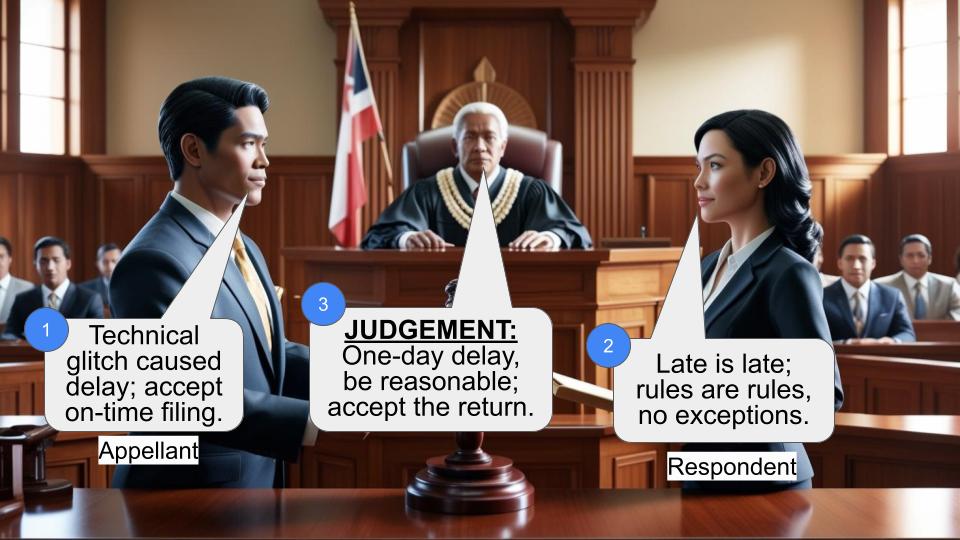
It's about a company called Cosme Matias Menezes Pvt. Ltd. who filed their tax return just one day late. The Income Tax Department refused to accept it, but the High Court stepped in and said, "Hold on, let's be reasonable here!" The court basically told the tax authorities to stop being so strict and consider the circumstances.
Get the full picture - access the original judgement of the court order here
Case Name:
Cosme Matias Pvt. Ltd. Vs Commissioner of Income Tax (High Court of Bombay)
Writ Petition No. 225 & 205 of 2011
Date: 7th May 2015
Key Takeaways:
1. Courts prefer a justice-oriented approach over a strict, technical one in delay cases.
2. Even a one-day delay can be condoned if there's a good reason.
3. The Central Board of Direct Taxes (CBDT) has the power to accept late applications in genuine hardship cases.
4. Technical glitches shouldn't penalize taxpayers if they've made a good faith effort to comply.
Issue:
The main question here was: Should a one-day delay in electronically filing a tax return be condoned when the hard copy was submitted on time and there were technical issues with the tax department's server?
Facts:
1. The company, Cosme Matias Menezes Pvt. Ltd., had to file their tax return for the 2006-2007 assessment year.
2. The deadline was March 31, 2008.
3. They submitted a hard copy of their return (Form-1) on March 31, 2008 - right on time!
4. But here's the catch - the electronic version wasn't uploaded to the Income Tax Department's server until April 1, 2008.
5. The company says this was because of some issue with the tax department's server.
6. The Income Tax Department refused to accept the return because it was technically a day late.
7. The company filed an application on April 6, 2009, asking the CBDT to condone the delay.
8. The CBDT dismissed this application on December 17, 2009.
9. So, the company took it to the High Court with a writ petition.
Arguments:
The company's side:
1. They argued that they did submit the hard copy on time (March 31, 2008).
2. The one-day delay in electronic filing wasn't their fault - it was due to server issues.
3. They said the CBDT made a mistake by thinking the delay was 17 months when it was actually just one day.
The Tax Department's side:
They stuck to their guns, saying the electronic submission was late, period.
Key Legal Precedents:
The court referred to two important cases:
1. Pala Marketing Co-operative Society Ltd. vs. Union of India and Others (2009) 311 ITR (Ker)
2. M/s. Bombay Mercantile Co-op Bank Ltd vs. The Central Board of Direct Taxes & Others CDJ 2010 BHC 2252
These cases emphasized that courts should avoid a overly strict approach in delay matters and instead focus on justice.
Judgement:
The court sided with the company. Here's why:
1. They said the tax authorities were being too rigid and not considering the circumstances.
2. The court noted that under Sections 139 (of Income Tax Act, 1961) and 239 (of Income Tax Act, 1961), there's actually a one-year grace period for filing returns and claiming refunds.
3. They pointed out that Section 119(2)(b) (of Income Tax Act, 1961) allows the CBDT to accept late applications in cases of genuine hardship.
4. The court felt that a one-day delay, especially when the hard copy was submitted on time, shouldn't cause such a problem.
5. They ordered the tax authorities to reconsider the company's application and look at the merits of their tax return.
FAQs:
1. Q: Does this mean I can always file my taxes late?
A: No, it's always best to file on time. This case was about a one-day delay due to technical issues.
2. Q: What's the difference between a "pedantic" and a "justice-oriented" approach?
A: A pedantic approach focuses strictly on rules without considering circumstances. A justice-oriented approach looks at the bigger picture and tries to be fair.
3. Q: Can the tax department still reject the company's return?
A: Yes, but now they have to examine the actual content of the return, not just reject it for being one day late.
4. Q: What should I do if I face technical issues when filing taxes?
A: Try to submit a hard copy on time if possible, and document any technical issues you encounter.
5. Q: Does this ruling apply to all tax-related deadlines?
A: Not necessarily. This case was specific to tax returns and refund claims. Other situations might be treated differently.

1. Heard Shri Valmiki Menezes, learned Counsel appearing for the Petitioners and Ms. Asha Desai, learned Counsel appearing for the Respondents.
2. Both the Petitions were taken up together as both the learned Counsel pointed out that the facts in both the Petitions were identical in respect of Assessment year 2006-2007.
3. The above Writ Petition, inter alia, prays for a writ of certoriari or direction quashing and setting aside the impugned Order dated 17.12.2009 of the Respondent and allow the application dated 06.04.2009 filed by the Petitioner for condonation of delay of one day.
4. Briefly, the facts of the case are that the Petitioner filed its return of income in Form – 1 in hard copy with the office of the Respondent on 31.03.2008 as the return of Income was not uploaded in the electronic form on to the server of the Income Tax Department. The server of the Respondent uploaded the return of Income on 01.04.2005 electronically. This return of Income was in fact the Petitioner's claim to refund of excess tax paid. However, as the filing of return of Income was one day later than the due date i.e. 31.03.2008 for assessment year 2006-07, the return of Income tax would not be examined resulting in refund not being granted. An application for condonation of delay was also filed on 06.04.2009 in filing the return of Income under Section 119(2) (of Income Tax Act, 1961) with the CBDT. But, however, such application was dismissed by the impugned Order dated 17.12.2009. Consequently, the Petitioners have filed the present Writ Petitions.
5. Shri Valmiki Menezes, learned Counsel appearing for the Petitioner, in support of the Petitions, has pointed out that the delay was held to be of 17 months in filing the returns overlooking the fact that the last date of filing the returns was on or before 31.03.2008 which was in fact filed, however, was electronically transferred on 01.04.2008 for no fault of the Petitioner. Learned Counsel further pointed out that the Petitioners have made out a sufficient cause to condone the delay which has been erroneously refused by the Respondent. The learned Counsel has thereafter taken us through the impugned Order, and pointed out that the delay was on account of genuine hardship to the Petitioner as the Petitioner was unable to electronically transfer Form – 1 on 31.03.2008 due to some fault with the server of the Respondent. The learned Counsel has thereafter taken us through para 8 of the impugned Order to point out that the Respondents have correctly noted that under Section 239(2)(c) (of Income Tax Act, 1961), the Petitioner was supposed to file its e-returns on or before 31.03.2008 but, however, while examining the justification to condone the delay, the Respondents have erroneously assumed that the delay was of 17 months. Learned Counsel as such submits that the impugned Order be quashed and set aside.
In support of his submissions, the learned Counsel has relied upon the Judgment reported in (2009) 311 ITR (Ker) in the case of Pala Marketing Co- operative Society Ltd. vs. Union of India and Others and the Judgment of this Court reported in CDJ 2010 BHC 2252 in the case of M/s. Bombay Mercantile Co-op Bank Ltd vs. The Central Board of Direct Taxes & Others.
6. On the other hand, Ms. Asha Desai, learned Counsel appearing for the Respondent, has relied upon the impugned Order challenged in the above Writ Petition.
7. We have given are thoughtful consideration to the rival contentions and we have also gone through the records. It is not disputed that the returns were to be filed by the Petitioner in terms of Section 239(2)(c) (of Income Tax Act, 1961), (said Act). Section 239(2)(c) of the Income Tax Act, 1961 reads thus : “Section 239(1) (of Income Tax Act, 1961) Every claim for refund under this Chapter shall be made in the prescribed form and verified in the prescribed manner (2) No such claim shall be allowed unless it is made within the period specified hereunder namely :
(A) where the claim is in respect of income which is assessable for any other assessment year, (one) year from the last day of such assessment year.”
8. Section 139(4) of the Income Tax Act, 1961 reads thus :
“Section 139(4) (of Income Tax Act, 1961) Any person who has not furnished a return within the time allowed to him under sub-section (1) or within the time allowed under a notice issued under sub section (1) of Section 142 (of Income Tax Act, 1961), may furnish the return for any previous year at any time before the expiry of one year from the end of the relevant assessment year or before the completion of the assessment, whichever is earlier.” Section 119(2)(b) of the Income Tax Act, 1961, reads thus :
(b) the Board may, if it considers it desirable or expedient so to do for avoiding genuine hardship in any case or class of cases, by general or special order, authorize, any income tact authority, not being a Commissioner (Appeals) to admit an application or claim for any exemption, deduction, refund or any other relief under this Act after the expiry of the period specified by or under this Act for making such application or claim and deal with the same on merits in accordance with law.”
9. Reading the said provisions, we find that Section 139 (of Income Tax Act, 1961) and 239 (of Income Tax Act, 1961) itself allows for filing of the returns and claim of refund within a period of one year from the end of the assessment year i.e. on or before 31.03.2008. The provisions of Section 119(2)(b) (of Income Tax Act, 1961) allow the CBDT to admit an application beyond the time prescribed under Section 139 (of Income Tax Act, 1961) and Section 239 of the Income Tax Act, 1961. In the present case we find that the Respondents have failed to exercise such powers to condone the delay in filing returns and consequent refund by the Petitioners on irrelevant and extraneous reasons.
10. This Court in the Judgment in the case of M/s. Bombay Mercantile Co-op Bank Ltd vs. The Central Board of Direct Taxes & Others (supra), has observed at para 8 thus :
“8. It is well settled that in matters of condonation of delay a highly pedantic approach should be eschewed and a justice oriented approach should be adopted and a party should not be made to suffer on account of technicalities.”
11. Taking note of the said observations and considering that the delay in the present case is only of one day, we find that the approach of the Respondents in refusing to condone the delay is a pedantic which, if allowed to stand, would result in great hardship to the Petitioners for no fault of the Petitioners. The Petitioners have also produced the hard copy to show that in fact such return in Form – 1 were filed on 31.03.2008 which was admittedly the last date for filing such returns. This factual aspects have not been disputed by the Respondents. Needless to say, we have not examined the merits of the claim of the Petitioners based on the returns filed by the Petitioners but only considered whether the delay in filing such returns deserves to be condoned. Such returns and the claim of the Petitioners have to be examined by the Respondents on its own merits.
12. As such, the Petitions succeed and, consequently, Rule is made absolute in both the Petitions in terms of prayer (a) with no Order as to costs.
M. S. SANKLECHA, J. F. M. REIS, J.
×
Questions
Court Favors Justice-Oriented Approach in One-Day Tax Return Delay Case
Write your CommentSimilar Posts

Generic
- Reportdata/3757.pdf
