


Court Favors Pharma Company in Tax Deduction Dispute, Subject to Supreme Court …


Full News

Court Favors Pharma Company in Tax Deduction Dispute, Subject to Supreme Court Decision
Court Favors Pharma Company in Tax Deduction Dispute, Subject to Supreme Court Decision
This case involves an appeal filed by M/S. MICROLABS LIMITED (the appellant) against the Assistant Commissioner of Income Tax (the respondent) regarding tax deductions under Sections 80 (of Income Tax Act, 1961)-IB and 80HHC of the Income Tax Act, 1961. The High Court largely ruled in favor of the appellant, overturning the Income Tax Appellate Tribunal's decision, but made part of the ruling subject to a pending Supreme Court decision.
Get the full picture - access the original judgement of the court order here
Case Name:
M/s. Microlabs Limited (Rep. by its Managing Director Sri. Dilip Surana) Vs Assistant Commissioner of Income Tax (High Court of Karnataka)
ITA No.101 of 2010
Date: 8th January 2020
Key Takeaways:
1. The court ruled that R&D expenses should not be allocated to units that didn't manufacture the researched products in the relevant year.
2. Capital expenditure on R&D should be excluded when allocating R&D expenses between units.
3. The court's decision on deductions under Sections 80HHC (of Income Tax Act, 1961) and 80-IB (of Income Tax Act, 1961) is subject to a pending Supreme Court ruling.
4. The case highlights the complexities in allocating R&D expenses and calculating tax deductions for pharmaceutical companies.
Issue:
The main issues were:
1. Whether the tribunal was justified in allocating R&D expenditure to the Pondicherry unit when no products were manufactured there during the relevant year?
2. Should capital expenditure be excluded from total R&D expenditure when allocating between units?
3. How should deductions under Sections 80HHC (of Income Tax Act, 1961) and 80-IB (of Income Tax Act, 1961) be computed and applied?
Facts:
- The appellant, Microlabs Limited, is a pharmaceutical company engaged in manufacturing and exporting.
- They filed a tax return declaring income of ₹8,62,79,470 and claimed deductions under Sections 80 (of Income Tax Act, 1961)-IB and 80HHC.
- The Assessing Officer initially allowed the claim, but after appeals and reassessment, reduced the profit eligible for relief under Section 80-IB (of Income Tax Act, 1961).
- The case went through multiple appeals, reaching the High Court.
- The company had a research and development unit, and the allocation of its expenses was a key point of contention.
Arguments:
Appellant's arguments:
1. R&D expenses shouldn't be allocated to the Pondicherry unit as no relevant products were manufactured there in the assessment year.
2. Capital expenditure of ₹99 lakhs should be excluded from the total R&D expenditure of ₹1.99 crores when allocating between units.
3. The computation of deduction under Section 80HHC (of Income Tax Act, 1961) shouldn't be reduced by the deduction under Section 80-IB (of Income Tax Act, 1961).
Respondent's arguments:
1. Two products developed by the R&D unit were produced in the Pondicherry unit in the subsequent year, justifying the allocation.
2. The tribunal's decision on the computation of deductions under Sections 80HHC (of Income Tax Act, 1961) and 80-IB (of Income Tax Act, 1961) was correct.
Key Legal Precedents:
The judgment mentions the case of JCIT Vs. Mandideep Engineering & Packaging Industry Pvt. Ltd. 292 ITR 1, which was relevant to the quantification of deduction under Section 80HHC (of Income Tax Act, 1961).
Judgement:
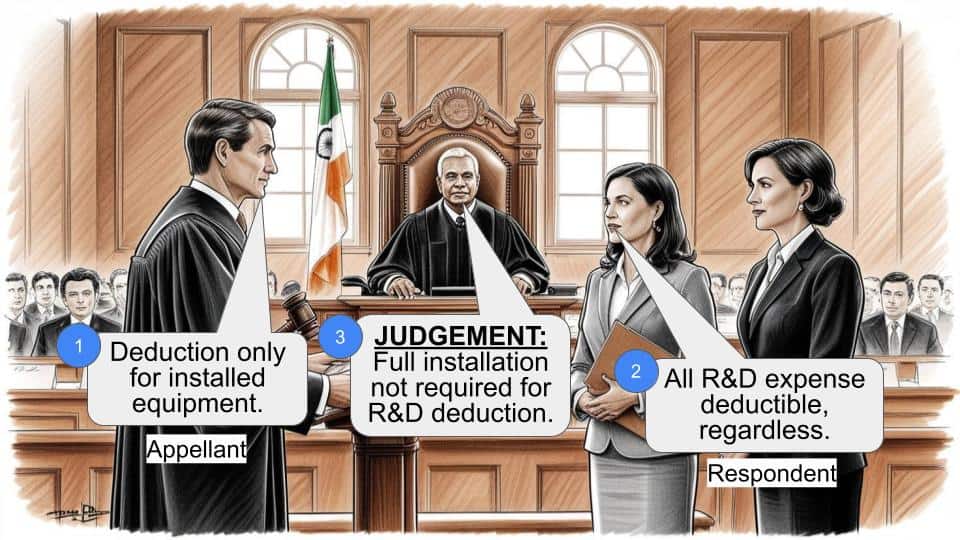
1. The court ruled in favor of the appellant on the first two questions, stating that R&D expenses shouldn't be allocated to the Pondicherry unit for the relevant year.
2. The court agreed that the ₹99 lakhs capital expenditure should be excluded from the total R&D expenditure when allocating between units.
3. On the third and fourth questions regarding Sections 80HHC and 80-IB, the court ruled in favor of the assessee but made it subject to a pending Supreme Court decision.
4. The Income Tax Appellate Tribunal's order dated 30.10.2009 was quashed.
FAQs:
1. Q: What was the main dispute in this case?
A: The main dispute was about the allocation of R&D expenses and the computation of tax deductions under Sections 80 (of Income Tax Act, 1961)-IB and 80HHC of the Income Tax Act.
2. Q: Why did the court rule against allocating R&D expenses to the Pondicherry unit?
A: The court ruled against this because no products researched by the R&D unit were manufactured in the Pondicherry unit during the relevant assessment year.
3. Q: What is the significance of the ₹99 lakhs mentioned in the case?
A: The ₹99 lakhs represented capital expenditure on R&D, which the court ruled should be excluded from the total R&D expenditure when allocating expenses between units.
4. Q: Why is part of the judgment subject to a Supreme Court decision?
A: The questions related to the computation of deductions under Sections 80HHC (of Income Tax Act, 1961) and 80-IB (of Income Tax Act, 1961) are pending before the Supreme Court, so the High Court's decision on these points is subject to the Supreme Court's ruling.
5. Q: What does this judgment mean for pharmaceutical companies with R&D units?
A: This judgment suggests that companies should carefully consider how they allocate R&D expenses, especially when different units manufacture products at different times. It also highlights the importance of distinguishing between capital and non-capital R&D expenditures for tax purposes.

1. Mr. S. Parthasarathi, learned counsel for the appellant. Mr. K.V. Aravind, learned counsel for the respondent.
2. This appeal under Section 260-A (of Income Tax Act, 1961), 1961 (hereinafter referred to as ‘the Act’, for short) has been filed by the assessee which was admitted by a Bench of this Court on the following substantial questions of law:
i) Whether in law the tribunal was justified in allocating the R & D expenditure to the Pondy unit when no such products were manufactured by the Pondy unit during the relevant year for which research was carried out by R & D unit.
ii) Even when the answer to the first question is in the affirmative, whether in law, the tribunal is justified in not excluding the capital expenditure to the tune of Rs.99 lakhs from the total R & D expenditure of Rs.1.99 crores while allowing the expenditure on R & D between the other units.
iii) Whether the tribunal was right in holding that the computation of deduction under Section 80HHC (of Income Tax Act, 1961) has to be done by reducing the deduction under Section 80-IB (of Income Tax Act, 1961) for the purpose of ascertaining eligible profit.
iv) Whether the tribunal was right in not following the principle laid down by the Hon’ble Supreme Court in the case of JCIT Vs. Mandideep Engineering & Packaging Industry Pvt. Ltd. 292 ITR 1 while quantifying the deduction under Section 80HHC (of Income Tax Act, 1961).
3. Facts giving rise to the filing of the appeal briefly stated are that appellant is a company carrying on the business of manufacture and export of pharmaceuticals. The appellant filed its return of income declaring the income of `8,62,79,470/- and claimed deduction under Section 80-IB (of Income Tax Act, 1961) and under Section 80HHC (of Income Tax Act, 1961). The Assessing Officer by an order dated 23.12.2003 allowed the claim of the appellant. Being aggrieved, an appeal was preferred. The Commissioner of Income Tax (Appeals) by an order dated 10.03.2006 remitted the matter to the Assessing Officer with a direction to carry out the assessment afresh. The Assessing Officer by an order dated 11.02.2008 reduced the profit on which the relief under Section 80-IB (of Income Tax Act, 1961) was given and only net balance of profit was considered for allowing the relief under Section 80HHC (of Income Tax Act, 1961).
4. Being aggrieved by the order of Assessing Officer, the appellant preferred an appeal before the Commissioner of Income Tax (Appeals), which was partly allowed by an order dated 11.02.2008. An appeal was preferred before the Income Tax Appellate Tribunal. The Tribunal by an order dated 30.10.2009 dismissed the appeal preferred by the appellant. In the aforesaid factual background, the appellant has preferred this appeal.
5. Learned counsel for the appellant, at the outset, submitted that sofar as substantial questions of law Nos.3 and 4 are concerned, the same have already been answered in favour of the appellant by an order dated 11.07.2011 passed in ITA No.471/2008. However, it was fairly submitted that the issues pertaining to question Nos.3 and 4 are pending consideration before the Supreme Court. It is further submitted that the Tribunal was not justified in allocating research and development expenditure to the Pondicherry unit of the appellant when no such products were manufactured in the aforesaid unit in the relevant year. It is also urged that even if it is assumed to be so, the Tribunal ought to have excluded capital expenditure to the tune of `9 lakhs from the total research and development expenditure of `1.99 crores while allowing the expenditure of research and development expenditure between other units. It is further submitted that the question of apportionment of expenses in research and development unit will arise only to the extent of utility of research and development unit by the other units that is, Pondicherry unit.
6. On the other hand, learned counsel for the revenue fairly submitted that the question Nos.3 and 4 be answered in favour of assessee subject to the outcome of the special leave petition pending before the Supreme Court. It was further submitted that it has been conceded by the appellant that in the Pondicherry unit infact two products were produced by research and development unit in the subsequent year, though they were developed in the preceding year.
7. We have considered the submissions made by the learned counsel for the parties and have perused the record. From the perusal of the record, it is evident that two products namely DIANOUM/RETARD tablets and NOVOLID tablets were manufactured by the Pondicherry unit not in the relevant year, for which research was done by research and development unit during the relevant year and expenditure, if any, was incurred in the preceding year. Therefore, there could not have been apportionment of the current year’s expenditure to the Pondicherry unit. It ought to have been appreciated that when research was helpful for other units, the question of apportionment of the expenditure to the Pondicherry unit would not arise. This fact can also be ascertained from the books of accounts of the Pondicherry unit. Thus, if the product is manufactured by other unit of the appellant, then only allocation of research and development expenses to the other unit is justified. Therefore, the first substantial question of law framed is answered in favour of the assessee and against the revenue.
8. Section 35(1) (of Income Tax Act, 1961) provides that in respect of expenditure on scientific research, the deductions made therein namely expenditure laid down or expended on the scientific research related to the business and an amount equal to one and one and a half times of any sum paid to a research association which has its object, the undertaking of scientific research or to a university, college or other institution to be used for scientific research. Since the amount of `99 lakhs was expended towards research and development, therefore, in view of Section 30(1) (of Income Tax Act, 1961), the same ought to have been excluded from the total capital expenditure of `1.99 crores while allowing the expenditure on Research and development units. Accordingly, the second substantial question of law is answered in favour of the assessee and against the revenue.
9. Sofar as third and fourth substantial questions of law are concerned, the same are answered in favour of the assessee subject to the decision of the issue involved in the aforesaid substantial questions of law which is pending adjudication before the Supreme Court. Needless to state that depending on the view taken by the Supreme Court, the revenue shall be at liberty to take an action against the appellant, if so advised in accordance with law.
10. In view of preceding analysis, the impugned order dated 30.10.2009 passed by the Income Tax Appellate Tribunal is hereby quashed. Accordingly, the appeal is disposed of.
Sd/-
JUDGE
Sd/-
JUDGE
×
Similar Ripples
Questions
Court Favors Pharma Company in Tax Deduction Dispute, Subject to Supreme Court Decision
Write your CommentSimilar Posts

Generic
- Reportdata/6331.pdf
