


Court invalidates property purchase order due to lack of fair market value dete…



Full News
Court invalidates property purchase order due to lack of fair market value determination
Court invalidates property purchase order due to lack of fair market value determination
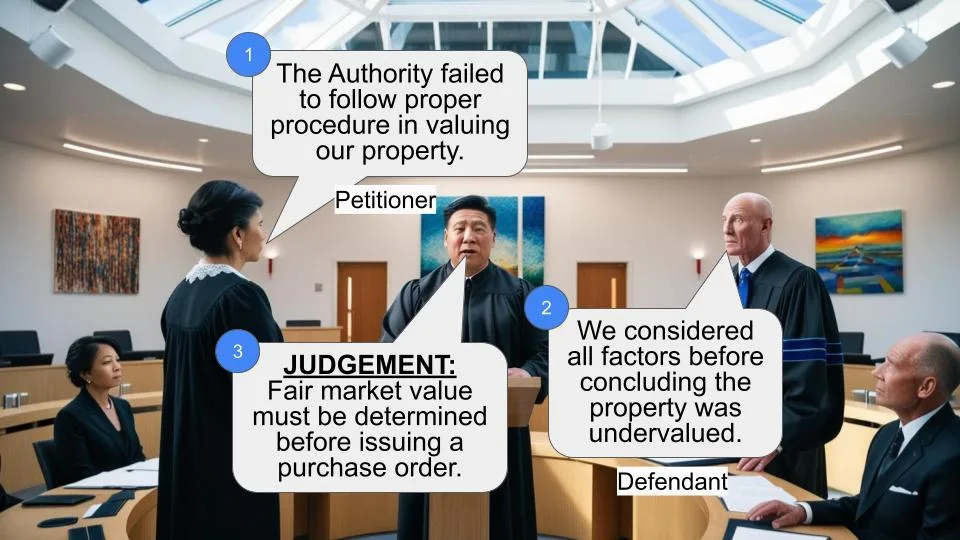
This case involves petitioners challenging an order by the Appropriate Authority under Section 269UD(1) (of Income Tax Act, 1961). The Authority had ordered the preemptive purchase of a flat without determining its fair market value. The court ruled in favor of the petitioners, quashing the purchase order as invalid.
Get the full picture - access the original judgement of the court order here
Case Name:
Chandrakant Kantilal Shah & Anr. vs S. K. Lal & Ors. (High Court of Bombay)
Writ Petition No.545 of 1993
Date: 29th October 2007
Key Takeaways:
1. Fair market value must be determined before issuing a preemptive purchase order.
2. Undervaluation of 15% or more than fair market value is required for such orders.
3. Comparable sale instances must be carefully considered and justified.
4. Previous approvals of similar property sales can impact the validity of undervaluation claims.
Issue:
Was the Appropriate Authority's order to purchase the flat valid without first determining its fair market value?
Facts:
1. On September 18, 1986, the petitioners agreed to purchase a flat for Rs.10,51,000/-.
2. They filed necessary forms with the Competent Authority under Chapter XX-A and later with the Appropriate Authority under Chapter XX-C.
3. After some legal back-and-forth, including a writ petition, the Appropriate Authority issued a show cause notice on December 30, 1992.
4. Despite the petitioners' detailed reply and objections, the Authority ordered the purchase of the flat on February 25, 1993.
5. The petitioners challenged this order in the present petition.
Arguments:
Petitioners:
1. The transaction falls under Chapter XX-A, not XX-C.
2. The fair market value wasn't determined, making the order invalid.
3. Sale instances used by the Authority weren't comparable.
4. Similar flat sales were approved by the Authority, contradicting the undervaluation claim.
Revenue:
1. All objections were considered before passing the order.
2. Comparable sale instances justify the undervaluation conclusion.
3. The order shouldn't be interfered with unless findings are perverse.
Key Legal Precedents:
1. C.B. Gautam vs. Union of India & Ors. (1993) 199 ITR 530 (SC): Established that purchase orders under Chapter XX-C can only be passed if there's significant undervaluation (15% or more) of the property's fair market value.
2. Vimal Agarwal vs. Appropriate Authority (210 ITR 16):
Mentioned regarding the practice of determining fair market value.
3. Vimladevi Maheshwari vs. S.K. Laul (208 ITR 734):
Cited to argue that purchase orders shouldn't be interfered with unless findings are perverse.
Judgement:
The court quashed and set aside the Appropriate Authority's order dated 25/2/1993 under section 269UD(1) (of Income Tax Act, 1961). The court reasoned that:
1. The fair market value wasn't determined, which is necessary to establish 15% or more undervaluation.
2. The Authority failed to consider the merits and demerits pointed out by the petitioners regarding comparable sale instances.
3. The Authority didn't justify why similar or better-located flats sold at comparable prices were approved while this sale was deemed undervalued.
FAQs:
Q1: Why is determining fair market value important?
A1: It's crucial to establish if there's an undervaluation of 15% or more, which is required for a valid purchase order under Chapter XX-C.
Q2: What impact does this judgment have on future cases?
A2: It emphasizes the need for authorities to determine fair market value and carefully consider comparable sales before issuing purchase orders.
Q3: Can the Appropriate Authority appeal this decision?
A3: While not mentioned in the judgment, generally, higher courts' decisions can be appealed in superior courts.
Q4: How does this case affect property buyers?
A4: It provides some protection against arbitrary purchase orders by ensuring authorities follow proper procedures in determining undervaluation.
Q5: What should authorities do differently in future cases?
A5: They should determine fair market value, carefully consider comparable sales, and justify their decisions, especially when similar properties have been approved at comparable prices.

1. This petition is filed to challenge the order dated 25-2-1993 passed by the Appropriate Authority under Section 269UD(1) (of Income Tax Act, 1961) (‘Act’ for short).
2. By an agreement dated 18th September, 1986, the petitioners had agreed to purchase flat No.1 situated on the ground floor of a building known as ‘Rekha’ at Ridge Road, Bombay- 400 006 (‘flat in question’ for short) for a consideration of Rs.10,51,000/-. The carpet area of the said flat was 925 square feet and the built up area of the said flat was 1014 square feet. The petitioners paid a sum of Rs.2,51,000/- by way of earnest money and agreed to pay the balance consideration in instalments as more particularly set out in the agreement.
3. On 26th September, 1986, the petitioners filed a statement in form No.37-EE along with transfer form with the competent Authority constituted under Chapter XX-A of the Act.
4. During the pendency of said proceedings Chapter XX-C was introduced to the Act w.e.f. 1st October, 1986. Thereupon, the petitioners filed a statement in form 37-I on 16th October, 1986 before the Appropriate Authority without prejudice to their contention that the transaction in question is covered under Chapter XX-A not under Chapter XX-C of the Act.
5. By an ex-parte order dated 19th December, 1986, the Appropriate Authority purported to purchase the said flat without giving any opportunity of hearing to the petitioners. The petitioners filed a Writ Petition bearing No.3559 of 1986 challenging the validity of the said order dated 19th December, 1986. By an order dated 16th December, 1992 the said Writ Petition was allowed by setting aside the order dated 19th December, 1986 and directing the Appropriate Authority to reconsider the matter and pass fresh order in accordance with the judgment of the Apex Court in the case of C.B. Gautam V/s. Union of India reported in 199 I.T.R. 530 (of Income Tax Rules, 1962).
6. In the meantime, pursuant to form 37-EE submitted by the petitioners, the Competent Authority had issued a notice on 3rd July, 1987 under Section 269D(1) (of Income Tax Act, 1961), calling upon the petitioners to show cause as to why the flat in question should not be acquired. The petitioners filed detailed reply to the said notice setting out the reasons as to why the flat in question should not be acquired under Chapter XX-A of the Act. By an order dated 28th march, 1988, the Competent Authority dropped the proceedings for acquisition of the flat in question under Chapter XX-A of the Act.
7. As regards the proceedings under Chapter XX-C is concerned, the Appropriate Authority, on remand, issued a show cause notice on 30th December, 1992 calling upon the petitioners to show cause as to why the said flat should not be purchased in the light of sale instances set out therein. The petitioners filed detail reply to the said show cause notice and pointed out that the flat in question was not comparable with the sale instances set out in the show cause notice. The petitioners filed a report of the Registered Valuer to show that considering various disadvantages attached to the flat in question, the price at which the petitioners agreed to purchase the flat in question constituted the fair market value. The petitioners had also cited two comparable sale instances, one, sale of a flat in the very same building in which the flat in question is situated and another sale of a flat in a neighbouring building. In both the cases, requisite N.O.C. has been granted by the Appropriate Authority. Petitioners had also filed written submissions during the course of personal hearing.
However, the Appropriate Authority rejected the contention of the petitioners and by the impugned order dated 25th February, 1993 decided to purchase the flat in question. Challenging the said order, the present petition is filed.
8. Mr.Pardiwala, learned counsel appearing on behalf of the petitioners submitted that in the present case, the transaction in question is covered by Chapter XX-A and not Chapter XX-C and, therefore, the impugned order passed under Chapter XXC is without jurisdiction. Assuming that Chapter XX-C applies to the facts of the present case, Mr.Pardiwala submitted that the impugned order cannot be sustained, because, firstly the Appropriate Authority has not determined the fair market value of the flat in question without which no order could be passed under Section 269UD(1) (of Income Tax Act, 1961) by holding that there is under valuation to the extent of 15% or more than the fair market value. Secondly, the sale instances relied upon by the Appropriate Authority are not comparable with the flat in question. Thirdly, the Appropriate Authority is not justified in purchasing the property in question by holding that there is undervaluation, when sale of a similar flat has been approved by the Appropriate Authority as NOC has been granted. Accordingly, Mr.Pardiwala submitted that the impugned order passed under Section 269UD(1) (of Income Tax Act, 1961) is liable to be quashed and set aside.
9. Mr.Ashokan, learned counsel appearing on behalf of the revenue, on the other hand, submitted that the Appropriate Authority has considered all the objections raised by the petitioners regarding the sale instances set out in the show cause notice and also the sale instances relied upon by the petitioners and has passed the impugned order in accordance with law. He submitted that prior to the decision of this Court in the case of Vimal Agarwal V/s. Appropriate Authority reported in 210 ITR 16, there was no practice of determining the fair market value in respect of the property sought to be purchased under Section 269UD(1) (of Income Tax Act, 1961) and, therefore, even though the fair market value of the flat in question is not determined, on the basis of the comparable sale instances the appropriate authority was justified in holding that there is undervaluation. Relying upon a decision of this Court in the case of Vimladevi Maheshwari V/s. S.K. Laul reported in 208 ITR 734, Mr.Ashokan submitted that the purchase order passed by the Appropriate Authority after considering all the material on record cannot be interfered with unless the findings of the Appropriate Authority are perverse. He submitted that in the present case, after inspecting the flat in question and after considering the objections raised by the petitioners the Appropriate Authority has passed the impugned order and, therefore, no interference is called for.
10. We have carefully considered the rival submissions. In the present case, admittedly the fair market value of the flat in question has not been determined by the Appropriate Authority. As per the decision of the Apex Court in the case of C.B. Gautam (supra) the purchase order under Chapter XX-C of the Act can be passed only where there is significant undervaluation of the property to the extent of 15% or more than the fair market value. Therefore, without determining the fair market value of the flat in question, it could not be said that the price at which the petitioners agreed to purchase the flat in question is undervalued by 15% or more than the fair market value. Consequently, the impugned purchase order passed without determining fair market value cannot be said to be valid in law.
11. On perusal of the impugned order, it is seen that the Appropriate Authority concluded that the flat in question is undervalued by more than 15% of the fair market value by relying on six sale instances set out therein. In their reply, the petitioners had specifically stated that the sale instances referred to in the show cause notice are not comparable because, the said flats are situated in prestigious and posh buildings with unrestricted sea view and the flats in those buildings are occupied by high profile personalities like film stars, Industrialists etc., whereas the flat in question is situated in a building occupied by higher middle class people. It was further submitted that the flat in question is situated on the ground floor without any sea view and even the building was not well kept, whereas the sale instances relied upon by the Appropriate Authority were situate in well maintained buildings. It was further submitted that the sale instances relied upon by the Appropriate Authority had additional amenity such as spacious compound, land scape garden, swimming pool, ample car parking place and very well planned modern flats, which are not there in the building in which the flat in question is situated. All these factors have not been considered in the impugned order. It is only after considering the merits and demerits of the flat in question with the six sale instances if the appropriate authority had come to the conclusion that the flat in question is undervalued by 15% or more than the fair market value, an order for purchase of the flat in question could have been passed. In the present case, the appropriate authority failed to consider the merits and demerits of the case pointed out by the petitioners. In these circumstances, it is difficult to hold that the sale instances relied upon by the Appropriate Authority were comparable and consequently, it is difficult to hold that the flat in question sought to be purchased by the petitioners has been undervalued by 15% or more than the fair market value.
12. It is pertinent to note that the petitioners had relied upon two sale instances, namely sale of a flat in building ‘Dev Darshan’and sale of a flat in building ‘Rekha’. It is not in dispute that the buildings ‘Dev Darshan’ and ‘Rekha’ (in which the said flat in question is situated) are situated in the same locality on the Ridge Road itself. Flat on the first floor in ‘Dev Darshan’ building was sold on 29/9/1986 at the rate of Rs.1,160/- per sq. ft. and the same has been approved by the Appropriate Authority, whereas, sale of the flat in question situated on the ground floor in building ‘Rekha’ which the petitioners have agreed to purchase by an agreement dated 18/9/1986 at Rs.1,036/- per sq. ft. is held to be undervalued without assigning any reasons. There is no material on record to show that the flat in ‘Dev Darshan’ building is not comparable and, therefore, it cannot be said that the flat in question is undervalued by 15% or more than the fair market value.
13. Moreover, it is pertinent to note that a flat situate on the first floor of the building ‘Rekha’ has been sold on 9/12/1985 at the rate of Rs.950/- per sq. ft. and the same has been approved by the Appropriate Authority. However, the agreement to purchase the flat in question situated on the ground floor of the very same building ‘Rekha’ at the rate of Rs.1,031/- per sq. ft. is held to be undervalued by 15% or more than the fair market value. Though the time lag between the above two transactions is about 9 months, in the absence of any material to show that the price escalation during those nine months was more than 15% and considering the fact that the flat in question situate on the ground floor is agreed to be sold at a higher price than the flat on the first floor, the sale of which is approved by the appropriate authority, in our opinion, it cannot be said that the flat in question is undervalued by 15% or more than the fair market value.
14. For the all the aforesaid reasons, we quash and set aside the impugned order dated 25/2/1993 passed by the Appropriate Authority under section 269UD(1) (of Income Tax Act, 1961).
15. Accordingly, the petition succeeds. Rule is made absolute in the above terms with no order as to costs.
(F.I. REBELLO, J.)
(J.P. DEVADHAR, J.)
×
Questions
Court invalidates property purchase order due to lack of fair market value determination
Write your CommentSimilar Posts

Generic
- Reportdata/5222.pdf
